


More news on this day
A freight train derailment near Bollebygd in western Sweden has caused extensive damage to rail infrastructure and brought a busy regional line to a standstill, coinciding with an intense early-summer heatwave that is straining transport networks across Scandinavia and mainland Europe.
Get the latest news straight to your inbox!
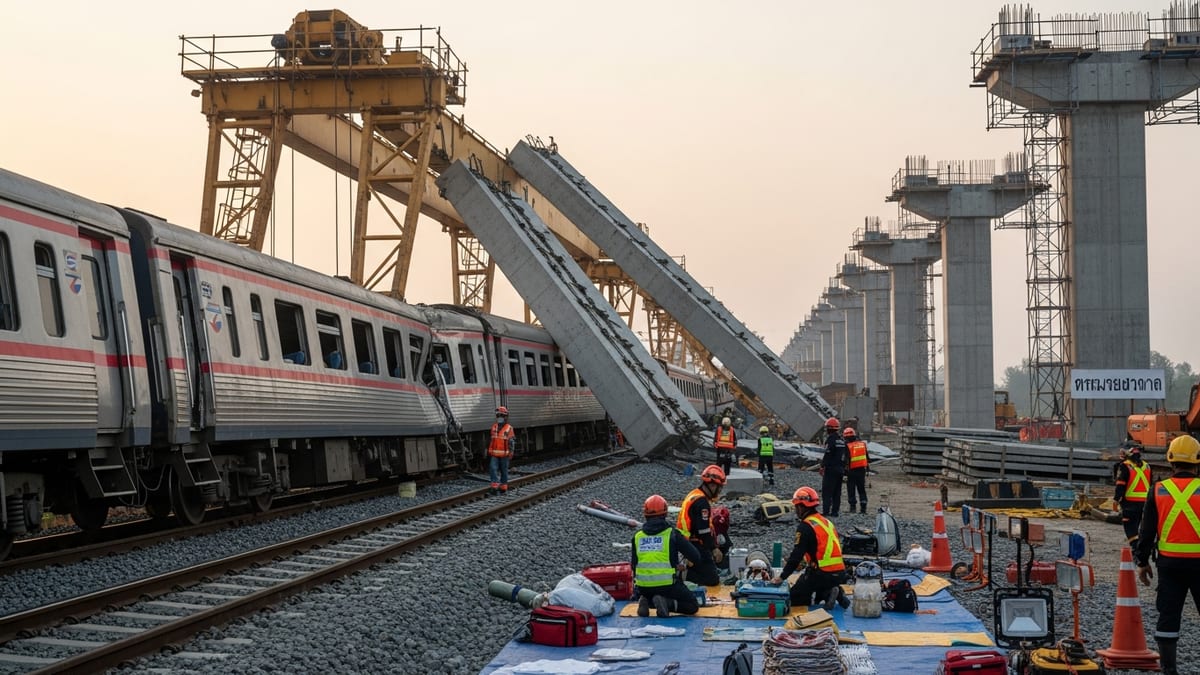
Derailment Near Bollebygd Shuts Key Western Sweden Line
Reports from Swedish media indicate that the freight train left the tracks just outside the town of Bollebygd on Thursday, June 25, in the afternoon, tearing up large sections of rail and ballast. Images from the scene show several wagons tipped or skewed across multiple tracks, with overhead lines visibly affected in the immediate area.
The Swedish Transport Administration has described the damage as extensive, with early assessments suggesting that both the track bed and signaling equipment along the affected stretch have been compromised. The location sits on an important corridor in western Sweden, linking regional centers and feeding longer-distance passenger connections.
No serious injuries have been reported in relation to the incident, but rail traffic through the area has been largely suspended while technical investigations and recovery work proceed. Replacement road transport has been introduced on some stretches, though capacity remains well below normal levels.
According to publicly available information, initial projections from infrastructure managers suggest it could take up to two weeks to fully restore normal traffic, depending on the pace of repairs and the delivery of replacement components.
Heatwave Adds Stress to Tracks and Overhead Systems
The derailment comes as a powerful heatwave grips large parts of Europe, including Sweden, Denmark and Germany, pushing rail infrastructure to its limits. National and regional weather services have recorded unusually high daytime temperatures in southern and western Sweden, with trackside conditions often several degrees hotter than ambient air.
Railway engineering studies from Swedish universities and the national transport administration have long warned that sustained heat can deform rails, affect ballast stability and strain overhead catenary systems. Elevated temperatures can cause steel rails to expand, increasing the risk of buckling if the track is already under stress or lacks sufficient lateral resistance.
Publicly available guidance from the Swedish Transport Administration notes that high heat may require reduced speeds, intensified inspections and, in some cases, preemptive traffic restrictions to avoid more severe failures. The current heatwave has already led to speed reductions and localized disruptions on other parts of the network, as operators attempt to manage the combined impact of climate and heavy summer demand.
While the precise technical cause of the Bollebygd derailment has not yet been established, the incident fits into a broader pattern of weather-related rail problems emerging during periods of extreme temperature across the continent.
Travel Disruptions for Tourists and Regional Commuters
For travelers in western Sweden, the derailment has immediately translated into longer journey times, crowded replacement buses and uncertainty around connections. The affected corridor is used by both regional commuters and tourists heading between Gothenburg, smaller inland towns and, via transfers, onward to southern Sweden and Denmark.
Rail operators have published revised timetables with a combination of diverted services, shortened routes and bus links around the damaged section. Passengers are being advised through public channels to allow extra time, check schedules on the day of travel and be prepared for heat-related slowdowns even on unaffected segments.
The timing is particularly sensitive for international visitors who have planned rail-based itineraries through Scandinavia to avoid car travel during the summer peak. Interconnected disruptions linked to the heatwave, including earlier reports of major disturbances in Skåne and advisories on reduced rail reliability in neighboring countries, are adding to the complexity of cross-border journeys.
Accommodation providers in key hubs such as Gothenburg are likely to see more last-minute changes and cancellations as travelers rebook or adjust plans in response to delayed services and uncomfortable conditions on some trains without robust air conditioning.
Repair Work and Safety Assessment Underway
Infrastructure teams have begun clearing the derailed wagons and assessing the underlying track structure near Bollebygd. Publicly available information suggests the recovery effort is being staged in phases: first stabilizing and removing damaged rolling stock, then inspecting sleepers, rails, signaling cabling and overhead power lines for heat or impact-related damage.
Specialized track-measurement equipment is expected to be used to verify that geometry and alignment meet safety standards before any gradual reopening. In previous European derailments involving freight trains, similar processes have taken days to weeks, depending on how deeply the wheels have gouged into the ballast and whether bridges, culverts or embankments were affected.
Given the concurrent heatwave, engineering teams are also monitoring how high daytime temperatures might interact with newly laid track and tensioned catenary. In some recent cases elsewhere in Europe, operators have chosen to reopen lines with temporary speed limits during hot periods, lifting them only once temperatures drop and additional checks have been completed.
Travelers can expect partial restorations to come in stages, with priority often given to re-establishing limited passenger services before full freight capacity returns on the corridor.
Climate Resilience Questions for Nordic Rail Networks
The Bollebygd derailment adds urgency to ongoing discussions about climate resilience in Nordic transport systems. Research focusing on Swedish conditions has traditionally highlighted vulnerability to winter storms, snow and freeze-thaw cycles. However, newer studies and recent summers indicate that persistent high heat is becoming a more serious challenge for infrastructure originally designed for cooler, more stable temperature ranges.
Analyses of weather-related failures in Sweden point to a mix of risks during hot spells, including rail buckling, overhead line sagging, and increased wear on critical components such as switches and crossings. As international and domestic travel rebounds, the tolerance for long periods of disruption along key routes is shrinking, especially during peak holiday seasons.
According to published coverage across Europe this week, rail networks in several countries are facing similar strains, with speed restrictions, cancellations and localized breakdowns linked to extreme temperatures. For Nordic planners, incidents such as the Bollebygd derailment may feed into broader decisions on track renewal standards, summer inspection regimes and the placement of wayside monitoring sensors.
For travelers, the episode serves as a reminder that climate-related disruptions are now a regular part of long-distance and regional rail planning. Building extra time into itineraries, staying alert to operational advisories during heatwaves and considering flexible tickets can all help mitigate the impact when key links on the Scandinavian network are suddenly taken out of service.