


Ask a dozen Istanbul regulars when Sultanahmet feels most magical and you will hear two passionate camps: the sunrise purists who swear by the quiet of first light, and the sunset faithful who live for the golden glow between the Blue Mosque and Hagia Sophia. Both are right. In this tightly packed historic square, the quality of light, crowds, sounds and even smells can make the same stones feel like two different cities. Choosing your moment is less about chasing a postcard and more about matching the mood and experience you want from Istanbul’s most iconic neighborhood.
Get the latest updates straight to your inbox!
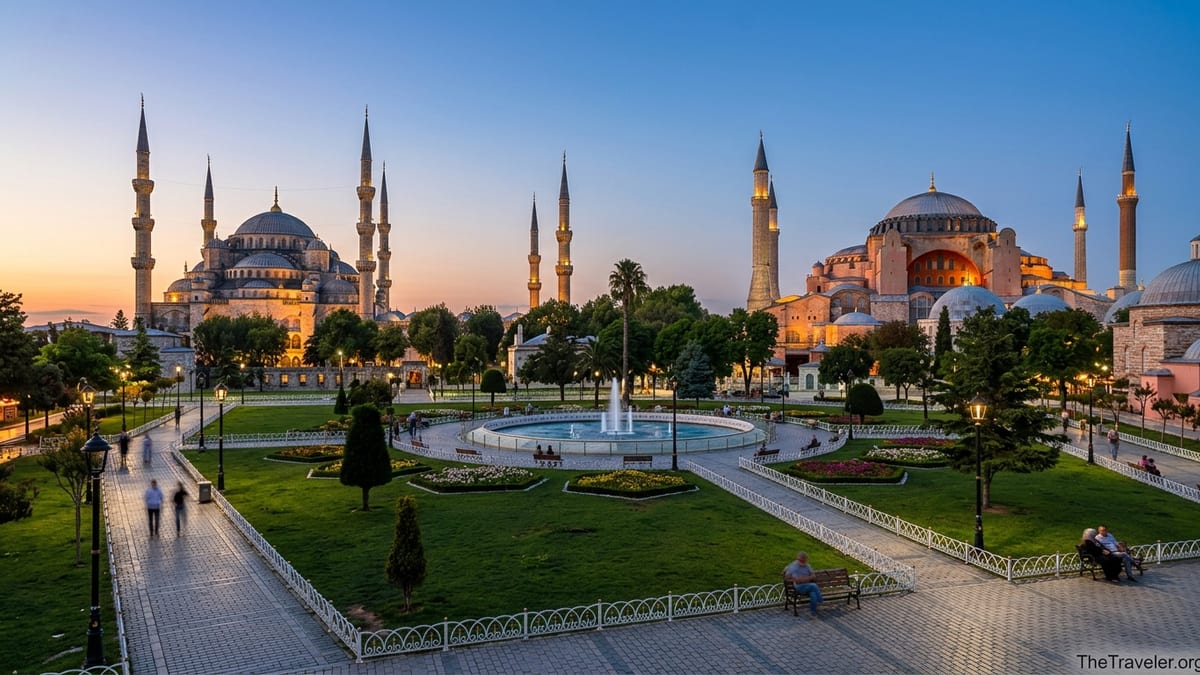
The Light That Shapes Sultanahmet
Sultanahmet is essentially a stone amphitheater for light. The twin icons of the district, the Hagia Sophia Grand Mosque and the Blue Mosque, sit at opposite ends of a gently sloping park, with trimmed lawns, fountains and chestnut trees that catch color differently between dawn and dusk. Around the summer solstice, the sun rises in Istanbul a little after 5.30 am and sets close to 8.40 pm, which means long, lingering golden hours in both morning and evening for much of May through August. In winter the days are shorter, the light colder and lower, but the angles can be beautiful for photography.
At sunrise, light typically creeps in behind the Hagia Sophia and gradually washes over its buttresses, domes and minarets before sliding across the park to the Blue Mosque. From the benches near the central fountain or the low railings by the tulip beds in spring, you see the stone go from slate grey to soft rose and then to a pale honey color in the space of half an hour. In the evening this sequence reverses. The last warm rays fall especially nicely on the Blue Mosque’s courtyard and cascading domes, before the entire square shifts into twilight blues and then the warm amber of artificial lighting.
For photographers, this difference matters. Morning golden hour often comes with clearer air and fewer atmospheric pollutants from traffic, making contrasts crisper. Sunset, by contrast, gives stronger color separation between the illuminated facades and the deepening blue of the sky behind the skyline. Those hoping to capture both mosques in a single frame often climb to one of the terrace cafes on Divanyolu Street or in nearby Sirkeci, where blue hour after sunset can be the most rewarding time to shoot the illuminated domes from above.
Morning in Sultanahmet: Quiet Stones and Everyday Rituals
Arriving in Sultanahmet just after first light requires an early alarm, but the reward is a version of the district that many day trippers never see. At 6.00 am the tram is still relatively empty when you ride the T1 line toward Sultanahmet station. Souvenir stalls around the square remain shuttered, the line of chestnut and corn vendors is absent, and only a few hotel guests drift out for a jog past the Hippodrome. In spring and autumn the air carries a cool, slightly saline breeze from the Marmara Sea, and the last notes of the pre-dawn call to prayer may still hang in the air.
Concrete details underscore how different the square feels at this hour. On a typical weekday, coach groups begin arriving around 9.00 am, when Hagia Sophia’s gallery level opens to ticketed visitors and the Blue Mosque begins allowing tourists between prayer times. Arriving at 7.00 am gives you a generous two-hour window to walk the perimeter of both mosques, photograph the exterior details like the calligraphy panels and buttresses, and even sit quietly on a bench in the park to watch local dog walkers and municipal gardeners at work. You may share the square with a few tripods and amateur photographers, but the constant chatter of tour guides and groups is mostly absent.
Morning is also the best time to see local routines. On the side streets like Nakilbent Sokak and the lanes that loop behind the Blue Mosque, bakery staff start stacking simit rings in glass cases, tiny tea shops rinse tulip-shaped glasses, and delivery workers push carts laden with bottled water and fresh produce to the small hotels clustered around Kutlugün and Akbiyik streets. Grabbing a simit from a street cart for the price of a city tram ticket and a glass of strong Turkish tea from a basic lokanta can turn your early start into a small ritual that feels authentically Istanbul.
Sunset in Sultanahmet: Crowds, Color and Atmosphere
If morning belongs to residents and early risers, sunset in Sultanahmet belongs to almost everyone. By late afternoon, tour buses line up on the edges of the district, and the park between Hagia Sophia and the Blue Mosque becomes a slow-moving current of families with strollers, couples posing for photographs, and friends meeting after work. Street musicians often stake out spots at the edges of the square, filling the warm air with bağlama or clarinet melodies while children chase each other around the flower beds.
From a practical standpoint, the hours leading up to sunset overlap with popular visiting times for the monuments themselves. Ticketed access to Hagia Sophia’s upper galleries usually runs into the early evening, with last entry around half an hour before closing, while the Blue Mosque stays open to visitors between prayer sessions until roughly early evening. This means that a late-afternoon visit that flows directly into sunset allows you to see both interiors and exteriors under changing light. Many travelers report that entering the Blue Mosque after the main daytime crowds thin, often around 4.30 pm, can reduce waiting times to roughly 10 minutes compared to much longer queues at midday.
In terms of atmosphere, the square at sunset is undeniably more theatrical. As the sky shifts from gold to orange and finally to deep cobalt, both mosques light up slowly, their domes and minarets outlined by warm spotlights. The central fountain sometimes alternates colored lighting, throwing purples and blues onto the spray. On mild evenings, the low hum of conversation drifts from the terraces of nearby restaurants on Divanyolu and Alayköşkü streets, where diners watch the skyline over plates of grilled sea bream or meze. It can feel busy and commercial, but for many first-time visitors the combination of light, sound and scale is exactly the Istanbul they dreamed about.
Crowds, Access and Prayer Times: Planning Your Moment
Choosing between morning and sunset in Sultanahmet is not just about aesthetics. It is also about managing crowds and working around religious practice. Both Hagia Sophia and the Blue Mosque operate as active mosques, which means they close to tourist visits during the five daily prayer times and for a longer window around Friday noon prayers. In practice this results in rolling closures: you might arrive 15 minutes before the midday call and find yourself gently ushered back out by staff, or discover that a line you joined suddenly stops moving because visitors are being held outside until prayers finish.
Morning visits can help you avoid the most disruptive of these overlaps. On many days, if you reach the Blue Mosque soon after its morning visiting window begins, you are likely to be through security and inside before the queues build. For Hagia Sophia’s upper galleries, arriving within the first hour of opening can mean a shorter line for ticket purchase or validation and a smoother security process. You will still need to check local prayer times, which shift daily and seasonally, but your chances of a lengthy closure cutting into your visit are lower earlier in the day than mid-afternoon.
Sunset visits, meanwhile, require more deliberate planning. The maghrib prayer is linked directly to sunset, which means that exterior views of Hagia Sophia and the Blue Mosque are at their most photogenic exactly when the interior spaces are off limits to non-worshippers. Many visitors therefore aim for a pattern like this: visit one mosque interior around 4.00 pm, cross the square to see the other before its last pre-sunset visiting slot closes, then linger outside in the park as the lights come on and the call to prayer rises in stereo between the minarets. It is a reminder that Sultanahmet is not only a museum district but a living religious quarter, and that part of its magic comes from observing, respectfully and at a short distance, how the space is used by those who live and worship there.
Photography and Storytelling: What Each Time of Day Gives You
From a storytelling perspective, morning and sunset in Sultanahmet provide very different narrative textures. Photographers who arrive at dawn can work almost undisturbed around the Hippodrome, where the Egyptian Obelisk and Serpent Column stand in an elongated square with few visual obstacles. The absence of crowds lets you compose wider frames that show the scale relationship between the monuments and the surrounding streets. A 24–70 mm lens remains versatile here, wide enough at 24 mm to capture the Blue Mosque framed by plane trees from the park, yet tight enough at 70 mm to pick out mosaic details under the arches of the courtyard once visiting hours begin.
Sunset and blue hour favor a different sort of image making. Those terrace cafes along Divanyolu, such as the modestly priced hotel rooftops that sell tea or Turkish coffee for the cost of a midrange pastry, provide elevated angles that compress both mosque silhouettes against the gradually darkening sky. Shooting at a wider aperture, say f/2.8 or f/4, with a 35 mm lens can help separate a foreground figure on a balcony from the illuminated domes behind, creating intimate yet context-rich portraits. Street-level photographers can work handheld in the square, using the flow of tourists and locals as moving foreground elements, blurring slightly at slower shutter speeds to convey the neighborhood’s energy.
Crucially, each time of day also lends itself to different emotional stories. The near-empty benches and long shadows of early morning support reflective narratives: the solo traveler looking up at 1,500 years of history with a coffee in hand, or the couple wandering quietly along the tram tracks before the city wakes. Sunset favors scenes of connection: extended families posing together after visiting Hagia Sophia’s galleries, children balancing on the low fences around the lawns while parents take photographs, or small groups of friends using the square as a rendezvous before heading to dinner. For travel writers and content creators, planning to visit at both times, even on different days, can help you build a more layered and honest portrait of the district.
Real-world Itineraries: Morning-first or Sunset-focused
Turning these impressions into an actual day in Sultanahmet means working within opening hours, walking distances and your own energy levels. One realistic morning-focused itinerary might begin with a 6.30 am tram ride into Sultanahmet. Spend your first quiet hour simply walking the perimeter of the square, looping past the Hippodrome, pausing at the German Fountain, and cutting down to the outer walls of Topkapı Palace for a distant sea view. Around 8.30 am, when neighborhood bakeries have fully opened, step into a no-frills spot near Çemberlitaş for a breakfast of börek and tea at a price closer to what office workers pay than hotel buffet rates.
From there, you could time your entry to the Blue Mosque just as its tourist visiting window opens after morning prayers, before continuing to Hagia Sophia’s galleries once their ticket office begins work. With this sequence, you would likely have both major monuments finished by early afternoon, leaving time for the Basilica Cistern or the Archaeology Museums before the hottest and most crowded part of the day. You might then cross the Galata Bridge toward Karaköy for a late lunch and different neighborhood vibe, effectively using Sultanahmet as a morning anchor rather than an all-day base.
A sunset-focused day follows another rhythm. You might spend your morning elsewhere, perhaps browsing the Spice Bazaar in Eminönü or exploring less touristed neighborhoods like Balat or Fener. Returning to Sultanahmet around 3.30 pm gives you a natural window to visit Hagia Sophia’s gallery level, with enough time to navigate security and walk the upper balconies before the late-afternoon wave of visitors. After exiting, you can stop for coffee or fresh pomegranate juice from one of the mobile stands arrayed along the tram route, then enter the Blue Mosque for a final look at its famously blue-tiled interior during the last pre-sunset visiting slot.
As the muezzin’s call echoes through the square, you step back outside to see the sky deepen and the lights flick on simultaneously across the skyline. Many travelers simply sit on the low walls bordering the lawns, using their day packs as backrests, and let a full cycle of twilight unfold over 30 or 40 minutes. Finishing with dinner at a low-key grill restaurant on a back street like Akbiyik Caddesi, where prices tend to be lower than on the main squareside terraces, lets you end your day with a sense of closure and continuity between the sacred monumental core and the everyday life that surrounds it.
Safety, Comfort and Seasonal Considerations
Whether you choose morning or sunset for your Sultanahmet experience, comfort and safety come down largely to paying attention to season, clothing and basic city awareness. In high summer, pre-8.00 am visits can spare you the searing midday heat that bakes the stone pavements. Temperatures later in the season and into autumn remain more moderate, but the reflective surfaces of the square and the security queues, where shade is sometimes limited, can still feel punishing. Carrying a small, refillable water bottle and a light scarf that can double as both sun and shoulder cover for mosque entry is more practical than relying entirely on vendors or your hotel.
In winter, by contrast, the early start for a sunrise visit feels less extreme because the sun rises later, but wind from the Bosphorus and Marmara can make the square surprisingly cold. Layers, including a windproof outer shell, make both slow photography sessions and long waits for interior access much more comfortable. Sunrise and sunset both arrive earlier than in summer, so checking the exact times for the day of your visit helps you avoid arriving either in full darkness or too late for good color in the sky.
As for safety, both dawn and early evening are generally busy enough in Sultanahmet to feel secure, especially around tram stops and major hotel clusters. Basic big-city precautions still apply. Keep cameras and phones close to your body in crowds, be wary of overly friendly strangers insisting on guiding you to carpet shops or rooftop bars, and confirm taxi fares or meters before getting in if you hail a cab from the edges of the district. Using the tram in and out, especially in the early morning when it is less crowded, is usually straightforward and cost-effective compared with negotiating individual rides.
The Takeaway
So, when does Sultanahmet feel most magical: at morning’s first light or at the last color of sunset? The honest answer is that each reveals a different city. Morning gives you a chance to inhabit the district as a neighborhood rather than a stage set, to see hotel staff hosing down pavements, bakers stacking simit and gardeners tending lawns while the mosques stand almost aloof under a softening sky. It is the time to be alone with the stones, to walk, listen and let the scale of history around you sink in without constant interruption.
Sunset, on the other hand, is Sultanahmet at its most unapologetically iconic. The golden light on marble, the overlapping calls to prayer, the glow of spotlights on ancient domes and the hum of dozens of languages in the square combine into a spectacle that feels close to what draws many people to Istanbul in the first place. It is busy, sometimes crowded, occasionally overwhelming, but rarely dull. For many first-time visitors, this is the memory that endures: the outline of the Blue Mosque against a deepening sky and the sense of standing at the center of a living, layered city.
If your schedule allows, the most rewarding choice is not to choose at all, but to give Sultanahmet both a morning and an evening. Let one visit be slow and solitary, rooted in observation and simple rituals like tea and bread. Let the other embrace the color, crowds and orchestrated drama of sunset. Between the two, you will have experienced not only when Sultanahmet looks most beautiful, but when it feels the most like itself.
FAQ
Q1. Is sunrise or sunset better for photographing Hagia Sophia and the Blue Mosque?
For clear, low-contrast images with fewer people in frame, sunrise is usually better. For dramatic colors, illuminated domes and a lively atmosphere, sunset and the following blue hour tend to be more rewarding.
Q2. Will I be able to enter Hagia Sophia or the Blue Mosque at sunrise?
No, interior visiting hours for tourists generally begin later in the morning after the first prayer times. At sunrise you can enjoy only the exteriors and the square, which are still highly atmospheric.
Q3. How early should I arrive in Sultanahmet for a peaceful morning experience?
Arriving between 6.30 am and 7.00 am usually lets you experience the square before most tour groups and day visitors appear, while still giving you enough light for photography and easy tram connections.
Q4. Is it safe to be in Sultanahmet before dawn or after dark?
The main streets, tram stops and hotel areas around Sultanahmet are generally well patrolled and busy enough to feel safe. Standard big-city precautions apply: stick to lit routes, keep valuables secure and be cautious with unsolicited offers of help.
Q5. Do prayer times affect visiting at sunset?
Yes. The maghrib prayer coincides with sunset, so interiors close to tourists around that time. Plan to visit mosque interiors earlier in the afternoon, then stay outside in the square to enjoy the light, call to prayer and illuminated exteriors.
Q6. Which time of year offers the best sunrises and sunsets in Sultanahmet?
Spring and autumn usually provide the most comfortable temperatures and clear, colorful skies. Summer brings longer golden hours but also stronger heat and more crowds, while winter offers beautiful low-angle light but can be windy and cold.
Q7. Can I see both Hagia Sophia and the Blue Mosque properly in one morning?
Yes, many travelers visit both in a single morning by starting early, entering the Blue Mosque soon after its visiting window opens, then continuing to Hagia Sophia’s galleries once their ticket office opens.
Q8. Are rooftop views of Sultanahmet better in the morning or evening?
Rooftop views are more photogenic in the evening, when the sky color shifts behind the skyline and both mosques are gradually illuminated. Morning rooftop views are quieter but generally less dramatic in terms of artificial lighting.
Q9. What should I wear for early morning or sunset visits to the mosques?
Dress modestly with shoulders and knees covered, and bring a scarf to cover your head if you are a woman. Layers help adjust to changing temperatures, and socks are useful since you will remove shoes inside.
Q10. If I only have one evening in Istanbul, should I spend sunset in Sultanahmet or on the Bosphorus?
If it is your first visit, sunset in Sultanahmet offers an iconic, concentrated experience of the city’s history and skyline. A Bosphorus cruise at another time, even in daylight, can then complement that with broader views of the city’s shores.