


More news on this day
Passengers at London Heathrow Airport faced mounting frustration today as a cluster of cancellations and widespread delays involving Scandinavian Airlines, Delta Air Lines, United Airlines and British Airways disrupted major routes to Oslo, Toronto, Brussels, Berlin, Frankfurt and other key hubs.
Get the latest news straight to your inbox!
Targeted Cancellations Hit Key Transatlantic and European Links
According to live operational data and flight-tracking services, a total of five departures and arrivals operated by or in partnership with Scandinavian Airlines, Delta Air Lines, United Airlines and British Airways were suspended at Heathrow, affecting services to both European capitals and North American gateways. Publicly available schedules show that the cancellations were concentrated on high-frequency business routes, amplifying the knock-on impact across the day’s timetable.
The suspended flights included services on the busy Heathrow to Oslo corridor, which is shared between Scandinavian Airlines and codeshare partners such as Delta, as well as British Airways routes serving continental destinations such as Berlin, Brussels and Frankfurt. On the long-haul side, disruptions also touched transatlantic links to Toronto, a route jointly served through alliances involving British Airways and North American partners. The loss of just a handful of rotations at a tightly scheduled hub created a bottleneck that quickly cascaded into delays for later departures.
Operational information from Heathrow indicates that while the airport itself remained open, schedule reductions and out-of-position aircraft led to a series of “knock-on” delays across multiple terminals. Airlines were forced to reroute aircraft and reassign crews, leaving some passengers facing last-minute changes to their travel plans or extended waits in departure lounges.
Data from passenger-rights platforms and aviation trackers suggests that the combined effect of the five cancellations and subsequent propagation of delays left a sizable share of Friday’s schedule running behind time. With most carriers already operating close to capacity, options to rebook disrupted passengers on the same day were limited, particularly on core routes at peak times.
More Than 100 Delays Ripple Across Heathrow’s Schedule
Publicly available tracking boards and independent analytics pointed to more than 100 delayed movements at Heathrow linked to the latest episode of disruption. The delays ranged from modest hold-ups of 30 to 45 minutes to extended waits of several hours, particularly on short-haul routes funnelling traffic onward to continental Europe.
Reports indicate that British Airways was among the most affected carriers, reflecting its dominant share of slots at Heathrow and its reliance on precise connection timings. Delays on feeder flights serving cities such as Brussels, Berlin and Frankfurt had a direct impact on passengers connecting onward to long-haul destinations in North America, Asia and the Middle East. In some cases, travelers who made it as far as London found themselves stranded overnight when their onward services departed without them or were retimed beyond legal crew duty limits.
Alliance partners also felt the strain. Delta Air Lines and United Airlines, which depend on transatlantic connectivity and onward European feeds via Heathrow, reported disruptions on itineraries combining North American departures with intra-European legs operated by European partners. Scandinavian Airlines, which uses Heathrow as an important spoke for its Scandinavian hubs, saw its Oslo-bound passengers caught in the same web of delays and missed connections.
While a large share of flights eventually departed, the cumulative effect of ground holds, extended turnaround times and aircraft awaiting connecting passengers meant that the day’s schedule never fully recovered. Late-running evening services risked encroaching on Heathrow’s strict night-time operating limits, placing additional pressure on airlines to trim or consolidate flights.
Weather, Airspace Management and Tight Crewing Drive Fragility
Industry analysis of recent disruption patterns at Heathrow suggests that adverse weather over southern England and related air traffic control flow restrictions have played a recurring role in schedule instability. Public guidance from air-traffic and airport authorities in recent days has referred to temporary caps on movements during periods of poor visibility and congestion, a factor that forces airlines to prioritise certain services and cancel others to remain within reduced arrival and departure limits.
In this latest episode, reports indicate that a combination of unsettled weather and airspace management measures again constrained operations at critical points in the day. When capacity is throttled, hub carriers such as British Airways, as well as foreign airlines operating multiple daily frequencies, are typically instructed to remove a portion of flights from the schedule. This requirement often leads to the cancellation of shorter European sectors that can be consolidated onto later departures, such as those to Brussels, Berlin and Frankfurt.
The broader aviation backdrop remains fragile. Airlines across Europe have warned that tight crew rosters, aircraft availability challenges and ongoing maintenance backlogs leave little margin for recovery when disruption strikes. Even a limited series of cancellations can ripple outward as crews reach duty-hour limits and aircraft arrive late from previous sectors, as seen on the Heathrow to Oslo route shared by Scandinavian Airlines and its codeshare partners.
Operational resilience is further tested by continuing geopolitical and airspace constraints, particularly on routes passing near conflict zones. Airlines have had to lengthen certain flight paths or reroute entirely, consuming additional fuel and time and leaving schedules more vulnerable to any further delays. Although these factors may not be the sole trigger for the latest Heathrow disruption, they contribute to the system-wide sensitivity now evident during periods of intense demand.
Passengers Face Long Queues, Missed Connections and Uncertain Rights
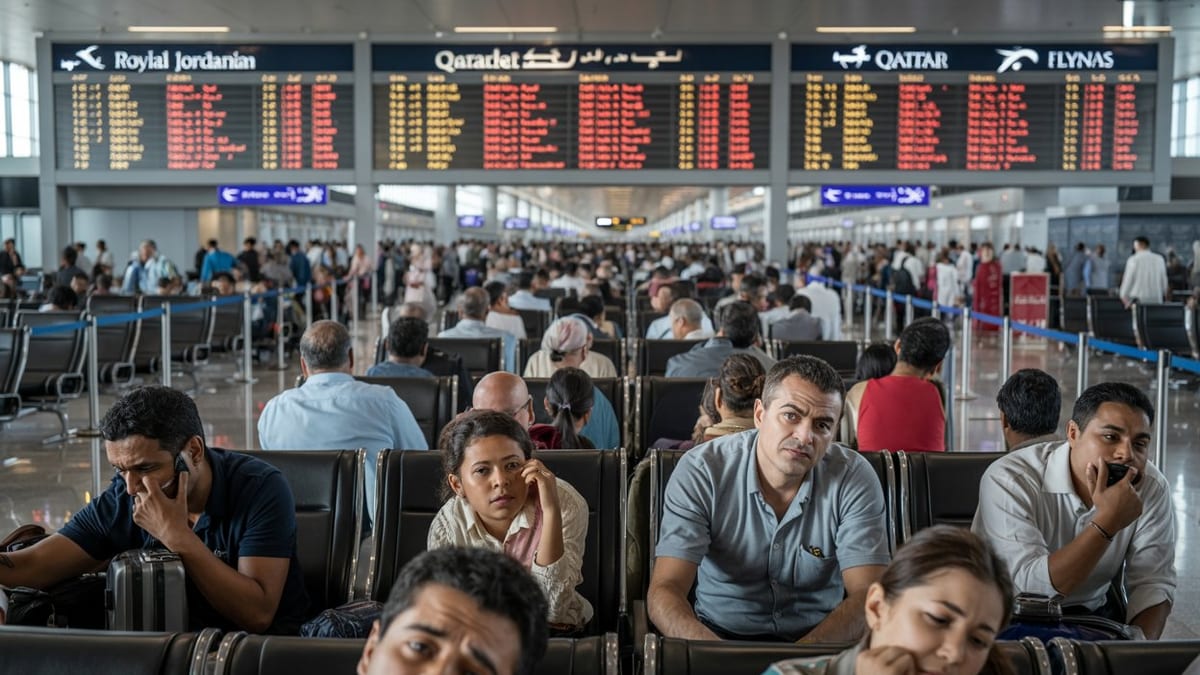
Travelers caught up in the disruption reported crowded departure halls, long queues at airline service desks and uncertainty over rebooking options. With multiple carriers affected and spare seats in short supply, many passengers on cancelled flights to Oslo, Brussels, Berlin, Frankfurt and Toronto faced waits of a day or more for alternative connections, particularly if they needed to travel together as families or larger groups.
Publicly available guidance from consumer-rights organisations stresses that passengers flying from the United Kingdom or European Union are often protected by compensation and care rules when delays or cancellations are within an airline’s control. However, those same sources note that when disruption is attributed to extraordinary circumstances such as severe weather, air traffic control restrictions or wider airspace closures, direct financial compensation may not apply, even though airlines are still expected to provide assistance such as meals, refreshments and hotel accommodation where necessary.
Advisory groups recommend that affected passengers keep boarding passes, booking confirmations and any written communication about the disruption in order to support potential claims. They also encourage travelers to check both the airline’s app and independent flight-tracking tools, which can sometimes reflect operational decisions such as cancellations or significant delays before airport departure boards are updated.
For connecting passengers, especially those travelling via Heathrow on itineraries involving multiple airlines, the situation can be more complex. Missed onward flights, baggage delays and reissued tickets often require coordination among alliance partners, and public information shows that call centres and online chat services experienced heavy demand as disrupted customers sought clarity on their options.
Heathrow’s Hub Role Magnifies Global Impact
The disruption underlines how dependent global travel patterns remain on London Heathrow’s status as a major international hub. As one of Europe’s busiest airports for both short-haul and long-haul traffic, any operational disturbance quickly spreads beyond the United Kingdom to affect passengers and schedules across Europe, North America and beyond.
Heathrow’s route map links London to key business and political centres such as Oslo, Brussels, Berlin and Frankfurt, as well as long-haul cities including Toronto. Publicly available route and terminal information highlights that British Airways, United Airlines, Delta Air Lines and Scandinavian Airlines collectively feed a complex web of onward connections at Heathrow, meaning that a missed or cancelled leg can disrupt entire journeys spanning several continents.
Aviation analysts note that, although airlines and the airport have invested heavily in contingency planning and technology, the combination of near-capacity operations, stringent airspace and noise regulations and external shocks such as weather or geopolitical tensions means that Heathrow remains vulnerable to sudden bouts of disruption. When several carriers are simultaneously affected, as in this latest episode, the consequences for travelers can be far-reaching.
With summer and peak holiday seasons approaching, passenger groups are urging travelers to build additional buffer time into itineraries involving Heathrow, particularly for tight international connections. Public travel advisories continue to emphasise the importance of monitoring flight status frequently, considering travel insurance that covers disruption and being prepared for last-minute changes when flying through one of the world’s busiest and most tightly scheduled hubs.