


More news on this day
Helicopter footage captured above the Bedfordshire countryside north of London shows a harrowing scene of twisted carriages, shattered windows and frantic rescue efforts after two passenger trains collided on one of England’s busiest intercity corridors.
Get the latest news straight to your inbox!
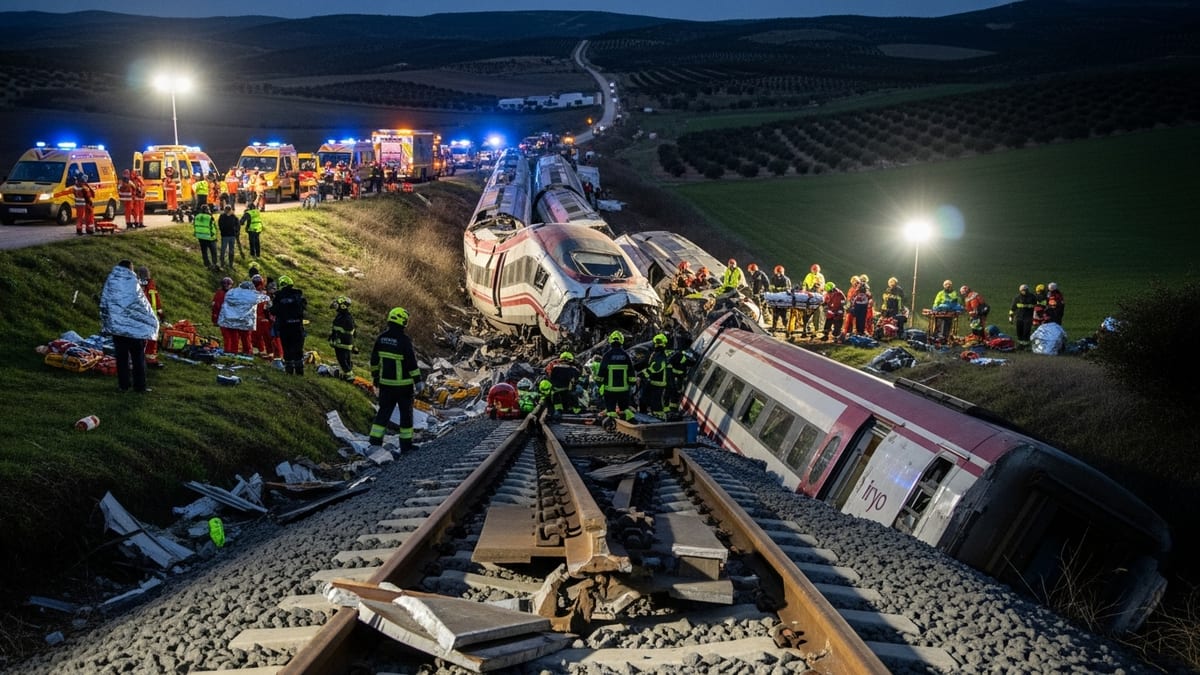
Collision North of London Halts Major Rail Corridor
The collision took place on Friday evening on the main line linking London St Pancras with towns and cities across the East Midlands, on a stretch of track a few miles south of Bedford. Publicly available information indicates that one high-speed East Midlands Railway service was struck from behind by another train running on the same route.
Early reports describe a sudden impact that threw passengers from their seats and left several carriages damaged, with at least one section appearing to have ridden up over another. Social media posts from people on board and nearby show broken interior fittings, scattered luggage and people tending to visible injuries.
Services in and out of London St Pancras were quickly suspended as rail operators and emergency responders converged on the scene. Travellers heading between the capital and key regional hubs faced abrupt cancellations and diversions, with evening peak journeys turned into hours-long odysseys by replacement buses and alternative routes.
Rail operators warned that disruption on the north–south spine could continue into the weekend, as investigators document the site and engineers begin the complex task of clearing damaged rolling stock and checking the track.
Helicopter Images Show Scale of Damage
As news of the incident spread, helicopter footage began circulating that offered the clearest overview yet of what happened on the fast tracks north of London. Filmed from above the scene, the images show two trains locked together on parallel rails, their noses compressed and bodywork crumpled, but remaining largely upright.
The overhead shots reveal rescue vehicles lined along an adjacent access road and clustered at trackside, their lights illuminating a scene otherwise surrounded by fields and hedgerows. Several carriages appear visibly buckled, with distorted metal around the couplings where the impact was concentrated.
The aerial perspective also highlights how close the collision came to causing a more catastrophic derailment. In the footage, some bogies appear to have shifted off alignment and ballast is disturbed alongside the rails, but the majority of coaches seem to have stayed on or close to the track formation, a factor that may have limited further damage.
Thermal imaging and zoomed-in clips shared by broadcasters and online users show personnel moving between the coaches, with doors propped open and ladders positioned to help passengers down to the track. The helicopter vantage point underlines both the intensity of the initial collision and the speed with which a large-scale response was mounted.
Injuries Reported as Rescue Operation Continues
Published coverage from national and local outlets indicates that a number of passengers and rail staff sustained injuries of varying severity in the crash. Images taken inside one of the trains show people lying on floors or seated with improvised bandages, while others are seen helping those around them.
Ambulance crews, specialist medical teams and air ambulances were called to the rural stretch of line, with some patients treated at the scene and others transported to nearby hospitals. Precise numbers have not yet been officially confirmed, but regional hospitals were placed on heightened readiness in expectation of multiple casualties.
Witness accounts shared with broadcasters describe a loud bang and a sudden jolt followed by clouds of dust and the sound of shattering glass. Several passengers reported that carriage lights went out briefly, adding to confusion before emergency lighting and mobile phone torches helped illuminate the way to exits.
As night fell, portable lighting rigs were brought in so that rescuers could continue working along the length of the trains. Rail operators advised anyone with friends or family on affected services to await further information rather than travel to the crash site, as access roads remained restricted to emergency traffic.
Early Focus on Train Protection Systems and Signalling
While it is far too early for firm conclusions, attention is already turning to how two modern passenger trains came to collide on a main line fitted with layers of protection. Commentators drawing on rail industry experience note that rear-end collisions on Britain’s intercity network are rare and typically involve a sequence of technical or procedural failures.
According to material shared by rail specialists online, one working theory is that a train ahead may have come to a standstill after its on-board safety systems reacted to a signal or detected a fault, leaving it static on the line. How a following service then approached at sufficient speed to cause such damage is likely to be a central question for investigators.
Britain’s network employs multiple safeguards, including lineside signals, cab warning systems and, on many routes, automatic train protection technologies designed to reduce the risk of trains passing red signals or approaching hazards too quickly. The circumstances north of London will test how these systems interacted in real-world conditions and whether any component failed or was overridden.
Rail safety specialists point out that investigations into comparable incidents in the UK and elsewhere often lead to changes in procedures, upgrades to signalling equipment or amendments to driver training, even when the number of casualties is limited. The Bedfordshire collision is expected to be examined in similar detail, given the importance of the route and the intensity of public interest.
Travel Disruption and Wider Implications for Passengers
The immediate impact for travellers has been severe. Long-distance and commuter services using the St Pancras corridor were suspended or heavily curtailed, with knock-on congestion spreading to parallel routes as operators attempted to reroute some trains via alternative lines.
Rail passengers reported crowded concourses, long queues for replacement buses and scarce information in the first hours after the crash, as control rooms worked to redraw timetables in real time. People heading for flights, onward connections or major events in London and the Midlands were urged to consider postponing their journeys or switching to other operators where possible.
In the days ahead, attention is likely to shift from the emergency response to the broader question of resilience on one of Britain’s key north–south arteries. Regular travellers are already asking whether additional layers of protection, more flexible timetabling or infrastructure enhancements are needed to further reduce the chances of such a collision.
For now, the stark images from the helicopter circling over Bedfordshire capture a moment of sudden rupture on a route that usually symbolizes routine connectivity between London and the rest of the country, and they underline how dependent that connectivity remains on complex systems working perfectly, every minute of the day.