


Villa d’Este in Tivoli is one of Italy’s most photogenic UNESCO sites: a 16th century villa cascading into terraced gardens, more than 50 fountains, and views sweeping over the Roman countryside. Yet on a busy spring or summer weekend, its narrow terraces can feel packed with tour groups and tripod-toting photographers. Timing your visit is the single most powerful way to come home with better images and a calmer experience. Here is how to choose the right season, day and hour to see Villa d’Este at its best.
Get the latest updates straight to your inbox!
Understanding Villa d’Este’s Seasons and Opening Hours
Villa d’Este sits in Tivoli, about 30 kilometers east of Rome, and follows the typical central Italian pattern of peak tourism in spring and early autumn, with the hottest and often most crowded days in late June through early September. The site is usually open from 8:30 in the morning until roughly one hour before sunset, with the ticket office closing about an hour earlier. Exact closing times shift through the year, from late afternoon in winter to early evening in midsummer, so it is worth checking the official schedule for your exact date before planning golden-hour shots.
Broadly, spring (April to early June) and autumn (September to October) blend mild temperatures with lively but manageable visitor numbers. Several recent visitor guides and Italian tourism resources describe these months as a sweet spot where you still get long-enough days and active fountains without the hottest temperatures. In contrast, July and August often see a surge of day-trippers and coach tours from Rome, especially mid-morning to mid-afternoon, when temperatures can climb well above 30 degrees Celsius, which makes the steep garden paths more tiring.
Winter, from November through February, is the quietest time. Daylight is short and some restoration work or partial closures are more likely, but on a clear, crisp weekday you may wander stretches of the terraces almost alone. For photographers, softer midday light, misty breath in the air, and fewer people in frame can more than compensate for the shorter opening hours and cooler conditions. Many travelers aiming for people-free shots of the famous Hundred Fountains or the panorama from the Gran Loggia deliberately schedule December or January visits for that reason.
Official information also notes that on particularly busy days or for safety reasons, entry can be limited and some indoor spaces or routes adjusted. This often happens around national holidays or during special events. If you travel during a peak period like Easter week or Italy’s Republic Day at the start of June, expect higher footfall and consider booking tickets in advance to secure your preferred time slot.
Best Months for Light, Foliage and Manageable Crowds
For most photographers, April, May and September stand out as the ideal months to visit Villa d’Este. In April and May, the terraced gardens are lush, with fresh greens and blooming plants adding depth and color to wide shots of the fountains. Temperatures typically hover in the comfortable teens and low twenties Celsius, which makes it easy to spend three or more hours exploring, framing long exposures and climbing between terraces without overheating. Travel writers focusing on Villa d’Este often point out that April and May combine that photographic freshness with crowd levels that are busy but rarely overwhelming.
By late June and throughout July and August, the light is strong and direct for much of the day, while heat and humidity climb. This can be a striking time to capture sun sparkling off the fountains at midday, but it is less forgiving for portraits and for handheld shots in shady sections where the contrast range becomes quite high. Crowds also peak, driven by international summer vacations. If your dates are fixed in these months, you can still find good opportunities, but it becomes even more important to target opening time or late afternoon rather than the middle of the day.
September is particularly appealing for photography. Temperatures begin to drop, the crowds thin compared with August, and the sun sits a little lower, giving softer light in the late afternoon. Many photographers rate the first half of September as one of the best balances of warm weather, long opening hours and less oppressive visitor numbers. October can also be rewarding, with lower prices in Rome, slower-paced day trips, and occasionally a touch of autumn color in the surrounding hills, though afternoon showers are more likely and days are shorter.
Winter months appeal to travelers who prioritize emptier frames over bright foliage. From mid-November through February, coach tours are fewer and weekday mornings particularly quiet. You might find yourself shooting the Organ Fountain with only a handful of other visitors nearby. The trade-off is that garden vegetation is less full, some fountains may be under maintenance, and low sun or overcast skies mean flatter light. Still, if moody shots and contemplative strolls matter more to you than blue skies, a winter weekday can be a great choice.
Timing Your Visit: Best Days of the Week and Hours of the Day
Across the year, the two consistent rules for smaller crowds at Villa d’Este are to visit on a weekday and to aim for the edges of the opening day. Tuesday, Wednesday and Thursday tend to be the calmest, because many Italians plan day trips on Saturdays and Sundays and international group tours often favor Fridays and Mondays to fit long-weekend city breaks in Rome. When national holidays fall midweek, like Republic Day on 2 June, expect a spike in Italian visitors as well.
Within any given day, arriving at opening time, around 8:30 in the morning, gives you the best chance of photographing key viewpoints before the biggest groups arrive from Rome. For example, a traveler catching the 7:00 to 7:30 train from Roma Tiburtina can often be in Tivoli soon after 8:00, walk up through the old town and be among the first through the gate. Early in the day, the Avenue of One Hundred Fountains is still relatively quiet, and you can set up along the balustrade of the Gran Loggia for wide shots that capture both the gardens and the hazy Tiber Valley beyond without dozens of people clustering at the rail.
Late afternoon is the second sweet spot. As day-trippers begin returning to Rome, the site gradually empties in the last two hours before closing. In summer, that may mean from roughly 5:30 p.m. onward; in winter, from about 3:00 p.m. The lower sun creates directional light that sculpts the stone balustrades and hedges, giving your images more depth. Shadows lengthen behind statues and cypress trunks, and reflections on the lower fish ponds gain a golden tint. It is an ideal time to photograph couples or family members on the terraces with a pleasant, flattering backlight rather than the squint-inducing overhead glare of midday.
Midday, by contrast, is when crowds and contrast tend to peak. Between roughly 10:30 a.m. and 3:00 p.m., many organized tours from Rome arrive, and the narrower stairs and viewpoints can feel congested. That does not mean you cannot shoot at this time, but you will need to be more patient, waiting for gaps and reframing around other visitors. If you must visit in the middle of the day, consider spending your first hour indoors in the frescoed palace rooms, then emerging into the gardens once some early-arriving groups have moved on.
Light and Composition: Where to Shoot at Different Times of Day
Villa d’Este’s multi-level design means that light behaves differently in each section through the day. In the first hour after opening, the upper terraces and palace façades often bask in soft, angled light that works well for wide establishing shots. Standing near the main entrance courtyard, you can frame the façade with a hint of garden below, capturing a sense of scale without harsh shadows under the arches. A standard zoom lens in the 24–70 mm range on a full-frame camera is ideal here, letting you switch quickly between wide views and details of the stonework.
By late morning, as the sun climbs higher, contrast becomes stronger on the upper terraces, but shaded areas around the Fountain of the Dragons and the side paths near the Hundred Fountains remain workable. These zones are good for tighter compositions using a short telephoto, around 50–85 mm, to isolate sculptural details, carved masks and flowing water without too much blown-out sky. Reflections on the narrow channels, combined with the dappled shade from overhanging trees, can create intimate, low-contrast scenes even at midday.
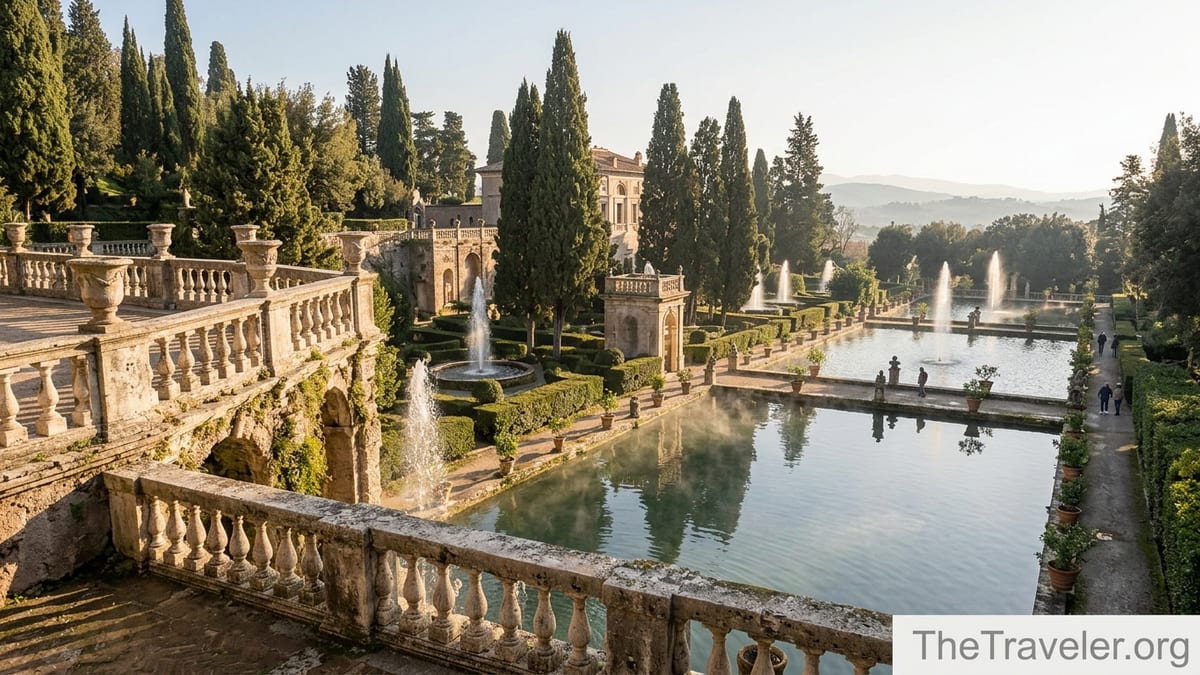
In late afternoon, the lower gardens and large fish ponds come into their own. Standing on the path along the upper end of the ponds, you can shoot back toward the villa as the warm light strikes the façade and terraces, using the water surface as a leading line. With a tripod and a neutral-density filter, some photographers set up here to blur the fountains into silky streams at shutter speeds of half a second or longer. Others simply handhold at higher shutter speeds and focus on capturing candid human moments, such as children leaning over the balustrade to watch the jets of water.
If you happen to visit during one of the occasional evening openings that local cultural organizations advertise, you will find a very different mood again. The gardens are partially illuminated, jets and cascades stand out against the dusk, and you can experiment with long exposures from stable points like the Gran Loggia terrace. Evening access is not guaranteed every season, so if night photography is important to you, watch for announcements a few weeks before your trip and be prepared to book those limited-time slots quickly.
Strategies to Avoid Crowds and Tour Groups
Even in high season, a few concrete strategies can dramatically reduce how many people end up in your frame at Villa d’Este. The first is simply to pre-book your ticket for an early or late slot rather than arriving whenever is convenient. Recent traveler reports mention that buying tickets on the day is still possible, but queues for the ticket office can stretch 30 minutes or more on busy weekends. Pre-booking means you can walk past the line, scan your code, and head straight to the viewpoints while they are still relatively empty.
Second, build your own circuit that runs counter to the usual flow of large groups. Many tours begin in the palace, move to the upper terraces for a quick overview, then descend to marquee features like the Oval Fountain and the Hundred Fountains before looping back up. If you arrive right at opening, consider going straight down to the lower fish ponds and the area below the Organ Fountain while most others linger near the entrance. After an hour, when tour groups start to fan out, work your way back up, using side paths to reach intermediate terraces that are often overlooked on quick visits.
Third, use patience and framing rather than trying to chase total emptiness. For example, at the Oval Fountain, step to either side rather than shooting front-on where people naturally congregate. Elevate your camera slightly or use stairs as a viewpoint so that garden elements fill more of the frame and incidental visitors appear smaller and less distracting. Or, embrace their presence by composing with one or two well-placed silhouettes to give a sense of scale instead of dozens of heads partially blocking the fountain.
Finally, consider timing your visit away from free-entry days, such as the first Sunday of certain months, when Villa d’Este can be significantly busier than usual. Free days are excellent for budget travelers, but if your priority is to avoid crowds and secure clean compositions, paying the standard ticket on a normal weekday usually offers a better overall photography experience.
Practical Photography Tips: Gear, Comfort and Site Rules
From a gear perspective, you do not need specialized equipment to make strong images at Villa d’Este. A modern smartphone with a good wide-angle lens can capture sweeping views of the gardens, especially from upper terraces and the Gran Loggia balcony. For those using dedicated cameras, a lightweight mirrorless or DSLR with a 24–70 mm or similar zoom covers most situations. A fast prime lens around 35 mm or 50 mm is useful for low-light interiors in the palace, where tripods are usually restricted and flash is discouraged.
Tripods may be limited or prohibited in certain indoor areas and could draw attention on crowded terraces, so a compact travel tripod or even a beanbag to stabilize your camera on a wall can be more practical than a full-sized rig. A circular polarizing filter can help manage reflections on the water surfaces and deepen sky tones on clear days, though be careful not to overuse it when shooting wide views that include both sky and shaded gardens, as uneven polarization may appear.
Comfort is a critical but often overlooked factor. The site involves a lot of stairs and sloping paths on old stone, which can be slick when damp. Wear comfortable shoes with good grip rather than thin sandals, particularly if you plan to carry gear and move frequently between levels. In summer, a refillable water bottle, sunhat and light, breathable clothing make it easier to keep exploring during the quieter early afternoon windows should you choose to stay through. In cooler months, a packable rain jacket and thin gloves can make long waits for the perfect moment more pleasant.
Photography rules and access conditions can change, especially during restoration projects or special exhibitions. In general, non-commercial photography is allowed, but using drones is not, and commercial shoots require special permits. Flash is often prohibited in frescoed rooms to protect the artwork. If you are unsure, a quick check with staff at the entrance or signage near specific spaces will keep you on the right side of regulations and let you focus on creativity instead of potential misunderstandings.
Combining Villa d’Este With Tivoli and Day Trips From Rome
How you structure your Tivoli day influences what kind of light and crowd conditions you experience at Villa d’Este. Many Rome-based visitors combine the villa with Hadrian’s Villa outside town on the same day. If photography at Villa d’Este is your main goal, consider starting your morning there at opening time, then heading to Hadrian’s Villa after lunch when the sun is higher and the wide-open archaeological spaces handle harsh light better. Some travelers do the reverse to avoid heat in the ruins, but that often puts them in Villa d’Este’s gardens right in the midday crush.
If you can stay overnight in Tivoli, you gain more flexibility. Checking into a guesthouse near Piazza Trento, just outside the villa’s entrance, makes it easy to pop in at opening, retreat for a midday rest during the busiest period, then return for the last two hours. Tivoli’s small centro storico offers plenty of places for a late lunch or early aperitivo, and some hotel terraces even frame distant views of the villa’s cypresses and fountains, adding more photographic opportunities without additional entry tickets.
Transport logistics also matter. Trains from Rome’s Tiburtina station and regional buses from Ponte Mammolo typically bring you into Tivoli in under an hour, but services are less frequent early in the morning and late at night. Before committing to a sunrise arrival or close-to-closing departure, check the schedule so you are not forced to leave the gardens earlier than you planned or stranded after dark. Travelers who prefer a more hands-off day sometimes book small-group tours that include hotel pickup in Rome, timed entry to both Tivoli villas, and a local guide. These usually target mid-morning arrivals, so if your priority is emptier gardens, a do-it-yourself early train is often more rewarding.
Whichever structure you choose, plan to spend at least two to three hours inside Villa d’Este itself. Rushing through in under 90 minutes makes it difficult to wait out surges of people at popular spots and to experiment with different compositions as the light shifts. The best images often come not from the first glance at a famous fountain, but from the second or third circuit when you have a feel for how people move through the space and where quieter corners hide.
The Takeaway
Villa d’Este rewards thoughtful timing. To pair beautiful light with smaller crowds, target shoulder-season months like April, May and September, choose a midweek day, and plan your visit for opening time or the final two hours before closing. Accept that midday may be lively and lean into it for detail shots in shaded corners, then circle back to marquee viewpoints when groups disperse. Combine these timing strategies with light, flexible gear and a bit of patience, and you will leave Tivoli with images that do justice to one of Italy’s most enchanting Renaissance gardens, plus the satisfaction of having experienced it without feeling rushed or overwhelmed.
FAQ
Q1. What is the single best time of day to visit Villa d’Este for photos?
Early morning, right at opening around 8:30 a.m., usually offers the calmest conditions and soft, angled light on the upper terraces and main fountains.
Q2. Which month has the best balance of light, weather and crowd levels?
Many photographers favor May or September, when temperatures are pleasant, days are still reasonably long, and crowds are lighter than in July and August.
Q3. Are weekends much busier than weekdays at Villa d’Este?
Yes. Saturdays and Sundays typically see more Italian day-trippers and tour groups, so if you want fewer people in your shots, aim for Tuesday through Thursday.
Q4. Is winter a good time to visit if I want photos without people?
Winter weekdays are among the quietest periods, with fewer tours and emptier terraces, though you trade shorter days, cooler weather and less lush foliage.
Q5. How long should I plan to spend inside Villa d’Este for photography?
Plan for at least two to three hours to explore different levels, wait out tour groups at popular fountains and shoot as the light shifts through the gardens.
Q6. Do I need a professional camera to get good photos at Villa d’Este?
No. A recent smartphone can capture excellent images, though a camera with a versatile zoom lens offers more control over framing, depth of field and low light.
Q7. Is it worth buying tickets in advance to avoid crowds?
Pre-booking is helpful in busy months, as it can reduce time spent in ticket queues and increase your chances of entering right at opening or late afternoon.
Q8. Can I use a tripod inside Villa d’Este?
Small tripods are often tolerated outdoors when used considerately, but full-size tripods and any indoor setup may be restricted, so always check on-site rules.
Q9. Are there specific spots that stay quieter even in peak season?
Side paths between terraces, corners near the lower fish ponds and some intermediate viewpoints off the main routes are usually calmer than marquee fountains.
Q10. How should I combine Villa d’Este with Hadrian’s Villa in one day?
If photography at Villa d’Este is the priority, visit it at opening for softer light and fewer people, then head to Hadrian’s Villa later when the sun is higher.