


More news on this day
Hellenic Railways has commissioned European Train Control System (ETCS) Level 1 signalling on the Thessaloniki–Idomeni corridor in northern Greece, marking a significant step in modernising the country’s main rail gateway toward the Balkans and the wider European Union network.
Get the latest news straight to your inbox!
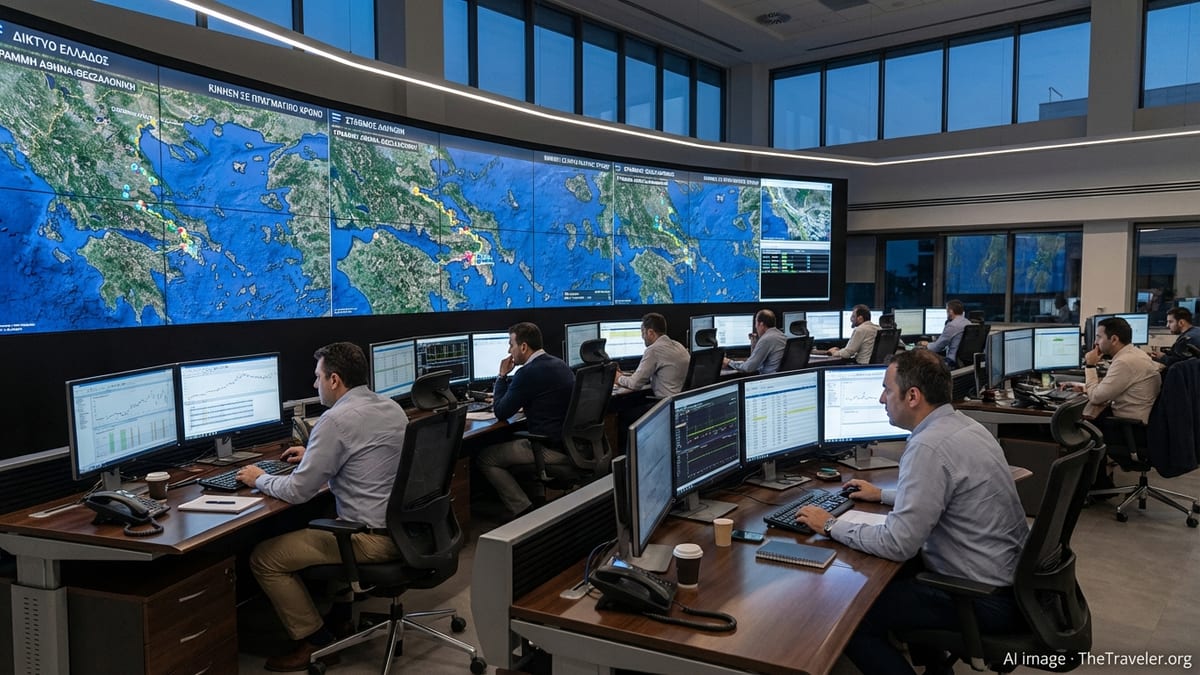
Key international freight and passenger artery upgraded
The upgraded section runs from Thessaloniki, Greece’s second-largest city and a major port, to Idomeni near the border with North Macedonia. Publicly available information describes this line as a primary international rail link connecting Greece to Central and Eastern Europe, carrying both freight and passenger traffic along a core segment of the Orient/East-Med TEN-T corridor.
Reports indicate that the newly commissioned infrastructure includes trackside ETCS Level 1 equipment over the length of the corridor, integrating with existing signalling to provide continuous speed supervision and automatic train protection. The project is part of a broader national programme to equip the main Athens–Thessaloniki–Promachonas and Thessaloniki–Idomeni axes with ETCS, bringing Greek practice into line with European interoperability standards.
The route is strategically important for cross-border logistics. According to published coverage on regional trade, freight flows through Thessaloniki’s port and onward by rail toward North Macedonia and further north are expected to increase as operators look for alternatives to congested road corridors. The ETCS deployment is framed as a key enabler for higher capacity, more reliable timetables and improved safety on these international trains.
The corridor also underpins future growth in international passenger services. Information from Hellenic Train and regional railway announcements highlights ongoing efforts to restore and enhance cross-border passenger links, with the upgraded signalling expected to support a gradual expansion of services as rolling stock fleets become ETCS-compliant.
What ETCS Level 1 means for safety and performance
ETCS is the signalling and train control component of the European Rail Traffic Management System, designed to provide a common standard across national networks. Level 1, the variant now operational on the Thessaloniki–Idomeni corridor, is an overlay system that uses balises mounted between the rails to transmit signal aspects, speed profiles and movement authorities to the train’s onboard equipment.
Technical descriptions published by specialist signalling references explain that ETCS Level 1 enhances conventional lineside signalling by adding continuous speed supervision and automatic braking if a train risks exceeding permitted limits. In practice, this reduces the likelihood of accidents caused by signal overruns or excessive speed, while allowing operators to optimise block spacing and headways without sacrificing safety.
For international routes, ETCS also brings interoperability benefits. Instead of relying on country-specific train protection systems, locomotives and multiple units equipped with ETCS can operate across borders without multiple onboard systems. This is particularly relevant on the Orient/East-Med corridor, where freight trains may run from Greek ports through the Balkans toward Central Europe under a harmonised signalling regime.
Industry analysis notes that ETCS Level 1 provides a foundation for future upgrades, including the potential migration to Level 2 or higher-capacity variants. By installing ETCS-compatible trackside equipment and establishing the necessary radio and control centre interfaces, infrastructure managers such as Hellenic Railways can build a pathway toward more advanced digital signalling with limited disruption to current services.
Part of a wider Greek signalling and ETCS rollout
The Thessaloniki–Idomeni commissioning forms one element of a broader Greek investment programme in signalling, telecoms and ETCS. Project documentation from ERGOSE and Hellenic Railways shows that ERTMS installations are planned or underway on the core Athens–Thessaloniki–Promachonas axis, as well as on selected regional lines that connect freight terminals, ports and industrial zones.
Greek National Implementation Plan material submitted to the European Commission outlines an ambition to equip the majority of the standard-gauge network with ETCS Level 1. The orientation of this policy is to eliminate legacy national train protection systems, improve safety margins and create a homogenous environment for both domestic and international operators using the Greek network.
Recent Greek press coverage has highlighted parallel efforts to upgrade infrastructure in Thessaly and central Greece, including works on the Athens–Thessaloniki main line aimed at delivering full remote control, modern signalling and 100 percent ETCS coverage by 2026. These projects, with budgets running into hundreds of millions of euros, are being carried out alongside station refurbishments, electrification works and capacity enhancements.
At the same time, national debates after past rail incidents have placed new scrutiny on the pace and quality of signalling modernisation. Public discussions around rolling stock compatibility, driver training and regulatory oversight suggest that infrastructure projects such as the Thessaloniki–Idomeni ETCS deployment are only one part of a wider safety culture shift underway in the Greek rail sector.
Implications for Balkan and EU rail logistics
The ETCS commissioning on the Thessaloniki–Idomeni corridor carries implications beyond Greece’s borders. The line provides a land bridge between the Aegean Sea and hinterland markets in the Balkans, forming a natural route for containerised traffic from the ports of Thessaloniki and Piraeus toward North Macedonia, Serbia, Bulgaria and further into Central Europe.
Analysts of European freight flows note that EU policy encourages the development of rail-based alternatives to long-haul trucking on transnational corridors, both to reduce emissions and to alleviate motorway congestion. Upgrading cross-border rail routes with interoperable signalling is seen as a prerequisite for attracting new logistics services and block trains that can operate efficiently along the full length of the corridor.
Recent agreements involving Thessaloniki port operators, Hellenic Train and neighbouring railways aim to expand intermodal services, using the Greek network as a southern gateway for goods bound to and from the Balkans. In that context, the availability of ETCS Level 1 signalling on the Thessaloniki–Idomeni line is expected to strengthen the corridor’s competitiveness against rival routes through other Adriatic and Black Sea ports.
For passengers, the long-term potential includes more frequent and faster regional services between Greece and its northern neighbours, particularly as rolling stock fleets are gradually upgraded or renewed with ETCS onboard equipment. Travel planners indicate that reliable, internationally compatible signalling is a key condition for scheduling attractive cross-border timetables and for integrating these services into wider European journey planning platforms.
Next steps for Hellenic Railways and operators
With the Thessaloniki–Idomeni ETCS Level 1 infrastructure now in service, attention is turning to the timetable for equipping locomotives and multiple units, as well as for completing remaining signalling projects on adjacent sections of the network. Greek media reports have pointed to a mixed picture in terms of onboard equipment, with some existing trains requiring retrofitting or replacement to meet ETCS specifications.
Hellenic Railways’ latest network statements and project updates emphasise the goal of creating a consistent, digitally controlled backbone along the country’s main north–south and east–west axes. Achieving this will require continued coordination between the infrastructure manager, the Ministry of Infrastructure and Transport, train operators and European funding programmes that co-finance ERTMS deployments across the continent.
Observers of the sector suggest that successful integration of the Thessaloniki–Idomeni corridor into a seamless ETCS-enabled network will depend not only on hardware installations but also on staff training, operational rule harmonisation and the capacity of national regulators to oversee the transition. As more sections of line in Greece adopt ETCS, operational experience gained on this upgraded corridor is expected to inform procedures on other routes.
For travellers and shippers, the immediate changes may be subtle, expressed in more stable timetables and incremental reliability gains rather than headline-grabbing journey time reductions. Over time, however, the commissioning of ETCS on this key international corridor positions Greece to play a more prominent role in European rail connectivity, supporting both sustainable mobility goals and the country’s ambitions as a regional logistics hub.