


Most visitors arrive in Shanklin Old Village, photograph the famous thatched cottages around the main junction and then move on to the beach or the chine. Yet within a few minutes’ walk of those postcard views is a quieter world of ivy-clad lanes, pocket-sized gardens, historic pubs and sea views that many people never find. This guide explores those hidden corners, showing you how to step away from the crowds and experience the village the way locals and slow travellers do.
Finding the Quiet Side of a Famous Village
Shanklin Old Village sits at the head of Shanklin Chine, a wooded gorge that tumbles down to the sea. The main streets around Church Road and High Street are instantly recognisable, with thick thatch, flower boxes and tea rooms clustered close together. Coaches stop nearby, day trippers spill out for cream teas and souvenirs, and on summer weekends it can feel more like a film set than a village. Yet the geography of the chine and the steep hillside means that within a few hundred metres there are side streets where you can hear birds in the trees rather than traffic and voices.
The key to finding these quieter corners is to slow your pace. Instead of following the flow between the Old Village car park and the main entrance to Shanklin Chine, look for narrow lanes that peel away from the central junction by the Crab Inn and Pencil Cottage. Even at the height of the season, stepping into these back ways can feel like stepping into another time. The cottages are still thatched, the gardens still immaculate, but without the constant click of phone cameras.
It also helps to time your explorations carefully. Early mornings outside of school holidays, or late afternoons once the coach groups have left for the day, reveal a different atmosphere. Shopkeepers stand chatting in doorways, delivery vans disappear and you may find you have entire viewpoints and garden benches to yourself. If you are staying in Shanklin or nearby Sandown, plan at least one walk through the Old Village at these off-peak times before you explore further afield on the coastal path or inland trails.
Orientation is simple. Picture the village as a rough triangle: the top anchored by the main road and Shanklin Theatre, one corner pointing down towards the upper entrance of the chine, and another pivoting out towards Rylstone Gardens and the clifftop. Most visitors shuttle between the first two points. This article focuses on the third side of the triangle and the tiny lanes and viewpoints that branch from it.
Keats Green and the Clifftop the Crowds Forget
From the centre of the Old Village, many visitors walk straight down into Shanklin Chine and on to the beach. Far fewer turn the other way, towards Keats Green, a narrow strip of public garden that hugs the clifftop between the village and Luccombe. Named for the poet John Keats, who stayed in Shanklin in 1819 and found inspiration in the landscape, this is one of the easiest places to find sea views and solitude within a short stroll of the busiest streets.
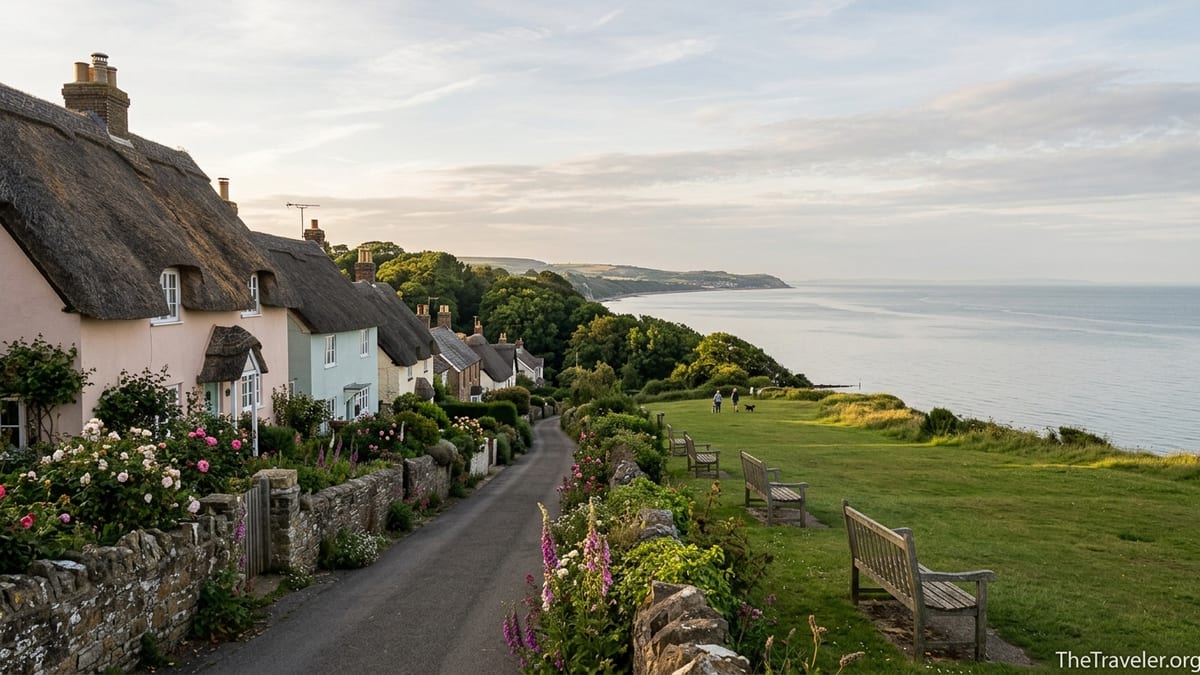
To find it, follow the signs towards Rylstone Gardens but keep an eye out for the clifftop path just beyond the main cluster of thatched cottages. Within a minute or two you emerge onto a grassy promenade lined with benches facing the Channel. On a clear day you can see the curve of Sandown Bay, the chalk cliffs at Culver Down and, if the light is right, even the mainland shimmer beyond. Because the path is slightly removed from the main coach routes and lacks shops or attractions, it tends to be used mainly by locals exercising dogs and in-the-know walkers heading towards the coastal path.
Keats Green is especially atmospheric in the hour before sunset on a still evening. The sea takes on muted blues and greys, swifts skim the cliff face and the last light catches the thatch and chimney pots of the houses tucked just behind the green. If you bring a takeaway coffee or an ice cream from the village and sit on one of the benches, you can watch the last cable cars on Shanklin Chine inch up and down the cliff in the distance without having to join the queue yourself.
Practical details are straightforward. The walk from the Old Village centre to Keats Green is gentle and takes around five to ten minutes depending on your route. There is low-level lighting in the evening but it still feels like a place owned by residents rather than tourists, so keep noise to a minimum and treat the benches and verges as you would in any small community. If you want to extend your stroll, continue along the clifftop towards Luccombe, where the formal promenade gives way to a more rural coastal path with views back across the bay.
Rylstone Gardens and the Corners Between Village and Sea
Most mentions of Rylstone Gardens highlight its traditional bandstand and summer concerts, but the charm of this compact park lies equally in its quieter fringes. Reached either via the upper entrance to Shanklin Chine or along the road from the Old Village, Rylstone sits on a shelf of land above the sea, screened by trees and reached by a warren of little paths. Because it is not directly on the main road and has no large car park of its own, it can feel unexpectedly peaceful even on a busy August afternoon.
Once inside the gardens, leave the central lawns and take any of the smaller paths that skirt the edge. The western side looks back towards the Old Village, with glimpses of thatch and the steeple of St Blasius Church framed by mature trees. On the seaward side, gaps in the vegetation reveal steep drops to the beach and the sweep of Shanklin’s esplanade. It is here, on shaded benches away from the bandstand, that you can sit with a book or a picnic and hear the sea without seeing the crowds below.
Prices here are reasonable by Isle of Wight standards. A simple takeaway tea or coffee from a seasonal kiosk in or near the gardens tends to cost only a little more than in town, so it is easy to build a budget-friendly break into your wanderings. Families often head for the mini-golf or open space near the bandstand, while couples and solo travellers gravitate to the quieter perimeters. If you are visiting outside the main summer season, check the latest local information for any changes to café opening hours, as some outlets scale back in winter.
One of the most rewarding ways to experience Rylstone Gardens is to approach it along the footpaths that link the Old Village to the clifftop. These paths, some of which form part of local walking routes towards Luccombe and beyond, weave between trees and older properties. Small signs point the way, but they are easy to miss if you are focused only on the main attraction boards for the chine. Allow time to explore these connectors and you may find secluded benches, memorial plaques and views that rarely make it into guidebooks.
Secret Lanes, Garden Walls and Story-Filled Cottages
Around the core of Shanklin Old Village, a network of short lanes and alleys retains the feel of an older settlement that pre-dates the holiday industry. Streets such as Church Road and the approaches to St Blasius Church curve gently away from the main junction, lined with cottages whose front gardens are as much a spectacle as the buildings themselves. Many visitors walk these lanes only as far as the most photographed properties, then loop back. If you continue to the quieter stretches beyond, you soon find yourself almost alone.
Look for small details as you go. House names carved into gateposts nod to the village’s long association with writers and artists. Old stone walls bulge and bow with age, sprouting ferns and ivy. Side gates reveal glimpses of apple trees, washing lines and vegetable plots, signs that these are still lived-in homes rather than stage sets. From time to time you may see residents tending hanging baskets or repainting window frames. A friendly greeting and a willingness to step aside on narrow pavements go a long way in places where visitors pass within arm’s length of someone’s front door.
Some of the most characterful buildings in this area now house small businesses that reward curious travellers. Pencil Cottage, for example, is one of the oldest properties in the village and has shifted from a traditional gift shop to a quirky mix of café and Christmas-themed retail space. Step inside and you not only support a family-run enterprise, you also get to experience low-ceilinged rooms and thick walls that hint at the building’s centuries of history. Similarly, the Old Thatch Teashop occupies a delicate pink thatched cottage with a garden that feels surprisingly secluded given its central position.
Because many of these businesses are small and family-run, opening hours can vary seasonally and may differ from generic information listed on older websites. It is wise to check blackboard signs outside each day or glance at recent online reviews before planning a special visit. Prices for cream teas and light lunches in the Old Village tend to be comparable to other popular Isle of Wight resorts, with a basic cream tea usually costing roughly what you would pay in the better-known tearooms of Yarmouth or Godshill. Choosing a tucked-away table in a side garden or upper room often gives you a much calmer experience than sitting at the front where passers-by stop to photograph the façade.
The Less Trodden Entrances to Shanklin Chine
Shanklin Chine itself is hardly a hidden attraction, but the way most people use it is surprisingly narrow. The majority of visitors enter via the main gate at the village end, descend at a steady pace, pause for photos at the two main waterfalls and then emerge at the seafront within 30 to 40 minutes. What many miss are the quieter offshoots and alternative approaches that transform the chine from a simple tourist site into a more nuanced part of the local landscape.
One option is to use the lower entrance by the beach to work your way up rather than down. Starting here, particularly early in the morning when the seafront is quiet, changes the feel of the walk. You move from open shore into increasingly dense greenery, with the soundscape shifting from waves and gulls to running water and birdsong. Because fewer people enter at this end first thing, you may have the lower bridges and viewpoints to yourself, even on a day when the upper entrance feels busy.
Another approach is to combine the chine with nearby footpaths that link to Old Church Road and the grounds around St Blasius Church. These paths, sometimes included in local walking guides and short “histree” trails, allow you to step out of the managed attraction and into semi-wild corners where the same stream carves its way through gardens and under old stone bridges. You may not find interpretive panels or lighting here, but you gain a more complete sense of how the gorge has shaped the village over centuries.
For any visit to the chine, plan practically. There is no parking inside the attraction itself, and local authorities recommend using the Old Village car park at Vernon Meadow or spaces along the esplanade, both of which usually operate pay-and-display systems. Surfaces in the gorge are often damp, even in summer, so footwear with decent grip is wise. If you are visiting outside the main season, check up-to-date information on opening times, as shorter winter hours and occasional evening illuminations can change how and when you experience the quieter corners.
Character Pubs, Seafront Corners and Night-time Atmosphere
Shanklin Old Village has long attracted travellers, and that history lives on most clearly in its pubs. At the heart of the village, the Crab Inn occupies a prime corner surrounded by some of the most photographed thatched buildings on the Isle of Wight. It is hardly a secret, yet even here there are quieter pockets. Choose a table in one of the side rooms or tucked-away corners instead of the main bar and you can admire low beams and historic details away from the main flow of people heading to and from the beer garden.
Far more of a hidden gem, at least in terms of its approach, is Fisherman’s Cottage down on the beach at the foot of Shanklin Chine. This thatched pub dates back to the early nineteenth century and sits almost directly on the sand at the far end of the esplanade. Many visitors walking along the seafront do not realise it is there until they round the last curve of the sea wall. On a calm evening, sitting outside with a plate of simple pub food and watching the last light fade over the bay feels a world away from the bustle of the arcades further along.
The route between the Old Village and the seafront holds its own small secrets after dark. Once the chine closes for the evening, the area around the upper entrance becomes quiet, and the streetlights pick out the shapes of the trees along the gorge. Walking back up from the beach via the road rather than through the attraction gives you glimpses into cottage windows, the murmur of conversation from small hotels and the occasional late-opening bar. In winter, when some attractions keep reduced hours, these streets can be almost silent by early evening, offering a different kind of charm for those staying overnight.
Budget-conscious travellers often worry that pubs and restaurants in the Old Village will be significantly more expensive than elsewhere on the island. While prices reflect the area’s popularity, they are generally in line with other established coastal resorts. You can still find straightforward options for a modest sum if you look beyond the most obviously busy spots. A simple main course in a village pub or bistro is typically comparable to what you would pay in Sandown or Ryde, and soft drinks or a half pint make lingering in a historic interior affordable even if you are not planning a full meal.
Walking Routes that Reveal the Village’s Edges
Some of the most rewarding hidden corners of Shanklin Old Village only reveal themselves if you are willing to walk slightly further than the average visitor. Several established footpaths link the village with the wider landscape, including the Isle of Wight Coastal Path and local trails towards Wroxall and Godshill. Portions of these routes pass close to the Old Village boundary, giving you alternative perspectives on familiar buildings and new vantage points over the chine and the sea.
A particularly scenic option starts near the top of Shanklin Chine and follows the coastal path towards Luccombe. After passing through small public gardens and skirting Rylstone’s wooded slopes, the trail emerges onto a more open stretch of clifftop where the village falls away behind you. Looking back, you can see the patchwork of rooftops, trees and church towers that most day trippers never view from this angle. Because access points are unsigned from the main coach drop-offs, the path tends to be used more by walkers than casual visitors.
Inland, paths such as the Worsley Trail and connectors like Old Church Lane lead through fields and along the edges of gardens where you catch oblique views of the Old Village’s thatched roofs. These routes are popular with local dog walkers and runners, but still quiet compared with the seafront. Allowing half a day to follow one of these trails out of the village and back again gives you a sense of how small and self-contained Shanklin once was, set between downs, farmland and sea.
When using these paths, come prepared. Surfaces can be muddy after rain, and while waymarking has improved in recent years, some junctions still require a quick check of a map app or printed guide. Mobile phone reception around parts of the chine and in some wooded sections can be patchy, so download any digital maps in advance. There is no need for specialist hiking gear, but sturdy shoes, a light waterproof and a refillable water bottle make these low-level walks more comfortable, especially in shoulder seasons when conditions change quickly.
The Takeaway
Shanklin Old Village is often presented as a simple checklist of sights: photograph the thatched cottages, walk the chine, have a cream tea, move on. Yet the real character of the place lies in the spaces between those headline experiences: the quiet benches on Keats Green, the shadowed paths linking gardens and clifftop, the side rooms of centuries-old pubs, the homely gardens of lived-in cottages. By stepping away from the busiest corners and allowing yourself time to wander, you gain a more intimate, less packaged sense of the village.
For travellers used to fast itineraries and crowd-drawing “must-sees,” this slower approach may feel unusual at first. There is no single viewpoint, café or attraction that unlocks Shanklin’s secrets; rather, it is the accumulation of small encounters: a chat with a tearoom owner in a back garden, a solitary moment looking out to sea from a nearly empty bench, a glimpse of the chine from a little-used side path. Together, these moments turn a pretty stop on a coastal drive into a place you remember long after your holiday ends.
To experience this quieter side of Shanklin Old Village you do not need a large budget or specialist gear, only comfortable shoes, a willingness to turn away from the obvious route and enough time to let the village reveal itself gradually. Plan at least one early-morning or late-afternoon wander, explore the edges where gardens meet fields and cliffs, and you will come away having discovered corners most visitors never see.
FAQ
Q1. How long do I need to explore the hidden corners of Shanklin Old Village?
Most travellers can get a good feel for the quieter lanes, Keats Green and Rylstone Gardens in half a day, but staying overnight allows you to experience early mornings and evenings when the village is at its most peaceful.
Q2. Is Shanklin Old Village suitable for visitors with limited mobility?
The central streets around the main junction are relatively level, but many of the most atmospheric lanes and paths involve slopes, uneven surfaces and occasional steps, so visitors with limited mobility may prefer to focus on the flatter sections and clifftop benches near road access points.
Q3. When is the best time of year to enjoy the village without crowds?
Late spring and early autumn typically offer a good balance of mild weather and fewer visitors, while midweek days outside school holidays are usually quieter than peak summer weekends.
Q4. Are the tearooms and small shops open all year?
Many businesses in the Old Village operate seasonally, opening daily in high summer but reducing hours or closing on some weekdays in winter, so it is wise to check current information or daily signs outside each venue.
Q5. Where is the best place to park for exploring the hidden corners on foot?
Most visitors use the Old Village car park at Vernon Meadow or spaces along the esplanade and then explore on foot, as parking is limited in the narrow central streets and not available directly at the chine.
Q6. Can I visit Shanklin Old Village easily without a car?
Yes, Shanklin has a railway station linked to island trains and buses, and it is roughly a 15- to 20-minute uphill walk from the station to the Old Village using signed routes through the newer part of town.
Q7. Are there family-friendly hidden spots, or is this mainly for adults?
Families often enjoy the lawns and quieter edges of Rylstone Gardens, short walks on Keats Green and visits to characterful tearooms, which offer a calmer alternative to the arcades and amusements on the seafront.
Q8. Is it safe to walk the quieter paths in the evening?
The Old Village and surrounding paths are generally considered safe, but lighting can be limited away from main roads, so carry a small torch, stay on known routes and avoid steep or wooded sections in poor visibility.
Q9. Do I need special footwear for exploring the chine and nearby trails?
While full hiking boots are not necessary, shoes with reasonable grip are recommended, as paths in the chine and on some trails can be damp or muddy even in warm weather.
Q10. How can I experience local life rather than just tourist spots?
Visiting early or late in the day, choosing side-street pubs and cafés, using local walking routes and allowing time to chat with business owners all help you connect with everyday village life beyond the busiest attractions.