


Stepping into Istanbul’s Grand Bazaar feels like entering a different century: vaulted ceilings, hanging lanterns, piles of carpets, and the sound of traders calling out in a dozen languages. It is one of the world’s most atmospheric places to shop, but it is also one of the easiest places to overpay. Between tourist markups, quiet commissions, and clever pricing tricks, the final cost at the Grand Bazaar can end up far above what locals would ever pay. With a bit of knowledge and a clear plan, however, you can enjoy the experience without walking out feeling scammed.
Get the latest updates straight to your inbox!
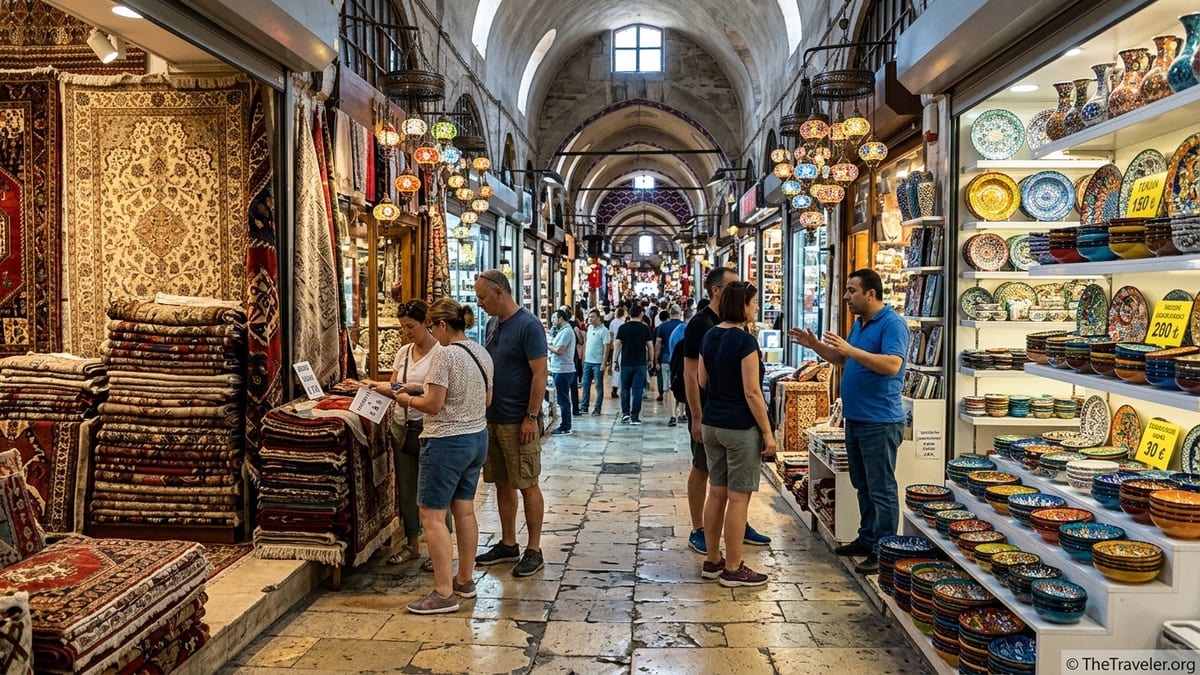
The Real Price of Atmosphere: Why the Grand Bazaar Costs More
The Grand Bazaar is not a cheap market. It is prime real estate in the historic center and one of the world’s largest covered bazaars, with more than 4,000 shops spread over 61 covered streets. The rent and maintenance costs are high, and traders pass those costs directly to customers. Many Istanbul residents come here mainly for gold and specialist items, but for everyday shopping they often choose cheaper areas like Mahmutpasa or neighborhood markets where prices are much closer to local standards.
For visitors this means that almost everything that looks like a small souvenir can be marked up heavily. A basic “Istanbul” T-shirt that might cost the equivalent of 5 to 8 euros in a side street can be quoted at 25 to 30 euros in one of the central alleys. A simple cotton scarf that locals might buy for roughly 150 to 200 Turkish lira in a non-touristy shop may be displayed for 600 to 800 lira or priced in euros to make the markup less obvious.
Not every price is outrageous, and not every trader is dishonest. But the starting prices are rarely real. Travelers regularly report first offers that are three to ten times higher than what the seller is ultimately willing to accept. If you do not enjoy haggling or you feel uncomfortable arguing over money, you will almost certainly leave the bazaar having paid far more than the local fair value.
To put this into context, imagine a hand-painted ceramic bowl. In a decent Istanbul design store outside tourist zones, a mid-sized bowl might sell for the equivalent of 15 to 25 euros. In the Grand Bazaar, you might first be quoted 80 to 100 euros for something that looks similar. After a friendly but firm negotiation, it is often possible to settle around 35 to 45 euros. The final price is still higher than in a local neighborhood, but you are paying for convenience, selection, and the setting rather than falling for the first number you hear.
Inflated Opening Prices, “Discounts,” and Currency Confusion
The most common hidden cost at the Grand Bazaar is simply the initial price given to obvious tourists. Sellers are experts at reading where you are from, what language you speak, and how confident you look. If you pause too long in front of a carpet, a leather jacket, or a lamp, the opening price you hear will almost never be the price a Turkish customer would see. It is normal for merchants to start high, but for inexperienced visitors the gap can be shocking.
A frequent pattern works like this: a traveler admires a mosaic lamp and asks the price. The seller says 120 euros. The visitor hesitates, and the trader immediately offers a “special price” of 90 euros, then 80 if the buyer looks doubtful. The buyer feels they are winning a big discount and agrees. Only later, after seeing similar lamps in less touristy areas for 30 to 40 euros, does it become clear that the final “deal” was still heavily marked up. A similar scenario plays out with leather bags, where initial quotes of 300 to 400 euros can drop to 120 or less after some bargaining.
Currency confusion adds another quiet cost. Shops may quote in euros or dollars, then convert to lira with a rate that favors them rather than you. For example, if the mid-market rate suggests 1 euro equals roughly 35 lira, a trader might round it to 40 or more when calculating your bill. On a 200-euro purchase, that difference adds up to several hundred lira. If you pay directly in foreign currency, you lose control over the conversion entirely and rely on the shop’s private rate.
To avoid paying extra here, get a sense of the daily exchange rate before you go and keep it in your phone. When a trader names a euro or dollar price, do a quick mental or calculator conversion to lira to understand what you are really paying. You can then counter in lira and insist on a total in lira before committing. Travelers who firmly insist on quoting and settling in Turkish lira, and who counteroffer at half or slightly less than the first number, generally end up closer to a fair rate.
Payment Traps: Credit Card Fees, Rounding, and Receipt Tricks
Another category of hidden costs shows up not in the sticker price, but in how you pay. Credit card transactions cost merchants a processing fee, and it is common practice for some Grand Bazaar shops to quietly pass this cost to you. A trader might say that a lamp is 1,500 lira in cash, but 1,650 lira if you want to pay by card. Sometimes this surcharge is stated openly; in other cases, it appears as a higher final total without explanation, especially if the initial bargaining was done in a foreign currency.
Rounding is another subtle trick. After a long bout of bargaining, you might agree verbally on 1,400 lira for a scarf and a few small items. At the counter the seller taps on a calculator, adds tax or a claimed “service fee,” and shows you 1,500 lira. The extra 100 lira feels small compared with the entire negotiation, and many visitors simply shrug and pay. In more problematic cases, particularly for sweets and spices sold by weight, tourists have reported agreeing on a price per 100 grams but being charged for a full kilogram at the register, turning what they thought was a 200-lira treat into a 2,000-lira bill.
There are also situations where the amount entered on the point-of-sale terminal does not match what was agreed. For example, a traveler might agree on 80 euros for a box of Turkish delight and some nuts. The seller then charges the card for the lira equivalent of 120 euros, counting on the customer to be distracted or unfamiliar with local currency. Complaints about this pattern often appear in online forums, especially from visitors who only notice the discrepancy after checking their bank statement later.
To protect yourself, always confirm the total in Turkish lira and in your own currency before you hand over a card. Watch the keypad as the seller enters the amount, and do not be afraid to cancel the transaction if the number is higher than expected. If a shop insists that the price is different from what was agreed, walk away. For any purchase above your comfort level, ask for an itemized handwritten receipt with the agreed price clearly stated. The extra two minutes this takes can save you from large surprises later.
Commissions, “Helpers,” and Carpet Showroom Detours
One of the most misunderstood sources of inflated prices in and around the Grand Bazaar is commission. Many visitors are approached by friendly strangers or even by seemingly official guides who offer to “help” them find the best carpets, leather, or jewelry. These helpers almost always earn a commission from the shop where they take you, sometimes 20 percent or more of the sale. The cost of that commission is baked into the price you are offered, so you start the negotiation from much higher ground than a walk-in local customer.
This is particularly common with carpet showrooms. A visitor might be invited for tea and a “quick look” at traditional Turkish rugs. Once inside a comfortable room, the staff unroll carpet after carpet, telling stories about tribal patterns and hand-knotting techniques. There is nothing inherently wrong with this hospitality, but the atmosphere can make it emotionally difficult to walk out without buying. Prices for a room-sized wool rug might start at several thousand euros, and after an hour of conversation and multiple “discounts,” the buyer might still pay far more than a comparable piece would cost in a reputable fixed-price gallery elsewhere in the city.
Leather shops operate similarly. A salesperson or informal guide may walk with you from the main bazaar lanes to a back showroom, saying they know the owner and can get you a special price. If you buy a leather jacket for the equivalent of 400 euros after “big discounts,” it may feel like a bargain in the moment. Only later, when you see similar quality jackets in regular Istanbul stores for 150 to 250 euros, does the scale of the markup become obvious.
The easiest way to avoid paying hidden commissions is to politely decline unsolicited help. If someone appears from nowhere and offers to lead you to their “cousin’s shop,” assume they are working for commission and say no. When you want to look at carpets or high-value items, choose a shop yourself. If you are interested in a guide, book an accredited walking tour through a reputable operator and clarify in advance whether the tour includes shopping stops and how commissions are handled.
Quality Questions: Counterfeits, Mass Production, and “Handmade” Claims
Another hidden cost at the Grand Bazaar is quality, or rather the lack of it when the price suggests otherwise. The bazaar has a long tradition of craftsmanship, but in recent years more and more stalls have filled with mass-produced goods, some imported from outside Turkey. Visitors often assume that anything bought here must be handmade or locally produced, and traders sometimes reinforce that belief with phrases like “all hand-painted” or “pure silk” even when the reality is mixed.
Leather is a clear example. Türkiye is known for its leather industry, and there are excellent Turkish-made jackets and bags. At the same time, some shops in and around the Grand Bazaar sell lower-grade products that imitate luxury brands or that mix genuine leather with synthetic panels. A jacket priced at the equivalent of 300 euros may be presented as top-quality Turkish leather, yet the stitching, lining, and zippers reveal something closer to fast fashion. The hidden cost appears later, when the item wears out quickly or does not look as good at home as it did under the showroom lights.
Carpets and kilims are even more complicated. A hand-knotted wool rug can legitimately cost thousands of euros depending on size, knot density, and origin. However, some dealers blur the line between hand-knotted rugs and machine-made pieces, using vague terms like “handmade design” or focusing on the story rather than the technical details. A tourist might pay several hundred euros for what they believe is a handwoven village kilim, only to learn later that a similar machine-made rug sells in Turkish department stores for a fraction of the price.
With ceramics, lamps, and jewelry, the same principle applies. Many attractive items are genuinely handmade and worth a premium, but others are factory-produced in large batches. If a “hand-painted” plate is offered in exactly the same pattern at a dozen different shops, it is likely a mass product. The best defense is curiosity: ask very specific questions, compare similar goods in several stores, and do not be afraid to walk away if the story and the finishing details do not match the price.
Spices, Sweets, Shipping and Other Often Overlooked Extras
Some of the most tempting items at the Grand Bazaar are edible: pistachio-stuffed Turkish delight, apple tea, saffron, and colorful spice blends. These are also some of the easiest areas for quiet overcharging. Shops often display per-kilogram prices, but when you ask for “a small mixed box” or “a little of this and that,” the seller may scoop generously and then weigh the entire selection at the register. What you imagined as a 200-lira treat can become an 800-lira box before you realize how much has been packed.
Quality and freshness are another question. Many Istanbul residents actually buy their Turkish delight and baklava from established pastry chains or specific neighborhood sweet shops rather than inside the Grand Bazaar. In the bazaar, you pay extra for convenience and presentation, and not all stalls turn over their stock quickly. A luxury-looking gift box of sweets priced at 50 or 60 euros might not taste significantly better than a simpler box from a non-touristy bakery at half the cost.
Shipping is a separate hidden cost, especially for carpets, lamps, and large ceramics. A shop might offer “free worldwide shipping” as an incentive, but the shipping cost is usually built into the product price, or an insurance or handling fee appears at the end. In other cases, you may be quoted a separate shipping fee that sounds reasonable in euros, only to discover later that it was far above standard courier rates for the same size and weight. Problems also occur when customs duties or taxes in your home country are not discussed in advance, leaving you with additional bills upon arrival.
Before agreeing to shipping, ask which company will be used, whether the parcel is insured, and what happens if it arrives damaged. Request a written invoice that includes your full details, the exact description of the item, and its value. If the shop hesitates or gives vague answers, consider carrying the item yourself instead or buying from a retailer back home where returns and guarantees are clearer.
Practical Strategies to Pay Fair Prices Without Stress
Despite the potential traps, it is entirely possible to enjoy the Grand Bazaar and come away with purchases you are happy about. The key is preparation and a few firm rules. Start by researching baseline prices before you go. Look at Turkish online retail sites or price similar items at modern malls or neighborhood shops. If you know that a decent leather bag usually sells for the equivalent of 60 to 100 euros in Istanbul, it becomes much easier to recognize when a bazaar quote is unrealistic.
Once inside, treat the first price as the opening chapter of a conversation, not as information. If a seller quotes 1,000 lira, a common tactic is to counter at around 400 to 500 lira with a friendly smile. You can then meet somewhere in the middle. Walking away is your strongest tool. If the price does not come down to a range you are comfortable with, thank the merchant and head for the door. In many cases, you will be called back with a better offer. If not, there are usually many other shops selling similar goods.
Shopping away from the most crowded central alleys can also reduce the hidden cost of tourism. Traders on side streets, near the bazaar exits or in the nearby Mahmutpasa area, often have lower rents and slightly more realistic prices. Their selection might be more limited, but you are less likely to encounter the steepest markups. If you are making a large purchase, such as a carpet or serious jewelry, consider getting a quotation in at least three different shops over a day or two before deciding.
Finally, set your own limits in advance. Decide how much you are willing to spend on souvenirs overall and on any single item. This mental ceiling helps you resist pressure and prevents a moment of enthusiasm from becoming a financial regret. Remember that you are not obligated to buy anything just because you accepted tea, listened to a story, or spent time in a shop. Hospitality is part of the culture, but it is understood that not every visitor will make a purchase.
The Takeaway
The Grand Bazaar is one of Istanbul’s essential experiences, but it is not a place to shop blindly. High rents, tourist demand, complex commission structures, and currency confusion all contribute to prices that can be much higher than in the rest of the city. The most common hidden costs are not outright scams but layers of markups, small fees, and quality mismatches that quietly push your final bill well beyond the fair value of what you take home.
If you arrive informed, keep an eye on exchange rates, negotiate calmly, and refuse to rush big decisions, you can significantly reduce these costs. Choosing your own shops instead of following unsolicited helpers, checking weights and totals before paying, and being ready to walk away will put you in a far stronger position. In the end, what you are paying for at the Grand Bazaar is not just an object but a story and an experience. With a bit of care, that story can feel like a treasured memory rather than an expensive lesson.
FAQ
Q1. Is everything in the Grand Bazaar overpriced compared with the rest of Istanbul?
Not everything, but many tourist-focused items carry noticeable markups. Everyday souvenirs, T-shirts, scarves, and gift boxes of sweets are usually more expensive here than in neighborhood shops or less touristy markets. High-value goods like quality gold jewelry and serious hand-knotted carpets can still be fairly priced if you know what you are looking for and compare several vendors.
Q2. How much should I realistically bargain off the first price?
For typical tourist merchandise such as lamps, ceramics, and textiles, it is common for locals to aim for 40 to 60 percent of the initial quote. If you are offered a lamp for 1,000 lira, countering around 400 to 500 lira and settling somewhere in the middle is reasonable. For finer jewelry or high-end carpets, margins are often tighter, and the discount might be smaller, but there is almost always some room for negotiation.
Q3. Is it better to pay in Turkish lira, euros, or dollars?
Paying in Turkish lira usually gives you more control and transparency. When you pay in euros or dollars, the shop chooses the exchange rate, which may not be in your favor. Check the current rate on your phone before you start shopping, agree on a price in lira, and verify that the amount entered on the card terminal matches what you agreed.
Q4. Are the carpets in the Grand Bazaar genuine and good value?
Many carpets sold in and around the Grand Bazaar are genuine, but the range of quality is wide. There are excellent hand-knotted rugs alongside machine-made or mass-produced pieces sold at similar-looking prices. The bazaar is not usually the cheapest place to buy; you pay extra for the setting and the sales ritual. If you are serious about buying a rug, do some research on materials and knot counts, visit several shops, and avoid rushing into a purchase after a single tea session.
Q5. How can I avoid being overcharged for Turkish delight and spices?
Always ask clearly whether the price is per 100 grams or per kilogram and watch the scale as the seller weighs your selection. Decide roughly how much you want to spend before they start filling boxes, and stop them if they scoop more than you asked for. Comparing one or two nearby shops first also helps you recognize when a price per kilo is unusually high.
Q6. Do shops in the Grand Bazaar really add extra fees for using a credit card?
Some do. It is not unusual for a merchant to quote a lower price for cash and a slightly higher one for card payments to cover processing fees. Others may quietly round up the total when you pull out a card. To avoid surprises, ask in advance whether the price is the same for cash and card, and check the terminal display carefully before approving the transaction.
Q7. Are the “helpers” who offer to guide me to carpet or leather shops trustworthy?
They are usually working on commission, which means the shop will factor their fee into your price. That does not automatically make the experience dishonest, but it almost always makes it more expensive. If you prefer to avoid hidden commissions, politely decline unsolicited help and choose shops on your own or with a transparently arranged guide.
Q8. How can I tell if something is really handmade?
Look closely at the details. Handmade items often have small variations in pattern, slight irregularities, and signs of individual workmanship. If you see identical pieces in many shops, it is probably factory-made. Ask specific questions about how and where the item was made, and be cautious if the seller relies more on stories than on clear, verifiable information about materials and techniques.
Q9. Is shipping large items home from the Grand Bazaar safe and reliable?
Many shops regularly ship carpets, lamps, and ceramics abroad and use reputable couriers, but experiences vary. Before agreeing, ask which company will handle the shipment, whether it is insured, how long delivery is expected to take, and what happens if the item arrives damaged. Get a detailed invoice with your contact information and the item description. If a shop is vague or resistant to providing documents, reconsider the purchase or carry the item with you instead.
Q10. Can I enjoy the Grand Bazaar without feeling pressured to buy?
Yes, if you set boundaries. It is perfectly acceptable to browse, admire goods, accept tea, and then thank the seller and leave without purchasing. A polite smile and firm phrases such as “I am just looking, thank you” or “I will think about it” go a long way. Treat the visit as a cultural experience first and a shopping trip second, and you are more likely to walk away with good memories and any purchases made on your own terms.