


Most visitors leave Palazzo Vecchio talking about the size of the Salone dei Cinquecento or the view from the Arnolfo Tower. Yet the building’s real magic lies in details that are easy to miss when you are swept along in a busy museum route or an audio guide on fast‑forward. From painted ceilings that double as political manifestos to cupboard doors that open onto the known world, Palazzo Vecchio rewards travelers willing to slow down and look twice.
Get the latest updates straight to your inbox!
The Hall Where History Hides in Plain Sight
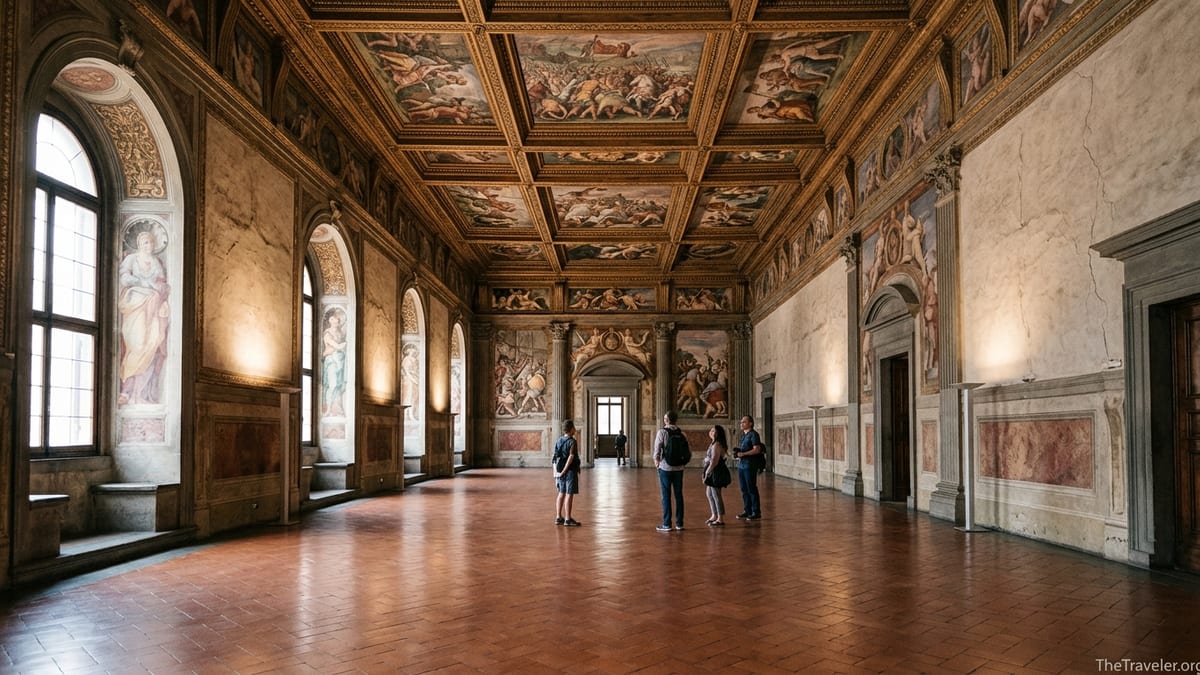
Almost every visitor walks into the Salone dei Cinquecento and looks up at the gilded coffered ceiling, then at Vasari’s huge battle scenes. Far fewer realize how much quiet storytelling is packed into this vast space. If you pause instead of simply rotating in place for a selfie, you begin to see how the room is designed as a piece of propaganda celebrating Cosimo I de’ Medici rather than just a generic Renaissance council hall. The central ceiling panel shows the Apotheosis of Cosimo I, turning a bureaucratic assembly chamber into a visual throne room.
One detail many people miss stands high above eye level: near Vasari’s fresco of the Battle of Marciano, the tiny inscription "Cerca trova" is painted on one of the green battle flags. It reads "seek and you shall find" and has fueled decades of debate about whether Leonardo da Vinci’s lost Battle of Anghiari might survive behind Vasari’s wall. Guides will often mention the mystery, but very few visitors take the time to locate the phrase on the fresco itself. Bring a small pair of theater binoculars or use the zoom on your smartphone camera and you can actually hunt for the words while you are in the room.
The hall also hides its engineering. Standard visits keep you on the floor, but special "secret passages" tours sometimes lead up behind the ceiling, where you can see the enormous wooden trusses that support Vasari’s raised roof. For travelers interested in architecture, this behind‑the‑scenes view changes how you look back down at the lavish decoration. The painted coffers stop being a flat pattern and become a clever veneer over an audacious 16th‑century engineering project that allowed Cosimo to literally elevate the hall above its Republican past.
Because the Salone is used for events by the city of Florence, furniture and lighting rigs sometimes clutter the space. Rather than letting this distract you, use it as a reminder of continuity. This is still the town hall. When you notice the modern audio equipment tucked beneath Renaissance frescoes or the contemporary chairs lined up along the wall, you are seeing the same room in the dual role it has played for centuries: both museum and working seat of power.
Ceilings That Map Power, Elements and Myth
Throughout Palazzo Vecchio, the ceilings are more than pretty decoration. In the Quartiere degli Elementi, for instance, each room corresponds to one of the classical elements. If you simply walk through with a quick glance at the walls, you might register "mythological scenes" and nothing more. Look carefully at the ceiling of the Sala dell’Aria and you will see that it literally stages air, with swirling clouds, airborne deities and birds that pull your eyes upward. The element becomes an organizing principle that turns the entire room into an allegory of Cosimo’s control over nature and the cosmos.
In neighboring rooms, flames, oceans and earthy landscapes repeat above you. The Sala di Saturno has a ceiling that mixes the god Saturn with agricultural imagery, connecting time, harvest and Medici stability. Visitors standing in the middle of the room often focus on the fireplace and wall frescoes. To really understand the program, try this: step into the doorway, lean lightly against the jamb and look up for a full minute without moving. Slowly, a visual hierarchy emerges from what at first felt like dense decoration. The Medici arms appear again and again, but always in relationship with elemental forces, as if to say that the family rules like the planets rule the heavens.
These ceilings reward close inspection from different angles. Because the rooms are small, ceiling frescoes can appear distorted when you stand directly beneath them. Move toward a corner and you will see that many figures were painted with a preferred viewpoint in mind, often close to where Cosimo or his guests would have sat. Travelers with a basic knowledge of photography will recognize this as a deliberate management of perspective, a Renaissance version of choosing the right focal length. You do not need specialized art history training to enjoy this. Simply experiment by standing in several spots and noticing how a figure that looked oddly stretched suddenly becomes natural from another point in the room.
When the Quartiere degli Elementi reopened after careful conservation work in recent years, colors once dulled by centuries of grime became more legible. Today the subtle blues, greens and brick reds look surprisingly fresh but not glossy. If you visited before the restoration, you might remember these spaces as dark and heavy. Returning now, you will notice a softness in the palette and an almost matte finish that reflects the candlelit environment they were painted for, not the harsh overhead lighting of a modern gallery.
Eleonora’s World: Domestic Luxury Behind Political Walls
On the upper levels, the Quartiere di Eleonora reveals another side of the palace that many visitors hurry past: the domestic world of Eleonora di Toledo, Cosimo’s Spanish‑born wife. While tour groups often crowd into the chapel to admire Bronzino’s luminous frescoes, fewer people stop to read these rooms as a story about gender, faith and status in a Renaissance court. Look at the embroidered patterns in the painted fabrics and the jeweled borders of Eleonora’s imagined gowns. They echo the real textiles she owned, which you can compare if you have seen Bronzino’s famous portrait of her and her son in the Uffizi.
In Eleonora’s chapel, the walls are dense with religious scenes, but there is also a sense of intimacy that differs from the public halls downstairs. Instead of large battle scenes, you find moments of private devotion, angels in warm, saturated colors and small architectural details that suggest a personal retreat. Many travelers note the beauty of the frescoes without noticing the acoustics. If you step in when the room is quiet and speak in a low voice, you will hear how sound softens, unlike in the echoing Salone dei Cinquecento. The small scale of the space, the wood, and the layers of paint create a hush that feels almost like that of a domestic chapel in a private villa.
From the loggia outside Eleonora’s rooms you can glimpse the earliest stretch of the Vasari Corridor crossing toward the Uffizi. Guides often point out the corridor from the street or from the Ponte Vecchio, but here you are at the level where the Medici actually stepped into it. If you stand by the window and imagine the duchess walking from her apartments into this elevated passage, you begin to see how the palace interior functioned as a protected network. What looks like a simple painted ceiling or a carved doorway is part of a larger system meant to let the ruling family move unseen above the city.
Details of everyday life survive in these rooms too. Look for small painted cupboards, fireplaces with modest decoration compared to the grand rooms, and floor patterns worn by centuries of feet. In a corner or by a window niche you might find traces of what were once functional spaces: a place to sit, to store devotional books, to warm hands over a brazier. For travelers used to thinking of palaces as stage sets, recognizing these traces of domestic life adds an unexpected layer of realism.
The Studiolo: A Pocket‑Sized Universe of Secrets
One of Palazzo Vecchio’s most remarkable and most overlooked interiors is also one of its smallest: the Studiolo of Francesco I. Tucked beside the Salone dei Cinquecento, it is easy to miss or to treat as just another pretty painted room. In reality, it was an intensely private laboratory of the mind, where Francesco indulged his interests in alchemy, natural science and the collecting of rare objects. Every surface is covered, from barrel‑vaulted ceiling to paneled walls, making visitors today feel as if they have stepped inside the prince’s imagination.
The panels here are not arranged for narrative comfort in the way a chapel might be. Instead, each one corresponds to a category in Francesco’s encyclopedic worldview: elements, metals, plants, animals, even specific crafts. Some of the paintings depict alchemical workshops, glassmaking or goldsmiths at work, while cupboards hidden behind them once stored actual minerals, instruments and curiosities. On a standard museum visit, you cannot open the doors, but you can often spot tiny keyholes or hinges that reveal how interactive the room once was. It functioned a bit like a three‑dimensional filing system or a Renaissance version of a research database surrounding its user.
Most visitors glance at the ceiling, note that it is "beautiful," and move on in under two minutes. If you stay longer, patterns emerge. Try focusing on one thematic thread, such as water. Seek out images of rivers, seas, storms and maritime trade, and imagine what these meant to a ruler whose wealth depended on Tuscan ports. Or choose images related to fire and laboratories, thinking about Francesco’s experiments with distillation and chemical processes. By turning your visit into a focused treasure hunt, you will connect the room to the broader history of science, not just to decorative art.
Because the studiolo is compact and access is sometimes regulated, it can feel crowded when a tour group enters. A practical strategy is to time your visit so you can return to it. If you are using the Museum of Palazzo Vecchio’s standard ticket, you are usually allowed to loop back within your time window. Step in first with a guide to get orientation, then come back alone when the room empties for a moment. In the relative quiet, pay attention to the temperature, the subdued light and the slightly uneven painted wood. These physical sensations make it easier to imagine the studiolo not as a postcard image, but as a working space where someone once handled instruments, unlocked cupboards and pored over maps by candlelight.
The Hall of Maps: A Wardrobe of the Known World
Toward the end of the museum route, many visitors are tiring and thinking about gelato in Piazza della Signoria. That is when they rush through one of Palazzo Vecchio’s most extraordinary interiors without really seeing it: the Sala delle Carte Geografiche, or Hall of Geographical Maps. At first glance, the room looks like a handsome library with dark wood cabinets and a giant globe in the center. Slow down, and you realize that nearly every cupboard door is a painted map created in the 16th century to visualize the known world for the Medici court.
Designed by Giorgio Vasari and painted by cosmographers such as Egnazio Danti and Stefano Bonsignori, the room acted both as a guardaroba, or storage space for the Grand Duke’s treasures, and as a cosmography theater. Cabinet doors carry detailed regional maps of Europe, Africa, Asia and the Americas, organized in a Ptolemaic sequence. Labels in Latin and Italian, tiny ships, sea monsters and miniature cities cover the surfaces. Some names are familiar, others feel archaic, reminding you that these maps were drawn at a time when coastlines were still being revised and continents only partially surveyed.
One of the most surprising things for modern travelers is the physicality of the maps. Unlike a flat atlas page, these are heavy wooden doors that once opened to reveal objects associated with the regions depicted: curiosities, documents, tribute. Imagine a Medici official pulling open "Africa" to reveal ivory or a casket of diplomatic gifts, or opening "Peru" to show silver ingots and specimens. Even though the original contents have long been dispersed, you can still intuit the concept. The world was not just pictured on the walls, it was packed into the cupboards, giving the room a theatrical, almost immersive quality that predates modern multimedia displays by centuries.
Recent restoration work has stabilized many of the panels and allowed conservators to study the pigments, revealing, for example, how green and blue tones have shifted with time. Today, visitors see maps that are slightly more muted than in the 16th century, but that muting actually makes them easier to read under museum lighting. To appreciate the detail, step close to one door and follow a river from its source to the sea with your finger hovering just above the surface. You will notice mountain ranges rendered as tight, rhythmic lines and cities indicated by schematic fortresses, a visual language quite distinct from the satellite images we are used to.
The large globe at the center of the room is heavily restored and today functions more as a symbolic anchor than a precise scientific instrument. Many people take a quick photograph of it and move on. Instead, try walking slowly around it, comparing its surface to the surrounding maps. Where are coastlines missing or incomplete. Where do myth and measurement blur. This comparative exercise turns a five‑minute stop into a memorable encounter with how Renaissance Florence imagined its place in a globalizing world.
Secret Passages, Hidden Doors and Everyday Shortcuts
Stories about secret passages in Palazzo Vecchio tend to focus on drama and intrigue, but the architectural reality is often more practical. Many of the "hidden" routes are simply clever circulation paths designed to let officials and family members move between key rooms without crossing public spaces. The Duke of Athens’ stairway, built into the thickness of the walls in the 14th century, is a good example. Today, special tours sometimes take small groups through this narrow staircase, which feels less like a movie set and more like an efficient medieval fire escape hidden inside the masonry.
Once you have seen one of these passages from the inside, you start to spot their traces all over the palace. Look for slightly oversized paintings, paneling that does not align perfectly, or doors that seem to open into a wall. In the Salone dei Cinquecento, one such disguised door leads directly toward the Studiolo of Francesco I. In other areas, you may notice short stretches of corridor that run behind a sequence of decorated rooms. For staff and dignitaries, these routes functioned the way internal staircases and staff elevators do in today’s hotels, allowing discreet movement between floors and wings.
For contemporary visitors, the crucial thing to notice is how these hidden infrastructures shape the visible interiors. A painted program might read one way from the public route and another from the vantage point of someone using a side door. Knowing that a duke or duchess could enter a room unseen through a concealed passage changes how you interpret the hierarchy of space. The most decorated wall is not always the one facing the main entrance. Sometimes it faces the private doorway, aligning the best view with the eyes of power, not with the tourist flow.
Several tour operators and the museum itself occasionally offer "secret paths" or "secret passages" visits in addition to the regular ticket. These are typically more expensive than the standard entry but still within reach for many travelers, often priced roughly in the range of a mid‑range restaurant meal in Florence. If you are deciding whether it is worth the extra cost, consider how interested you are in architecture and circulation. For visitors who enjoy peeling back layers of a building’s history, the chance to walk inside the palace walls and then return to the public rooms with new eyes can be more memorable than an additional museum elsewhere in the city.
Reading Symbols: Medici Branding Across the Interiors
One of the easiest details to overlook in Palazzo Vecchio is also one of the most pervasive: Medici symbols. Visitors often notice the more obvious family coat of arms carved on the facade or on exterior banners, but inside the palace the Medici brand repeats in dozens of subtle forms. The famous shield with red balls appears on ceilings, fireplace surrounds and door frames, sometimes worked into elaborate frames, other times almost casually tucked into corners of frescoes.
If you turn your visit into an informal "logo hunt," you quickly see patterns. In rooms used for high‑level receptions, the arms are large, gilded and surrounded by personifications of virtues or by allegories of Florence. In more private spaces, they might be smaller, woven into decorative borders or combined with initials such as "C" for Cosimo or subtle references to Eleonora’s Spanish heritage. This scaling of the symbol mirrors modern branding strategies, where a company might feature a full logo in advertising but use a simple monogram on internal stationery.
Take a closer look at shields that include a blue field with golden fleurs‑de‑lis among the usual red balls. This references the Medici’s connection to the French crown, a reminder that the family did not see itself as merely local rulers but as players on a European stage. When you spot this variation above a doorway or in a ceiling corner, you are literally seeing diplomacy painted into the architecture. For travelers used to thinking of heraldry as decorative noise, recognizing these nuances turns the interior into a readable document of alliance and ambition.
Symbols extend beyond the coat of arms. Look for recurring motifs such as diamond rings, feathers, turtles with sails or mottos inscribed on ribbons. These emblems often relate to specific family members or personal devices, carrying meanings such as perseverance, prudence or speed restrained by wisdom. Once you start spotting them, they link distant rooms together. A turtle that appears in a small studiolo might reappear in a grand hall ceiling, quietly asserting continuity of message between intimate reflection and public display.
The Takeaway
Palazzo Vecchio’s interiors can feel overwhelming on a first visit, especially if you are moving in step with a busy group or trying to cover everything in under an hour. Yet the palace rewards a slower, more investigative approach. The Salone dei Cinquecento hides engineering feats and cryptic inscriptions inside an apparently straightforward civic hall. The Quartiere degli Elementi and Eleonora’s apartments translate power, piety and domesticity into layered ceilings and quiet side rooms. The Studiolo of Francesco I compresses a prince’s intellectual universe into a jewel box of panels and cupboards, while the Hall of Maps wraps global ambition around a working wardrobe.
For travelers, the difference between a checklist visit and a memorable encounter often comes down to the decision to stop and look twice. Arrive with a few concrete missions: find "Cerca trova" in the battle fresco, trace a river on one of the map doors, identify three variations of the Medici arms, or simply spend a full five minutes in the studiolo letting your eyes wander. These small acts of attention turn the palace from a backdrop for photographs into a place you genuinely get to know, room by room, symbol by symbol. Long after you have forgotten which ticket line you used or what time your entry slot was, you are likely to remember the feeling of standing under a ceiling that suddenly made sense, or of realizing that a painted cupboard door was once the front of a world in miniature.
FAQ
Q1. How much time should I plan to explore Palazzo Vecchio’s interiors in depth?
For a visit focused on the interiors and their hidden details, plan at least two to three hours. This gives you enough time to see the main halls, pause in smaller rooms like the studiolo and Hall of Maps, and, if available, join a short themed or secret passages tour without feeling rushed.
Q2. Is the Studiolo of Francesco I always open to the public?
Access policies can vary, but in general the studiolo is part of the standard museum route and viewable from the doorway or interior space. Occasionally conservation work or crowd management may limit entry. Check on arrival at the ticket desk and, if it is important to you, mention it when you purchase your ticket so staff can advise on current conditions.
Q3. Are there guided tours that focus specifically on hidden details and secret passages?
Yes. The Museum of Palazzo Vecchio and several local operators periodically offer "secret paths," "hidden Palazzo Vecchio" or similar tours that highlight lesser known spaces, including sections of internal stairways and behind‑the‑scenes areas. These usually require advance booking and are priced higher than basic admission, but they can be worthwhile if you are interested in architecture and the building’s history of power.
Q4. Can I photograph the interiors, including the ceilings and maps?
Non‑flash photography for personal use is generally permitted in most areas of Palazzo Vecchio, including the Salone dei Cinquecento, decorated apartments and the Hall of Maps. However, rules can change for temporary exhibitions or specific rooms, so always check posted signs and follow staff instructions. Tripods and professional lighting are typically not allowed without prior authorization.
Q5. What is the best way to appreciate the painted ceilings without getting a sore neck?
A simple strategy is to use your phone as a periscope: take a few zoomed‑in photos while standing in different corners of the room, then study the images at eye level. Alternating between looking up for short intervals and examining details on your screen helps you see the compositions clearly without strain, especially in spaces where benches are not available.
Q6. Are the Hall of Maps and the globe suitable for children and teenagers?
The Hall of Maps often fascinates younger visitors because it feels like stepping into a giant, antique atlas. Teenagers who enjoy geography or strategy games may particularly like tracing routes on the cabinet doors and comparing old coastlines with what they know from modern maps. For younger children, turning the visit into a treasure hunt for sea monsters, ships and exotic animals on the panels can keep them engaged.
Q7. How can I connect what I see in Palazzo Vecchio with other sites in Florence?
Look for recurring figures and symbols. For example, compare Bronzino’s work in Eleonora’s chapel with his portraits in the Uffizi, or match Medici coats of arms in Palazzo Vecchio with those on churches like San Lorenzo. Recognizing the same artists, patrons and emblems across the city helps you understand how Palazzo Vecchio functioned as the nerve center of Medici power.
Q8. Is there an ideal time of day to visit to avoid crowds in the smaller rooms?
Early morning entry slots and the last scheduled entries of the day tend to be quieter, particularly outside peak holiday periods. If your schedule allows, aim for the first hour after opening or plan to be in the upper floors and smaller rooms while most visitors are still concentrating on the main hall and tower access earlier in their visit.
Q9. Do I need prior knowledge of art history to enjoy the palace’s symbolism?
No. While art history background can deepen your understanding, simple observation goes a long way. Focus on repeating motifs such as shields, planets, elements or specific objects like rings and turtles. Reading room labels slowly and comparing what you see from different spots in the room can reveal patterns without any specialized training.
Q10. Are any parts of Palazzo Vecchio still used for government or official functions?
Yes. Palazzo Vecchio remains Florence’s town hall, and some rooms are still used for council meetings, ceremonies and receptions. Occasionally this means a space may be closed or partially set up for an event when you visit. Rather than seeing this as an inconvenience, consider it part of the building’s living history, where Renaissance interiors continue to serve civic life today.