


On a hot June afternoon in Florence, I stepped under the massive stone bulk of Palazzo Vecchio and felt the noise of Piazza della Signoria fall away. Outside, gelato cups clattered into bins and phones snapped the replica of Michelangelo’s David. Inside, cool shadows, echoing footsteps and the smell of old stone made it suddenly easier to imagine a very different city: Renaissance Florence, when this fortress-palace was less a museum than the beating political heart of the republic and later the Medici court. Walking through its frescoed halls and steep tower staircases, the Renaissance stops being a chapter in a guidebook and starts feeling like a living place you can still move through with your own two feet.
Get the latest updates straight to your inbox!
Arriving at the Fortress Heart of Florence
Most visitors first see Palazzo Vecchio as a dramatic backdrop to Piazza della Signoria, its crenellated tower rising like a stone ship above the square. Designed around 1299 by Arnolfo di Cambio as the seat of Florence’s government, it still houses the city hall today. That double life is instantly tangible. You queue for tickets beside locals hurrying through a side entrance with folders and lanyards, there to attend council meetings where the same walls once heard Savonarola’s sermons and Medici decrees.
Ticket prices change slightly year to year, but in 2026 a standard adult ticket to the museum is typically in the mid-teens in euros, with a small supplement if you add the tower climb. Discounts apply for youths and certain EU residents, and children often go in free or at a symbolic price. The important detail is in the options: one ticket covers just the museum, another includes both museum and tower, and timed tours open up secret routes. Buying online through the official city system can save you from the slowest lines and lets you choose an entry slot that fits around Uffizi or Duomo bookings.
Stepping through the entrance, flanked by the copy of David and Bandinelli’s muscular Hercules and Cacus, you cross an invisible border between selfie-filled piazza and a guarded civic interior. The first courtyard, reworked for a Medici wedding in the 16th century, is a good moment to pause. Columns painted with stylized northern cities remind you that Florence’s elite thought constantly about trade routes and alliances, not postcard views. In the center, the bronze putto atop a fountain once refreshed ambassadors and princes. Today it cools overheated tour groups, but the function is not so different: this was always a place built to impress arrivals.
What strikes you early in the visit is how compact Renaissance power could feel. Palazzo Vecchio is massive from the outside, but once inside you quickly realize how interconnected everything is: council halls just a few doorways from family bedrooms, hidden staircases beside public stairways, a tower staircase tucked behind what looks like a storage door. It begins to feel less like an abstract monument and more like a working machine for ruling a very restless city.
Salone dei Cinquecento: Where Power Performed Itself
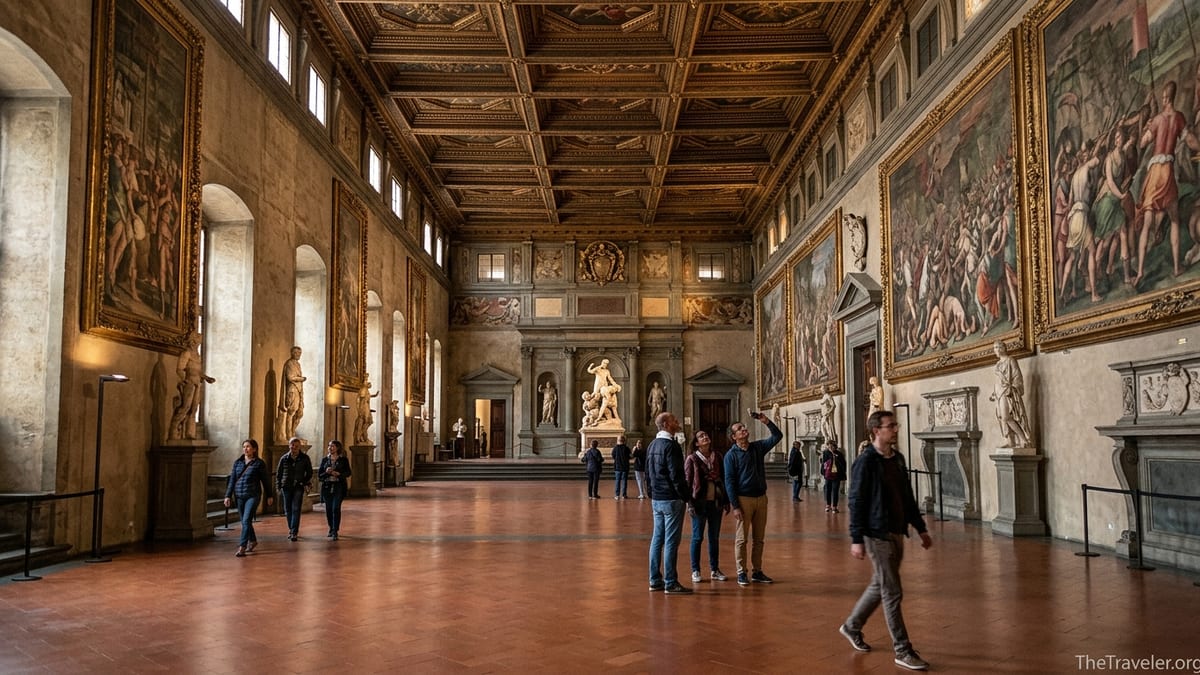
Climbing the ceremonial stair by Giorgio Vasari, your footsteps echo toward the highlight of Palazzo Vecchio: the Salone dei Cinquecento, the Hall of the Five Hundred. This space was built around 1494 for a vast republican council and then transformed in the mid-1500s into a stage for Medici power. The shift is written into the walls. You walk in through a relatively dark corridor and the hall explodes around you: a cavern of gilt and color, more than 50 meters long, with panelled ceilings and immense war scenes by Vasari celebrating Florence’s victories over rival cities like Pisa and Siena.
Standing there, it becomes easier to picture Renaissance politics less as dusty treaties and more as physical spectacle. The 500 council members once sat here debating under frescoes that literally surrounded them with examples of heroic Florentine triumph. Later, when Cosimo I de’ Medici staged court events in the same space, the message was even clearer: the duke’s power stretched from these painted battlefields to every corner of Tuscany. Today, a modern conference setup sometimes occupies part of the hall for city events, reinforcing that this is still a working civic interior, not a frozen film set.
One of the details that makes history feel unnervingly close is the ongoing mystery beneath the paint. Art historians have long debated whether wall sections may conceal remains of Leonardo da Vinci’s lost “Battle of Anghiari,” abandoned when the experimental technique failed. In person, you cannot see Leonardo’s hand, only Vasari’s sweeping compositions and the small Latin motto “He who seeks, finds” painted above one of the banners. Yet knowing that unfinished experiments and rivalries might still lurk between bricks and plaster makes the Renaissance less a neat success story and more a human, messy process of trial and error.
If you book a small-group “secret passages” tour, you are sometimes led off the main floor up into the timber roof or along narrow upper galleries. From there, you look down at the crowd in the hall and suddenly understand how Renaissance rulers could watch assembly sessions unobserved. The sensation is oddly voyeuristic: you are literally in the rafters of history, sharing the vantage point of dukes and spies who preferred to observe rather than be seen.
Private Apartments: Renaissance Life Room by Room
Leaving the grandeur of Salone dei Cinquecento, you move into a sequence of smaller, lower-ceilinged rooms that once formed the Medici private apartments. The shift in scale is immediate. These spaces, frescoed by Vasari and his collaborators, are dense with allegory and family propaganda, but they also feel like places where real people argued over breakfast, worried about alliances and soothed sick children.
In the so-called Quartiere degli Elementi and the Apartments of Eleonora of Toledo, you pass through rooms dedicated to virtues and mythological scenes that quietly mirror Medici ambitions. Ceiling panels depict personifications of Earth, Air, Fire and Water, reminding guests that the duke’s rule touched every element of Tuscan life. One room honors Cosimo the Elder, another Lorenzo the Magnificent. Portraits, where originals survive or copies replace them, place the Medici lineage in front of you like a family Instagram feed of the 1500s.
The Chapel of Eleonora is perhaps the most intimate moment of the visit. Frescoed by Bronzino, its small walls shimmer with rich blues and reds, showing biblical stories like the Crossing of the Red Sea. Standing in the doorway, you can imagine duchess Eleonora, born in Spain and married off to Cosimo as a teenager, kneeling here in quiet prayer between grand receptions. The chapel reminds you that the Renaissance elite were not just patrons and politicians but also migrants, spouses and parents negotiating foreign languages and expectations.
Elsewhere in the apartments, small objects ground the experience: a carved chest too low for modern backs, uneven stone thresholds worn by centuries of skirts and boots, painted doorframes where keys once scraped away pigment. None of these details carry the weight of a Michelangelo sculpture, yet together they make it much easier to see the building as a lived-in Renaissance home rather than a detached art gallery.
Hidden Rooms and Secret Passages
One of Palazzo Vecchio’s most captivating spaces is the Studiolo of Francesco I, a tiny, windowless study just off the Salone dei Cinquecento. Completed in the early 1570s, it is a barrel-vaulted jewel box whose every surface was once covered with small paintings and panels representing natural marvels, alchemical themes and mythological scenes. Here, the grand duke escaped court protocol to surround himself with curiosities: rare stones, scientific instruments, exotic specimens. In person the room is darker and much more compact than photos suggest, and that claustrophobia makes the idea of Renaissance intellectual life oddly physical. Learning, in this setting, meant withdrawing into a carefully curated microcosm.
Many visitors now choose tours that highlight “secret routes” within the palace. These typically lead through narrow staircases in the thick stone walls, once used by guards, messengers or the Medici themselves when they wanted to move unseen between council chambers and private apartments. On one such passage, you might emerge behind a disguised door in a wall of painted cupboards, stepping abruptly into a public room through what was, to the Renaissance eye, solid decoration. It is hard not to think of modern security corridors in government buildings, connecting press rooms with back offices, and realize that the logic has barely changed.
The mythic Vasari Corridor, which today links Palazzo Vecchio with the Uffizi, the Ponte Vecchio and ultimately Palazzo Pitti, completes this network of privileged movement. Although entry is managed via the Uffizi rather than Palazzo Vecchio itself, knowing that such a raised, enclosed walkway begins here gives you a mental map of how tightly the Medici stitched their city together. While ordinary Florentines jostled through market streets, the ruling family could walk above them, literally on a different level. Inside Palazzo Vecchio, every hidden spiral stair and concealed doorway feels like a small-scale rehearsal for that larger architectural gesture.
On a practical level, these passages can also change the rhythm of your visit. Small-group tours often slip away from the main flow of crowds, and for a few minutes you may find yourself almost alone in stone corridors that resonate faintly with the footsteps of a guide. Those quiet interludes, between the big decorated rooms, are where the building can feel most like a time machine.
Climbing Arnolfo’s Tower: A Vertical History Lesson
If your legs and the weather allow, adding the Arnolfo Tower to your ticket turns the visit into a literal climb through history. The staircase, built into the tower’s thick walls, is steep and narrow, with worn steps that testify to centuries of use. Modern safety rules now restrict access in bad weather and limit the number of visitors at a time, so time slots may sell out on busy summer days. It is worth planning ahead, especially if you are coordinating with timed entries at the Duomo dome or the Uffizi.
As you wind upward, small slits open onto fragments of the city: a stone lion here, a glimpse of terracotta roofs there. You pass levels that once served as guard posts and even prison cells. Guides like to point out that political enemies could find themselves confined inside the same walls that symbolized Florence’s liberty, a reminder that Renaissance “freedom” was tightly defined. When you finally step onto the tower terrace, the view is generously three-dimensional. The Duomo’s red dome swells almost eye-level, the Arno curves under the Ponte Vecchio, and modern traffic hums where Renaissance processions once moved in choreographed lines.
From up here, the layered roles of Palazzo Vecchio make more sense. You can see how the building anchors the urban fabric: within a few minutes’ walk are the banking streets around Orsanmichele, the religious power of the cathedral, and later Medici residences like Palazzo Pitti across the river. Looking down at Piazza della Signoria, where public executions once took place and where David originally stood as a warning to would-be tyrants, it becomes clear that this square was simultaneously a civic stage, an open-air courtroom and a daily marketplace.
Modern Florence does not pause while you absorb the view. School groups sit cross-legged in the piazza below, listening to guides, delivery bikes weave between tour groups, and protesters occasionally gather with banners on the very stones where earlier crowds shouted for or against the Medici. That continuity makes the climb more than a photo opportunity. It is a balcony from which you can see, in real time, how a Renaissance power center turned into a twenty-first-century city hall without losing its centrality.
Practical Tips to Experience the Renaissance More Deeply
Because Palazzo Vecchio serves both as museum and municipal building, its opening hours can vary slightly based on civic events. In recent years, the regular pattern has been late-morning to evening on most days, often extending into the late evening in high season, with reduced hours on certain holidays. Checking the latest schedule on the official city culture portal shortly before your visit is wise, especially if you are coming in winter or around major Italian holidays like Ferragosto in mid-August or the Christmas–New Year period.
In peak months such as June and September, mid-morning and mid-afternoon are the most crowded, when day trippers and cruise excursions converge. If you want a touch more quiet, aim for the first entry of the day or the last couple of hours before closing. Evening visits can be particularly atmospheric: the Salone dei Cinquecento glows in artificial light, and when you exit the palace, Piazza della Signoria feels like an open-air theater set against the softly lit Loggia dei Lanzi and fountain of Neptune.
Budget-conscious travelers will notice that while Palazzo Vecchio tickets are not cheap, they are usually slightly less expensive than the Uffizi or combined Duomo passes, and the experience is more varied. You get art, architecture, history and views in one stop. Some visitors pair Palazzo Vecchio with a walk through the Oltrarno neighborhood, crossing the Ponte Vecchio to see where the Medici eventually moved their main residence to Palazzo Pitti. Others combine it with Palazzo Medici Riccardi, where the earlier generation of the family lived. In that comparison, Palazzo Vecchio often feels like the place where ideology and daily life intersect most sharply: a working palace rather than a purely noble residence.
If you are traveling with children or teens, consider renting audio guides or downloading an official app that offers storytelling routes. Many describe rooms using narratives about princes, conspiracies and secret doors, which mirrors the way Renaissance Florentines themselves saw these spaces: as backdrops to very human dramas. Stopping for a simple espresso or a bottle of water in a nearby bar before or after the visit is also a small but concrete way to pace the experience. Renaissance politics can be dense; a quick break before diving into Vasari’s fresco cycles makes it easier to absorb the symbolism without fatigue.
The Takeaway
Walking through Palazzo Vecchio is less about checking another sight off a Florence list and more about letting a building recalibrate how you think about the Renaissance. Here, history is not sealed behind glass. It clings to steep stone staircases, whispers through narrow wall passages and glitters from gilt ceilings designed to overawe visiting envoys. You share doorways with city employees heading to modern offices and climb a tower that still surveys the same street grid mapped by medieval guilds and Medici planners.
By the time you step back out into Piazza della Signoria, the replica statues and souvenir stands feel thinner, like a bright layer painted over deeper colors. Having traced the path from public council hall to private chapel, from secret study to tower terrace, you carry a more three-dimensional picture of Florence: not just as a destination of masterpieces, but as a place where ideas about power, beauty and civic life were literally built into stone. In that sense, Palazzo Vecchio does something no textbook or lecture can quite match. It lets you walk through the Renaissance in the present tense.
FAQ
Q1. How long should I plan to spend inside Palazzo Vecchio?
Most visitors spend about 1.5 to 2 hours exploring the museum rooms, with an extra 30 to 45 minutes if you climb Arnolfo’s Tower or join a secret passages tour.
Q2. Do I need to book tickets for Palazzo Vecchio in advance?
Advance booking is not strictly required, but in busy months like May through October it is sensible to reserve a time slot online, especially if you want tower access or a guided tour.
Q3. Is the Arnolfo Tower climb suitable for everyone?
The tower involves steep, narrow stairs and is not recommended for visitors with mobility issues, heart or breathing problems, or serious vertigo. Small children must usually be accompanied by an adult, and access may be suspended in bad weather.
Q4. Can I visit Palazzo Vecchio with young children?
Yes. Families regularly visit, and children often enjoy the armor, maps and secret doors. A stroller can be used on some levels, but narrow stairs and certain routes require carrying infants or folding strollers.
Q5. Are photos allowed inside Palazzo Vecchio?
Non-flash photography is generally allowed in most museum areas for personal use, but tripods, drones and professional lighting equipment are not permitted. Always follow posted signs and staff instructions, as rules can change for temporary exhibitions or events.
Q6. What is the best time of day to visit if I want to avoid crowds?
Early morning right after opening and the last hours before closing are usually quieter than mid-morning and mid-afternoon, when tour groups are most numerous, particularly in high season.
Q7. Is Palazzo Vecchio included in any city museum passes?
Palazzo Vecchio is sometimes part of Florence municipal museum combinations or seasonal passes that bundle several civic sites. Availability and conditions change periodically, so check current offers on the official Florence museum information platforms before you buy.
Q8. How does Palazzo Vecchio compare with the Uffizi or Palazzo Pitti?
The Uffizi is primarily an art gallery, Palazzo Pitti a grand court residence and art complex, while Palazzo Vecchio combines civic history, Medici apartments, monumental halls and a tower in one compact site, making the political side of the Renaissance especially tangible.
Q9. Are there guided tours focused on secret passages and hidden rooms?
Yes. Several official and licensed tours highlight hidden staircases, the Studiolo of Francesco I and other lesser-known spaces. These usually require a specific booking and may have restricted group sizes and fixed time slots.
Q10. Can people with limited mobility still enjoy a visit?
Many of the main halls and some apartment rooms are accessible by elevator or ramps, though not all historic routes or the tower can be adapted. If accessibility is a concern, it is advisable to consult up-to-date information from the official museum services before planning your visit.