


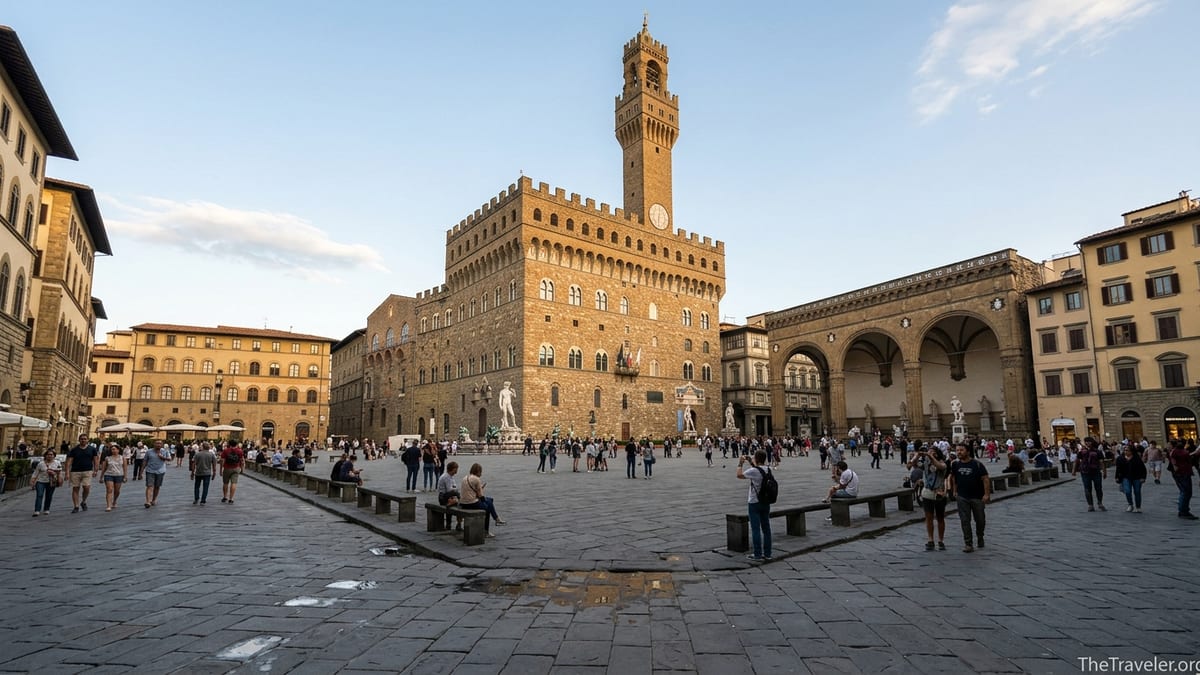
Stand in Piazza della Signoria today and Palazzo Vecchio feels solid and timeless, its rough stone walls and jagged battlements rising above selfie sticks and gelato cones. Yet this fortress-palace has been anything but calm. For more than seven centuries it has been Florence’s nerve center, where guild leaders plotted against rivals, fiery preachers challenged the Medici, and dukes reshaped the city’s destiny. Understanding the story behind Palazzo Vecchio is one of the most engaging ways to decode how political power worked in Florence, and why this building still matters to visitors in the twenty first century.
Get the latest updates straight to your inbox!
From Fortress Palace to City Hall: How Palazzo Vecchio Was Born
Palazzo Vecchio began life at the end of the thirteenth century, when Florence was a booming banking and textile city that needed a secure headquarters for its ruling council. Construction started around 1299, probably to designs by architect Arnolfo di Cambio, on a plot squeezed between rival families’ towers. The idea was simple and pragmatic: build a combined town hall and mini fortress where the city’s leaders could debate, vote, and if needed barricade themselves in during street fighting. Even today, the rough rusticated stone, small high windows, and overhanging battlements make the façade look more like a castle than a palace.
The building was first called the Palazzo della Signoria after the Signoria, Florence’s main executive body. The Signoria was a group of nine priors chosen from major guilds and rotated frequently so that no family could entrench itself too easily. They lived in the palace during their two-month term, effectively locked inside to reduce outside pressure. When you walk through the big wooden doors today, you are stepping into the same space where these short term rulers once ate, slept, and argued over taxes, war, and trade deals that affected much of Europe.
Even the palace’s asymmetrical look reflects political reality. The tall Arnolfo Tower seems deliberately offset, a visual reminder that Florence’s power grew step by uneven step. Inside, a tangle of corridors, staircases, and hidden passages made it easier to move officials and documents safely. Modern visitors still glimpse traces of this defensive mindset in narrow stone stairwells and heavy doors that feel more medieval stronghold than refined Renaissance court.
The Florentine Republic: Democracy, but on Florentine Terms
To understand why Palazzo Vecchio matters, you need to grasp what made the Florentine Republic unusual. Between the thirteenth and early sixteenth centuries, Florence experimented with a form of oligarchic republic: real power rested with wealthy merchant families and guild leaders, but it operated under a complex system of councils, elections, and term limits. The Signoria met inside Palazzo Vecchio every day, discussing alliances with other city states, regulating trade, and managing public works from bridges to churches.
In theory, any qualified male who belonged to a major guild and had a good reputation could be randomly selected to serve as a prior and move into the palace for two months. In practice, a small circle of families learned to navigate the system and influence which names were placed in the draw. Palazzo Vecchio became the stage where this balancing act between broad participation and concentrated influence played out. When you stand in the grand Salone dei Cinquecento today, imagine it filled not with tourists but with hundreds of stern faced citizens debating whether to go to war with Pisa or negotiate with the papacy.
The building also housed administrative offices that handled the nuts and bolts of government: tax records, diplomatic correspondence, and legal documents. Figures like Niccolò Machiavelli, who later wrote The Prince, worked in this bureaucratic world, drafting letters and reports inside or adjacent to Palazzo Vecchio. For a modern traveler, it is a reminder that behind every dramatic political story sit archives, clerks, and meetings in windowless rooms that looked out on the same courtyard you walk through today.
Medici Power Play: Turning a Republican Palace into a Ducal Residence
By the early sixteenth century, the Medici family had transformed their banking wealth into political dominance, but their relationship with Palazzo Vecchio was complicated. At times they were expelled from Florence; at other moments they controlled it behind the scenes. The turning point came in 1540, when Cosimo I de Medici moved his official residence from the family palace on Via Larga into the former Palazzo della Signoria. That symbolic shift declared that Medici power was no longer just influence over a republic, but direct rule.
Cosimo I commissioned architect and artist Giorgio Vasari to reshape the interior into something fit for a duke. Rooms that had been fairly austere civic spaces were transformed into richly decorated apartments with coffered ceilings, gold leaf, and elaborate frescoes. The enormous Salone dei Cinquecento was remodeled with new wall paintings celebrating Medici military victories and Florentine glory. When you crane your neck today to study scenes of battles and allegorical figures, you are seeing a carefully curated political message. The walls were meant to tell visiting ambassadors that Florence was stable, powerful, and guided by a legitimate dynasty.
Cosimo did not stop there. He ordered the construction of the elevated Vasari Corridor, which linked Palazzo Vecchio to the new Uffizi and across the Arno River to Palazzo Pitti. The corridor allowed the ruling family to move between centers of administration and their private residence without touching the street. For a twenty first century visitor, that corridor is a vivid architectural example of how the Medici literally built a private route above the heads of ordinary citizens, turning a once open republican building into the nerve center of a dynastic state.
Moments of Crisis: Savonarola, Bonfires, and Executions
Some of Palazzo Vecchio’s most dramatic chapters unfolded not inside its walls, but in the piazza directly in front of it. In the 1490s, the Dominican friar Girolamo Savonarola rose to power after the ousting of the Medici. He preached fiery sermons against luxury and corruption, calling for a moral republic aligned with Christian ideals. The government gave him significant influence over policy, and for a few brief years Florence experimented with a kind of religiously charged civic regime.
The most famous episode came on 7 February 1497, when Savonarola’s followers organized the Bonfire of the Vanities in Piazza della Signoria. Citizens were urged to bring objects considered sinful excess, including cosmetics, fine clothing, secular books, and even some artworks, and pile them onto a massive wooden pyre. When you stand in the square today, surrounded by souvenir shops selling leather bags and silk scarves, it can be hard to imagine Florentines dragging similar luxuries from their homes to throw into the flames beneath the gaze of Palazzo Vecchio’s tower.
Savonarola’s moral revolution was short lived. By 1498, political opposition and pressure from the papacy turned against him. On 23 May that year, he and two fellow friars were hanged and burned in the same piazza. A small circular plaque set in the paving stones marks the spot. Travelers today often walk over it without noticing, hurrying from the replica of Michelangelo’s David to a café terrace. Pausing there for a moment connects you directly to the most turbulent clash between religious idealism and Florentine power that Palazzo Vecchio ever witnessed.
Art as Propaganda: Reading Political Messages in Stone and Fresco
One of the most fascinating ways for visitors to understand Palazzo Vecchio’s political story is to treat its art and architecture as a visual language of power. Take the statues flanking the main entrance. On the right stands a copy of Michelangelo’s David, first placed in front of the palace in 1504 and later moved to the Accademia, leaving the replica behind. For republican Florence, David symbolized the small but virtuous city standing up to giant enemies. Placing him next to the seat of government was a deliberate statement that the city saw itself as a righteous underdog.
Next to David is Baccio Bandinelli’s Hercules and Cacus, installed in 1534 during Medici dominance. The muscular figure of Hercules defeating the monster can be read as an image of strong authority crushing disorder. Together the two statues illustrate a shift from a communal vision of civic virtue to a more personal, hero-centered idea of rule. Modern travelers can literally see centuries of political argument carved in marble as they queue for tickets beneath these figures.
Inside, the Salone dei Cinquecento offers a crash course in how rulers used monumental painting to shape public memory. Giorgio Vasari’s fresco cycles show victorious battles and glorified leaders, but they were painted decades after some events and heavily edited to suit Medici narratives. Stand toward the center of the hall and look up at the coffered ceiling: each painted panel bears personifications of cities, virtues, and episodes from Florentine history. The effect is overwhelming, and it was meant to be. A sixteenth century envoy standing there would have felt the same sense of orchestrated grandeur that hits twenty first century tour groups, only with more direct political pressure attached.
Even smaller rooms carry messages. The Studiolo of Francesco I, a windowless study tucked off the main hall, is lined with paintings that hide cupboards behind them, blending science, alchemy, and art. It shows how late Medici rulers cultivated an image of intellectual refinement and control over nature. To a modern visitor, it feels like a tiny jewel box, but in its own time it helped project the idea that Florence’s leaders were not just warriors and bankers, but patrons of knowledge with almost magical reach.
From Royal Court to Modern City Hall
By the nineteenth century, Florentine politics had shifted again, but Palazzo Vecchio remained at the center of events. When Florence briefly became the capital of the newly unified Kingdom of Italy from 1865 to 1871, the building housed parts of the national government. New administrative offices were created and some rooms were adapted to modern bureaucratic needs, yet the fortress-like silhouette on the skyline stayed the same. For a few crucial years, laws shaping the future Italian state were debated inside the same walls that had once heard the voices of guild leaders and Medici dukes.
Today Palazzo Vecchio is both a museum and the seat of Florence’s municipal government. The mayor’s office and city council chambers occupy parts of the building, while most of the historic rooms are open to visitors who buy a museum ticket. It is one of the few major European city halls where tourists regularly wander through spaces that still belong to an active civic administration. When you climb the stairs and notice a modern nameplate next to a heavy wooden door, you are seeing how Florence continues to use its medieval political heart for twenty first century governance.
Practical details underline this dual identity. As of 2026, standard museum tickets for Palazzo Vecchio are typically in the low teens in euros for adults, with reduced prices for children and seniors. Separate tickets are sold for climbing the Arnolfo Tower, which rewards you with panoramic views over the Duomo and the Arno River but requires tackling steep stone steps. Opening hours generally run from morning to early evening, with last entry about an hour before closing and shorter hours on some weekdays, so it pays to check the current schedule locally or through the official city channels before you go.
Experiencing Power: How to Visit Palazzo Vecchio with History in Mind
Visiting Palazzo Vecchio can easily become a blur of frescoes and photos if you rush. To really appreciate its political story, it helps to structure your visit like a journey through different regimes. Start in the main courtyard, redesigned in the sixteenth century with delicate stucco work and frescoed cityscapes. Imagine guild representatives and foreign ambassadors waiting here to be summoned upstairs, eyeing each other warily as they assessed alliances and rivalries. This was where power announced itself in everyday rituals, from processions to public proclamations.
From there, head up to the Salone dei Cinquecento and take time to stand at different points in the room. Near the center you feel dwarfed by the scale, as intended for large assemblies and foreign delegations. Along the sides, where the dais once stood, picture key figures such as Savonarola or Medici dukes addressing crowds below. Guides often point out a small inscription, “cerca trova” or “seek and you shall find,” painted on a green banner in one fresco, which has sparked speculation about a lost Leonardo da Vinci mural behind the wall. Whether or not the theory is accurate, the inscription captures how Florentines love to layer politics, art, and mystery together.
After exploring the grand spaces, the private Medici apartments and smaller rooms like the Studiolo or the Room of the Elements offer a contrast. These were not designed for public audiences but for family life, contemplation, and backroom decisions. When you see a hidden passageway or a small door disguised in panelling, think about how rulers could slip from a ceremonial hall into a private corridor in seconds, shifting from public performance to confidential negotiation without ever stepping outside.
The Takeaway
Palazzo Vecchio is much more than a scenic backdrop for photos in Piazza della Signoria. It is the stone archive of Florence’s long struggle over who should hold power and how it should be displayed. From the rotating councils of the medieval republic to the carefully staged prestige of the Medici court, from Savonarola’s burning vanities to the meetings of modern city councillors, this building has framed debates about freedom, authority, and civic identity for more than seven hundred years.
For travelers, understanding that story turns a standard museum visit into a richer experience. Every statue by the entrance, every fresco in the Salone dei Cinquecento, and every hidden staircase in the walls can be read as a clue to Florence’s political imagination. As you leave the palace and step back into the crowded piazza, glance up one more time at the Arnolfo Tower. Its irregular, fortress-like outline is a reminder that in Florence, beauty and power were forged together, and that the city’s most photogenic landmarks are also its most revealing political documents.
FAQ
Q1. What was the original purpose of Palazzo Vecchio?
It was built around 1299 as the fortified headquarters of the Florentine Republic’s ruling council, the Signoria, combining town hall functions with a defensive stronghold.
Q2. Why is it called “Palazzo Vecchio” or “Old Palace”?
The name “Palazzo Vecchio” only became common in the sixteenth century, after the Medici moved their main residence to Palazzo Pitti, making this the “old” palace by comparison.
Q3. How did the Medici family use Palazzo Vecchio?
Cosimo I de Medici turned it into his ducal residence and political headquarters, commissioning Giorgio Vasari to remodel interiors and fill them with art that promoted Medici power.
Q4. What happened during the Bonfire of the Vanities in front of the palace?
In 1497, followers of the friar Girolamo Savonarola burned items seen as sinful luxuries, such as fine clothes, cosmetics, and artworks, on a huge pyre in Piazza della Signoria.
Q5. Is the statue of David outside Palazzo Vecchio the original?
No. The original Michelangelo David was moved indoors to the Accademia Gallery in the nineteenth century. A high quality copy now stands in its historical position by the entrance.
Q6. Can visitors still see active government offices inside?
Yes. While most historic rooms are part of the museum, Palazzo Vecchio remains Florence’s city hall, and some areas house the mayor’s office and municipal council chambers.
Q7. How much time should I plan for a visit?
Most visitors spend between 1.5 and 3 hours exploring the museum, depending on whether they add the Arnolfo Tower climb and take time to study the artworks in detail.
Q8. Is the Arnolfo Tower climb worth it?
For many travelers it is a highlight, offering wide views over the Duomo, the Arno, and the Tuscan hills, but the climb involves many steep, narrow steps and is not ideal for those with mobility issues.
Q9. Are guided tours recommended for understanding the politics?
A good guided tour or audio guide can greatly help, since many rooms and artworks were designed as political messages that are easier to decode with expert commentary.
Q10. When is the best time of day to visit Palazzo Vecchio?
Arriving early in the morning or later in the afternoon usually means smaller crowds, shorter waits for tickets, and more space to appreciate large halls like the Salone dei Cinquecento.