


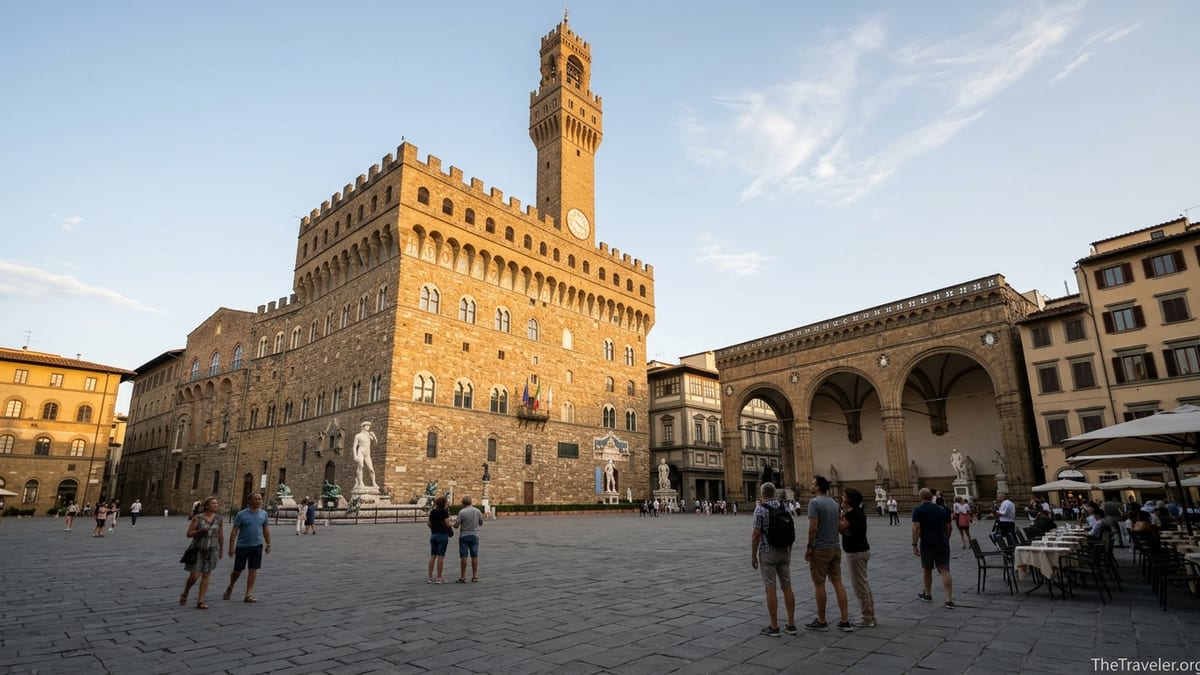
Rising above Piazza della Signoria with its unmistakable crenellated tower, Palazzo Vecchio is far more than a picturesque backdrop for Florence’s historic center. It has been the city’s political heart for more than 700 years, a stage where republics rose and fell, the Medici cemented their power, and modern Florence still governs itself today. For travelers, understanding what Palazzo Vecchio is and why it matters turns a beautiful building into a living timeline of the city.
Get the latest updates straight to your inbox!
What Exactly Is Palazzo Vecchio?
Palazzo Vecchio is Florence’s medieval town hall and Renaissance civic palace, standing on Piazza della Signoria in the very core of the historic center. Designed at the turn of the 14th century by architect Arnolfo di Cambio, it was built as the seat of the city’s priors, the magistrates who governed the Florentine Republic. Today it has a dual identity. Part of the building houses Florence’s municipal government, including the mayor’s offices and council chambers, while the rest is a museum that welcomes hundreds of thousands of visitors each year.
The palace’s massive stone walls, small high windows and battlements immediately signal its original purpose as a fortress as much as a government building. In an era of volatile politics and frequent unrest, Florence’s leaders needed a place that could be defended. Walking into the main courtyard, with its arched loggias and frescoed walls, visitors can still sense that blend of power and protection, even as tour groups now cluster around guides holding colored flags instead of soldiers bearing arms.
Palazzo Vecchio is also a symbol. Alongside Santa Maria del Fiore (the Duomo) and the Ponte Vecchio, it is one of the three silhouettes most often used to represent Florence on posters, book covers and travel campaigns. Stand in Piazza della Signoria at sunset and you will see how central it is to daily life: office workers crossing the square after work, school groups queuing for guided tours, and street musicians playing beneath the replica of Michelangelo’s David that guards the entrance.
A Stage for Florence’s Political Drama
To understand why Palazzo Vecchio is so important, you need to see it as a stage for shifting power. In the early 1300s it was called the Palazzo dei Priori or Palazzo della Signoria, named after the Signoria, the executive council of the Florentine Republic that met inside. Here the powerful merchant and banking families of Florence argued, negotiated and fought over laws, taxes and foreign policy. When you visit the frescoed Audience Hall, it helps to imagine these spaces filled not with tourists, but with robe-clad officials and messengers carrying sealed documents.
In the late 15th century, the Dominican friar Girolamo Savonarola used the palace as the stronghold of his short-lived religious republic. He ordered the construction of a vast new council chamber, today’s Salone dei Cinquecento, to house an enlarged “Great Council” of 500 citizens. His reforms were an attempt to dilute elite control and create wider participation in government. From a modern traveler’s perspective, this hall tells you that Florence’s history was not just about princes and popes. It was also about experiments in early civic representation that anticipated later European republics.
Power shifted again in the 16th century when Cosimo I de’ Medici became Duke, and soon Grand Duke, of Tuscany. Cosimo moved his court into Palazzo Vecchio in the 1540s, transforming it from a republican town hall into a ducal residence. Grand ceremonial rooms were redecorated to glorify Medici rule, while private apartments were carved out for Cosimo and his Spanish wife, Eleonora of Toledo. When you walk through the Quartiere degli Elementi or Eleonora’s Chapel today, you are literally moving through rooms designed to project dynastic power to ambassadors and visiting nobles.
The story does not stop in the Renaissance. In the 1860s, when Florence briefly served as the capital of the newly unified Kingdom of Italy, parts of Palazzo Vecchio were adapted to host the national Chamber of Deputies. Today, locals still come here to attend city council meetings or civic events. The same building that once heard the voices of 15th century merchants and Medici dukes now echoes with debates about public transport, tourism regulations and housing policy.
Architecture and Art That Encapsulate a City
From the outside, Palazzo Vecchio looks like a fortified castle, but step inside and it becomes a densely layered art museum. The façade is built in rough rusticated stone, with a dramatically asymmetrical crenellated roofline and the tall Torre di Arnolfo soaring to about 95 meters. Travelers standing in Piazza della Signoria often use the tower as a landmark to orient themselves when navigating the tangle of medieval streets between the Duomo and the Arno River.
Inside, one of the most arresting spaces is the Salone dei Cinquecento, the Hall of the Five Hundred. This vast chamber, roughly 50 meters long and over 20 meters wide, was originally built in the 1490s for Savonarola’s enlarged council and later transformed by Giorgio Vasari for Cosimo I. The ceiling is covered in richly gilded coffers, and the walls are lined with enormous battle frescoes and sculptures celebrating Medici victories. Many visitors compare the sensation of entering the hall to walking into a Renaissance film set, except that every surface is authentic sixteenth century propaganda in paint, wood and stone.
Elsewhere in the palace, art and architecture continue the narrative. The private Studiolo of Francesco I, a small windowless chamber off the Salone, is a jewel box of Mannerist painting and carved wood. It was designed as a space where the Grand Duke could retreat to contemplate his interests in alchemy, science and collecting. Modern travelers often miss it if they rush through, but those who pause here find a rare glimpse into the introspective side of a ruler more often depicted in stiff formal portraits.
Even passageways provide surprises. The Vasari Corridor, which once linked Palazzo Vecchio to the Uffizi and across the river to Palazzo Pitti, begins in the palace. Although the original elevated walkway route is currently closed in parts or accessible only on special tours, knowing that this private corridor allowed the Medici to move between home, office and country villa without stepping into the street adds a cinematic layer when you look up at the palace from the square below.
Living Museum and Working City Hall
One of the most distinctive things about Palazzo Vecchio is that it still functions as Florence’s town hall. While many European palaces became purely museums, this building never lost its civic role. On a weekday morning, you might see wedding parties arriving for civil ceremonies, city employees carrying files through side doors marked “Comune di Firenze,” and technical staff wheeling equipment into the Salone dei Cinquecento ahead of a conference or cultural event.
For visitors, this dual role shapes the experience. Museum routes are clearly marked, but some staircases and corridors are off limits because they lead to active offices. On certain dates, the monumental Salone dei Cinquecento may be partly closed for official functions, from international summits to regional cultural festivals. Travelers who plan ahead by checking schedules on Florence’s municipal channels or asking at their hotel desk often find they can time their visit to see the hall at its quietest, usually earlier in the morning or later in the afternoon outside peak season.
The continued civic use also means that Palazzo Vecchio has to balance preservation with practicality. For example, modern lighting and climate control have been integrated carefully to protect frescoes while allowing evening events. During an evening ballet performance or classical concert in the Salone, the audience sits beneath Vasari’s painted battles and Cosimo I’s triumphal imagery, turning the hall again into a living gathering place rather than a frozen artifact.
For many Florentines, Palazzo Vecchio is the backdrop to everyday life. Local parents bring children to play in the square’s open space, office workers cross Piazza della Signoria to catch buses on Via Calzaiuoli, and protest marches or cultural parades often start or end here. When you sit at a café terrace facing the palace, you are not in a preserved historic bubble but in a square that still hosts civic demonstrations, holiday concerts and public speeches, as it has for centuries.
Why Palazzo Vecchio Matters for Travelers Today
For travelers with limited time in Florence, deciding what to prioritize can be difficult. The Uffizi, the Duomo complex and the Accademia compete for attention. Palazzo Vecchio earns its place on that shortlist because it combines several experiences in one visit: architecture, painting, sculpture, political history, panoramic views and contemporary civic life. In practical terms, it is also often less crowded than the Uffizi or the climb to Brunelleschi’s dome, particularly outside the central midday hours.
Ticket prices vary slightly depending on season and combined options, but as of 2026 a standard adult ticket to the museum typically costs in the range that many visitors would consider mid-tier for Florence, with a modest surcharge to include the tower climb. Families often find good value in family tickets or reduced rates for children and young adults, while EU residents under a certain age sometimes benefit from discounts. Travelers who book online through official or reputable channels can usually secure timed entry and avoid waiting in the general ticket line that regularly snakes across the courtyard during high season.
Another reason Palazzo Vecchio matters is that it offers an accessible way to read Florence as a whole. Guided visits in English, Italian and other languages often frame rooms not simply as art galleries, but as chapters of a political story that links Savonarola’s sermons to Medici realpolitik and the later unification of Italy. Even self-guided visitors can follow clear signage and room labels that connect artworks to historical events. Seeing an image of Cosimo I’s military campaigns on a wall where foreign envoys once stood makes the abstraction of “Renaissance statecraft” feel immediate.
Finally, the palace offers flexibility. Travelers on a tight schedule can see the main highlights in roughly 90 minutes, focusing on the courtyard, Salone dei Cinquecento and key apartments. Those with more time can spend half a day exploring side rooms, the tower, and the archaeological area beneath the palace, which reveals remains of the Roman theater that once stood on this site. This range makes Palazzo Vecchio suitable for everyone from first-time visitors ticking off major sights to repeat travelers looking for deeper layers of the city.
Highlights Not to Miss Inside Palazzo Vecchio
Most visits begin in the courtyard, remodeled in the 16th century with fountains, stucco decorations and frescoes that once greeted foreign dignitaries. From here a grand staircase by Vasari leads to the Salone dei Cinquecento. The scale of this room alone justifies the entry price for many guests. Standing in the center and slowly turning, you can take in the massive battle scenes attributed to Vasari and his workshop, the carved wooden ceiling panels and the monumental sculptures, including Michelangelo’s unfinished “Genius of Victory.”
Off the great hall, the Studiolo of Francesco I is a favorite stop for art lovers. Its dense cycle of small paintings and hidden cabinets reflects both the scientific curiosity and collecting habits of late Renaissance elites. Nearby, the Sala dei Gigli features elegant blue and gold fleur-de-lis motifs and a notable sculpture of Judith and Holofernes, a theme that recurs throughout Florentine art as a symbol of civic virtue overcoming tyranny.
On the upper floors, the Apartments of Eleonora of Toledo and the Quartiere degli Elementi offer richly decorated private rooms that once housed the Medici family. Travelers often single out Eleonora’s Chapel, with frescoes by Agnolo Bronzino, as a highlight. The paintings’ intense blues and reds, combined with the small scale of the chapel, create an intimate contrast to the bombast of the Salone dei Cinquecento below.
Beneath the palace, an archaeological area reveals the remains of Florence’s Roman theater, which are once again open to visitors after extended conservation work. Access typically requires a specific ticket or guided visit, and group sizes are kept small. For travelers interested in how Florence evolved from Roman settlement to medieval commune and Renaissance powerhouse, standing among these partial walls and foundations is a rare opportunity to see the city’s deepest layers directly underneath one of its most famous buildings.
Climbing the Tower and Practical Visiting Tips
One of the most rewarding experiences at Palazzo Vecchio is climbing the Torre di Arnolfo. The ascent involves several hundred narrow steps, and there is no elevator, so it is best suited to reasonably fit visitors wearing comfortable shoes. The reward is a sweeping open-air view over Florence: the red-tiled dome of the Duomo dominating the skyline, the Arno cutting through the city, and the hills of Fiesole and Settignano in the distance. Many travelers consider this view a strong alternative to climbing the Duomo itself, particularly for those who prefer slightly shorter queues.
Access to the tower is usually sold as a separate or combined ticket with the museum, and timed entry is often enforced for safety reasons. In peak months such as May, June and September, late morning and mid-afternoon slots can sell out, so travelers who know they want to climb are wise to select a time when buying their museum ticket. The tower may close temporarily in bad weather or for safety checks, so checking the situation earlier in the day gives you time to adjust plans if needed.
Inside the palace, crowd patterns are fairly predictable. Group tours often cluster in the Salone dei Cinquecento between 10 am and 1 pm, especially from April through October. Early risers who enter shortly after opening, or visitors who wait until the last two hours before closing, tend to experience quieter rooms and clearer views of ceiling details. Photography is generally allowed without flash in most museum areas, but tripods and bulky photography equipment can be restricted, which matters for visitors planning detailed interior shots.
Practical tips also include choosing the correct entrance. Some pre-booked tickets and guided tours begin at side doors along Via dei Gondi rather than the main portal on Piazza della Signoria. Many first-time visitors lose time queuing in the wrong line, only to discover that their voucher specifies a different meeting point. Reading ticket instructions carefully, or asking a staff member at the entrance, saves frustration and ensures you spend your time with frescoes and views rather than with paperwork.
The Takeaway
Palazzo Vecchio is one of Florence’s most important landmarks because it concentrates the city’s identity into a single structure. It has served as republican fortress, Medici court, national parliament and modern city hall, all while accumulating layer upon layer of art and architecture that narrate these transformations. When you stand in the Salone dei Cinquecento or on the terrace of the Arnolfo Tower, you are not just admiring decorative ceilings or pretty panoramas. You are standing where crucial decisions about war, diplomacy, faith and urban life were once debated.
For travelers, this makes Palazzo Vecchio more than a secondary attraction. It is a key to reading the rest of Florence, from the Medici chapels to the Uffizi collections and even the street grid of the historic center. A half-day spent in and around the palace provides context that enriches every church façade and gallery visit that follows. In a city filled with masterpieces, Palazzo Vecchio stands out not only for what it contains, but for what it continues to do as the beating civic heart of Florence.
FAQ
Q1. What is Palazzo Vecchio used for today? Palazzo Vecchio serves both as Florence’s city hall, housing the mayor’s offices and council chambers, and as a museum open to the public, with historic rooms, art collections and the Arnolfo Tower available to visitors.
Q2. Where is Palazzo Vecchio located in Florence? Palazzo Vecchio stands on Piazza della Signoria in the historic center, a short walk from the Uffizi Gallery and about 10 minutes on foot from the Duomo, making it easy to combine with other major sights in a single day.
Q3. How much time should I plan for a visit? Most travelers spend about 90 minutes to two hours visiting the main museum areas, and roughly an extra hour if they also climb the Arnolfo Tower or join a guided tour of the archaeological area beneath the palace.
Q4. Is the tower climb at Palazzo Vecchio difficult? The tower climb involves several hundred narrow steps and no elevator, so it can be challenging for visitors with mobility issues or fear of heights, but most reasonably fit travelers find it manageable and are rewarded with exceptional city views.
Q5. Do I need to book tickets in advance? Advance booking is strongly recommended in peak seasons such as spring and early autumn, particularly if you want a specific tower time slot or are visiting on weekends when ticket lines and same-day availability can be unpredictable.
Q6. Can I visit Palazzo Vecchio with children? Yes, Palazzo Vecchio is generally family friendly, and many children enjoy the grand halls, hidden staircases and tower climb, though parents should be prepared for stairs, crowds in peak hours and the need to supervise younger kids closely in high or narrow areas.
Q7. Are there guided tours available inside the palace? Visitors can typically choose between audio guides, scheduled group tours in several languages and privately arranged guides, with tours often focusing on themes such as Medici history, secret passages or the palace’s artworks and architecture.
Q8. Is Palazzo Vecchio accessible for travelers with mobility issues? Many museum rooms are accessible via elevators and ramps, and staff can assist with alternative routes, but some areas such as the tower and certain stair-heavy sections remain difficult or impossible to reach for wheelchair users or those with limited mobility.
Q9. Can I see the Roman remains beneath Palazzo Vecchio? Yes, the archaeological area under the palace, which includes remains of a Roman theater, can be visited with a specific ticket or guided visit when available, offering a look at Florence’s ancient roots beneath the medieval and Renaissance structure.
Q10. Why is Palazzo Vecchio considered one of Florence’s most important landmarks? Palazzo Vecchio is central to Florence’s identity because it has continuously housed the city’s political power since the Middle Ages while preserving extraordinary art and architecture, making it both a symbol of civic life and a key site for understanding Florentine history.