


Most travelers reach Pisa, snap a few photos of the Leaning Tower, and move on without ever stepping into the low brick building facing the Camposanto. Inside, the Sinopie Museum holds one of Italy’s most unusual collections: the ghostly red underdrawings of medieval frescoes rescued from wartime destruction. Look a little closer, and this quiet museum reveals layers of craft, catastrophe, and creativity that almost every visitor misses.
Get the latest updates straight to your inbox!
A Museum Born From Disaster, Not Design
On a summer day in July 1944, an allied shell set fire to the lead roof of Pisa’s Camposanto, the monumental cemetery that closes the northern edge of Piazza dei Miracoli. As the roof burned, molten lead rained down the walls, blistering and scorching centuries of fresco painting. The rescue operation that followed created the Sinopie Museum almost by accident. To save what they could, conservators stripped the frescoes from the walls. Underneath, they discovered something unexpected: extensive preparatory drawings in red pigment that had never been meant for public view. Those hidden sketches, called sinopie, are what fill the museum today.
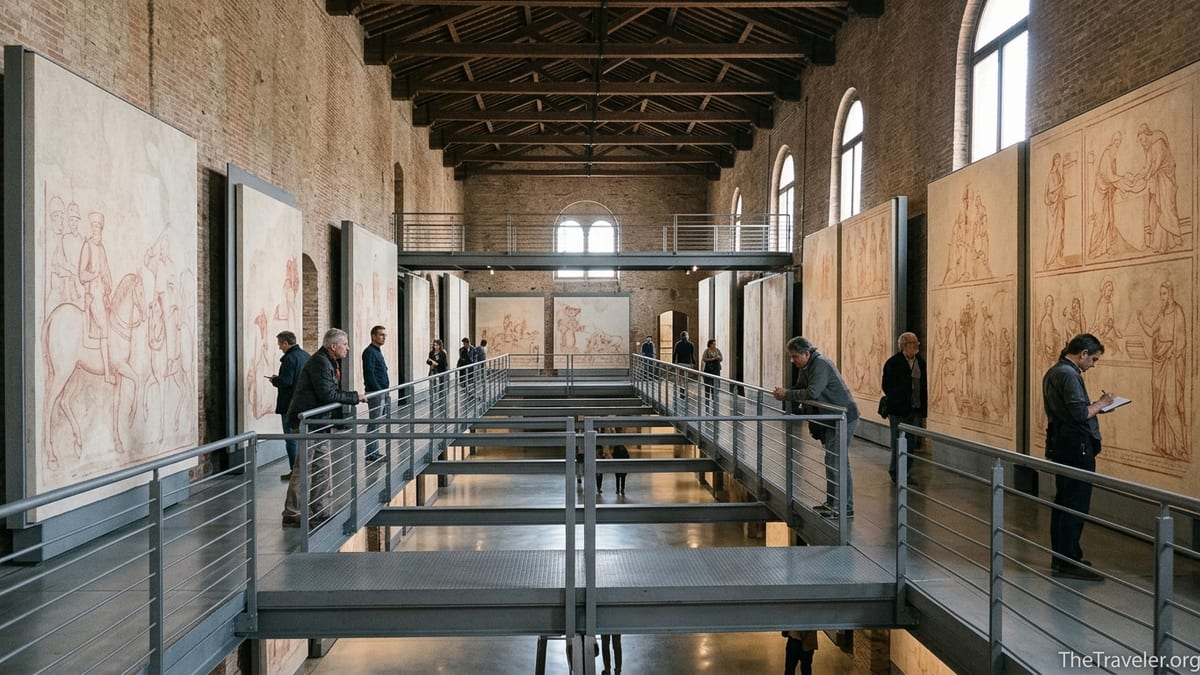
Most visitors walking through the ticket hall see a compact museum and assume the collection was planned like any other. In reality, the building on the south side of the square once housed the Spedale Nuovo di Santo Spirito, a 13th century pilgrim hospital designed in part by Giovanni di Simone, the architect behind the Leaning Tower. Only in the 1970s did this long, brick structure become a museum adapted specifically to display the fragile drawings, with metal walkways and panels designed so they could be inspected closely without direct handling.
If you look up while you move through the first gallery, the original hospital trusses and high windows hint at this earlier life. It is easy to pass under the steel walkways without realizing that this airy structure was carefully inserted inside an older shell, almost like a ship built within a ship. Knowing that you are walking through a medieval hospital refitted to protect art born from wartime salvage adds a quiet tension to the visit that most rushed tourists never sense.
For a very practical example of this history, stand near the entrance and glance back through the large windows that face the Camposanto. The distance is short enough that you can almost imagine the frescoes being carried across the square after the fire, still damp and vulnerable, into this improvised refuge that would become a permanent museum.
Reading Sinopie: The Red Ghosts Beneath the Frescoes
At first glance, many visitors mistake the sinopie for faded murals or unfinished sketches that were abandoned mid-project. In fact, they are working drawings executed directly on the fresh plaster before the colored fresco layer was applied. Their name comes from the reddish pigment sourced from Sinope on the Black Sea, ground into a soft earth color. In the Camposanto, artists from the 14th to the 15th century used this pigment to plan entire narrative cycles, from the Triumph of Death to Old Testament stories.
The museum’s panels reveal details that the painted frescoes, even in their prime, would have softened. Look closely at the sinopia for the Triumph of Death, attributed to Buonamico Buffalmacco: you can see firm strokes of red defining the sweep of the scythe, looser lines indicating crowds of tiny figures, and quick adjustments where the artist changed his mind about a gesture or the position of a horse. In painted form these hesitations disappear beneath layers of color; here the artist’s decision-making remains, as raw as a live sketchbook page.
A few meters away, the Crucifixion sinopia associated with Francesco di Traino rewards slow looking. Step back until you see the whole composition, then approach until your nose is less than a hand’s width from the wall. The red outlines of Mary and John at the foot of the cross, the soldiers’ spears, the skull at the base of Golgotha: all are executed with a confidence that suggests a master controlling a busy workshop. Under raking light from the high windows, you will notice the tooth of the plaster and small pits where the pigment pools more darkly, physical traces that never translate in photographs.
Museum labels explain that these drawings come primarily from cycles such as the Stories of the Anchorites, Scenes from the Life of Job by Taddeo Gaddi, Old Testament narratives and the Annunciation by Benozzo Gozzoli, and the Theological Cosmography by Piero di Puccio. Yet on a weekday afternoon you may have entire rooms almost to yourself, free to move repeatedly between, say, Spinello Aretino’s Stories of Saints Efisio and Potito and Gozzoli’s lively biblical scenes, tracing differences in how each master handles drapery or architectural backdrops.
Following the Hands of Different Masters
One of the most revealing aspects of the Sinopie Museum is how it makes artistic authorship visible. In a finished fresco, large workshops often blend into a single, unified style, but on the underdrawing level you can literally see multiple hands at work. Art historians use the thickness of lines, the way faces are constructed, and how anatomical details are indicated to distinguish one artist from another, and you can try the same detective work as you walk.
Stand between the panels from the Triumph of Death and those from the Last Judgment. Close inspection highlights subtle but telling differences. Buffalmacco’s horses, for instance, are built from quick, almost calligraphic curves, while the figures in the Last Judgment show a tighter control and more measured construction. Even without formal training, you will likely feel that the energy shifts from panel to panel, suggesting where a master stepped in to adjust an assistant’s work or where a younger painter blocked in minor figures.
Another spot where these shifts are especially clear is in the sinopie for the Thebaid scenes, which depict early Christian hermits living in the desert. In some sections the rocky landscapes are indicated with angular, almost geometric strokes; in adjoining sections they dissolve into more fluid, rolling forms. Imagine the workshop in the 1330s: apprentices lining up along a scaffold, each responsible for a section of wall, all trying to follow the same overall plan drawn out by the chief painter.
For a concrete way to engage with this, bring a small notebook. Choose one panel by Gozzoli and another by Spinello Aretino and sketch a single detail from each, perhaps a hand or a foot. You will quickly sense that Gozzoli tends toward more rounded, almost playful forms, while Spinello favors sharper angles. This kind of close observation turns the museum from a static display into an active lesson in how large medieval art projects were truly collaborative enterprises.
Details in the Building Most People Walk Past
The art is not the only thing worth close attention. The former hospital building itself retains discrete features that most tourists never notice as they move from room to room. Near the entrance, for instance, the high brick arches once opened into separate wards where pilgrims and the sick were housed. Today they frame modern ticket counters and security desks, but if you look for traces of blocked windows or irregular patches in the masonry, you can glimpse the outlines of long-vanished doors.
On the upper metal walkway, pause midway and rest your hands on the rail. The contrast between the cool steel and the warm brick walls tells the story of the 1970s conversion, when architects deliberately kept the new structure self-supporting so as not to stress the historic envelope. Look up to spot the dark wooden beams of the original truss roof, blackened in places by age but not by the devastating fire that destroyed the Camposanto’s own covering.
Accessibility features are another layer that is easy to overlook, even as they quietly shape your visit. A modern lift connects the ground floor and upper level, making the entire museum step-free for wheelchair users. Tactile floor markers near key thresholds guide visitors with low vision. These adjustments follow regional guidelines introduced only in recent years, so their presence is concrete evidence of how historic sites across Tuscany are being adapted for broader audiences without erasing their character.
Because the Sinopie Museum belongs to the same complex that manages the Leaning Tower and cathedral, ticketing is integrated. As of mid 2026, a combined pass that includes the Camposanto, cathedral museum, and Sinopie Museum typically costs only a few euros more than access to the cemetery alone, and significantly less than the separate tower climb ticket. Many travelers who are focused solely on the tower miss this option at the ticket office and walk right past the museum doors to line up outside. If you keep an eye out for the discreet “Museo delle Sinopie” signage on the south side of the square, you can make a simple change of direction that adds a whole new dimension to your Pisa stop.
Wartime Scars and Conservation Stories Hidden in Plain Sight
Beyond their artistic interest, the sinopie double as documents of one of Pisa’s most traumatic modern episodes. Some panels preserve scorch marks or areas of abrasion where the detached fresco surface tore away roughly, exposing the drawing below. These irregular edges are not damage from centuries of neglect but scars from the frantic mid-20th century rescue efforts. If you look carefully along the sides of the larger panels, you may notice traces of the cuts made when conservators separated one scene from another to fit them onto portable supports.
Interpretive boards describe how, after the fire, each fresco section was carefully peeled from the wall using a technique known as “strappo.” The painted layer, attached to a new canvas, was re-mounted elsewhere, while the underlying sinopia was then detached in turn. This two-stage process required considerable skill and inevitably introduced losses. In the museum, for example, you may see sinopie where faces or hands simply vanish mid-gesture, sliced off by an earlier cut line designed for the painted surface rather than the drawing beneath.
A particularly poignant case is the set of sinopie for the Old Testament stories once attributed to Piero di Puccio. In certain sections, entire architectural backgrounds are missing, leaving isolated figures seemingly floating in space. Knowing that these absences result not from artistic intention but from emergency conservation decisions during wartime adds a sense of fragility. These fragments survive almost by chance, and the museum’s calm, climate-controlled galleries are the final stage of a chain of improvisations stretching back to 1944.
For visitors interested in conservation practice, the Sinopie Museum offers real-world examples of how techniques and ethics have evolved. Today, most fresco detachments are carried out only in extreme circumstances, with careful documentation and digital imaging. Standing before the Camposanto sinopie, you can see the consequences of an earlier generation’s choices: the works are saved, yet irreversibly separated from their architectural setting. It is a nuanced reminder that even the best-intentioned rescue can alter the meaning of a work of art.
How to Experience the Museum Beyond a Quick Walkthrough
Because the Sinopie Museum is compact, many visitors treat it as a brief add-on. Allowing just 30 minutes, they follow the main route from entrance to exit without pausing. With a little planning, you can turn the same space into a deeply rewarding one- to two-hour visit. One simple strategy is to schedule the museum for the warmest part of the day, perhaps between 1 pm and 3 pm, when crowds outside on the grass are thickest and the cool interior offers a welcome break.
Tickets for the Sinopie Museum are usually bundled with access to at least one other monument on the square. If you are staying in Pisa overnight rather than visiting on a tight day-trip schedule from Florence, consider buying a combined ticket the afternoon before your planned tower climb. This way you can explore the quiet museum at your own pace when bus tours have departed, then return the next morning refreshed for the more crowded sights.
Once inside, resist the urge to keep moving. Choose just three or four panels in the entire museum and give each ten full minutes of attention. Start, for instance, with the Triumph of Death sinopia, then the Stories of Job by Taddeo Gaddi, and finally one of Benozzo Gozzoli’s Old Testament vignettes. For each, first scan the whole composition, then focus successively on faces, hands, and draperies. Try to reconstruct the sequence in which the artist drew: which lines came first, where corrections were made, how larger curves were built from smaller strokes.
If you are traveling with children or teens, turn it into a game. Ask them to find an area where an artist clearly changed his mind, such as a horse whose legs have been repositioned or a figure whose arm shows overlapping outlines. Another challenge is to locate scenes where architectural details are only loosely sketched, suggesting that the painter planned to refine them during the painting stage. These small discoveries give younger visitors a feeling of participation and often spark conversations that go far beyond the typical “we saw the tower” trip report.
The Takeaway
For many travelers, Pisa is a place of single images: the leaning marble cylinder, a grassy square, a standard set of photographs. The Sinopie Museum complicates that postcard view. It introduces the idea that even the most stable-seeming monuments are shaped by accident, damage, and rescue, and that behind every finished masterpiece lies an invisible web of sketches and decisions. The museum’s collection of red underdrawings is rare enough in scope to be considered unique, yet it remains one of the least visited sites in the Piazza dei Miracoli.
By stepping off the main path, you discover that Pisa’s story runs from medieval healthcare and pilgrim routes through wartime devastation and modern conservation ethics. You begin to see the square not only as a cluster of photogenic monuments but as a living laboratory of how societies build, destroy, protect, and reinterpret their cultural memory. Most visitors leave Pisa with a memory card full of images; those who linger in the quiet halls of the Sinopie Museum also carry away a sense of how vulnerable and precious those images really are.
FAQ
Q1. What exactly is displayed in the Sinopie Museum in Pisa?
The museum exhibits the sinopie, or preparatory drawings in red pigment, for the medieval and early Renaissance frescoes once painted on the walls of the Camposanto, along with interpretive materials explaining their creation and rescue.
Q2. How is the Sinopie Museum different from the Camposanto itself?
The Camposanto is the original monumental cemetery where the frescoes were painted, while the Sinopie Museum, located across the square in a former hospital, houses the underdrawings uncovered when those frescoes were detached after the 1944 fire.
Q3. How much time should I plan for a visit to the Sinopie Museum?
Most visitors spend 30 to 45 minutes, but allowing about 60 to 90 minutes lets you study a handful of panels in depth and appreciate both the art and the building.
Q4. Is the Sinopie Museum included in combined tickets for Piazza dei Miracoli?
Yes, access to the Sinopie Museum is commonly bundled with tickets to other monuments in the square, such as the Camposanto and the Cathedral Museum, often for only a modest supplement compared with individual entries.
Q5. Is the Sinopie Museum accessible for visitors with limited mobility?
The museum has step-free access, elevators between floors, and clear circulation paths, making it easier for wheelchair users and visitors with reduced mobility than some of the older structures in the square.
Q6. Can I visit the Sinopie Museum without seeing the Leaning Tower?
Yes, you can purchase a ticket that covers the museum and other monuments without climbing the tower, which is useful if you prefer quieter, less crowded experiences or have limited time.
Q7. Are the sinopie original works or later copies?
The sinopie are original medieval and early Renaissance drawings executed directly on the plaster beneath the frescoes; they were detached and mounted on panels during 20th century conservation efforts.
Q8. Are there guided tours or audio guides available inside the museum?
Depending on the season, you may find printed guides, panels in multiple languages, and occasional guided visits organized by the site’s managing body, though many travelers explore independently at their own pace.
Q9. When is the best time of day to visit the Sinopie Museum?
Midday and early afternoon are ideal, when the museum offers a cool, uncrowded refuge from the busier lawns outside, and the natural light from the high windows enhances the visibility of the red drawings.
Q10. Is the Sinopie Museum suitable for children and non-specialists?
Yes, the vivid scenes, visible corrections, and clear storylines in the sinopie can be engaging even for visitors without an art history background, especially if you turn observation into a simple drawing or spotting game.