


Most travelers arrive in Pisa to climb the Leaning Tower and snap a photo. A few steps away, though, there is a quieter doorway that opens onto something far rarer: the chance to look directly into the creative process of medieval Italian painters. The Sinopie Museum, housed in a former pilgrims’ hospital in Piazza dei Miracoli, preserves the ghostly red underdrawings that lay hidden beneath the famous Camposanto frescoes for centuries. For anyone interested in Italian art history, it is one of the most revealing museums in the country.
Get the latest updates straight to your inbox!
What Exactly Is the Sinopie Museum?
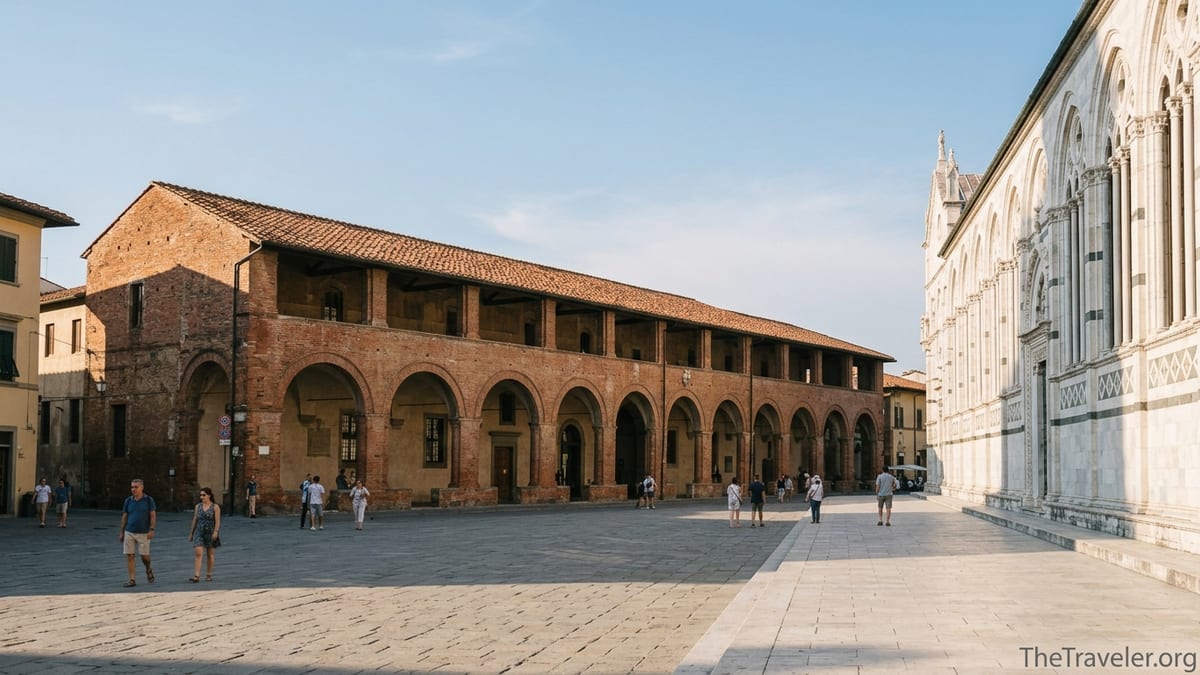
The Sinopie Museum in Pisa, known in Italian as the Museo delle Sinopie, is dedicated to a very specific and fragile type of artwork: sinopie, the preparatory drawings executed in reddish-brown pigment beneath frescoes. These are not finished paintings but the working sketches that guided some of the most important mural cycles of the Italian Middle Ages. The museum stands on the south side of Piazza dei Miracoli, directly facing the Camposanto Monumentale, whose frescoes once covered the inner cloisters of the cemetery walls.
The building itself is historic. It occupies part of the former Spedale Nuovo di Santo Spirito, a brick hospital complex founded in the mid 13th century by Pope Alexander IV as a refuge for pilgrims. For centuries, this large hall functioned as a place of care and hospitality for travelers arriving in Pisa. It was only in the late 20th century, after a long restoration process, that the space was transformed into the Sinopie Museum and opened to the public around 1979.
Today the museum presents what specialists consider the most important collection of medieval sinopie in Italy, and likely the largest group from a single monument anywhere. Almost all of the drawings on display come from the Camposanto frescoes created between the 14th and 15th centuries by artists such as Francesco Traini, Buonamico Buffalmacco, Taddeo Gaddi, Andrea Bonaiuti and Benozzo Gozzoli. For visitors, this means you are not looking at random fragments, but at a coherent visual archive of how a major sacred complex in medieval Pisa was decorated.
In practice, a visit feels very different from walking through a conventional painting gallery. The long, high room is lined with pale surfaces covered in reddish outlines of figures, landscapes and architectural details. Some drawings are almost complete compositions, others appear as quick corrections or ghost images under later changes. Instead of admiring finished brushwork, you are invited to read the decision-making process of artists who usually remain anonymous behind their polished frescoes.
The Story Behind the Sinopie: War, Fire and Rescue
The museum might not exist at all were it not for a catastrophe. On 27 July 1944, during the Second World War, artillery fire struck the roof of the Camposanto Monumentale. The lead sheets that covered the roof melted in the ensuing blaze and dripped down over the frescoed walls, scorching and blistering entire cycles that had survived since the 1300s. In the aftermath, Italian conservators faced an emergency: how to save what remained of these murals before moisture, soot and broken plaster destroyed them entirely.
Conservation techniques at the time suggested a drastic solution. Large sections of the frescoes were detached from the walls using the strappo method, in which the painted surface is lifted away with layers of glue and canvas. As these layers were removed, restorers made a surprising discovery. Beneath the main painting layer, faint but extremely vivid drawings in red pigment appeared, mapping out figures, buildings and narrative scenes. These were the sinopie, preserved like a hidden sketchbook beneath the damage.
Because the underdrawings were now exposed and extremely fragile, they too were detached, mounted on new supports and kept separately from the fresco fragments. Over the following decades, major portions of the fresco cycles returned to the reconstructed cloisters of the Camposanto. The sinopie, however, remained in storage until a suitable museum space was found. Converting part of the old Santa Chiara hospital into the Sinopie Museum meant that the underdrawings could finally be displayed in a controlled environment, protected from light, humidity and mechanical stress.
For visitors today, this wartime story explains why the Sinopie Museum is so tightly linked to the Camposanto. A typical half-day visit to Piazza dei Miracoli might combine a climb up the Leaning Tower with entry to the cathedral, baptistery, Camposanto and the Sinopie Museum on a combined ticket that usually costs under ten euros for all four monuments. Seeing the restored frescoes in the Camposanto first and then crossing the square to study their sinopie gives a powerful sense of loss and survival: most of what you see in the museum was never meant to be visible.
What Is a Sinopia and How Did Italian Fresco Painters Use It?
The word sinopia originally referred to a reddish-brown earth pigment imported to Italy from the Black Sea region, but over time it came to describe the underdrawing itself. In traditional fresco technique, a painter first roughened and prepared the wall, applied a brownish preparatory coat, then sketched out the composition with a brush using sinopia pigment before finally laying down the smooth wet plaster and painting the final colors on top.
In most Italian churches and palaces, these underdrawings disappeared forever once the final fresco was complete. Occasionally restorers find traces when later damage peels back the color layer, but the drawings rarely survive in large continuous sections. This is what makes Pisa unique. Because the Camposanto frescoes were stripped for conservation, the sinopie were separated almost like pages from an enormous cartoon book, preserving the working structure of dozens of scenes at once.
Walking through the museum, you can clearly see how different artists used sinopia in distinct ways. In some drawings, such as those attributed to Francesco Traini, figures are modeled in elegant, flowing contours, with careful attention to drapery and gesture. In others, like the cycles associated with Benozzo Gozzoli, the underdrawing seems more economical: quick lines establish perspective and figure placement, leaving the detail to be developed in color later. For art historians, these variations are a primary source for understanding individual workshop methods.
For travelers with only a basic knowledge of art, the sinopie are still highly readable. Many scenes are full of expressive body language: mourners twisting in grief, devils dragging the damned by the hair, nobles turning away in horror from the approaching figure of Death. Following these outlines, you start to realize how much of the emotional tone of an image was decided before a single brushstroke of color was applied. The museum labels, usually in Italian and English, help identify specific episodes from the Bible, the lives of saints and didactic allegories that guided medieval viewers.
Highlights of the Collection: From Triumph of Death to Benozzo Gozzoli
Among the most famous works represented in the Sinopie Museum are the sinopie related to the Triumph of Death and Last Judgment cycles, long associated with the painter Buonamico Buffalmacco. Even in their skeletal red outline, these compositions feel intense and cinematic. You can trace how the artist arranged groups of elegant courtiers suddenly confronted by corpses, or how angels and demons swarm across the sky in carefully balanced diagonals. The underdrawing reveals revisions and corrections, showing that the final terrifying effect was the result of many staged decisions.
Nearby, the sinopie for Francesco Traini’s Crucifixion present a very different mood. Here the emphasis falls on the vertical sweep of Christ’s body and the clustered figures at the foot of the cross. By comparing these drawings with reproductions of the surviving fresco fragments in the Camposanto, you can see where assistants simplified certain details or where color later softened the stark outlines of the original design.
The museum also preserves important sinopie from later 14th and 15th century cycles. Taddeo Gaddi’s Stories of Job, for instance, show how a Florentine-trained artist adapted narrative strategies to a long continuous wall, distributing episodes rhythmically across the surface. Andrea Bonaiuti’s scenes from the life of Saint Ranieri, Pisa’s local patron, blend city views, port scenes and processions, offering modern visitors a stylized but informative glimpse of how medieval Pisans imagined their own urban space.
Particularly appealing for many travelers are the sinopie linked to Benozzo Gozzoli and his workshop, who painted extensive Stories from the Old Testament in the Camposanto around the mid 1400s. Here the drawings map out winding processions of prophets, patriarchs and anonymous followers through landscapes populated with towers, fields and fortified towns. Even without color, the compositions feel almost like storyboards for a historical film, giving a sense of movement and crowd dynamics that is easier to see in line than in paint.
Why the Sinopie Museum Is Unique in Italian Art History
Italy is scattered with outstanding fresco cycles, from Giotto in Padua to Masaccio in Florence and Michelangelo in Rome. Yet very few places allow you to see the underpinnings of those works on such a scale. This is where Pisa stands apart. The Sinopie Museum presents a rare, almost laboratory-like view of medieval artistic practice, showing not only isolated sketches but an entire program’s worth of planning drawings rescued from a single monumental complex.
From an art historical perspective, this concentration is invaluable. Scholars use the Pisa sinopie to study workshop organization, the division of labor between master and assistants, and the ways large narrative programs were planned across architecture. For example, subtle differences in drawing quality across a long wall can suggest where a senior painter laid out the main figures while apprentices completed secondary characters. Visitors with a keen eye can sometimes spot these shifts in the museum, even without specialist training.
The museum is also unique because it is the direct product of 20th century conservation ethics. In many other Italian sites, earlier restorers destroyed sinopie when detaching frescoes, focusing only on saving the visible painting. In Pisa, by contrast, the decision to preserve and exhibit the underdrawings reflects a more modern understanding of historical value. The sinopie are not treated as mere preparatory scraps but as works that record lost phases of the creative process. This approach influenced later conservation strategies elsewhere and is often cited in professional debates about how much of an artwork’s “making” should be exposed.
For the general traveler, the museum’s uniqueness lies in the kind of experience it offers. After visiting the Leaning Tower, baptistery and cathedral, many visitors remark that the Sinopie Museum is the one place where they feel closest to the hands and minds of medieval painters. You are no longer at a distance from finished masterpieces behind ropes and altars; instead, you stand a few feet from lines that were once drawn quickly on fresh plaster in semi-dark cloisters. That intimacy is hard to find in more famous but more crowded Italian attractions.
Planning Your Visit: Practical Tips and Ticket Options
The Sinopie Museum forms part of the broader monument complex of Piazza dei Miracoli, managed by the Opera della Primaziale Pisana. Tickets are usually structured so that you can choose access to one, two or four monuments. At the time of writing, a single-monument ticket for the Sinopie Museum is typically priced around five euros, while a combined ticket that includes the Camposanto, baptistery and the museum costs only a few euros more. Prices are subject to change, so it is worth checking the current tariffs at the official ticket office on arrival.
Opening hours vary seasonally, but the pattern is fairly regular. In the quieter months from November to February, the museum usually opens from mid-morning to late afternoon, while in peak season from April to September it tends to open earlier, around 8:30, and remain accessible into the evening. Access normally closes about 30 minutes before the posted closing time. Because the Sinopie Museum rarely sees the same crowds as the Leaning Tower, you do not generally need a time slot reservation; many visitors simply include it spontaneously once they are on site.
From Pisa Centrale railway station, getting to the museum is straightforward. Local LAM Rossa buses run from the station area toward Piazza dei Miracoli, with a ride of roughly 10 to 15 minutes depending on traffic. Many visitors, however, prefer to walk: the route through the historic center takes about 20 to 25 minutes at a gentle pace, passing cafes and gelaterias along the way. Once you reach the square, the museum sits along the southern side in a long brick building, opposite the white marble Camposanto.
For budget-conscious travelers, the Sinopie Museum can be one of the best-value cultural stops in Pisa. Because it is indoors and relatively quiet, it offers a peaceful break from heat, rain or crowds without requiring a large time investment. Many travelers report that 40 to 60 minutes is sufficient for a first visit, though art enthusiasts may easily spend longer comparing specific cycles. Audio guides covering the whole complex of Piazza dei Miracoli can usually be rented on site for a modest fee, and often include commentary on both the Camposanto frescoes and the sinopie.
Reading the Drawings: How to Get the Most from Your Time Inside
Stepping into the Sinopie Museum, it is easy to feel a bit overwhelmed by the sheer number of lines and figures. One practical approach is to begin by locating subjects you already recognize from Western art, such as the Crucifixion, the Last Judgment or Old Testament episodes like Noah’s Ark. Once you find a familiar reference point, you can orient yourself more easily and follow how the artist distributed scenes along a wall. Many of the display panels reproduce the approximate layout of the Camposanto cloisters, so you are effectively walking around the cemetery in line form.
Another useful strategy is to focus on details that reveal the working method. Look for places where a hand, head or architectural element has been redrawn slightly to one side, leaving ghost lines behind. These small corrections show the painter adjusting proportions directly on the wall, a rare opportunity to see “edits” usually hidden under the final surface. In some scenes you may spot marks that likely guided assistants, such as rough indications of drapery folds or simple symbols used to locate colors later on.
If you are traveling with children or visitors who are not deeply interested in art history, turn the visit into a kind of visual detective game. Challenge them to find the largest figure of Death, the funniest devil, or the most crowded procession in the sinopie. Because the drawings are monochrome and more graphic than painterly, they can be easier for non-specialists to read than heavily restored frescoes full of faint colors and smoke damage. The museum’s quiet atmosphere also makes it a good stop for families needing a calmer space after the bustle of the Leaning Tower queues.
For those with a particular interest in conservation, it is worth paying attention to the display materials and technical notes. Panels sometimes explain the strappo process and show photographs from the mid 20th century restorations, including images of the Camposanto after the 1944 bombing. These contextual materials turn the museum into an informal lesson on how attitudes to cultural heritage have evolved, and how much effort is required to keep a fragile ensemble like Pisa’s square of miracles accessible to 21st century tourism.
The Takeaway
The Sinopie Museum is not a headline attraction in the way the Leaning Tower is, but for anyone curious about how Italian art was actually made, it offers insights you will not find elsewhere. In the quiet halls of a former medieval hospital, you walk alongside the bare bones of great fresco cycles, seeing choices, corrections and compositional experiments that were never meant for public view. It is as close as most travelers will get to standing in a 14th century workshop while a master painter plans his next wall.
Within the larger context of Italian art history, Pisa’s sinopie are a rare survival. They document the creative process across an entire monument, from early Trecento allegories of death and judgment to fifteenth century biblical narratives, all linked to a single sacred space. The fact that they owe their visibility to a wartime disaster and painstaking conservation only adds depth to the experience. A visit becomes not just an art lesson, but a reflection on fragility, endurance and the long life of images in a city that has seen empires, trade, war and mass tourism pass across its piazza.
For travelers planning even a short stop in Pisa, setting aside an hour for the Sinopie Museum can change the way you see every other fresco in Italy. After you have traced these red lines on the walls of an old hospital, you will likely walk into the next painted chapel or palace with new eyes, imagining the hidden drawings beneath the surface. In that sense, this small museum quietly transforms Pisa from a one-photo destination into a place where you can truly engage with the making of art.
FAQ
Q1. Where is the Sinopie Museum located in Pisa?
The Sinopie Museum stands on the south side of Piazza dei Miracoli in Pisa, in a long brick building facing the Camposanto Monumentale.
Q2. What exactly are sinopie?
Sinopie are preparatory drawings made in reddish-brown pigment on the wall beneath a fresco, used by painters to plan compositions before applying the final colored plaster.
Q3. Why are the Pisa sinopie considered unique?
They form an unusually large and coherent group of medieval underdrawings from a single monument, the Camposanto, preserved after wartime damage and conservation.
Q4. How did the Sinopie Museum come into existence?
After a 1944 bombing damaged the Camposanto frescoes, conservators detached both the paintings and their underlying sinopie, which were later housed in the restored former hospital building.
Q5. How much time should I plan for a visit?
Most visitors spend about 40 to 60 minutes in the Sinopie Museum, though art enthusiasts interested in comparing individual cycles may prefer around 90 minutes.
Q6. Is the Sinopie Museum suitable for visitors without an art background?
Yes. The clear outlines and expressive figures make the drawings easy to read, and bilingual labels help explain key scenes for non-specialists.
Q7. Can I buy a combined ticket that includes the Sinopie Museum?
Usually yes. The monument complex offers combined tickets that can include the Sinopie Museum along with the Camposanto, baptistery and other sites in Piazza dei Miracoli.
Q8. What is the best sequence for visiting the Camposanto and the museum?
Many travelers find it helpful to see the restored frescoes in the Camposanto first, then visit the Sinopie Museum to study the underlying drawings with those images in mind.
Q9. Is photography allowed inside the Sinopie Museum?
Policies can change, but photography without flash is often permitted in many Italian museums; always check posted signs or ask staff when you arrive.
Q10. Is the Sinopie Museum accessible for visitors with reduced mobility?
The museum is generally on a single level within the former hospital building, and recent accessibility information suggests that services for visitors with reduced mobility are available on site.