


Most visitors arrive in Pisa to see a famously leaning bell tower. Yet just a few steps from the crowds of Piazza dei Miracoli, another story unfolds inside a quiet red-brick building. Here, in the Sinopie Museum, the ghostly red lines of medieval artists cover the walls. These fragile drawings, once hidden beneath the great frescoes of the Camposanto cemetery, reveal how fourteenth and fifteenth century painters planned some of Italy’s most haunting images of heaven, hell and everyday life. The museum is not just a collection; it is a record of disaster, rescue and the intimate working process behind monumental art.
Get the latest updates straight to your inbox!
From Pilgrims’ Hospital to Museum of Hidden Drawings
The Sinopie Museum occupies the oldest wing of the former Hospital of Santa Chiara, on the southern side of Pisa’s Piazza del Duomo. The complex began life in the mid thirteenth century, after Pope Alexander IV issued a papal bull in 1258 that encouraged the construction of a “new hospital” to mark reconciliation between Pisa and the Holy See. The brick building functioned as a place of care and a refuge for pilgrims heading toward the cathedral and the famous cemetery beyond its doors.
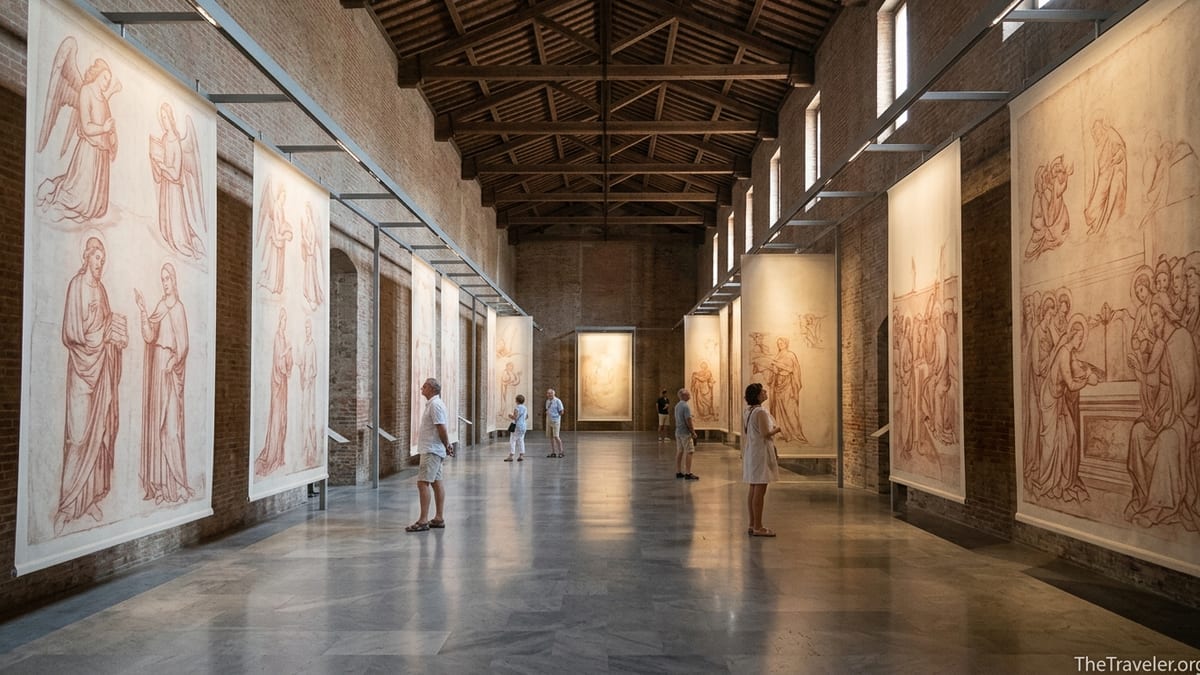
Architecturally, the structure is typical of Pisan Gothic in brick: long facades punctuated by narrow windows, with interiors supported by wooden trusses and broad halls that once held rows of beds. For today’s visitor, that hospital scale is still evident in the soaring central nave that now serves as the main exhibition space. Instead of patients, it hosts towering panels of red-brown drawings that echo the height and length of the Camposanto walls they once adorned.
The building remained part of the hospital system well into the twentieth century. Only in 1969 was it definitively reassigned for cultural use, and in the 1970s a major restoration adapted the former ward into a museum space. The Sinopie Museum opened to the public in 1979, just a few years after Italy’s broader efforts to rethink how war-damaged monuments should be preserved and presented. When you walk in today, you are stepping into a carefully designed compromise between historical shell and modern display.
Practically, this matters for travelers. The museum stands directly opposite the Camposanto on the quieter edge of Piazza dei Miracoli, behind rows of souvenir stands selling Leaning Tower keychains. If you buy a combined ticket for the square’s monuments, you can usually add the Sinopie Museum for only a modest supplement, often less than the cost of a coffee and pastry in a nearby bar. This makes it one of the most accessible “extra” sites in Pisa for those who want to see beyond the postcard view.
The Night the Camposanto Burned
The story of the Sinopie Museum begins with catastrophe. On 27 July 1944, during the final phases of the Second World War in Italy, artillery fire struck the lead-covered roof of the Camposanto Monumentale, the monumental cemetery that bounds the northern edge of Piazza dei Miracoli. The bombardment ignited a fire in the timber roof; as the lead tiles melted, streams of molten metal cascaded down onto the frescoed walls below, scorching and blistering paintings that had decorated the cloister since the fourteenth century.
Pisa was then a frontline city, and the damage to the Camposanto went largely unnoticed outside specialist circles at the time. Yet for art historians, what was happening behind the blackened walls was nothing short of a crisis. The cemetery had contained cycles like the Triumph of Death and the Last Judgment, already famous among nineteenth century writers and travelers for their grim, visionary power. After the fire, entire areas darkened, pigment detached and large surfaces of plaster bulged away from the masonry. Local authorities and conservators had to decide quickly whether anything could be saved.
Postwar restoration efforts in Italy were often improvised and experimental. In Pisa, specialists concluded that leaving the frescoes in place would expose them to continued flaking and loss. They decided to remove the paintings from the walls using a technique known as “strappo,” literally “tearing off.” Conservators glued canvas to the painted surface with animal glue, then carefully peeled away the thin layer of painted plaster, separating it from the underlying wall. It was an aggressive solution by today’s standards, but one of the few options available in the late 1940s.
As those war-time restorers worked panel by panel, they uncovered something no one had expected: beneath the detached fresco layers, the walls were covered with fluid, red-brown line drawings. These were sinopie, the full-scale preparatory sketches that the original painters had laid down with sinopia, an iron-rich earth pigment. What had been considered merely an intermediate step in fresco production now appeared, stripped of their overpainting, as autonomous artworks. The fire that threatened to erase the Camposanto frescoes had, paradoxically, revealed a second, hidden monument underneath.
What Exactly Is a Sinopia, and Why Does It Matter?
In fresco technique, a sinopia is a full-size underdrawing made directly on the rough plaster of a wall before the final, smooth layer is applied and painted. The name comes from the pigment itself, a red earth associated with the port of Sinope on the Black Sea. Medieval workshops used it to sketch out compositions, define the placement of figures and sometimes even suggest shading. Once the sinopia was complete, assistants covered small sections of it with fresh plaster for each day’s work, known as a giornata, and the master painter recreated the drawing in color before the plaster dried.
In many churches and palaces, these drawings have disappeared forever, either covered by the finishing plaster or destroyed when later frescoes replaced earlier ones. The case of Pisa is therefore exceptional. When conservators stripped the Camposanto frescoes, they removed only the upper, painted skin, leaving the reddish outlines exposed on the wall. Later, they removed these drawings as well, transferring them to canvas supports to protect them from humidity and structural problems. The result is a unique collection of monumental underdrawings spanning from the fourteenth to the fifteenth century.
For art historians, sinopie are a goldmine. They show the hand of the artist without the filtering layer of assistants, repainting or later restoration. In Pisa, you can compare, for example, how Buonamico Buffalmacco conceived the chaotic crowds in the Triumph of Death with how they finally appear in the reconstructed frescoes now rehung in the Camposanto. In the museum’s sinopia, figures seem more restless, with rapid strokes indicating fluttering drapery or quick adjustments to the position of a horse or angel. You can sometimes see earlier ideas ghosting beneath corrections where the artist changed his mind.
For a traveler without specialist training, sinopie can also demystify fresco painting. In the museum, wall labels often explain which section of the Camposanto a given drawing corresponds to, and reproductions of the final frescoes help you match underdrawing to finished image. Standing before a preparatory scene of the Last Judgment, you can trace how a sketchy semi-circle became a ring of angels, or how loosely blocked-in coffins evolved into individualized resurrected figures. It is the medieval equivalent of looking at an architect’s pencil plans beside a completed building.
Inside the Sinopie Museum: What You Will Actually See
Entering the museum today, you find yourself in a long, high hall articulated by a metal walkway system installed in the 1970s. Suspended panels carry the sinopie, often at near original scale, while elevated walkways allow visitors to view them at different heights. Natural light filters through clerestory windows, supplemented by discreet artificial illumination designed to protect the fragile pigment from excessive brightness. The atmosphere is surprisingly quiet compared to the bustling square outside.
One of the first works many visitors encounter is the sinopia for the Crucifixion usually attributed to Francesco Traini, dated around 1335. In its drawn form, the scene is less about color and more about direction: spears, arms and gazes all converge on Christ at the center, allowing you to see how the artist orchestrated movement and emotion through line alone. Nearby, preparatory drawings for the Triumph of Death and the Thebaid cycles, associated with Buffalmacco, stretch along several panels. Without the later color, details emerge more starkly: a noblewoman turning away from a corpse, a group of youths surprised by the arrival of Death, monks absorbed in meditation.
As you move further, you find sinopie from later cycles executed between the late 1300s and the 1400s. These include drawings for the Stories of Job by Taddeo Gaddi, the Stories of Saint Ranieri by Andrea Bonaiuti and extensive Old Testament narratives by Benozzo Gozzoli. In Gozzoli’s works, the underdrawings already hint at the elaborate pageantry that would characterize his later frescoes in Florence, with processions of figures, animals and architectural backdrops mapped out in a confident, looping line.
The museum does not rely solely on the drawings. Text panels, often in both Italian and English, outline the history of the Camposanto, the events of 1944 and the techniques used in the conservation campaign. Scale models of the cemetery help orient you: you can see exactly where, for instance, the sinopia of a group of mourners once stood in relation to a nearby tomb. In some cases, small fragments of original fresco plaster are displayed beside their corresponding sinopie, giving a direct before-and-after comparison. This interpretive approach makes the museum accessible even for those encountering fresco technique for the first time.
How the Sinopie Changed Our Understanding of Medieval Art
Before the discovery in Pisa, sinopie were known but rarely seen at this scale. The Camposanto drawings, removed in the late 1940s and early 1950s and systematically studied over the following decades, provided an unprecedented window into how large workshops operated. Scholars realized that what looked like a single, unified fresco might rest on underdrawings by several hands. In the Triumph of Death cycle, for instance, subtle differences in line quality suggest that the master sketched key figures while assistants handled secondary characters, vegetation or decorative motifs.
The museum encourages visitors to look for these nuances. In some panels, vigorously drawn horses and expressive faces stand beside more mechanical outlines of trees or rocks. This division of labor reveals much about how time-pressured and collaborative fresco production was. Large Camposanto walls had to be covered in relatively short campaigns, and the underdrawing stage was where planning, delegation and corrections happened. Seeing these choices in raw form helps demystify the idea of the solitary medieval genius working alone in an inspired trance.
The sinopie also prompted reevaluations of attribution. Stylistic analysis of the red drawings supported, for example, the link between the Camposanto’s more dramatic scenes and Buffalmacco, a painter mentioned in early written sources but whose surviving works are sparse. Comparisons between the Job cycle drawings and signed works by Taddeo Gaddi in Florence strengthened the case for his authorship. For students and enthusiasts, the museum functions as a visual textbook in connoisseurship, showing how specialists match specific ways of turning a contour or hatching a shadow to known artists.
Beyond academic circles, the emergence of the sinopie shifted how Pisa presented its heritage. Rather than lament the irretrievable loss of the original fresco surfaces, the city reframed the story as one of layering: the Camposanto now offers reconstructed frescoes mounted on removable supports, while the Sinopie Museum presents the underlying creative process. Visitors who follow both sites in sequence move from initial sketch to finished work, and then to contemporary restoration, effectively touring seven centuries of art history and conservation in a single afternoon.
Planning Your Visit: Practical Details and On-the-Ground Tips
For most travelers, the Sinopie Museum is best visited as part of a half-day circuit of Piazza dei Miracoli. Combination tickets are typically sold that cover the cathedral, Camposanto, Baptistery and one or more museums. While exact ticket structures and prices change periodically, admission to the Sinopie Museum is usually modest when bundled, often adding only a few euros compared to the basic options. Buying a combined pass at the official ticket office on the southern side of the square can be more economical than purchasing individual entries on the spot.
The museum tends to be far less crowded than the Leaning Tower or the cathedral interiors. If you arrive in Pisa on a busy summer day when tower climbs are sold out or timed entries are later than you hoped, the Sinopie Museum can fill that waiting period in a meaningful way. Many visitors report spending around 45 minutes to an hour inside, more if they carefully compare each sinopia with images of the corresponding fresco. Late afternoon visits, when tour groups have largely drifted away, can be especially quiet and contemplative.
Environmental conditions inside are kept stable to protect the fragile pigment and supports. This means the museum can feel cool compared with the sun-drenched piazza, particularly in spring or autumn. Bringing a light layer can make it more comfortable if you plan to linger. Photography policies can vary, so be prepared that flash may be prohibited or that only non-commercial, handheld photography is allowed. Leaving large backpacks in your accommodation or at a staffed cloakroom elsewhere can also make navigating the relatively narrow walkways easier.
Because the museum stands just meters from cafes and simple trattorias on Via Santa Maria, it is easy to pair a visit with a quick espresso, a focaccia sandwich or, for those staying longer, a leisurely lunch. Many travelers choose to start with the Sinopie Museum and Camposanto in the morning, when the sun illuminates the square from the east, and then tackle the Leaning Tower climb later in the day. This sequence lets you begin with quieter, more reflective spaces before joining the more crowded tower queues and photo spots.
Connecting the Dots: From Sinopie Back to the Camposanto
To fully appreciate the Sinopie Museum, it helps to treat it as one half of a dialogue with the Camposanto. A practical itinerary might start inside the museum, where you study the drawn compositions in calm surroundings, and then cross the square to see how those ideas materialized in color on the reconstructed frescoes mounted in the cemetery’s cloisters. Even if you reverse the order, the connection is enriching. Recognizing a cluster of figures in red outline in one place and then spotting their painted counterparts in another creates a satisfying sense of discovery.
For instance, after examining the sinopia for a scene from the Stories of Job with Job on his dung heap, you can walk into the Camposanto and search for the corresponding fresco panel. There, the same forms appear fleshed out with blue robes, gold accents and expressive faces, yet the underlying geometry remains exactly as the sinopia mapped it. In another section, a sinopia of the Resurrection of the Dead shows sparse coffins and skeletal outlines; across the way, in the colored fresco, robust bodies rise from those coffins amid a swirl of angels. Seeing both stages allows you to mentally peel back layers and imagine the wall as the painters once did.
The museum’s interpretive materials often encourage this back-and-forth. Floor plans correlate specific sinopie with bays in the cemetery, and timelines place each cycle within Pisa’s political and religious history. For travelers who enjoy context, this transforms the square from a collection of isolated monuments into a network of linked stories. The hospital that became a museum, the cemetery struck by war, the artists whose names resurface through stylistic detective work: each piece enriches the others.
Even if you have only a short time in Pisa, choosing to see at least one sinopia and its matching fresco can dramatically shift your impression of the city. Pisa becomes not just a place of a tilting tower, but a city where fragility, loss and careful study have produced something new out of damage. That awareness often stays with visitors longer than any single photograph from the lawn in front of the cathedral.
The Takeaway
The Sinopie Museum tells a layered story that begins with a medieval hospital and ends with a modern museum devoted to what was once considered disposable working material. It owes its existence to a wartime disaster that nearly destroyed one of Pisa’s great monuments, yet in doing so uncovered the largest surviving group of medieval fresco underdrawings in Europe. For travelers, it offers a rare chance to see how artists like Buffalmacco, Traini, Gaddi and Gozzoli thought, corrected and coordinated on a grand scale.
Visiting the museum transforms the experience of Pisa’s Piazza dei Miracoli. Instead of seeing only white marble facades and a leaning tower framed for postcards, you step inside a space where faint red lines carry the traces of human hands from seven centuries ago. Paired with a walk through the Camposanto, the Sinopie Museum invites you to see each fresco not as a static masterpiece, but as the result of planning, revision and collaboration. In a city so often reduced to a single tilted landmark, this quiet museum offers one of the most compelling reasons to slow down, look closer and let the past reveal its hidden layers.
FAQ
Q1. What is the Sinopie Museum in Pisa?
The Sinopie Museum is a museum beside Pisa’s Piazza dei Miracoli that displays the full-scale preparatory drawings for the medieval frescoes of the Camposanto cemetery.
Q2. Where is the Sinopie Museum located in relation to the Leaning Tower?
The museum stands on the southern side of Piazza dei Miracoli, directly opposite the Camposanto and just a short walk from the Leaning Tower and cathedral.
Q3. Why were the sinopie in Pisa discovered only in the twentieth century?
They were revealed after a 1944 wartime fire damaged the Camposanto frescoes. Conservators removed the painted surfaces and unexpectedly uncovered the red underdrawings beneath.
Q4. What exactly is a sinopia?
A sinopia is a full-size underdrawing made on wall plaster with red earth pigment to plan a fresco’s composition before the final, smooth plaster layer and colors were applied.
Q5. Which artists’ works can I see represented in the Sinopie Museum?
The museum features preparatory drawings linked to artists such as Buonamico Buffalmacco, Francesco Traini, Taddeo Gaddi, Andrea Bonaiuti and Benozzo Gozzoli, among others.
Q6. How much time should I plan for a visit to the Sinopie Museum?
Most visitors spend about 45 minutes to an hour inside, longer if they carefully compare the sinopie with reproductions of the final Camposanto frescoes.
Q7. Is the Sinopie Museum suitable for visitors without an art history background?
Yes. Clear labels, diagrams and comparisons with the finished frescoes make the museum accessible, even for those new to fresco techniques or medieval art.
Q8. Can I visit the Sinopie Museum with a combined ticket for Piazza dei Miracoli?
Often yes. Ticket packages frequently include the Camposanto and may offer entry to the Sinopie Museum for a small additional cost, making it good value for visitors.
Q9. Does seeing the Sinopie Museum change the experience of the Camposanto?
It usually deepens it. After studying the underdrawings, visitors often notice more details in the reconstructed frescoes and understand the artists’ decisions more clearly.
Q10. When is the best time of day to visit the Sinopie Museum?
Late morning or late afternoon are often pleasant, as the museum is quieter than the main monuments and offers a calm break from the busiest tower visiting hours.