


More news on this day
As Miami gears up to welcome tens of thousands of football fans for the 2026 World Cup, new performance data shows its main gateway airports already battling some of the highest flight delay rates among major U.S. hubs, raising concerns about how the region’s air system will cope with a sharp surge in summer traffic.
Get the latest news straight to your inbox!
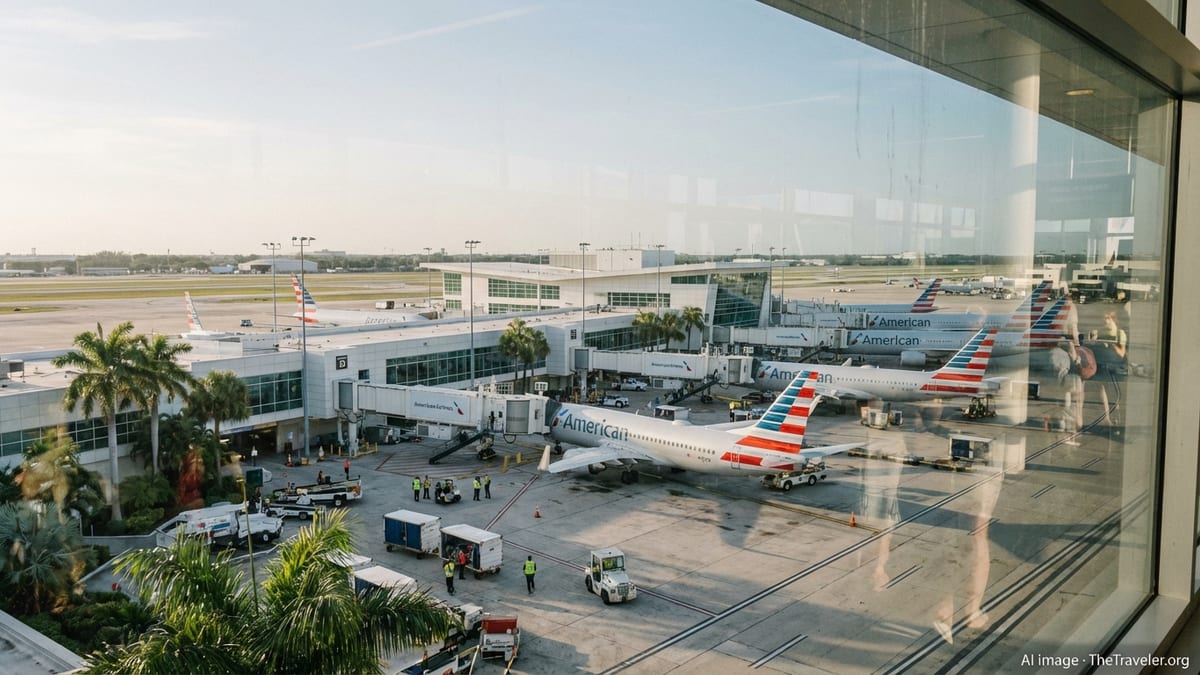
Miami’s World Cup airports lag on on-time performance
Miami International Airport and Fort Lauderdale Hollywood International Airport are both emerging near the bottom of national rankings for on-time performance just months before the World Cup match schedule begins in South Florida. Aggregated analyses of federal statistics and commercial delay trackers for 2025 and early 2026 place both airports among the U.S. facilities with the largest share of delayed departures and arrivals, with roughly one in four flights running late at each field on a typical day.
Flight tracking services that compile data from the Bureau of Transportation Statistics, the Federal Aviation Administration and airline feeds indicate that, as of May 2026, Fort Lauderdale Hollywood is seeing delay rates around 24 percent, while Miami International is close behind at about 23 percent. Those figures place the two South Florida airports within the ten most delay prone large U.S. airports, at a time when the national on time average for major hubs is in the mid 70 percent range.
Broader research into airport punctuality trends for the 2025 calendar year also shows Miami trailing many peer hubs. One widely cited index of global airport performance ranks Miami outside the top 20 among large North American airports, with an on time arrival rate in the high 60 percent range last year, below the U.S. average. Fort Lauderdale, a primary base for several low cost carriers and a key leisure gateway, shows similar patterns, with a higher share of late running departures compared with inland or northern peers.
These statistics form the backdrop for the World Cup buildup, in which Miami is expected to function both as a destination for match days and as a connecting point for fans headed to other host cities around the United States, Mexico and Canada.
World Cup demand set to stress an already stretched system
Miami’s aviation role during the tournament is substantial. The city is scheduled to host seven World Cup matches in 2026, including the bronze final, with games concentrated over several weeks in June and July. Airlines have already begun marketing dedicated World Cup services, highlighting hundreds of daily nonstops into Miami International and positioning Fort Lauderdale Hollywood and Palm Beach International as alternate entry points for fans.
Miami International is designated in public planning documents and travel industry coverage as one of the primary air gateways for World Cup spectators, both for South Florida matches and as a connecting hub linking Latin America, Europe and other U.S. cities. Fort Lauderdale Hollywood, located about 15 to 20 miles north of Miami’s match venue, is likewise described in aviation and tourism materials as a major access point for fans, particularly those on low cost carriers or regional services.
Federal aviation planners are preparing for an exceptional traffic surge across all U.S. World Cup host cities. The Federal Aviation Administration has issued a dedicated advisory and planning framework for the 2026 tournament, outlining the likelihood of ground delay programs, temporary flow restrictions and other measures designed to keep the national airspace system stable during peak match days. The guidance notes that traffic into host city terminal areas is expected to be significantly heavier than normal, and that airports serving match venues will experience concentrated waves of arrivals and departures before and after games.
For South Florida, this means that Miami and Fort Lauderdale will be managing World Cup peaks on top of their existing congestion patterns. Both airports already handle dense schedules of domestic leisure flights, international long haul services and regional connections, and World Cup traffic is projected to be layered over the busy summer travel season rather than replacing existing demand.
Weather, congestion and late inbound aircraft drive delays
Reasons for Miami’s sluggish on time record are multifaceted. Florida’s storm prone climate plays a central role, with regular afternoon thunderstorms and periods of low visibility often triggering ground stops, slowed arrival rates and airborne holding. Local news coverage in early 2026 highlighted weather related ground delay programs and brief ground stops at Miami International during winter frontal systems, while summer storm activity traditionally intensifies the pattern.
Operational congestion compounds these weather challenges. Both Miami and Fort Lauderdale function as high density, banked schedule airports, where carriers time arrivals and departures into narrow windows to maximize connections. Industry analyses of national delay causes consistently show late arriving aircraft as the dominant factor behind missed departure times, a pattern that is particularly visible at busy connecting hubs such as Miami. Once early flights fall behind schedule, delays ripple through the remaining banks of the day.
Runway and taxiway capacity pressures are also a factor. Federal operations data show that both airports handle heavy volumes of flights relative to their physical footprints, especially during peak travel periods and holidays. While capacity expansion projects and terminal upgrades have been underway or recently completed, many improvements focus on passenger facilities rather than adding new runways, leaving airfield constraints largely unchanged in the near term.
At Fort Lauderdale Hollywood, a strong presence of ultra low cost carriers has brought rapid growth in point to point leisure services. These airlines tend to operate tight aircraft utilization schedules, which can heighten susceptibility to knock on delays when disruptions occur earlier in the day or at outstations feeding South Florida routes.
New plans and playbooks to handle tournament pressure
In anticipation of sustained high traffic and potential tarmac delays, Fort Lauderdale Hollywood has recently updated and filed a formal tarmac delay contingency plan. The document outlines procedures for keeping passengers informed, managing extended onboard waits and coordinating with airlines when flights are forced to remain on the apron for long periods. The updated plan, submitted in early 2026, reflects federal requirements but also acknowledges the likelihood of irregular operations affecting multiple flights during peak events.
Miami International, meanwhile, is included in broader federal and regional planning efforts covering World Cup air traffic. The FAA’s World Cup advisory materials describe how host city airports will use ground delay programs, time based metering and other traffic management tools to smooth demand at times of heavy arrival surges. Local transportation planning documents for Miami Dade County also reference the airport’s role as a critical node in moving international visitors during the tournament period.
Airlines are adjusting their own playbooks as well, according to travel industry reporting. Some carriers are adding early morning departures, when nationwide delay statistics tend to be considerably better, and building in slightly longer scheduled block times on competitive World Cup routes to improve on time reliability. Others are planning to upsize aircraft on certain Miami and Fort Lauderdale flights to accommodate tournament demand without increasing the number of takeoffs and landings during constrained hours.
Even with these measures, aviation analysts note that the basic arithmetic remains challenging: two airports that already post above average delay rates are preparing to absorb a once in a generation demand spike during the busiest part of the travel year.
What travelers can expect and how to reduce disruption risk
For fans flying into South Florida for the World Cup, the data suggest that schedule padding and risk management will be essential. With roughly a quarter of flights at Miami and Fort Lauderdale typically running late and national on time rates also below pre pandemic highs, travelers with match tickets may want to avoid tight same day connections or arrivals that cut close to kick off times.
Travel and consumer finance publications analyzing recent delay patterns recommend prioritizing early morning departures wherever possible, when cascading delays have not yet built up and on time rates are materially higher. Booking nonstop flights into Miami or Fort Lauderdale rather than relying on multi stop itineraries can also reduce the number of potential failure points, especially on days when thunderstorms or national air traffic management programs are expected.
Observers further advise allowing additional buffer time at the airport, particularly around security and check in, given the likelihood of heavier than normal crowds and more complex passenger flows. While some South Florida facilities have reported relatively moderate average security wait times in recent surveys, large event periods often bring unpredictable spikes as charter operations, supporter groups and occasional travelers arrive in concentrated waves.
With less than a year to go before the first World Cup whistle in Miami, the region’s airports are working within a tight window to prove they can keep pace with global expectations. Their recent performance numbers underline how narrow the margin will be between a smooth fan experience and a tournament overshadowed by missed connections, overnight delays and packed departure halls.