


Amsterdam Airport Schiphol can feel overwhelming at first glance: a sprawling European hub under a single roof, packed with shops, yellow signs and crowds of connecting passengers. Yet once you understand how the airport is laid out and how each stage of the journey fits together, Schiphol becomes one of the easier major hubs to use. This guide walks you step by step through how the airport works in 2026, from the moment your plane’s wheels touch down to the moment you board your onward flight or train into Amsterdam.
Get the latest updates straight to your inbox!
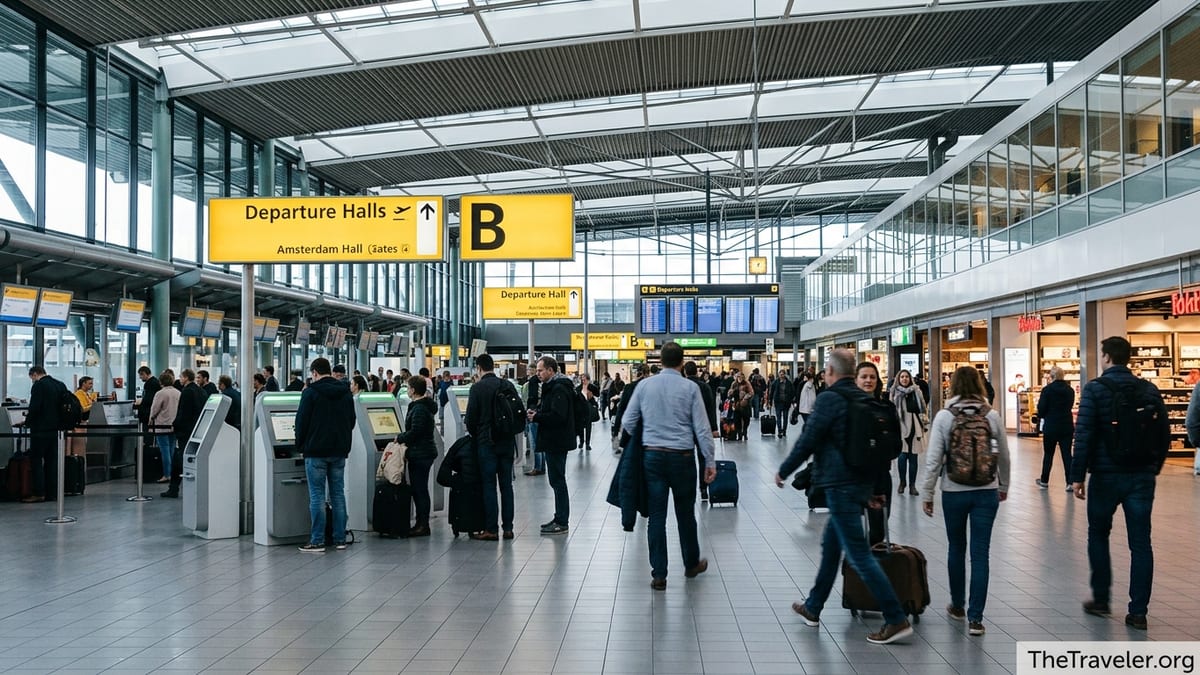
Understanding Schiphol’s One-Terminal Layout
Schiphol operates as a single-terminal airport, which means that all check-in desks, security lanes, and most gates sit under one continuous roof. Instead of multiple separate terminals like Heathrow or Charles de Gaulle, Schiphol has three main departure halls that fan out into several piers labeled B, C, D, E, F, G, H and M. In practice, this means that once you are inside the terminal you can walk between most areas without ever leaving the secure zone, which is especially convenient if you are connecting between airlines or alliances.
At departures level, Hall 1 mainly serves Schengen flights from piers B and C, Hall 2 bridges Schengen and non-Schengen flights via pier D and pier E, and Hall 3 focuses on long-haul and many low-cost carriers using piers F, G, H and M. Arrivals sit one level below, with baggage carousels grouped into several arrival halls that all open onto the same public concourse known as Schiphol Plaza. Below that again is the railway station, built directly under the terminal. For a traveler arriving from New York on KLM at pier E and continuing by train to Amsterdam Centraal, everything from the gate to the baggage hall to the trains happens inside this stacked, connected structure.
The Schengen and non-Schengen areas are separated by passport control but remain physically connected. For example, the long D pier has Schengen gates on its upper level and non-Schengen gates below, with a passport-control filter and escalators mediating the switch. This can be confusing for first-time visitors, but if you think of Schiphol as a single building with a passport “fence” running through part of it, the layout becomes much easier to follow.
Vertical movement is as important as horizontal at Schiphol. A typical pattern is arriving to your gate level, walking along the pier to the central lounge spine, then going down one level to baggage reclaim or up one level to reach certain lounges. The yellow overhead signs are the airport’s main navigation tool: follow “Baggage hall” and “Arrivals” to leave, or “Transfer” and your next gate letter to connect. The good news is that walks between neighboring piers such as D and E are typically in the range of 5 to 12 minutes for the average traveler, which is manageable even with a medium-length layover.
From Touchdown to the Baggage Belt
Your journey through Schiphol begins as soon as the aircraft parks. If your flight uses a jet bridge at one of the main piers, you will step directly into the enclosed pier corridor and follow the overhead signs towards “Baggage hall/Arrivals.” On some services, especially low-cost or regional flights, you may be parked on a remote stand and taken by bus to the terminal. In that case, you typically arrive at a ground-level entrance near Arrivals, then follow signage up or inward to immigration and baggage reclaim.
If you are arriving from another Schengen country such as France, Germany or Spain, you usually walk straight from the gate into the main lounge and then toward the “Baggage hall” signs without passing passport control. Once you reach the central area, escalators and ramps take you down to the baggage level, where you will see large screens listing flights and carousel numbers. For example, an early afternoon KLM flight from Paris might be assigned to belt 4 in Arrivals 1, while a Transavia service from Lisbon could be at belt 10 in Arrivals 2. The Schiphol app and most airline apps show the belt assignment shortly before landing, so you can verify where you are heading as you walk.
For non-Schengen arrivals such as the United States, United Kingdom or the United Arab Emirates, there is an extra step: passport control. From the gate you follow the same “Baggage hall” signs, but they bring you to a border-control area operated by the Dutch Royal Marechaussee. Here the line splits between EU/EEA/Swiss citizens and all other nationalities. Many travelers with biometric passports can use automated e-gates, which typically move more quickly than the staffed booths, although during peak summer hours even the e-gate queue can extend significantly.
Once through passport control, you descend to the baggage hall. Schiphol’s baggage reclaim areas are labeled by arrival hall number and carousel range. One real-world pattern: intercontinental KLM flights from North America and Asia often use belts in Arrivals 2, while holiday charters and some low-cost carriers are directed to belts further along toward Arrivals 3 and 4. At busier times, it is not unusual to wait 20 to 40 minutes for checked bags to appear, especially if ground handling teams are stretched. Many frequent travelers into Schiphol now choose to travel with only carry-on baggage when possible to bypass this delay entirely.
Clearing Customs and Reaching Schiphol Plaza
After collecting your luggage, you pass through customs on your way out to the public landside area. For most travelers this is a formality. There are typically three channels: green for “Nothing to declare,” red for “Goods to declare,” and in some cases a separate route for EU passengers with limited items. Random inspections do occur, but for visitors arriving with standard personal items and no large purchases, walking through the green channel takes less than a minute.
Once you exit customs you emerge into Arrival Halls 1, 2 or 3, which all open into Schiphol Plaza. This is the airport’s central landside concourse, functioning as both a shopping mall and transport hub. Here you find supermarket-style outlets, cafés, fast-food chains, pharmacies, luggage storage and several currency exchange counters. For example, a traveler arriving from Toronto late in the afternoon might grab a coffee at a major international chain across from Arrivals 2, pop into the supermarket to buy a Dutch SIM card or a bottle of water at local prices, and then walk a short distance to the train ticket machines.
Schiphol Plaza is also where you access onward transport into Amsterdam and beyond. Straight ahead and down the escalators lie the train platforms. Outside the sliding doors are taxi ranks, hotel shuttles, and bus stops including the well-known airport express bus to Museumplein and Leidseplein. Just a few minutes’ walk under cover from the terminal is car park P1, the main short-stay parking area with clearly marked pedestrian access and charging points for electric vehicles. Travelers being picked up by friends or family often arrange to meet directly under the large blue-and-yellow meeting point sign in Schiphol Plaza, a recognizable landmark near the central escalators.
If you have a longer wait before continuing your journey, Schiphol Plaza offers practical services that can help bridge the time. There are luggage lockers where you can store a suitcase for a few hours while you make a quick trip into the city, and several cafés with ample seating where you can sit with a coffee and charge your phone. The environment feels more like a busy urban shopping center than a typical cramped arrivals hall, which can make layovers or delays somewhat more bearable.
Onward Transport: Trains, Buses, Taxis and Car Rentals
For many visitors, the next step after emerging into Schiphol Plaza is getting into central Amsterdam. The fastest and most cost-effective option for most travelers is the frequent train service from Schiphol Airport station, located directly underneath the terminal. Escalators and elevators from the plaza level take you down to a concourse with bright yellow ticket machines and digital departure boards. Standard second-class tickets to Amsterdam Centraal are typically in the range of a few euros each way, and the journey takes about 15 to 20 minutes on direct intercity or sprinter trains.
Buying tickets from machines is straightforward: you can usually pay with major credit cards or contactless payment methods. There is often a small surcharge if you choose to buy a ticket at a staffed counter rather than from a machine. Some visitors prefer using a rechargeable smart card or app-based barcode ticket if they plan to use public transport extensively during their stay. For example, a couple arriving from Chicago for a five-day city break might buy individual one-way tickets into town, then switch to multi-day public transport passes once they reach their hotel.
If your destination is in the museum district or the city’s southwest, the airport express bus that runs towards Museumplein and Leidseplein is a convenient alternative. The buses depart from clearly numbered platforms just outside the terminal, and the ride typically takes 30 to 40 minutes depending on traffic. For travelers staying in popular areas like Vondelpark or near the Rijksmuseum, this bus can drop you closer to your accommodation than the train, saving the hassle of transferring to trams or metros with heavy luggage.
Taxis and rides with professional car services are readily available from the official taxi rank just outside Schiphol Plaza. Licensed airport taxis use fixed or metered fares; a typical ride to central Amsterdam often comes to several tens of euros, and takes 25 to 35 minutes in normal traffic. This becomes more attractive if you are traveling in a group of three or four with multiple suitcases, or if you are arriving late at night when train frequencies drop. Car rental desks for major brands sit just off Schiphol Plaza, and the rental car parking garages are reachable via enclosed walkways. A business traveler landing from London on a Monday morning, for instance, might pick up a rental car and drive directly to a client meeting in Rotterdam, avoiding a rail transfer with heavy presentation materials.
Departing Schiphol: Check-in, Bag Drop and Security
For departures, the process begins at the upper departures level, where three main halls handle check-in and bag drop. Airlines display their hall and row on ticket confirmations and apps, and large screens at the entrance list all flights with arrows pointing to the correct hall. For example, KLM and many SkyTeam partners often use Hall 1 and Hall 2, while some long-haul carriers and low-cost airlines use Hall 3. Because Schiphol operates as one terminal, it is not a disaster if you are dropped off at the wrong door; walking from Hall 1 to Hall 3 is simply a matter of a few extra minutes along the same corridor.
Standard guidance in 2026 is to arrive at Schiphol around two hours before departure for Schengen flights and three hours before non-Schengen flights. At peak holiday times or during widely reported staffing shortages, adding an extra buffer can be wise. Many travelers now use the Schiphol app or airline apps to book security time slots where available. These allow you to enter a dedicated line for security within a 15-minute window, which can significantly shorten waiting times compared with the general queue, especially on busy mornings.
Check-in and bag drop are handled either at staffed counters or at self-service kiosks paired with automated bag-drop belts. It is increasingly common to check in online, store a mobile boarding pass in your smartphone wallet, and use a kiosk only to print a bag tag before leaving your luggage on a self-service belt. As a concrete example, a solo traveler flying Transavia to Malaga might arrive with a pre-printed boarding pass, print a tag at a kiosk in Hall 3 in less than two minutes, place the suitcase on the belt, and head straight to security without visiting a traditional counter at all.
After check-in, you follow the “Departures / Security” signs towards the centralized security filters. Schiphol used to separate security by pier, but now most passengers pass through common security checkpoints that serve all departure halls. You scan your boarding pass at a turnstile, then join one of multiple parallel lines that feed into screening lanes. At busy times, airport staff walk along the rows to direct you towards newly opened lanes and to answer quick questions about liquids and electronics. Families with small children, people needing assistance, and premium passengers may have dedicated lanes, although availability can vary by time of day.
Security, Passport Control and the Departure Lounges
Security screening at Schiphol follows the standard European model. You place carry-on bags, laptops, tablets and jackets in trays that travel through X-ray machines, while you pass through a metal detector or body scanner when directed. In newer lanes, you can often leave liquids and laptops inside your bag thanks to upgraded scanners, but rules are not yet fully uniform, so staff instructions and signage over each lane are important. If your bag is flagged for manual inspection, you step aside to a dedicated counter while another officer searches inside, which can add several minutes but usually resolves without issues.
Once you are through security, your next step depends on whether your flight is Schengen or non-Schengen. For Schengen flights, such as to Berlin or Rome, you typically enter the main departures lounge directly and can walk unimpeded to your gate area along piers B, C or the Schengen level of pier D. For non-Schengen destinations like New York, Dubai or London, you must clear passport control after security. Automated e-gates are available for many EU biometric passports, with manned booths handling others and those needing extra checks. During peak evening waves of long-haul departures, passport queues can rival security for waiting time, so budgeting an extra 15 to 30 minutes here is prudent.
Beyond passport control is the non-Schengen departures lounge, where many long-haul gates are located along piers E, F and G, plus the non-Schengen level of pier D. This area hosts a mix of duty-free shops, mid-range fashion brands, electronics stores and restaurants. For instance, a passenger waiting for an overnight KLM flight to Johannesburg might have dinner at a sit-down brasserie near the E pier, pick up last-minute toiletries from a drugstore chain, and then walk ten minutes to gate F6 for boarding.
Schiphol offers several airline and pay-per-use lounges in both Schengen and non-Schengen areas. KLM’s Crown Lounges are particularly prominent, with one located near the D pier for Schengen flights and another larger lounge between the E and F piers for intercontinental departures. Access is typically limited to business class passengers, frequent flyers with sufficient status, or travelers willing to purchase a day pass. Inside, guests find quieter seating, complimentary food and drinks, showers and workspaces, which can transform a long layover from a chore into a manageable pause between flights.
Transfers, Minimum Connection Times and Common Pitfalls
For passengers connecting through Amsterdam, Schiphol’s one-terminal layout is a major advantage. Official minimum connection times can be as low as around 40 to 50 minutes for certain combinations, and many journeys are possible without changing terminals or re-clearing security. If you are arriving from a Schengen destination and departing to another Schengen city on the same ticket, you typically walk from one gate to another inside the secure area without seeing passport control at all. In practice, a traveler flying from Munich to Amsterdam and then onward to Edinburgh might have just enough time in a 65-minute layover to walk from a C gate to a D gate and stop briefly at a café.
Connections involving a change between Schengen and non-Schengen require passing through passport control. For example, if you are flying from Lisbon to Amsterdam and then on to New York, you arrive into the Schengen area, walk towards your next gate and pass through an outbound passport check into the non-Schengen zone. Conversely, arriving from Toronto and connecting to a flight to Copenhagen involves an inbound passport check into Schengen, then a walk to your new gate without additional security screening if you stay within the secure area. The routing is clearly signposted with “Transfer” arrows and gate letters; you generally do not follow “Baggage hall / Arrivals” unless you are ending your journey in Amsterdam or switching to a separate ticket.
One common pitfall occurs when travelers unintentionally exit to Arrivals during a connection. If you follow signs to the baggage hall and pass through customs, you are now landside and will need to check in again and pass through security and possibly passport control from scratch. This can be particularly risky on tight layovers or when flights are on separate tickets. As a real-world example, a budget-conscious traveler might book a low-cost airline from London to Amsterdam and a separate onward low-cost flight to Prague. In this case, they must collect checked bags, clear customs, re-check bags landside, and repeat the entire departure process including security and passport control, which can easily consume two to three hours.
Another common source of confusion is gate changes. Schiphol assigns gates based on operational needs, and it is not unusual for a flight that originally showed gate D4 in the app to move to D22 or even to another pier like E within a couple of hours of departure. Because walking times between piers can be up to 15 minutes, especially to the far ends of F and G, it is wise to check the screens or app periodically and not settle into a café too far from your boarding area until the gate has been stable for a while. Airport staff wearing distinctive vests patrol busy areas and can confirm whether you are heading in the right direction if you are unsure.
Boarding, Last-Minute Services and What Happens if Things Go Wrong
Boarding at Schiphol typically starts 30 to 45 minutes before departure time for European flights and up to an hour before for larger intercontinental aircraft. Most gates use a combination of automated gates and manual scanning. You line up when your group or row number is called, scan your boarding pass at the gate reader, and then either proceed down the jet bridge or walk down stairs to a waiting bus if the plane is parked remotely. Airlines often pre-board families with young children, passengers needing special assistance and certain frequent-flyer tiers before general boarding begins.
Near many gates you will find last-minute services such as water fountains, restrooms and small kiosks selling drinks, snacks and travel essentials. Some non-Schengen gates also have their own secondary waiting rooms after an additional document check. For example, on flights to the United States, Canadian or some Asian destinations, gate agents may ask additional security questions and verify visas or return tickets before allowing passengers into the final seating area. This can create a second queuing moment about 30 minutes before departure, so you should avoid arriving at the gate only at the final boarding call.
If your flight is delayed or canceled, customer service desks for airlines and their partners are scattered throughout the departure lounges. For instance, a disrupted KLM passenger might be directed to a desk near the B or D pier, while a Delta traveler may find assistance near gates commonly used for North American flights. During major disruptions such as weather events or air traffic control strikes, lines at these desks can stretch for hours. In such situations, many passengers have more success rebooking through the airline’s app or phone line while they wait in the physical queue as a backup.
Schiphol also has dedicated desks and service points for lost property, baggage tracing and accessibility assistance. If your checked suitcase fails to appear on the carousel on arrival, airline baggage offices near the baggage halls can register a missing-bag report and arrange delivery to your hotel or home once it is found. Travelers with reduced mobility can arrange wheelchair assistance or escort services in advance through their airline; agents then greet them at check-in or at the aircraft door and guide them through every step, including security and passport control.
FAQ
Q1. How early should I arrive at Amsterdam Schiphol before my flight?
Most travelers should aim to arrive about two hours before a Schengen flight and three hours before a non-Schengen flight. During school holidays or widely reported busy periods, adding another 30 to 60 minutes can provide a useful buffer, especially if you need to check bags or have to return a rental car.
Q2. Do I always have to go through passport control at Schiphol?
No. You pass passport control only when you enter or leave the Schengen area. If you arrive from and depart to Schengen countries on the same journey, you usually do not see passport control. If either your origin or destination is outside Schengen, you will go through an immigration check at some point during your transfer or arrival.
Q3. Is security at Schiphol before or after passport control?
For departures, security generally comes first, followed by passport control for non-Schengen flights. After you clear security, you either go directly into the Schengen departures lounge or proceed through passport control into the non-Schengen area, where long-haul and UK flights typically depart.
Q4. Can I walk between all gates inside Schiphol without leaving security?
Yes, almost all piers are connected airside, so you can walk between most gates without exiting the secure area. The main exceptions are some low-cost and bus gates that use separate flows, but even then you generally remain within the secured zone as long as you follow “Transfer” signs and do not head towards “Baggage hall / Arrivals.”
Q5. How long does it take to get from Schiphol to central Amsterdam?
By train, the journey from Schiphol Airport station to Amsterdam Centraal usually takes around 15 to 20 minutes on frequent direct services. By taxi, travel time is typically 25 to 35 minutes depending on traffic, and costs are significantly higher than the train, which makes the rail option the best value for most visitors.
Q6. Where can I buy train tickets at Schiphol?
You can buy train tickets from the yellow ticket machines on the station concourse below Schiphol Plaza, usually paying with major bank cards or contactless methods. There are also staffed ticket counters in the same area, though purchasing there often adds a small service surcharge compared with using the machines or an official rail app.
Q7. What happens if I accidentally exit to Arrivals during a connection?
If you follow signs to the baggage hall and pass through customs, you are now landside and must go through the full departure process again. That means checking in or visiting a transfer desk if necessary, passing through security, and potentially passport control. This can easily consume one to two extra hours, so connecting passengers should always follow “Transfer” signs unless they intentionally want to enter the Netherlands.
Q8. Are there showers or lounges I can use on a long layover?
Yes. Several airline lounges, including KLM Crown Lounges, offer showers and quiet seating for eligible passengers and those who purchase access. There are also independent pay-per-use lounges in both Schengen and non-Schengen areas. For travelers who prefer not to use a lounge, some terminal restrooms include basic washing facilities, and a few hotels directly connected to the terminal offer day rooms.
Q9. Is Schiphol easy to use for travelers with limited mobility?
Schiphol is generally well equipped for passengers with reduced mobility, with elevators, ramps, accessible restrooms and special assistance services. If you request assistance through your airline in advance, staff can meet you at check-in or the aircraft door and escort you through security, passport control and to your gate or exit, using wheelchairs or electric carts where appropriate.
Q10. How likely is it that my gate will change at Schiphol?
Gate changes are relatively common, especially several hours before departure while the airport optimizes aircraft parking. It is wise to treat the initial gate assignment as provisional and keep an eye on the airport screens or your airline app. Once you are within about an hour of departure the gate is less likely to change, but it still can, so staying reasonably close to your gate area is prudent.