


Florence’s Opera del Duomo Museum is often overshadowed by the cathedral dome climb and the Baptistery, yet it holds more than 700 years of Florentine religious art in one carefully designed space. Knowing how much time to spend here can make the difference between a rushed box-ticking stop and one of the most moving museum visits of your trip.
Get the latest updates straight to your inbox!
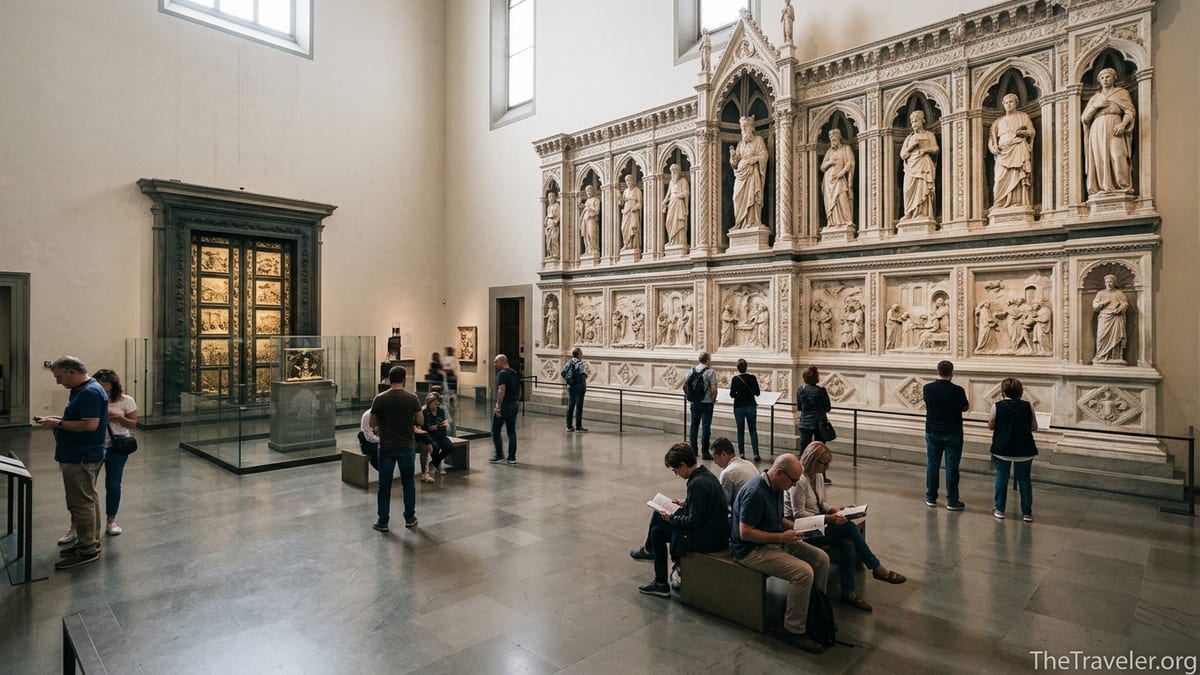
Understanding the Size and Scope of the Museum
The Opera del Duomo Museum, or Museo dell’Opera del Duomo, is far larger and more comprehensive than many visitors expect. After a major renovation, it now spreads over roughly 6,000 square meters arranged on three floors and close to 30 rooms. The collection encompasses more than 750 works, including original sculptures, reliefs, and treasures from Florence Cathedral, Giotto’s Campanile, and the Baptistery, covering around 720 years of history. Even if you only plan to see the highlights, the physical scale of the building means you will be walking through a lot of space.
Most visitors underestimate how much visual detail there is to absorb. Masterpieces by Ghiberti, Donatello, Michelangelo, Arnolfo di Cambio, and Luca della Robbia are displayed at eye level, in controlled lighting, often much closer than you will ever see them outdoors. A quick walk-through is technically possible, but you will miss context and subtle details like tool marks on marble, traces of original gilding, or the way figures once interacted across the cathedral façade. When deciding how long to stay, remember that this is not a single gallery but an entire complex of themed rooms.
The museum is also designed as a narrative journey, not just a storage space for removed sculptures. Rooms are arranged to follow the building history of the Duomo complex, from its medieval origins to its Renaissance reimagining. This storytelling aspect rewards visitors who have at least an hour to slow down, read a few room panels, and understand how the works once connected with the exterior monuments you see in Piazza del Duomo.
Finally, the museum is indoors, climate controlled, and generally less crowded than the cathedral floor or dome climb. If you are visiting Florence in high season or during a hot afternoon, it can be an excellent place to spend one to two hours in relative calm, especially if you need a break from queues and direct sun on the square.
Typical Visit Durations: From Quick Highlights to Deep Dives
For most travelers focused on seeing the major works, 60 to 90 minutes is a realistic, comfortable amount of time at the Opera del Duomo Museum. This allows you to walk the main route, pause at the reconstructed façade hall, appreciate a few key sculptures by Donatello and Michelangelo, and glance through the treasury without feeling rushed. Many guided group tours of the Duomo complex allocate around one hour inside the museum, which is a useful benchmark if you like a fairly brisk pace.
If you enjoy art, sculpture, or architectural history, aim for 2 to 2.5 hours. With this amount of time, you can read more of the bilingual wall texts, compare original statues with the copies outside, and linger in the rooms dedicated to Brunelleschi’s dome models and workshop tools. Independent travelers who buy the combined cathedral complex pass often end up spending a full half day in and around Piazza del Duomo when they include the museum, Baptistery, and dome or bell tower climbs.
Travelers who only have a short layover or a packed day of sightseeing sometimes consider a 30 to 45 minute dash through the museum. While you can technically see three or four major highlights in that time, it will require discipline: walking directly to the main façade hall, stopping briefly at Donatello’s works and Michelangelo’s Pietà, and then heading out. This kind of visit is best if you already feel saturated by Renaissance art and simply want to check off the essentials.
On the other end of the spectrum, sculpture lovers or photographers can easily spend three hours or more here, especially if they are using the museum as a way to study Renaissance carving techniques up close. For example, an art history student might devote a full morning comparing Ghiberti’s Baptistery doors with contemporary reliefs, then returning after lunch to sketch in the large hall. If your schedule permits, it is worth over-allocating time rather than trying to squeeze the museum into a narrow gap between timed entries elsewhere.
Fast-Track: A 45–60 Minute Highlights Route
If you want to see the essentials in under an hour, the key is to follow a focused path and resist the temptation to stop in every side room. After entering and passing through the introductory spaces, head directly to the grand central hall, where a full-scale reconstruction of the original cathedral façade frames the room. Here you can see many statues that once stood high above the square, now at eye level. Spend 10 to 15 minutes here, picking out a few favorites rather than trying to examine each sculpture in detail.
From there, move on to the galleries showcasing the original bronze doors of the Baptistery. These include Ghiberti’s famed “Gates of Paradise,” whose copies now face the cathedral square. Even in a fast visit, allow at least 10 minutes to study a couple of panels up close: for instance, you might choose the “Story of Isaac” and the “Story of Joseph” to appreciate the level of detail, use of perspective, and casting technique. Compared to seeing only the replicas outdoors, this is often a revelation.
Next, make your way to the rooms with major works by Donatello and other sculptors connected to the bell tower and cathedral decoration. Focus on one or two standout pieces such as Donatello’s Penitent Magdalene, whose gaunt wooden figure leaves a strong emotional impression even if you are short on time. Limit yourself to another 10 to 15 minutes here, noting the contrast between marble and wood, and between Gothic and early Renaissance approaches to the human body.
To round off a fast-track visit, head to the room containing Michelangelo’s unfinished Pietà, sometimes called the “Bandini Pietà.” Budget about 10 minutes here. This sculpture was originally intended for Michelangelo’s own tomb, and the visible carving marks and broken limbs make it particularly compelling. Even in a tight schedule, pausing quietly in this room offers a powerful counterpoint to the more polished masterpieces you may have seen in the Accademia or the Uffizi.
Balanced Visit: A 90–120 Minute Classic Experience
A classic museum visit of about 90 to 120 minutes gives you space to enjoy the highlights while still following the story the curators have laid out. Start again with the reconstructed façade hall, but this time allow 20 minutes to walk its length, reading a couple of the interpretive panels that explain how the original façade differed from what you see on the cathedral today. Take a moment to turn around and look back from different angles; the sheer scale makes it easier to imagine how medieval Florentines experienced the Duomo when it was newly built.
Continue to the Baptistery doors, where you can now take 15 to 20 minutes to compare different sets of panels. Many visitors like to begin with the “Gates of Paradise” and then cross to the earlier doors to notice how style and technique evolved. If you have children with you, choosing one biblical story they already know and asking them to find it in the bronze scenes can make this section more engaging without dramatically prolonging the visit.
With a balanced time budget, you can dedicate 20 to 30 minutes to the rooms featuring Donatello, Nanni di Banco, and other sculptors. Rather than trying to see everything, pick three or four works to focus on: perhaps Donatello’s Prophets, a relief from the campanile, and one of the Madonna and Child images. In each case, look closely at expressions, clothing folds, and how the figure interacts with space. You might quietly compare them with what you saw earlier outside on Giotto’s bell tower or on the cathedral façade.
Finally, spend at least 15 to 20 minutes with Michelangelo’s Pietà and the surrounding late Renaissance works, then leave 10 or so minutes to walk through the treasury spaces near the end, which hold chalices, reliquaries, and liturgical objects used in the cathedral over centuries. This pacing allows for occasional photo stops, brief conversations with your companions, and a short pause on a bench without rushing through the last rooms.
In-Depth Exploration: When to Allow 2–3 Hours or More
Planning two to three hours at the Opera del Duomo Museum is recommended if this is not your first trip to Florence, if you have a strong interest in sculpture and architecture, or if the museum is the centerpiece of your day rather than an add-on around other timed tickets. With this amount of time, you can move beyond a checklist of famous names and engage with how the Duomo complex evolved across centuries of religious and political change.
An in-depth visit might involve spending a full half hour in the façade hall alone, sketching or photographing details in different light as it filters through the upper windows. You could then take 30 to 40 minutes in the Baptistery door galleries, using the information panels to trace how casting techniques improved and how narrative reliefs began to show richer landscapes and architectural backgrounds. Audio guides or detailed guidebooks become more valuable on this kind of visit; many describe individual panels and symbols that casual visitors would overlook.
With extra time, you can also appreciate the more technical rooms focusing on Brunelleschi’s dome. Here you will find wooden models, tools, and explanatory displays that help you interpret the structure when you view it from the cathedral square or climb it later. Spending 20 or 30 minutes in these galleries can transform the dome from an impressive silhouette into a story of engineering experiments, worker safety issues, and logistical challenges in 15th century Florence.
Finally, a long visit lets you pause for reflection in quieter corners. You might sit for 15 minutes in the room with the Pietà, watching how other visitors respond and noticing details like unfinished chisel strokes or changes in marble color. Or you may choose to retrace your steps to an earlier room once the crowds have thinned. If you are visiting on a hot summer afternoon, allowing three hours inside also serves as a practical strategy to rest, hydrate, and cool down before heading back into the busy streets around the Duomo.
How Museum Time Fits with Your Duomo Complex Ticket
Most visitors experience the Opera del Duomo Museum as part of a combined ticket that covers several monuments around Piazza del Duomo, often valid over multiple days. That means the time you devote to the museum is closely tied to how you schedule your dome climb, bell tower ascent, Baptistery visit, and cathedral interior. If you only have one full day in Florence and want to do everything, you may decide to limit the museum to 60 to 90 minutes so that you still have time for a morning dome climb and a late afternoon visit to the Baptistery.
For example, a typical one-day plan might involve booking a timed dome climb for 9:30 a.m., taking about an hour and a half including queues and photo stops on the terrace, then walking around the cathedral exterior and having an early lunch nearby. You could then enter the Opera del Duomo Museum around 1:00 p.m., spending 90 minutes indoors during the hottest part of the day, and finish with the Baptistery or bell tower later in the afternoon. In such a schedule, you are balancing physical exertion outdoors with quiet time in the museum.
If you have two days in Florence, you can be more generous. Many travelers choose to separate the experiences: climbing the dome and visiting the cathedral and Baptistery on one day, and dedicating a leisurely morning or afternoon of two hours or more to the museum on the other. This spacing prevents “Duomo fatigue,” where frescoes, sculptures, and altarpieces all blur together. It also gives you the chance to revisit the exterior of the cathedral after seeing the original sculptures inside, seeing them with newly informed eyes.
Families with children or older travelers should also think about energy levels. The museum involves less climbing than the dome or bell tower, but there are multiple floors and long corridors. If someone in your group tires easily, it can be wise to schedule the museum first, when everyone is more alert, and leave the climbs for later only if you still have energy. In that case, you might plan for about two hours in the museum, with short rests on benches between sections.
Practical Time-Saving Tips on the Day
Beyond choosing a target duration, a few practical strategies can help you use your time effectively. Arriving near opening, typically around 8:30 a.m., often means thinner crowds and a quieter atmosphere in the main halls. If you are an early riser, you might spend 90 minutes in the museum first, then move on to outdoor sites as the city wakes up. Late afternoon visits can also be pleasantly calm on many days, though it is important to remember that last entry is generally well before the posted closing time, so plan to arrive at least 90 minutes before closing for a relaxed highlights visit.
Using an audio guide or a well-structured app can prevent you from getting bogged down in less essential rooms. Many third-party audio tours are designed with short and long circuits, allowing you to select a 60-minute or 120-minute route. Choosing one in advance can keep you moving and ensure you do not accidentally spend 30 minutes in a minor gallery while rushing past a masterpiece later. If you prefer printed material, a compact guidebook to the Duomo complex, bought the day before, can help you flag which works matter most to you.
Another way to save time is to align your museum visit with your interests. If you are fascinated by sculpture but less drawn to goldsmith work, you might give yourself permission to move quickly through the treasury. Conversely, if you love liturgical objects and medieval craftsmanship, you can focus 20 minutes there and be briefer in the dome model rooms. Being honest about your interests prevents fatigue and makes whatever time you have feel richer.
Finally, consider basic logistics: eating and restrooms. There is no need to rush through the museum because you are hungry or in search of facilities. Plan to eat just before entering, especially if you are embarking on a two-hour visit, and remember that cafés in the nearby streets can be busy at peak lunch times. A well-timed coffee and pastry before your visit can help you maintain focus, making your hour and a half inside feel satisfying rather than draining.
The Takeaway
There is no single correct amount of time to spend at the Opera del Duomo Museum, but a thoughtful plan goes a long way. For many visitors, 60 to 90 minutes is enough to see the major highlights, understand the connection between the museum and the cathedral complex outside, and leave with a sense of coherence rather than overload. Travelers who care deeply about sculpture, architecture, or religious art should consider 2 to 3 hours, treating the museum as a centerpiece of their Florence itinerary rather than an afterthought.
Whichever duration you choose, it helps to decide in advance whether your visit will be a quick orientation stop, a balanced exploration, or an in-depth study session. Matching your time on-site to your interests and overall schedule will ensure that the Opera del Duomo Museum becomes one of the most rewarding parts of your stay in Florence, rather than just another museum you hurried through on the way to the next landmark.
FAQ
Q1. What is the minimum time I should allow to see the main highlights?
Plan for at least 45 to 60 minutes if you are moving efficiently and focus on the reconstructed façade hall, the Baptistery doors, Donatello’s Penitent Magdalene, and Michelangelo’s Pietà.
Q2. Is 30 minutes in the Opera del Duomo Museum worth it?
Thirty minutes is very tight, but if your schedule is packed you can still get a meaningful impression by heading straight to the façade hall and the Baptistery doors, then briefly visiting the Pietà. You will not see much else.
Q3. How much time do most visitors actually spend in the museum?
Most independent travelers spend around 60 to 90 minutes, while art enthusiasts, photographers, or students often stay closer to two hours or more, especially in quieter seasons.
Q4. Should I visit the museum before or after climbing the Duomo?
If you can, visit after the climb so you can connect what you saw outside with the original sculptures and models inside. However, if your dome time slot is later in the day or the weather is hot, a morning visit to the museum can be more comfortable.
Q5. Can I visit the Opera del Duomo Museum with kids, and how long is realistic?
Yes, children can enjoy the museum, especially the big façade hall and the detailed bronze doors. For families, 45 to 75 minutes is usually realistic before attention spans start to fade.
Q6. Is two hours in the museum too long for a casual traveler?
Not necessarily. Two hours lets you move at a calm pace, pause for breaks, and absorb the narrative without rushing. If you feel saturated, you can always leave earlier; your ticket covers the whole complex, not just time in one building.
Q7. How should I divide time between the museum and the Baptistery or dome climb?
On a one-day visit, a common balance is 60 to 90 minutes in the museum, about 90 minutes for a dome or bell tower climb including lines, and 30 to 45 minutes in the Baptistery.
Q8. When during the day is it best to visit if I want a calm, unhurried experience?
Early morning shortly after opening, or late afternoon well before last entry, are usually quieter. These times make a 90-minute or two-hour visit feel more relaxed and contemplative.
Q9. Do I need a guided tour to make the most of my time?
No, but a guided tour or good audio guide can help you use a 60- or 90-minute visit more efficiently by directing your attention to the most important works and stories.
Q10. How far in advance should I plan my time at the museum within my Florence itinerary?
Once you know your timed entries for the dome or bell tower, block a clear 60- to 120-minute window for the museum either earlier that day or on a separate day. Planning this in advance prevents you from having to rush through or skip it entirely.