


Many visitors arrive at Florence’s Opera del Duomo Museum assuming it will be a minor add-on to the cathedral and dome climb. Only afterward do they realize it is one of the city’s richest, most intelligently designed museums, and that a little advance planning could have transformed their visit. Understanding how tickets work, where the highlights are, and how to navigate the building makes the difference between rushing through tired at the end of the day and experiencing one of the great Renaissance collections in Italy at its best.
Get the latest updates straight to your inbox!
It Is Not a Standalone Ticket: How Passes Really Work
The first surprise for many travelers is that you cannot simply buy a basic “museum ticket” at the door. Access to the Opera del Duomo Museum is bundled into passes for the entire cathedral complex, such as the Brunelleschi Pass or Giotto Pass sold through the official Opera di Santa Maria del Fiore channels. These passes typically include timed entry to either the dome or bell tower plus flexible entry to the Baptistery, crypt of Santa Reparata, and the museum over a set number of days. Museum-only tickets are not usually offered, which frustrates visitors who only discover how good the museum is after they have already planned a tight schedule.
Imagine a couple in Florence for one day who booked a last-minute dome climb through a reseller for around 40 euros each. They queue, climb, descend, and only when walking out into Piazza del Duomo notice a small sign for the Opera del Duomo Museum on a side street. They assume it is another paid attraction, skip it to save time and money, and later learn that their ticket would have covered it if purchased directly as a pass. Booking the official pass in advance, often for substantially less than many third-party “skip the line” tours, not only opens the museum to you but also spreads your sightseeing more comfortably across one to three days.
Because the passes are valid over multiple days, experienced visitors often use the museum as their “anchor” on one of the mornings or afternoons when they are not climbing anything. If you arrive in Florence midday, for example, you can check into your hotel, walk to Piazza del Duomo, and start your pass with a relaxed museum visit that sets the historical context for everything else you will see in the complex.
One more detail that catches visitors off guard is that you must respect the validity period of your pass. If you activate a two or three day pass with a morning dome climb on a Monday, you do not want to leave the museum for Thursday. Check the start date shown on your confirmation, then mentally assign a specific window within that period for the museum so it does not slip off the end of your schedule.
Finding the Entrance and Planning Your Timing
From the piazza, many people look for a grand façade or obvious doorway and assume they will recognize the museum immediately. In reality, the entrance on Via della Canonica, just behind the cathedral, is remarkably discreet. Travelers regularly report walking past it several times before noticing the name above the door. If you are standing in front of the cathedral façade, walk around the right-hand side toward the rear until you reach the quiet side street with the Opera del Duomo offices and museum entrance.
Opening hours can shift slightly with seasons and religious holidays, but in recent years the museum has generally opened in the morning and closed in the early evening, with last admission usually around an hour before closing. Many guide publishers and ticket agencies currently suggest planning for typical hours like 9:00 a.m. to about 7:45 p.m., but you should double check closer to your travel dates, especially if you are visiting around Easter, major feasts, or August holidays when schedules can change. One practical rule of thumb: if you are climbing the dome or bell tower in the late afternoon, schedule the museum earlier in the day or for a different day altogether so you are not racing the closing time with tired legs.
In terms of crowd patterns, the museum is often significantly calmer than the cathedral interior or dome climb, even in peak season. Morning slots between 9:00 a.m. and 11:00 a.m. tend to attract visitors who specifically planned their visit, while late afternoon can be more of a mix of people wandering in after other sights. If you want space to contemplate Donatello reliefs or photograph the reconstructed medieval façade wall without many people in the frame, aim for opening time or the quieter hour right after lunch, especially in shoulder seasons like March, early May, or late October.
Travelers staying within walking distance of Piazza del Duomo often use the museum strategically on days with variable weather. On a hot July afternoon when the streets around the Arno shimmer in the heat, the museum’s air-conditioned galleries become a welcome refuge. Likewise, if thunderstorms are forecast, you can bring forward your indoor museum time and shift outdoor activities, like crossing the Ponte Vecchio or climbing to Piazzale Michelangelo, to another window.
Why It Matters to See the Museum Before or After the Cathedral
Another thing visitors often wish they had known is just how powerfully the museum “unlocks” the rest of the Duomo complex. The building was refurbished and expanded to create a narrative route through the original sculptures, reliefs, and architectural models from the cathedral, bell tower, and Baptistery. Instead of scattered masterpieces, you follow a story: how the buildings were conceived, how the sculptures looked in situ, and how their meanings connect. This context can transform your view of the complex from a series of pretty monuments into a coherent work of theology and civic pride.
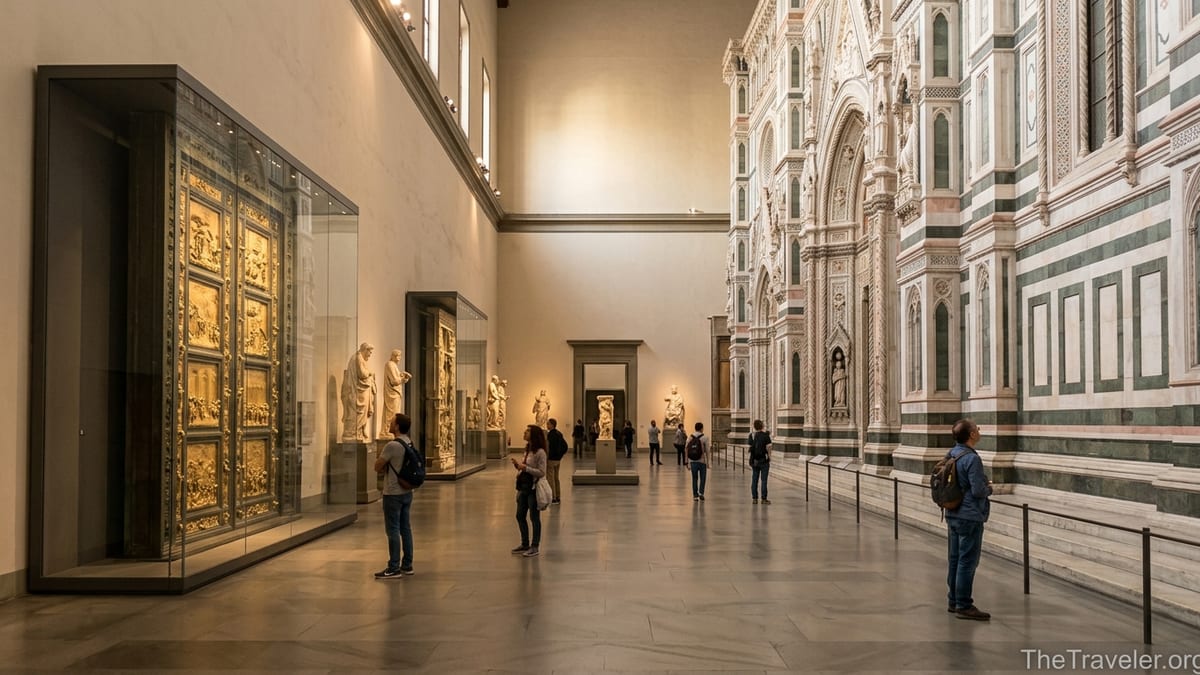
The huge first hall, dominated by a full-scale reconstruction of the original medieval façade, is a prime example. Many visitors who rush through this space do not realize they are looking at the façade that once stood where today’s neo-Gothic front does. Statues of prophets and saints, once weathering in the open air, are now displayed at roughly their original height. Seeing them at eye level reveals details that are impossible to appreciate when you look up at the current façade’s modern copies in the square. When you later stand outside the cathedral, the building feels less like an anonymous postcard view and more like a living palimpsest of centuries of change.
Likewise, understanding the Baptistery doors is much easier after you have examined the originals in the museum. The gilded “Gates of Paradise” and the earlier north and south doors are displayed in controlled conditions that allow you to walk close enough to pick out individual facial expressions and clothing textures. Visitors who only glimpse the outdoor copies among the crowds often leave with hazy impressions. Compare that to someone who spends fifteen focused minutes with the originals and then, the next day, stands outside the Baptistery recognizing individual panels as if they were familiar film scenes.
This narrative design means it can be especially rewarding to visit the museum either before you tour the rest of the complex or in between visits. For instance, you might visit the Baptistery in the morning, then walk straight to the museum to see its doors and related works in context, and only afterward climb the dome the following day. Organizing your itinerary that way turns each piece of the complex into a chapter that refers back to the others, rather than a disconnected checklist.
Hidden Highlights and How Not to Miss Them
Many visitors arrive with only vague expectations: “some sculptures” and “something by Donatello.” Once inside, they are often surprised by specific masterpieces and spaces they had not realized were there. Knowing a few of the highlights in advance helps you slow down in the right rooms, rather than drifting past everything at the same pace. One of the most striking spaces is the gallery where the original choir lofts by Donatello and Luca della Robbia face one another. Their delicately carved singing and dancing children show two very different artistic personalities reacting to the same brief; stopping here with a good audio guide or descriptive panel can be one of the most charming experiences in the museum.
Another room many people regret rushing through is the Pietà gallery, where an unfinished Pietà attributed to Michelangelo is displayed. According to most accounts, the sculptor originally conceived this work for his own tomb before eventually abandoning it. In the museum, it is installed in a dramatic vertical space with carefully controlled light. Visitors who do not realize its importance sometimes mistake it for one of several “similar” Renaissance pietàs and continue walking, only discovering later, reading a guidebook over dinner, that they had spent less than a minute in front of a late Michelangelo they might never see again.
On the upper levels, windows offer unusual perspectives back over the cathedral’s dome and the rooftops of the historic center. Because these vantage points are inside a museum rather than on an observation terrace, they can feel quieter and more intimate. Photographers often linger here, capturing the terracotta tiles and lantern against the sky without the crowds of the bell tower or dome climb. If you are traveling with someone who does not like heights or steep stairs, these upper galleries provide a way to enjoy near-panoramic views without a strenuous ascent.
Families with children usually find that the tactile models, including scale representations of Brunelleschi’s dome construction, are far more accessible than technical drawings in a guidebook. A parent might kneel beside a model and show a child how the double-shell structure works, then, later in the day, point to the real dome outside and say, “Remember how we saw the two layers?” This helps younger visitors connect the abstract idea of engineering with the very visible reality towering above the city.
Practicalities: Bags, Dress Code, Accessibility, and Photography
Because the Opera del Duomo Museum is part of a religious complex but not itself a consecrated space, the practical rules are slightly different from entering the cathedral. There is no strict dress code for the museum; shoulders and knees do not need to be covered in the same way. However, if you plan to combine the museum with a visit to the cathedral interior or Baptistery on the same outing, it is simplest to dress as you would for a church. Lightweight linen trousers, a knee-length skirt, or a scarf that can be wrapped over bare shoulders can spare you from being turned away at the cathedral door shortly after your museum visit.
Backpacks and large bags are a recurring pain point. Official guidance for the Duomo complex strongly encourages visitors to leave bulky items in the cloakroom area near the museum entrance, particularly before climbing the dome or bell tower where large bags are not allowed. An easy strategy is to start your complex visit at the museum, check any backpack, explore the galleries, and then continue to other sites unencumbered. Travelers who try to go straight to the dome with a daypack are often turned around by security and pointed back toward the museum cloakroom, losing precious time and missing timed entry slots.
In terms of accessibility, the museum is one of the most accommodating parts of the Duomo complex. Recent accessibility reports note that the building has elevators and step-free routes that make most galleries reachable for wheelchair users and visitors with limited mobility. This stands in contrast to the dome and bell tower climbs, which require tackling hundreds of narrow stone steps. Some travelers with mobility limitations choose to focus their Duomo time on the museum, Baptistery, and cathedral interior, and leave the climbs to other members of their group.
Photography is generally allowed for personal use in the museum, but flash and tripods are typically prohibited to protect delicate surfaces and avoid blocking other visitors. That means a modern smartphone or a compact camera with good low-light performance will serve you better than bulky gear. If you are a keen photographer, consider visiting in the earlier hours of the day when fewer people mean you can frame shots of the façade hall, Baptistery doors, and choir lofts without a forest of raised phones in front of you.
How Much Time You Really Need and How It Fits into Your Florence Itinerary
Travelers often underestimate how engaging the museum will be, penciling in “maybe 45 minutes” between a Uffizi visit and a sunset drink. Once inside, most people who enjoy art and architecture find that 90 minutes to two hours feels comfortable, allowing time to read interpretive panels, follow the chronological story, and sit briefly in front of works that speak to them. Visitors who move very quickly, simply walking through every room without stopping, may manage in under an hour but often report afterward that they wished they had slowed down.
If you are staying in Florence for two or three days, a well-balanced plan might look like this: on day one, focus on the cathedral interior, crypt, and Baptistery, leaving heavy climbing for a cooler or less crowded time. On day two, schedule your dome or bell tower climb for early morning and your museum visit for late afternoon, when your legs prefer calm gallery wandering to more stairs. On a shorter one-day stay, consider reversing that: visit the museum early when it opens, enjoy lunch in the historic center, then tackle your climb with a timed entry after the midday heat has peaked.
Combining the museum with other nearby sights can also help you group your walking. The Bargello, an important sculpture museum in its own right, is within a short stroll, and several travelers remark that pairing the Bargello and Opera del Duomo Museum in one day creates a rich “sculpture theme” that balances a painting-heavy day at the Uffizi. If you are traveling with someone less interested in museums, the relatively modest size of the Opera del Duomo Museum makes it easier to compromise: they can enjoy a coffee on a side street while you take an hour to explore the top floors and key highlights.
Finally, remember energy levels. The Duomo complex easily becomes one of the most physically demanding parts of a Florence trip because of the climbs, queues, and time spent standing. By placing the museum at a moment in your itinerary when you are still relatively fresh, you avoid associating it with the fatigue that often sets in by evening. Visitors who leave it until the final thing they do on a three-day pass often confess that they skimmed through, already saturated with churches and Renaissance art, and only later realized what they had missed.
The Takeaway
Most people who take the time to visit the Opera del Duomo Museum come away saying some version of, “I had no idea it would be this good.” The combination of original sculptures, carefully curated narrative, and intelligent architecture makes it far more than a side attraction to the dome. Treat it as a central part of your Duomo experience, not an optional extra. That means buying an official complex pass rather than a piecemeal ticket, setting aside at least ninety focused minutes, and, ideally, visiting either before or between other Duomo sites so you can see how its treasures connect to what stands outside in stone and brick.
With a bit of planning, the museum becomes a thread that ties your time in Florence together. It explains how the city’s most famous silhouette was engineered, preserves artworks that would otherwise have eroded in the weather, and offers a quiet, contemplative counterpoint to the noisy piazza. Go in with your eyes open to its importance, and you are far more likely to leave feeling that you have truly understood, not just glimpsed, the world of the Florentine Duomo.
FAQ
Q1. Can I visit the Opera del Duomo Museum without seeing the rest of the Duomo complex?
In practice, no. Access to the museum is included in combination passes for the cathedral complex, and museum-only tickets are generally not sold. You are free to use the pass only for the museum if you wish, but most visitors find it good value to also see the Baptistery, crypt, or at least one of the climbs.
Q2. How much time should I plan for the museum?
Most visitors are comfortable with 90 minutes to two hours inside the museum. If you are moving very quickly and only stopping at major highlights, you might manage in about an hour, but art and history enthusiasts often appreciate having closer to two hours to read panels and revisit favorite rooms.
Q3. Is the Opera del Duomo Museum suitable for children?
Yes, particularly for school-age children who have already seen the outside of the cathedral and Baptistery. The large models of the dome, the reconstructed façade, and the expressive sculptures can be engaging, especially if adults point out details or use an audio guide. For very young children, it is helpful to keep the visit shorter and focus on the most visually striking rooms.
Q4. Do I need to dress modestly for the museum?
The museum itself does not enforce the same strict dress code as the cathedral, so bare shoulders or knees are not usually an issue there. However, if you are combining the museum with the cathedral interior or Baptistery on the same outing, it is best to dress as you would for a church so that you are not turned away from those spaces.
Q5. Is the museum accessible for visitors with limited mobility?
Compared with the dome and bell tower, the museum is one of the most accessible parts of the complex. It offers elevators and step-free routes to most galleries. While some minor sections may have short flights or uneven flooring, visitors using wheelchairs or with limited mobility generally find it much more manageable than the climbs, which involve hundreds of steep steps.
Q6. When is the best time of day to visit the Opera del Duomo Museum?
Early morning when the museum opens or the hour immediately after lunch often provide a good balance of calm and natural light. Late afternoon can work well if you have already done your most strenuous activities earlier in the day. The museum is typically less crowded than the dome or cathedral, but visiting outside peak midday hours generally offers a more relaxed experience.
Q7. Can I take photos inside the museum?
Yes, personal photography is usually allowed, but without flash or tripods. This is important for protecting sensitive artworks and avoiding disruption to other visitors. A modern smartphone or compact camera with good low-light performance is usually sufficient, and many travelers enjoy photographing the reconstructed façade wall, Baptistery doors, and upper-floor views toward the dome.
Q8. Should I visit the museum before or after climbing the dome or bell tower?
There is no single right answer, but many visitors find it helpful to see the museum before or between climbs. Visiting beforehand gives you context about the construction of the dome and meaning of the sculptures you will glimpse outside. Visiting after a climb can also be rewarding, as you recognize details you have just seen at a distance. The key is to avoid scheduling an in-depth museum visit when you are already exhausted from stairs and crowds.
Q9. Are there guided tours of the Opera del Duomo Museum?
Guided options are periodically offered through official channels and independent tour companies, sometimes as part of a broader Duomo complex visit. If you prefer structure and expert commentary, look for small-group or private tours that explicitly list the museum on their itinerary. Otherwise, the museum’s own panels and audio guides provide enough information for most independent travelers.
Q10. What is one thing most visitors regret not doing at the museum?
Many people later say they regret rushing through the first large hall with the reconstructed façade and barely glancing at the original Baptistery doors. Slowing down in that initial space, studying a few of the sculpted figures, and then taking time with the doors in their controlled indoor setting often turns out to be the most memorable part of the visit.