


Florence has more blockbuster museums than most cities have churches, and two of its brightest stars are the Uffizi Gallery and the Museo dell’Opera del Duomo, usually shortened to the Opera del Duomo Museum. Both claim a prime spot on most itineraries, but many visitors only have time or budget for one major art stop. If you are weighing Opera del Duomo Museum or Uffizi Gallery and wondering which Florence museum gives you more, this guide walks through the experience, costs, highlights and practicalities so you can choose with confidence.
Get the latest updates straight to your inbox!
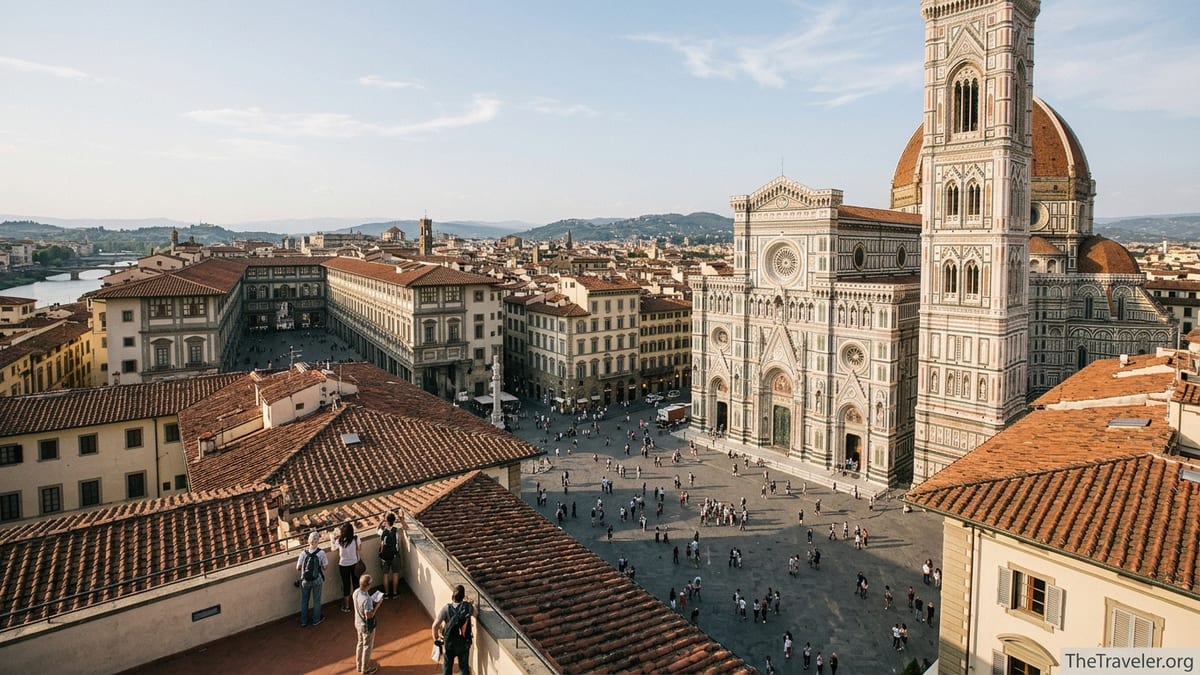
What Each Museum Actually Is
The Uffizi Gallery is Florence’s flagship art museum, a vast corridor of Renaissance painting and sculpture that grew out of the Medici family’s private collections. It spans several floors of a 16th century palace between Piazza della Signoria and the Arno, and is routinely described as one of the world’s great painting galleries. Visitors come for icons like Botticelli’s “Birth of Venus” and “Primavera,” Leonardo da Vinci’s early works, Raphael portraits and Caravaggio’s intense canvases. A full visit can easily stretch to three or four hours, even if you are selective.
The Opera del Duomo Museum serves a different purpose. Rather than being a generalized art museum, it is the backstage archive of Florence’s cathedral complex: the Duomo, Giotto’s bell tower and the Baptistery. Many of the original sculptures, reliefs and architectural fragments that once decorated the exterior now live here in carefully controlled conditions. The museum was thoroughly renewed in the mid‑2010s and today covers around 6,000 square meters over 28 rooms, with a modern, intuitive layout focused on telling the story of the cathedral and its builders.
In practice, this means that the Uffizi gives you the story of Florentine art in the context of Italy and Europe, while the Opera del Duomo Museum gives you the story of a single monumental project: Santa Maria del Fiore and its surrounding sacred spaces. One is broad and encyclopedic, the other focused and narrative. Which feels like “more” depends on whether you want a greatest‑hits overview of Renaissance art or a deep dive into Florence’s most famous building.
Many travelers end up seeing both, but if you are in Florence for only one full day or you have kids, jet lag or tight budgets to consider, choosing carefully can make the difference between an inspiring day and pure museum fatigue.
Tickets, Passes and Realistic Costs
Budget is often the first deciding factor. As of mid‑2026, a standard Uffizi ticket bought directly is around the high teens in euros in low season, and can rise significantly with seasonal pricing or special exhibitions. There is also a more expensive multi‑day combined ticket known as a Passepartout that includes the Uffizi, Pitti Palace and Boboli Gardens over five days and can reach several dozen euros in high season. Timed‑entry reservations are strongly recommended; buying on the day can mean long waits in peak months, and third‑party “skip the line” tickets add service fees on top of the base price.
The Opera del Duomo Museum, by contrast, is rarely sold as a standalone ticket. Instead, it is bundled into passes for the entire cathedral complex. The Brunelleschi Pass, typically around thirty euros for adults, includes the Duomo dome climb, Giotto’s bell tower, Baptistery, Santa Reparata archaeological area and the museum. The slightly cheaper Giotto Pass, usually about twenty euros, includes all of these except the dome climb. Both passes are valid for three calendar days from the activation date and require you to reserve only one timed slot, usually for the dome or bell tower climb; you can then visit the museum and other components at any point within the validity window.
If you compare like for like, a typical visitor who wants to climb the Duomo dome and also see the original sculptures and Ghiberti’s Baptistery doors inside the museum is effectively paying around twenty to thirty euros for an entire mini‑district of monuments, with the museum folded into the price. A Uffizi visit on its own will tend to cost slightly less than a full Brunelleschi Pass but more than a Giotto Pass, but you only get one building and one collection. If you are already planning to tour the Duomo complex, the Opera del Duomo Museum feels like excellent value. If your main goal is paintings and you have limited interest in climbing towers or visiting the Baptistery, the Uffizi ticket may stretch further for your particular interests.
In very concrete terms, consider a couple visiting in shoulder season. If they buy two Brunelleschi Passes and two basic Uffizi tickets, they may spend a figure approaching one hundred euros on admissions for these two sites alone. Opting for a Giotto Pass plus Uffizi may drop that by around twenty euros. Swapping the Uffizi for only the Duomo complex reduces the total further but also dramatically narrows the range of art they see. Framing your decision around how many museum hours you comfortably enjoy in a day will help you see where the value really lies.
Iconic Highlights: What You Actually See
When travelers ask which museum “gives you more,” they usually mean, “Where will I see the works I have heard of all my life?” On this front, the Uffizi is unmatched. It holds Botticelli’s “Birth of Venus” and “Primavera,” which alone draw queues of visitors with phones raised. You will also find Simone Martini’s delicate Gothic altarpieces, early Leonardo paintings like the “Annunciation,” Michelangelo’s powerful “Doni Tondo,” and portraits by Raphael. The later galleries move into dark, dramatic canvases by Caravaggio and his followers. Even casual museum visitors will recognize names on nearly every label.
The Opera del Duomo Museum is no slouch in the masterpieces department, but its stars are intimately connected with the cathedral rather than with general art history. One entire hall reconstructs the original medieval façade of the Duomo using surviving sculptures and architectural elements, so you can stand at eye level with prophets, saints and decorative reliefs that once sat high above the square. The museum houses Donatello’s haunting wooden “Penitent Magdalene” and his reliefs for the bell tower, Luca della Robbia’s lyrical marble cantoria, and, perhaps most famously, Lorenzo Ghiberti’s gilded “Gates of Paradise” Baptistery doors, now preserved indoors while replicas shine outside.
Another highlight is the section devoted to Brunelleschi’s dome, including models, tools and informative displays explaining how, in the 15th century, builders managed to raise such a massive self‑supporting structure without modern scaffolding. For travelers who loved Ross King’s book “Brunelleschi’s Dome,” this part of the museum feels like stepping into the story. By the time you climb the real dome or bell tower, you will have a much deeper appreciation for every brick and rib.
In short, if your Florence bucket list is defined by specific pictures you want to see on the wall, the Uffizi gives you more. If instead your goal is to understand how and why Florence built such a staggering cathedral, and to see the original artworks in a calm setting, the Opera del Duomo Museum delivers a more focused, story‑driven experience.
Time, Crowds and Overall Experience
Another way to look at “more” is to ask which museum gives you more enjoyment per hour. The Uffizi is famous for both its treasures and its crowds. In high season, even with timed entrance, you should expect lines at security, bottlenecks in the most famous rooms and a general background hum of tour groups. A focused visit that hits only the second‑floor highlights and perhaps one or two side rooms still usually takes at least two hours, not counting queuing or a coffee break. Many travelers leave exhilarated but also exhausted, with a camera roll full of masterpieces and sore feet from navigating the long corridors.
The Opera del Duomo Museum typically offers a calmer environment. Because visitor numbers are spread out across the Duomo complex and the museum is less of a bucket‑list item than climbing the dome, galleries inside can feel surprisingly spacious even on busy days. Benches are more common, sightlines are clear and the narrative layout leads you gently from one section to the next. Most visitors spend between 60 and 90 minutes here, often combining it with a Baptistery visit or a climb up the bell tower either just before or after.
From a time‑management standpoint, a morning at the Uffizi plus another major site like the Accademia can easily consume an entire day, leaving limited room for wandering Florence’s streets. By contrast, weaving the Opera del Duomo Museum into a half‑day circuit of the Duomo, Baptistery and tower climb often leaves the afternoon free for a stroll across the Arno, a long lunch in the Oltrarno or a sunset view from Piazzale Michelangelo.
If you are traveling with children, older relatives or anyone who does not thrive in dense crowds, the museum attached to the Duomo will almost certainly feel more manageable. Families often report that their kids engage more with the large, dramatic sculptures, models and short explanatory films in the Opera del Duomo Museum than with rows of paintings at the Uffizi, especially after a couple of days of European churches.
Accessibility, Layout and Practical Practicalities
Practical considerations such as opening hours, accessibility and restroom locations may seem minor, but they add up when you are trying to get the most out of a day in Florence. The Uffizi is open from early morning to late afternoon or early evening most days, typically Tuesday through Sunday. Mondays are usually closed. Early morning slots right at opening and later afternoon entries after the midday peak are often the most pleasant times to visit, with slightly fewer tour groups and more space in front of the big canvases. Independent travelers sometimes book a timed entry around 4 pm, spend two to three hours inside and then emerge for a twilight stroll along the river.
The Opera del Duomo Museum generally follows hours that start mid‑morning and run into late afternoon or early evening, varying by season. Because entry is included in the Duomo passes, you do not need a separate time slot for the museum itself, only for your climb. This allows you to be flexible. On a hot summer day, many travelers choose to do the physically demanding dome or bell tower climb as early as possible, then retreat to the air‑conditioned museum during the midday heat, using it as both a cultural highlight and a break from the sun.
In terms of physical layout, the Uffizi involves long, sometimes crowded corridors and a fair amount of walking. There are elevators and accessible routes, but they may require staff assistance. The Opera del Duomo Museum, designed more recently, tends to feel more accessible and intuitive, with lifts serving the different levels and more compact galleries clustered around a central hall. For visitors with limited mobility or those pushing strollers, the museum can be easier to navigate than the cathedral itself.
Facilities such as cloakrooms, cafes and restrooms are present at both, but the Uffizi’s on‑site cafe overlooking the inner courtyard is a particularly pleasant place for a short break, even if prices run higher than in a bar on a side street. Near the Opera del Duomo Museum, you are only a minute or two on foot from countless gelato shops and cafes around Piazza del Duomo, where you can refuel between the museum and a climb.
Which Museum Suits Which Traveler?
No single museum is objectively “better.” A more useful question is, “Which museum aligns with my interests and my energy level for this trip?” If you are an art history enthusiast, a photographer, or someone who has dreamed for years of standing in front of Botticelli’s Venus, the Uffizi is non‑negotiable. You will likely want to prebook a morning or late‑afternoon slot, download or pick up a map of the key rooms, and give yourself at least two hours to absorb the highlights without rushing.
If, however, you are primarily fascinated by architecture and engineering, or you have already scheduled a dome or bell tower climb, the Opera del Duomo Museum will probably feel like a more satisfying pairing. It contextualizes everything you see outside, from the marble cladding to the statues lining the Bell Tower, and you can often enjoy major works of sculpture at much closer range and in quieter rooms than in the Uffizi.
Short‑stay visitors, such as those coming to Florence for just one or two nights, often face a common dilemma: Uffizi or Duomo complex? In many cases, a well‑planned half day devoted entirely to the cathedral square, using a Giotto or Brunelleschi Pass and including the Opera del Duomo Museum, Baptistery and a climb, gives a stronger sense of Florence as a place than two pressured hours in the Uffizi. You physically move through the skyline you have seen in every postcard, then step inside to see the original artworks that once crowned it.
Repeat visitors, or those on longer trips, are in a different position. If this is your second or third time in the city, you might choose the Opera del Duomo Museum one trip and the Uffizi another, spreading out your “big museum” days across years. Some even break the Uffizi into multiple shorter visits using multi‑day passes, focusing on a specific school or era each time to avoid overload.
Strategies to Combine Both Without Museum Fatigue
Of course, the ideal scenario for many travelers is not Opera del Duomo Museum or Uffizi Gallery, but both. If time and budget allow, there are ways to see the two without burning out. One practical approach is to dedicate one morning to the Uffizi and a different half day, preferably not adjacent, to the Duomo complex and museum. For example, on day one you might book a 9 am Uffizi entry, stay until just after lunch and then spend the afternoon in the Oltrarno or strolling the markets rather than adding another major museum.
On day two, you could schedule an early bell tower or dome climb using your Duomo pass, then move directly into the Opera del Duomo Museum afterward, while your impressions of the views and the architecture are still fresh. Many visitors find that spending 60 to 90 minutes in the museum after a climb reinforces what they have just experienced, transforming what might have been a simple “checklist” activity into something meaningful.
Another tactic is to adjust expectations and pace inside the Uffizi. Instead of attempting to see everything in a single sweep, pick a limited set of goals: Botticelli, Leonardo, Michelangelo and Caravaggio, for example. Spend real time in those rooms, then accept that you do not need to read every label along the corridors. Travelers who adopt this curated approach generally emerge happier and still have energy to enjoy a relaxed evening, possibly saving the Opera del Duomo Museum for the following day.
Finally, if you are visiting in the hottest months, remember that both museums offer much‑needed air‑conditioned respite from the streets. Planning your climbs and outdoor walks for early morning or evening and using museum time for midday can help you stay comfortable while making the most of your tickets. In this sense, pairing the Uffizi one afternoon with the Opera del Duomo Museum on another hot midday may feel like getting “more” simply because your sightseeing aligns better with the climate.
The Takeaway
When you strip away the marketing and focus on the experience, the Uffizi Gallery “gives you more” if your definition of value is measured in world‑famous paintings per square meter. It is the place to commune with Botticelli, Leonardo, Raphael and Caravaggio, set amid an elegant Medici palace and framed by river views. It demands time, attention and tolerance for crowds, but it repays that investment with some of the most important works of art you will ever see in one building.
The Opera del Duomo Museum, on the other hand, “gives you more” if you prize depth of understanding over breadth of collection, or if you want your ticket to cover not just indoor galleries but a whole ensemble of monuments. Folded into the Brunelleschi or Giotto passes, it contextualizes your climb of the dome or bell tower, your visit to the Baptistery and your time in the shadow of the Duomo’s marble façade. It is calmer, easier to digest and deeply rooted in the lived fabric of Florence.
For a first‑time visitor with only one museum slot and a strong interest in painting, the Uffizi is the clear choice. For someone focused on the cathedral, architecture and sculpture, or for families who prefer a shorter, more tactile museum visit combined with outdoor experiences, the Opera del Duomo Museum may feel richer. Many travelers find that the perfect solution is to give each its own dedicated half day on separate dates, allowing Florence’s layers of art and faith to unfold at a human pace.
Whichever you choose, booking official tickets in advance, arriving well rested and giving yourself permission not to see everything will help ensure that your museum day in Florence feels like a highlight rather than a marathon.
FAQ
Q1. If I only have one day in Florence, should I choose the Uffizi or the Opera del Duomo Museum?
If you are passionate about painting and want to see Botticelli, Leonardo and other Renaissance masters, prioritize the Uffizi. If your focus is the cathedral, its architecture and sculpture, and you plan to climb the dome or bell tower, the Opera del Duomo Museum within a Duomo pass usually provides a more coherent and less tiring day.
Q2. How much time should I plan for each museum?
Most visitors should allow at least two hours for a highlights‑focused visit to the Uffizi and up to three hours if they enjoy reading labels and exploring side rooms. The Opera del Duomo Museum typically takes 60 to 90 minutes for a satisfying visit, often combined with time in the Baptistery and a dome or bell tower climb.
Q3. Which option is better value for money?
The Uffizi offers exceptional value if your main goal is to see as many world‑class paintings as possible in one place. The Opera del Duomo Museum is excellent value when you factor in that its entry is bundled with a Duomo complex pass, which also covers monuments like the dome or bell tower, Baptistery and archaeological area. For travelers planning to do those anyway, the museum effectively comes at a low incremental cost.
Q4. Are there long lines at both museums?
The Uffizi often has substantial lines, especially from late morning through mid‑afternoon in high season, and timed‑entry reservations are strongly recommended. The Opera del Duomo Museum itself usually has shorter waits, though there can be queues for security or for climbs within the Duomo complex. Arriving early in the day or later in the afternoon generally helps at both.
Q5. Which museum is better for children and non‑experts?
Families and casual visitors often find the Opera del Duomo Museum more approachable, thanks to its shorter visit time, dramatic sculptures, models and clear storytelling about the cathedral. The Uffizi can be rewarding but may feel overwhelming to children or those with limited interest in paintings unless you carefully select a few highlights and keep the visit short.
Q6. Can I visit the Opera del Duomo Museum without climbing the dome or bell tower?
Yes. While the museum is generally included in Duomo complex passes, you are not required to do a climb to use your ticket. If you prefer to avoid stairs or heights, you can still visit the museum, the Baptistery and the cathedral’s interior, tailoring your use of the pass to your comfort and mobility.
Q7. Is there a combined ticket for the Uffizi and the Duomo complex?
There are occasional combined offers and multi‑attraction passes sold by various providers, but most visitors buy Uffizi tickets and Duomo passes separately. Given that conditions and pricing change, it is safest to compare current options on the official Uffizi and Opera del Duomo channels and be cautious of third‑party markups that promise “skip the line” without adding real value.
Q8. Which museum is more accessible for visitors with limited mobility?
Both museums have elevators and accessible routes, but the Opera del Duomo Museum generally offers a more compact, modern layout that is easier to navigate than the Uffizi’s long corridors. However, climbs to the dome or bell tower involve many stairs and are not suitable for those with mobility limitations, so plan to focus on the museum, Baptistery and cathedral interior if accessibility is a concern.
Q9. When is the best time of day to visit each museum?
For the Uffizi, early morning right at opening or late afternoon entries tend to be less crowded than the late‑morning peak. For the Opera del Duomo Museum, many travelers prefer late morning or early afternoon, using it as an air‑conditioned break after an early climb or before an evening stroll, though it is usually manageable throughout the day outside of the very busiest weeks.
Q10. As a repeat visitor to Florence, is one of these museums more rewarding to revisit?
Both reward repeat visits, but in different ways. The Uffizi’s sheer scale means you can focus on different sections each time and still discover new works years later. The Opera del Duomo Museum changes more slowly, yet returning after reading about the cathedral or seeing new restoration updates can deepen your understanding. Many repeat visitors alternate, revisiting the Uffizi on one trip and the Opera del Duomo Museum on another.