


The first time I walked across Manhattan without a plan, I expected a single, continuous blur of noise and neon. Instead, what stunned me most was how quickly the city’s energy flipped, sometimes within the space of a single crosswalk. A block that felt like the center of the universe would dissolve, one corner later, into something closer to a quiet village. That block-by-block whiplash is not a glitch in Manhattan’s design. It is the point.
Get the latest updates straight to your inbox!
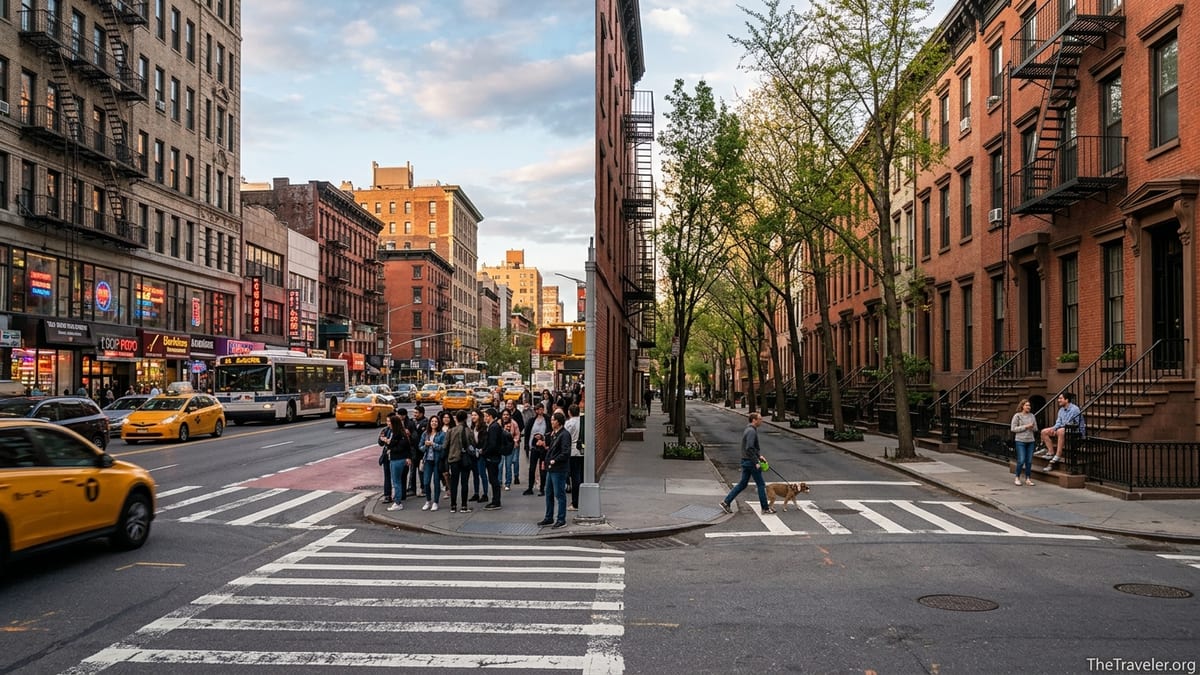
From Times Square Frenzy to Side Street Calm in Under a Minute
Nowhere captures Manhattan’s mood swings more clearly than Midtown. Stand at the corner of Broadway and West 45th Street in Times Square at 7 p.m. and the volume is almost physical: LED billboards bathing everything in sharp color, street performers competing with ticket hawkers, costumed characters negotiating photos, and a near-constant honk of taxis and rideshares. It is the version of New York many travelers brace for, right down to the $6 coffee and tourist shops selling “I Love NY” shirts late into the night.
Walk one short block west to Eighth Avenue, then slip onto a side street like West 46th between Eighth and Ninth. The transformation is jarring. The light softens. Neon gives way to brick walk-ups, a row of neighborhood restaurants, and the low hum of people lingering over dinner instead of racing to a show. Delivery bikes glide past instead of tour buses. On many evenings you can hear fragments of conversation instead of just the roar of traffic. Hotel prices might only shift slightly from one block to the next, but the daily soundtrack changes completely.
Keep walking another block or two, toward Ninth Avenue and Tenth, and you feel Midtown loosening its tie. New glass towers appear, but the sidewalks thin out. You might pass a small grocery where locals line up for pantry staples, or a laundromat with its doors propped open. Theaters and billboards are suddenly behind you, even though you are still technically in the same neighborhood. Manhattan teaches quickly: you cannot judge the next block’s energy by the one you are standing on.
Village Streets That Swing From Campus Buzz to Storybook Quiet
Downtown, the contrasts soften in scale but stay just as sharp. Take Greenwich Village, roughly between West 14th Street and Houston Street. Stand by Washington Square Park on a warm afternoon and the scene feels almost theatrical: NYU students crisscross the plaza, buskers play near the fountain, chess players tap clocks at the park’s edge, and dogs tangle leashes along the walkways. You could easily spend an hour here without realizing how compressed all this energy really is.
Walk west along West 4th or Waverly Place, peeling away from the park, and within two or three blocks the mood shifts to something quieter and more residential. Tree-lined streets with brick facades, stoops draped in ivy, and brownstones with bicycles locked to railings take over. Short cul-de-sacs and narrow lanes, especially around stretches of West 10th and its side streets, feel almost insulated from the park’s constant motion, even though you are only a five-minute walk away.
Turn one corner too many, though, and you can land on a livelier corridor again. A block like Bleecker near Seventh Avenue bounces with small boutiques, bakeries, and long-established restaurants. On a Saturday night, diners spill toward the curb, and the line outside a beloved pizzeria might snake past quiet residential doors. Travelers walking without a map experience it in real time: a quiet gallery of townhouses followed by a block that is suddenly all clinking glasses and late-night dessert.
The Lower East Side: One Block Party, One Block Residential
Nowhere dramatizes block-by-block energy shifts quite like the Lower East Side. On the map it reads as a single neighborhood, bounded loosely by Houston Street to the north and Canal Street to the south. On the ground, it feels more like a mosaic of micro-districts that collide at the intersections. Stand on Ludlow Street near Rivington on a weekend night and the street is almost fully given over to nightlife: music vibrating from basement venues, bars shoulder-to-shoulder, and crowds drifting in clusters from one doorway to the next.
Yet only a short walk away, toward blocks lined with mid-rise apartment buildings, the noise drops off. Head a couple of streets east toward the public-housing towers closer to the East River and you find a residential quiet punctuated not by bar chatter but by kids playing basketball, people walking dogs, and neighbors talking on benches. The same neighborhood name applies, but it feels like a completely different city rhythm. Rents for new luxury units on the livelier arteries might run in the mid four-figure range for a one-bedroom, while older, more residential blocks remain comparatively less glossy in both finish and atmosphere.
Even within a single street, micro-shifts show up. Orchard Street, for example, has long been associated with immigrant history and small-scale commerce. Walking those eight city blocks today, you pass a mix of boutique hotels, remaining discount shops, contemporary galleries, and tenement buildings layered with decades of stories. On some corners you are surrounded by visitors photographing murals; half a block later, a quiet patch of sidewalk might host nothing more dramatic than someone carrying their groceries home.
Side Streets vs Avenues: Two Different Manhattans
Many of Manhattan’s most dramatic energy swings trace a deceptively simple pattern: avenues for movement, side streets for life. Broad corridors like First, Second, and Third Avenue on the East Side, or Seventh and Eighth Avenue in Midtown, carry buses, bike lanes, and streams of taxis. These are where you find national chain pharmacies, larger supermarkets, and the crush of commuters heading to the subway at rush hour. Step onto an avenue at 8:30 a.m. near a major station such as Lexington Avenue and 86th Street and nearly every square foot feels in motion.
Slip mid-block to a side street, even one that runs between the same two avenues, and the shift can be instant. In neighborhoods like Kips Bay or Chelsea, for example, side streets in the high 20s or low 20s often soften into rows of walk-ups, small rental buildings, and a scattering of independent cafes or corner delis. The soundscape changes from engine noise to the clink of dishes from a ground-floor restaurant or the muffled thud of someone carrying laundry down the steps.
This pattern repeats across much of the island. On the Upper East Side, avenues can feel almost relentlessly vertical and polished, with tall residential towers and continuous traffic. Yet turn toward a block in Carnegie Hill or farther east into a pocket of older townhouses and you find calmer corners with more sky and slower footsteps. A traveler booking a hotel purely by neighborhood name might land on a second-floor room directly over a busy bus route, when the same money two blocks away would buy a deeply quieter experience with the same access to the subway.
Hidden Enclaves That Feel Like a Different City
Part of the surprise of walking Manhattan is discovering entire micro-neighborhoods tucked just out of view from major arteries. One clear example sits in Midtown East: Tudor City, a compact enclave near East 42nd Street. From the chaos of commuters heading into Grand Central Terminal, you walk a few minutes east and climb a short rise. Suddenly, the atmosphere shifts to manicured pocket parks, historic residential towers, and narrow streets that feel curiously self-contained. Office workers and tourists hurry past just a block away, but inside the enclave you hear birds, footsteps on brick, and the occasional rolling suitcase.
Similar pockets exist on both sides of the island. On the far East Side, Sutton Place gathers along a short stretch near the East River. Tree-lined streets, small riverside plazas, and a slower residential pace make it feel worlds apart from the traffic on nearby First Avenue. On the West Side, certain stretches of the Upper West Side or the riverfront near Riverside Park mix historic rowhouses and quietly elegant apartment buildings in a way that feels far calmer than the Broadway corridor only a block or two away.
Even downtown’s SoHo hides calm within its famously photogenic streets. A block like Greene Street between Spring and Prince, for instance, showcases classic cast-iron facades and cobblestones, yet can read as markedly quieter than shopping-heavy corners nearby. Tourists tend to crowd the better-known intersections, leaving some of the side blocks to residents walking dogs, gallery visitors slipping in and out of discreet doorways, and the occasional photoshoot working around parked delivery vans.
Why Manhattan Changes So Fast: History, Zoning, and Sheer Density
The reason Manhattan’s mood can pivot in the span of a single crosswalk is rooted in a mix of history and planning rather than accident. Streets layered with immigrant histories, like stretches of the Lower East Side, sit next to corridors reshaped by luxury development and hotel construction. Historic districts protect rows of 19th-century townhouses in parts of the Upper West Side, Greenwich Village, and Gramercy, keeping a lower scale on certain blocks while surrounding avenues climb taller. The result is a patchwork where building age, height, and use change in sudden, striking ways.
Zoning overlays reinforce this variety. Some blocks are zoned for towers with ground-floor retail, drawing in chain stores and heavy foot traffic. Others are limited to mid-rise or low-rise residential use, which naturally dampens commercial noise. A single avenue can describe a history of the city in a matter of blocks: older walk-ups giving way to glass condos, then institutional buildings, then quiet side streets where nothing taller than a small apartment house interrupts the trees.
Manhattan’s density magnifies every small difference. A single new hotel can reorient evening foot traffic for several surrounding blocks. A popular cafe opening on a corner can turn a previously overlooked stretch into a brunch destination, with lines that spill down the sidewalk every weekend. Conversely, a block with no major storefronts may stay surprisingly tranquil, even if it sits between two of the busiest intersections in the borough. For visitors, the lesson is simple but powerful: the name of the neighborhood tells only part of the story. The precise corner matters.
How Travelers Can Navigate These Energy Swings
Once you start noticing how quickly the city’s energy pivots, you can use it to your advantage. If you want to feel the full force of Manhattan in a single walk, choose a route that weaves across different types of blocks. For example, start at Times Square, cut west toward Hell’s Kitchen’s restaurant rows, then swing south through Chelsea’s gallery streets and into the Meatpacking District, finishing on the High Line. Each segment reveals a distinct tempo, and the transitions between them are half the story.
For a gentler day, look for accommodations that sit just off a busy avenue rather than directly on it. In Midtown East, lodging one block behind Lexington Avenue can mean lighter traffic noise while still keeping you within a short walk of major subway lines. Downtown, a hotel on a quiet side street in Tribeca or the West Village can deliver the classic stoop-and-tree feeling while still placing you a few blocks from busier dining and nightlife corridors in SoHo or the East Village.
When planning meals or evenings out, think in terms of adjacent energies. You might book a dinner on a lively block of the Lower East Side, then plan a short stroll afterward into a quieter residential stretch toward the river, where you can hear your own conversation again. In the East Village, you can start at a packed ramen spot on a major avenue, then turn onto a side street filled with small vintage shops and lower-key bars, where the volume and pace drop without requiring a cab ride.
The Takeaway
Manhattan’s reputation as a nonstop, around-the-clock city is only half-true. Yes, there are blocks where the lights never dim and the traffic never fully pauses. But equally real are the stretches where trees outnumber neon signs, where people know their neighbors by name, and where the loudest sound at night might be a garbage truck rumbling through once before dawn. All of this can exist within a radius of a few hundred meters.
For travelers, the biggest surprise is often that you do not need to choose between “energetic” and “quiet” New York. You can wake up on a calm, leafy side street, spend your afternoon in the thick of Midtown, then finish the evening on a cobblestone in SoHo that feels almost cinematic in its calm. The city’s true character emerges not on the postcard-famous corners but in the way one block slides into the next, each with its own rhythm.
Walk Manhattan without rushing, and you begin to feel those rhythms like shifting gears. The city stops being a single blur and becomes a sequence of neighborhoods, then streets, then individual blocks that each hold a slightly different story. That block-by-block transformation is the island’s greatest trick, and once you notice it, you will never walk New York the same way again.
FAQ
Q1. Why does Manhattan’s energy feel so different from one block to the next?
Manhattan’s block-by-block shifts come from a mix of history, zoning, and density. Older residential streets, commercial avenues, protected historic districts, and new development all sit tightly together, so crossing a single intersection can move you between areas built for nightlife, commuting, or quiet everyday living.
Q2. Which neighborhoods show the biggest contrast between busy and quiet blocks?
The Lower East Side, East Village, Greenwich Village, SoHo, Midtown around Times Square, and parts of the Upper East and Upper West Sides all offer strong contrasts. A nightlife-heavy street or major avenue often sits within a few minutes’ walk of calmer residential blocks with trees, stoops, and far less foot traffic.
Q3. How can I find a quiet hotel in Manhattan without giving up convenience?
Look for hotels on side streets rather than main avenues, especially in areas like Midtown East, the Upper West Side, Tribeca, or the West Village. Being even one block off a busy corridor often reduces noise and crowds while keeping you within a short walk of subway stations and major sights.
Q4. Are side streets always quieter than avenues?
They usually are, but not always. Some side streets host bars, restaurants, or music venues that stay lively late into the night. In general, though, avenues carry more vehicle traffic and buses, while mid-block residential streets see mainly local foot traffic, deliveries, and people coming and going from their buildings.
Q5. What is a good walking route to experience these energy changes in one afternoon?
One option is to start in Times Square, walk west into Hell’s Kitchen, continue south through Chelsea toward the Meatpacking District, then climb onto the High Line and follow it toward Hudson Yards or the West Village. You will pass through theater crowds, local restaurant rows, gallery blocks, and park-like walkways in a single continuous walk.
Q6. Do prices, like rent or hotel rates, change much from block to block?
They can. A building on a prime nightlife or shopping corridor often commands higher prices than a similar building a few quieter blocks away, especially in Downtown neighborhoods and around Midtown. That said, overall costs remain high across most of Manhattan, so think in terms of relative differences and atmosphere rather than expecting major bargains a single block over.
Q7. How can first-time visitors avoid feeling overwhelmed by busy blocks?
Plan your days so that intense areas like Times Square or major shopping streets are balanced with time in nearby parks, quieter side streets, or more residential neighborhoods. Moving just a block or two off crowded avenues, taking breaks in places like Bryant Park or Washington Square Park, and staying in a calmer area overnight all help keep the pace manageable.
Q8. Are there specific micro-neighborhoods that feel especially peaceful?
Yes. Pockets like Tudor City in Midtown East, Sutton Place on the East River, certain stretches of the Upper West Side near Riverside Park, and townhouse-heavy blocks in Greenwich Village or Gramercy often feel surprisingly calm. They sit close to busy routes but maintain a distinctly residential, slower mood.
Q9. Is it safe to explore quieter side streets at night?
Many residential side streets in Manhattan are well used and feel comfortable to walk, but conditions vary. Stick to areas with reasonable lighting, follow your instincts, and consider staying near main routes if you are unfamiliar with the neighborhood. Checking recent local advice and asking hotel staff for guidance can help you choose sensible routes after dark.
Q10. How should I choose where to stay if I want both nightlife and rest?
Choose a hotel that sits within a short walk of a lively corridor but not directly on it. For example, you might stay on a residential block in the West Village or Tribeca and walk ten minutes to busier dining and bar streets. That way you can enjoy Manhattan’s high-energy nights, then retreat to a quieter block when you are ready to sleep.