


Ask people in Antibes where they actually go for a swim on a summer evening, and Plage de la Salis comes up again and again. This long curve of pale sand, just south of the old town and at the gateway to Cap d’Antibes, is not the most glamorous beach on the Côte d’Azur. That is exactly why locals love it. With calm, clean water, postcard views of the ramparts and distant Alps, and straightforward access on foot, by bus, or by bike, Salis is the beach that fits into everyday life as comfortably as it does into a holiday itinerary.
Get the latest updates straight to your inbox!
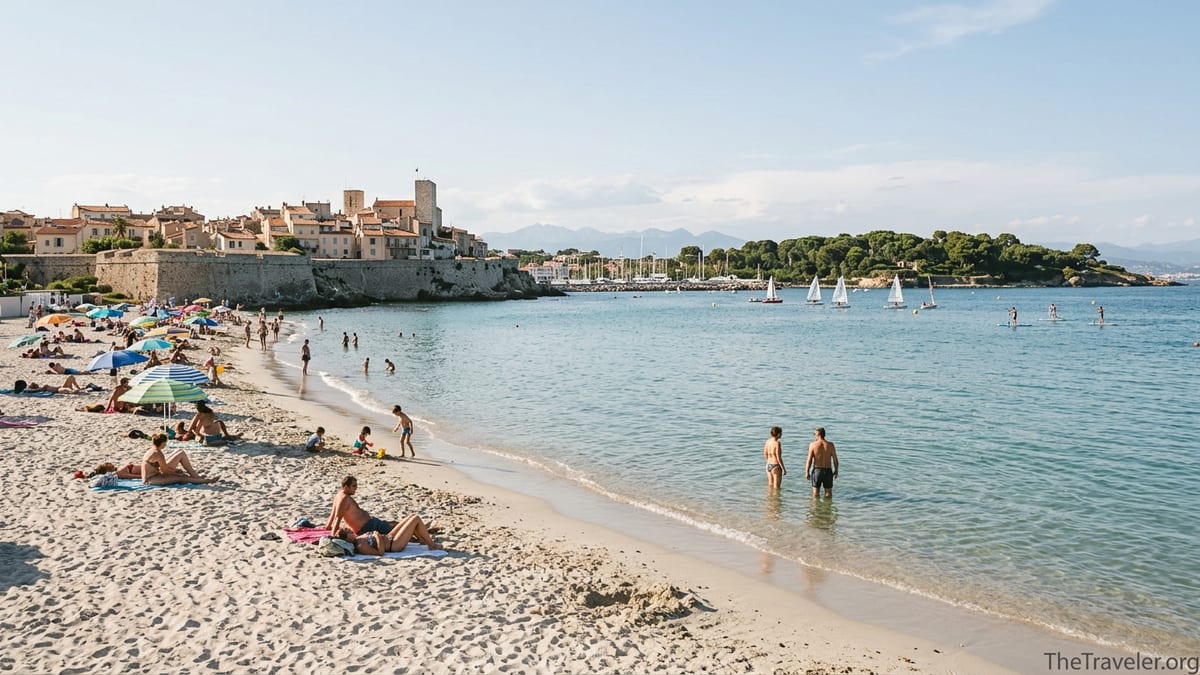
A Classic Antibes Beach With Everyday Charm
Plage de la Salis sits along Boulevard James Wyllie, between Antibes’ fortified old town and the start of Cap d’Antibes. The beach stretches for roughly half a kilometer in a gentle arc, giving swimmers plenty of space to spread out even in high season. On one side you look back toward the ochre facades and stone ramparts of Vieil Antibes; on the other, the wooded headland of the Cap pushes into the sea. Behind it all, on clear days, the far-off outline of the Alps frames the horizon.
Unlike some Riviera beaches that are mostly private, Salis is almost entirely public. There are no dense rows of paid loungers blocking the view, and you can simply drop a towel wherever you find a gap in the sand. Local residents appreciate this freedom. Many finish work, drive or cycle down, and are in the water within minutes without committing to an all-day rental. A couple living near Place Nationale described Salis as their “evening garden,” somewhere they can wander down to for a quick swim at sunset without planning ahead.
The atmosphere reflects that everyday use. In the mornings you might see retirees swimming slow laps parallel to shore, students from the local lycée sharing takeaway coffees on the wall by the sidewalk, and parents coaxing toddlers into the shallows. By late afternoon, office workers appear with a book and a beach bag. The mood is relaxed and quietly social rather than showy, an appealing contrast to the high-gloss beach clubs further along the coast.
Why Swimmers Rate the Water So Highly
For regular swimmers, water quality is non-negotiable, and this is where Plage de la Salis has built a strong local reputation. Independent guides that track weekly testing along the Antibes coastline consistently note Salis among the cleanest beaches in town, with good results through much of the summer season. Locals pay close attention to these reports, and many choose Salis specifically because of this record when deciding where to swim with children.
The geography helps. The beach curves inside a relatively protected bay, which softens waves and reduces the churn that can stir up debris. The sand underfoot is mostly fine and light, so the water tends to look clear and turquoise once the sun is high, especially from late morning onward. Regular users know that visibility is often at its best after a calm night, when the surface can resemble glass and you can see your toes as soon as you wade knee-deep.
Another factor that locals mention is the gentle slope of the seabed. Rather than dropping away abruptly, the water deepens slowly. This makes it possible to walk a fair distance from shore while still standing, which is reassuring for less confident swimmers. Parents often stand waist-deep chatting while children paddle nearby with inflatable rings. Stronger swimmers, meanwhile, use the gentle gradient as a warm-up, walking out chest-deep before setting off on longer parallel laps toward the headland.
Even in midsummer, when much of the Riviera can feel crowded, residents say you can often find relatively calm pockets of water at the far ends of Salis. Early risers in particular talk about having the sea almost to themselves at 7 or 8 in the morning in July, sharing the water mostly with a few stand-up paddleboarders and the occasional sailing dinghy from the neighboring yacht club.
Views That Capture the Essence of Antibes
What distinguishes Plage de la Salis from many practical urban beaches is the quality of the scenery. Face west and you are looking straight back at Antibes’ postcard side: the old ramparts running down to the harbor, terracotta roofs piled above narrow streets, and the towers of the historic château that now houses the Picasso Museum. As the sun begins to drop, the stone glows gold and the town seems to float above the sea.
Turn a little and the panorama takes in the curve of Plage du Ponteil and the marinas around Port Vauban, where forested masts and the silhouettes of superyachts punctuate the horizon. On clear days, particularly after a mistral has blown through, the outline of the Mercantour peaks is visible far inland. Longtime residents point out that the combination of old town, mountains, and harbor in a single view is what makes this spot feel “so Antibes” to them.
The eastern end of the beach, meanwhile, puts you at the doorstep of Cap d’Antibes. From here you can make out the start of the Sentier du Littoral coastal path wrapping around the headland and, further on, the direction of the famous Garoupe and Keller beaches. Many locals tie a swim at Salis into a longer walk. A common routine is a late afternoon stroll along the coastal path, then a final dip back at Salis just before heading home for dinner in the old town.
At night, the views change character again. Streetlights trace the curve of the shoreline and the glow from cafés and apartments in the old town flickers across the bay. Locals out for a summer walk often pause on the low wall behind the sand to watch the reflections, gelato in hand, while the last swimmers of the day stroke slowly in the darkening water.
Easy Access That Fits Real Life
One of the biggest reasons locals favor Plage de la Salis is how simple it is to reach. From the heart of old Antibes, it is a straightforward 15 to 20 minute walk: leave the ramparts behind, follow the waterfront past Plage du Ponteil, and you arrive at Salis without hills or detours. This flat, scenic route makes it realistic to factor a swim into ordinary errands or a morning market run rather than treating it as a separate excursion.
Public transport is equally practical. The local Envibus network serves the shoreline, with stops named for “Plage de la Salis” or nearby landmarks positioned directly on Boulevard James Wyllie. Tickets are inexpensive by Western European standards, with single rides typically costing around the price of a coffee at a local café. Visitors arriving by train at Antibes station often take a short bus ride or an easy 25 minute walk through town to the beach, a route that locals use themselves after commuting home from Nice or Cannes.
For drivers, there is a dedicated Salis car park at the eastern edge of the beach, along with on-street spaces lining the boulevard. Residents know the rhythm of parking availability. From mid-September to mid-June, parking here is usually free and fairly easy outside of sunny weekends. In peak season, the municipality introduces modest daytime charges and regulars aim to arrive before about 10:00 in the morning or after 5:00 in the afternoon to avoid circling. It is common for families staying in hillside neighborhoods to load the car with umbrellas and cool boxes for a full beach day, timing their arrival with these local patterns.
Cyclists and e-scooter users benefit from a largely flat seafront route, and you will often see bikes chained to railings or signs behind the sand. Antibes has gradually improved bike access along the coast, and residents who prefer to avoid summer traffic appreciate being able to pedal from residential areas such as La Fontonne or the hills above town straight to Salis in under half an hour.
Facilities That Make Staying All Day Simple
While Salis lacks the polished beach-club service of private strands, it offers just enough infrastructure to make long beach days straightforward. Showers are spaced along the waterfront, allowing swimmers to rinse off salt and sand before heading back into town. Public toilets in and around the nearby yacht club area provide basic amenities without needing to duck into a café, something parents with young children and older swimmers especially value.
In high season, a lifeguard post is staffed for much of the day, typically from morning into early evening. Locals report that guards are vigilant about keeping designated swim zones clear of boats and paddlecraft and quick to remind swimmers not to venture beyond safe boundaries when conditions change. This visible safety presence is one reason families and less confident swimmers choose Salis rather than more remote rocky coves.
Several kiosks and casual snack stands line the edge of the beach, selling standard Riviera fare: panini, ice creams, bottled drinks, and simple salads. Prices are naturally higher than in a supermarket but still within a range that local teenagers and office workers can justify for an occasional treat. Many residents keep costs down by stopping at a small supermarket or bakery in town first, picking up baguette sandwiches, fruit, and a chilled bottle of rosé, then using the kiosks mainly for a late-afternoon espresso or an ice cream for the children.
Rental options around Salis are modest but useful. The neighboring yacht club offers sailing classes and, in season, rentals of kayaks and stand-up paddleboards. It is common to see locals who have taken courses here returning each summer to refresh their skills, or families signing children up for a week of sailing stages while parents enjoy quieter swims nearby. Equipment like inexpensive inflatable loungers and beach toys is widely sold in nearby newsagents and mini-markets, so visitors do not need to arrive fully equipped to settle in comfortably for the day.
Accessibility and Calm for Families and All Ages
Plage de la Salis has earned a strong following among residents with limited mobility and families pushing strollers. The flat promenade-level sidewalk behind much of the beach, combined with ramps down to the sand at key points, makes accessing the shore more manageable than at many steeper or rockier coves along the Riviera. The beach has also been recognized under national accessibility labels in recent years, which typically involve features such as adapted pathways and assistance for swimmers who need support reaching the water.
For families, the mix of shallow entry, lifeguard presence in season, and relatively sheltered bay is particularly attractive. Parents in Antibes often contrast Salis with pebbly stretches in nearby cities where the seabed drops more steeply. Here, small children can sit and play at the water’s edge, and adults can stand within arm’s reach for quite a distance. The absence of heavy traffic directly along the sand adds another layer of comfort; behind the beach is a sidewalk and narrow road rather than a busy multilane thoroughfare.
The tone on the sand tends to be low-key. While summer weekends do bring groups of friends with portable speakers, local norms favor keeping music at a moderate volume, and most people come for swimming, sunbathing, and conversation rather than all-day partying. Early morning and late evening are notably tranquil, drawing older residents and serious swimmers who prefer silence or the sounds of the sea over any kind of buzz.
Because the beach is so integrated into daily routines, a sense of community often develops among regulars. People begin to recognize one another over the season: the couple who always arrives with folding chairs at 8 a.m., the group that plays beach bat-and-ball near the same lifeguard post every Sunday, the parents who coordinate meetups so their children can play together. Visitors who return for multiple summers sometimes find themselves folded into these informal circles, another reason the beach feels welcoming rather than anonymous.
How Locals Actually Use Plage de la Salis
Talking with residents, what comes through most strongly is how flexible Salis is. A young professional renting an apartment near the Albert 1er axis described a typical weekday in July: working remotely until late afternoon, then walking 10 minutes down to the beach for a 30 minute swim, showering at the beach, and heading straight into the old town for dinner with friends. The whole sequence requires no car, no reservations, and minimal planning.
Families in neighborhoods a short drive away treat Salis as their “default” beach. On days when grandparents are visiting or when cousins are in town, they will often choose Salis over smaller, more glamorous spots on Cap d’Antibes simply because logistics are easier. There is space for children to run around, toilets and snacks close at hand, and good chances of finding a parking space if they arrive by mid-morning. If the weather changes or younger children get tired, they can be back in the car and home in under 20 minutes.
Older residents use the beach almost as an open-air swimming pool. Many keep simple routines, such as swimming 20 widths of the designated zone every morning from May through October, then sitting to chat on the low wall with friends. The consistency of access and conditions at Salis makes these habits sustainable in a way that more exposed or remote beaches cannot match, especially for those who no longer drive and rely on the bus network or their own two feet.
Visitors staying in town quickly slip into similar patterns. A couple renting an apartment in Antibes for a week might browse the Provençal market in the morning, rest through the hottest part of the day, then stroll to Salis at 5 p.m. for a long swim and picnic dinner on the sand. Others use the beach as a gentle introduction to Mediterranean swimming before venturing to rockier coves or boat-access-only spots later in their trip. In each case, Salis serves as a dependable constant in an otherwise varied Riviera itinerary.
The Takeaway
Locals in Antibes do not love Plage de la Salis because it is the most spectacular or exclusive beach on the Côte d’Azur. They love it because it works. The water is reliably clean, the seabed slopes gently, and the views of the old town, harbor, and distant mountains make every casual swim feel special. Access on foot, by bus, by bike, or by car is straightforward enough that a dip can be squeezed between everyday commitments rather than reserved for rare occasions.
For travelers, choosing to spend time at Salis offers a chance to experience Antibes at its most authentic. You share the sand not just with other visitors but with residents who have woven the beach into their daily lives. Watch how they arrive lightly packed, how they time their swims around the sun and crowds, and how naturally they drift between the sea and the streets of the old town. In doing so, you will understand why this unpretentious curve of sand holds such a central place in local hearts.
FAQ
Q1. Where exactly is Plage de la Salis in Antibes?
Plage de la Salis lies along Boulevard James Wyllie, a flat waterfront road between Antibes’ old town and the start of Cap d’Antibes, about a 15 to 20 minute walk from the town ramparts.
Q2. How can I get to Plage de la Salis without a car?
You can walk from the old town along the seafront, take an Envibus service that stops near “Plage de la Salis,” or cycle along the mostly flat coastal route from other parts of Antibes.
Q3. Is the water at Plage de la Salis clean for swimming?
Regular testing along the Antibes coastline has shown Salis to have consistently good water quality, and locals often choose it specifically for its clean, clear conditions.
Q4. Is Plage de la Salis suitable for children and non-swimmers?
Yes. The seabed slopes gently, the bay is relatively sheltered, and in high season lifeguards supervise designated swim zones, making it popular with families and cautious swimmers.
Q5. Are there showers and toilets at the beach?
Yes. Freshwater showers are spaced along the beach, and public toilets are available in and around the nearby yacht club area, which locals use throughout the season.
Q6. Can people with reduced mobility access Plage de la Salis?
The beach has ramps and an accessible promenade level, and it has been recognized under national beach accessibility schemes, making sea access easier than at many rocky coves.
Q7. Is parking available near Plage de la Salis?
There is a dedicated Salis car park and on-street spaces along Boulevard James Wyllie. Parking is easier outside peak hours and outside high summer weekends.
Q8. Are there places to eat near the beach?
Snack kiosks on and behind the beach sell sandwiches, ice creams, and drinks, while small restaurants, bakeries, and supermarkets in the nearby streets offer more substantial food options.
Q9. Do I need to pay for sun loungers at Plage de la Salis?
No. Salis is largely a public beach where most people bring their own towels and umbrellas. If you prefer full-service loungers, private beach clubs are located on other nearby beaches.
Q10. When is the best time of day for a quieter swim?
Early mornings and late evenings are usually the calmest times, when locals come for laps before work or a quick dip at sunset and the beach is less crowded.