


On a glossy map, Banff, Lake Louise, the Icefields Parkway, and Jasper look like neighbors along a single scenic road. Many travelers arrive in Alberta imagining a compact loop of turquoise lakes and glacier views, with short hops between each highlight. The reality on the ground is very different: the Canadian Rockies cover a vast, mountainous region where distances are long, speeds are slow, and it is easy to spend more time behind the wheel than on actual trails or viewpoints. Underestimating the driving involved is one of the most common planning mistakes visitors make.
Get the latest updates straight to your inbox!
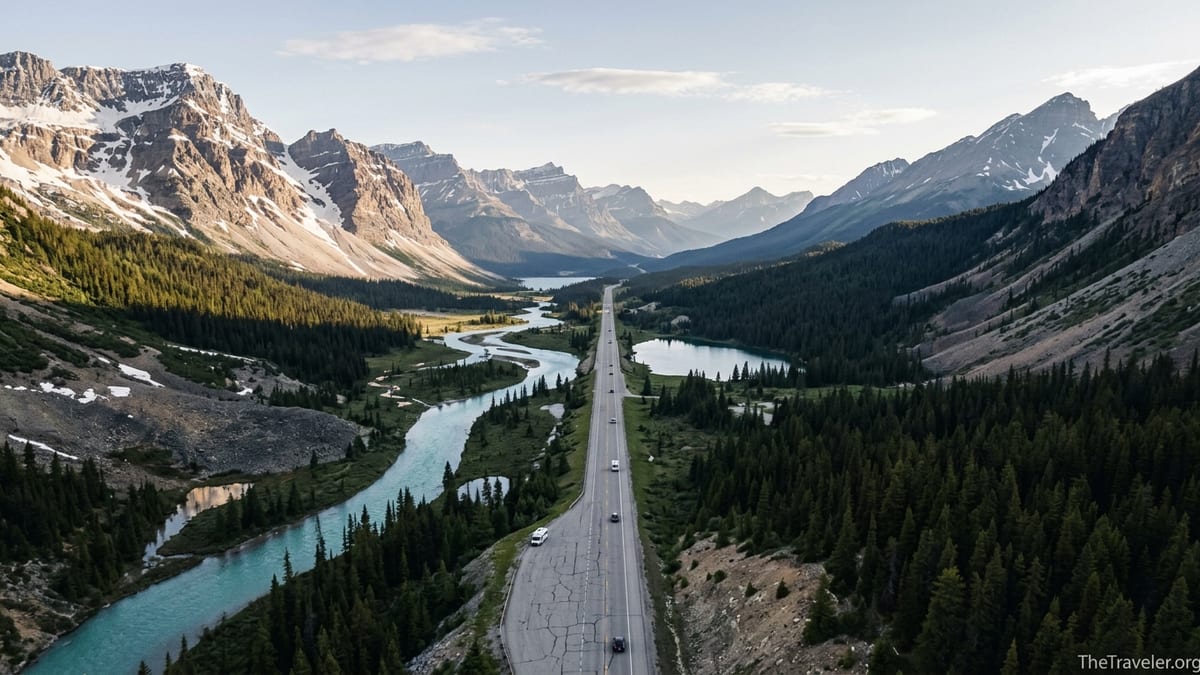
Why the Rockies Feel Smaller on the Map Than on the Road
The stretch most people picture when they think of the Canadian Rockies is the corridor from Calgary to Banff, Lake Louise, the Icefields Parkway, and Jasper. On a screen, that looks like a simple line. On the road, it adds up quickly. The Icefields Parkway alone, which connects Lake Louise and Jasper, is roughly 230 kilometers of two-lane mountain highway, and that does not include the extra distance to reach the viewpoints, trailheads, and lodges that pull you off the main road.
Even getting to the mountains is more of a drive than many first-time visitors expect. From Calgary International Airport to Banff town, you are looking at about a 90-minute drive in clear conditions. Continuing on to Lake Louise adds another 40 to 50 minutes, and driving non-stop from Lake Louise to Jasper typically takes around three hours at highway speeds, before any stops for lakes, waterfalls, or photo viewpoints. A simple round-trip from Calgary to Jasper and back via Banff and Lake Louise can easily exceed 900 kilometers.
Part of the surprise comes from how the highway looks on a navigation app. People see 180 or 230 kilometers and assume they can cover it in two hours like an interstate in the United States. In the Rockies, speed limits are lower, traffic is heavier in summer, and there are frequent slowdowns for wildlife, construction, and weather. What looks like a two-hour hop often becomes a four- to six-hour day on the road once you include stops and delays.
The scale of the landscape also plays tricks on the eye. Mountain ranges are vast, valleys are long, and the signature lakes and glaciers are spaced out along the corridor. When you stand at Lake Louise and look toward the distant peaks, it feels like everything is within a quick drive. In reality, the next major highlight, such as Peyto Lake or the Columbia Icefield, can be an hour or more up the Parkway even before you account for parking and walking time.
Typical Itineraries That Hide How Much Driving You Will Do
The most common trap is the ambitious four- or five-day Rockies trip that tries to “do it all” between Banff and Jasper while starting and ending in Calgary. One frequently proposed plan goes something like this: arrive in Calgary, drive to Banff for two nights, then drive to Jasper for a night or two, then head back to Calgary for a flight home. On paper, this sounds manageable. In practice, those transfers eat up the better part of two full days.
Consider a sample five-day loop: Day 1, Calgary to Banff; Day 2, exploring Banff; Day 3, Banff to Jasper; Day 4, Jasper to Lake Louise; Day 5, Lake Louise back to Calgary. Those transfer days are not short hops. Calgary to Banff is around 130 kilometers, Banff to Jasper via the Icefields Parkway is roughly 290 kilometers including detours, and Jasper to Lake Louise is about 230 kilometers. Even without side trips, you are spending five to seven hours each transfer day driving and stopping at a few of the must-see places along the way.
Another pattern is the “Banff base” strategy, where visitors book a single hotel in Banff for an entire week and plan to day-trip everywhere from there. On the map, Lake Louise looks close enough for a quick visit, and the Icefields Parkway and even Jasper seem like reasonable day trips. In reality, Banff to Lake Louise is about a 40- to 50-minute drive in light traffic each way, and Banff to the Columbia Icefield is often three hours one way, not counting stops. Trying to day-trip all the way from Banff to Jasper and back in one day can mean 7 or more hours of driving, with limited time left to actually explore.
Even within a smaller area, the distances add up. A traveler might schedule sunrise at Moraine Lake, a mid-morning stop at Lake Louise, a hike near Peyto Lake, and dinner back in Banff, all in one day. That involves driving from Banff to the Moraine Lake shuttle staging area, then moving between Lake Louise, Bow Lake, and Peyto Lake along the Parkway, then returning to Banff in the evening. The individual segments feel short, but as soon as you factor in parking, shuttle waits, traffic, and walking time from lots to viewpoints, the day can quietly become a 10- to 12-hour outing.
Understanding the Major Distances and Drive Times
To plan realistically, it helps to anchor your expectations with approximate real-world distances and times. From Calgary International Airport to Canmore, just outside Banff National Park, is roughly 120 kilometers and usually takes about one hour. Continuing to Banff adds around 25 kilometers and 20 to 30 minutes. From Banff to Lake Louise, you are looking at about 60 kilometers, which in summer commonly feels like a 45-minute to one-hour drive due to traffic and lower speed limits in the park.
The Icefields Parkway, which runs between Lake Louise and Jasper through Banff and Jasper national parks, is about 230 kilometers. On a clear day in spring or fall with minimal stops, this might take three hours of steady driving. In peak summer, most visitors will want to stop at several viewpoints and short walks like Bow Lake, Peyto Lake, Mistaya Canyon, the Columbia Icefield, and Athabasca and Sunwapta Falls. With just five or six short stops, a Lake Louise to Jasper drive turns into a six- to eight-hour travel day. Many people underestimate how long they will spend simply pulling over for photos and walking a few minutes to each lookout.
Smaller segments along the Parkway also require more time than they appear to. Lake Louise to Bow Lake is about 30 to 40 minutes under normal conditions. From Bow Lake to the Peyto Lake parking lot you can expect roughly another 20 minutes. Bow Summit, which gives access to Peyto Lake’s primary viewpoints, is the highest point of the drive and can see lingering snow and occasional low visibility even in early summer, which can slow things further. From there, continuing to the Columbia Icefield Visitor Centre typically takes another hour, and then it is about 90 minutes from the Icefield to Jasper without stops.
What rarely shows up clearly in online maps is the time spent just reaching the attractions from the parking areas. At Peyto Lake, the main viewpoint is only about a 10- to 20-minute uphill walk from the lot for most visitors. Around the Columbia Icefield, walking from the parking lots to the glacier viewpoint can take an additional 10 to 20 minutes each way, and joining an organized glacier or Skywalk tour can commit you to several hours off the road. None of this is driving, but it is part of the total time you must account for when planning how far you can realistically go in a day.
Parking, Shuttles, and Crowds: Time Costs Beyond the Odometer
Driving distance is just one piece of the equation. In the busiest months from late June through early September, the main hubs of Banff town, Lake Louise, and popular lakes like Moraine Lake are under intense pressure from visitor numbers. Parking lots at premium spots often fill early in the morning, which can force travelers to park farther away, circle for spaces, or use shuttle systems, all of which eat into the day and effectively extend the “driving” time.
Moraine Lake is a clear example of how access has shifted. Personal vehicles can no longer simply drive to the lakeshore parking lot in peak season. Instead, most visitors must park at designated staging areas near Lake Louise or along the Trans-Canada Highway and then transfer to a timed shuttle or commercial bus. That means building in extra time to reach the staging area, queue, board, and ride the shuttle up and back. For many travelers, a “quick sunrise at Moraine Lake” now involves leaving Banff well before dawn, driving 45 to 60 minutes to the staging area, then adding shuttle time before even reaching the shoreline.
Lake Louise itself is still accessible by private vehicle, but parking there is limited and can fill early in summer. If you arrive after mid-morning, it is not unusual to be turned back toward overflow lots or to spend time waiting for spaces to reopen. Each loop around the area adds minutes or more to what might have been a straightforward 40-minute drive. Similar patterns repeat in Banff town during busy afternoons, when congestion through the main streets can slow movement between hotels, trailheads, and restaurants.
Shuttles are useful tools in managing these crowds, but they come with their own time budget. A traveler who parks in the Lake Louise overflow lot, rides a shuttle to Lake Louise, switches to a connector that continues to Moraine Lake, and then reverses the process at the end of the day will often spend several hours in vehicles and queues without adding any highway kilometers. When you add in that travel to an already full driving day on the Icefields Parkway or between Banff and Jasper, the overall amount of time in motion can surprise even seasoned road trippers.
Seasonal Factors That Stretch Drive Times
Season plays a major role in how much driving time you need to allow between destinations. In July and August, the biggest factor is congestion. Tour buses, rental cars, and RVs share the same two-lane roads. A single slow-moving vehicle in front of you on the Parkway can effectively dictate your speed for long stretches where passing is limited. Wildlife sightings, such as bears or mountain goats by the roadside, frequently cause spontaneous slowdowns as drivers pull over or stop to take photos.
In shoulder seasons like May, early June, September, and October, traffic is generally lighter but weather becomes less predictable. Snow and ice can still linger on higher passes, and sudden snowfall or freezing rain can arrive with little notice. When that happens, posted speed limits become unrealistic goals, and you may find yourself safely traveling at half the normal pace. Road crews may also be working on repairs after winter, with temporary closures or pilot cars controlling one-way traffic sections, adding more time to each leg of the journey.
Winter visitors face an entirely different driving reality. While major routes between Calgary, Canmore, Banff, and Lake Louise are maintained year-round, conditions can change quickly from dry pavement to blowing snow and black ice. The Icefields Parkway can experience closures or travel advisories in periods of heavy snow, avalanche risk, or low visibility. Even when it is open, winter driving often means reduced speeds for long stretches, especially if you are not accustomed to mountain driving on snow. A segment that takes three hours in August can easily require five or more in January, assuming it is safe and permitted to drive at all.
Daylight hours also matter. In midsummer, sunset can be late in the evening, giving you a generous window to complete a long drive with plenty of light. By late September, days get noticeably shorter, which compresses the practical time for scenic stops and increases the likelihood of driving in the dark. Many travelers prefer to avoid night driving because of wildlife on the road and the loss of scenery, so they must schedule transfers earlier in the day and accept that they will have fewer usable hours for hiking or photography.
How to Structure a Trip to Minimize Exhausting Drive Days
The good news is that with realistic expectations and thoughtful planning, you can dramatically cut the amount of time you spend in the car without missing the region’s big highlights. One of the simplest strategies is to use multiple bases instead of trying to day-trip everywhere from a single town. A classic approach is to divide your time between Banff (or nearby Canmore), Lake Louise, and Jasper. For example, you might spend two or three nights in Banff or Canmore, two nights in Lake Louise or nearby Field in British Columbia, and two or three nights in Jasper.
By sleeping near Lake Louise, you cut down on repeated driving between Banff and Lake Louise and make it easier to access the Moraine Lake shuttles early in the morning. Staying in Jasper for at least two nights gives you a full day with minimal driving to explore nearby highlights like Maligne Lake, Pyramid Lake, and the town’s close-in trail network. When you then drive the Icefields Parkway just once each way, you can treat it as a full-day experience rather than a rushed transfer squeezed into an already packed itinerary.
Another useful tactic is to assign each day a primary focus area and keep your radius relatively tight. Instead of trying to see Banff town, Lake Minnewanka, Johnston Canyon, and Lake Louise all in a single day, dedicate one day to the Banff and Minnewanka area, another to the Lake Louise region, and a third to the Icefields Parkway up to a logical turning point like the Columbia Icefield or Sunwapta Falls. This approach reduces backtracking and makes it easier to build in time for hikes, meals, and unexpected photo stops without feeling like you are racing the clock.
Planning realistic drive windows is equally important. For any transfer longer than two hours on the map, assume it will effectively occupy most of the day once you add in stops, meals, and a bit of buffer for traffic or weather. If you are driving from Banff to Jasper, treat that as the centerpiece of the day and plan only short walks or viewpoints along the way, rather than trying to add a long hike at either end. Similarly, if your schedule requires you to drive from Jasper back to Calgary for a flight, avoid booking early-morning departures on the same day as that long transfer whenever possible.
Real-World Examples of Better and Worse Driving Days
To understand how these principles work in practice, consider two different ways of using the same number of days. In the first scenario, a couple lands in Calgary at midday, picks up a rental car, and drives directly to Banff for two nights. On the second day, they leave Banff early, drive all the way to Jasper via the Icefields Parkway with several photo stops, then spend the night in Jasper. On day three, they attempt to return from Jasper to Banff, stopping again at viewpoints they missed, and then continue on to Calgary for a late evening flight. While this plan technically works, it builds in two long, back-to-back drive days and risks major stress if traffic or weather slows the return to Calgary.
A more balanced version spreads the driving. That same couple might spend two nights in Banff, one night in Lake Louise, two nights in Jasper, and then a final night back near Calgary or in Canmore before flying out. They would drive the Icefields Parkway northbound once between Lake Louise and Jasper, stopping liberally for Bow Lake, Peyto Lake, the Columbia Icefield, and Athabasca Falls. On the way south, they could return along the same route but concentrate stops in different places, or choose a different highway route if conditions or time require. With this structure, no single day demands more than four or five hours of actual driving, leaving ample time for side trips and rest.
Another common example involves visitors basing solely in Banff and attempting aggressive day trips. One family might decide to leave Banff at sunrise, take the shuttle to Moraine Lake, visit Lake Louise afterward, then drive up the Icefields Parkway as far as the Columbia Icefield before turning around and returning to Banff at night. On a map, the distances appear reasonable. In reality, they could easily spend 11 to 13 hours in motion, much of it in vehicles or queues, with long stretches where tired kids and adults alike are simply riding instead of exploring.
In contrast, a family that splits their time between Banff and Lake Louise can design more relaxed days. From a Lake Louise base, they might take an early shuttle to Moraine Lake, hike for a few hours, and return by midday. After a rest at the hotel, they could walk or take a short drive to Lake Louise for an evening stroll along the lakeshore or a paddle in one of the rental canoes. The following day could be dedicated to a slower exploration up the Parkway, turning around at Bow Lake or Peyto Lake without feeling compelled to reach Jasper in a single push.
The Takeaway
The Canadian Rockies reward those who give them time. Distances between the marquee destinations of Banff, Lake Louise, the Icefields Parkway, and Jasper are longer than they first appear, and road conditions, crowds, and weather all conspire to stretch out drive times. When you underestimate the driving, you risk turning a bucket-list mountain holiday into a sequence of rushed transfers, early alarms, and late-night arrivals.
By acknowledging from the outset how much ground you will cover and planning accordingly, you can flip that script. Choosing multiple bases, dedicating full days to major transfers, and keeping your daily radius modest will free you from the pressure of constant motion. Instead of staring through a windshield at world-class scenery, you will have the hours and energy to step out of the car, walk to viewpoints, linger over lakes, and breathe in the alpine air that drew you to the Rockies in the first place.
FAQ
Q1. Can I visit Banff, Lake Louise, and Jasper in just three days?
It is technically possible, but you will spend much of your time driving. With only three days, it is wiser to focus on Banff and Lake Louise or Banff and the southern portion of the Icefields Parkway rather than trying to reach Jasper as well.
Q2. How long does it really take to drive from Lake Louise to Jasper?
Without stops, the 230-kilometer drive is often around three hours in good conditions. Most visitors should plan on six to eight hours to allow for viewpoints, short walks, and meal breaks.
Q3. Is a day trip from Banff to Jasper and back realistic?
For most travelers, a Banff to Jasper return day trip is too long. You could spend seven or more hours driving plus time for stops, leaving little opportunity to enjoy Jasper itself. It is usually better to stay at least one night in Jasper.
Q4. How early do I need to start to see Moraine Lake and Lake Louise in one day?
In peak season, many visitors leave Banff around 4 to 5 a.m. to catch early shuttles to Moraine Lake, then visit Lake Louise later in the morning. Even with an early start, you should expect a full day once you include driving, shuttles, walking, and crowds.
Q5. Are driving times shorter outside of July and August?
They can be, because there is usually less traffic and fewer tour buses. However, in spring and fall you must account for the possibility of snow, ice, or road work, which can slow travel as much as summer congestion does.
Q6. Do I need a car, or can I rely on tours and shuttles?
You do not strictly need a car. Many visitors use a combination of airport transfers, local shuttles, and organized tours to see key sights. However, having a car offers more flexibility, especially for sunrise or sunset visits and for less crowded trailheads along the Icefields Parkway.
Q7. How many hours of driving per day are reasonable on a Rockies trip?
For a comfortable trip that still feels like a vacation, aim for no more than three to four hours of driving on most days, with one or two longer transfer days up to about five hours if necessary.
Q8. Is it safe to drive the Icefields Parkway in bad weather?
Conditions vary. In heavy rain, fog, or snow, speeds should be reduced and caution is essential. In winter or shoulder seasons, always check current road reports and closures before setting out and be prepared to postpone travel if conditions are poor.
Q9. Should I stay in Banff or Canmore to reduce driving?
Both work well as bases. Canmore is just outside the national park and slightly closer to Calgary, while Banff is deeper inside the park and closer to many classic viewpoints. Splitting your stay between the two can minimize repeated long drives.
Q10. How far in advance should I book accommodation to avoid extra driving?
In peak season, it is wise to book several months ahead, especially in Lake Louise and Jasper where options are limited. Booking early lets you choose locations close to the sights you want to see, which helps avoid long daily commutes from distant towns.