


More news on this day
While aviation and high-speed rail projects dominate headlines, a quieter shift is emerging in the United States: overnight passenger trains are being reconsidered as a practical way to connect small and midsize cities to major travel corridors.
Get the latest news straight to your inbox!
Federal Rail Money Is Primed for New Overnight Corridors
Recent federal rail programs are laying the groundwork for an expanded intercity network that could support more overnight services, including on routes that link smaller communities. The Federal Railroad Administration’s Federal-State Partnership for Intercity Passenger Rail program now explicitly funds projects that expand or establish new intercity passenger rail service, not just upgrade existing lines. Publicly available information on the program notes that eligible capital projects can increase train frequencies, expand capacity and improve reliability, which are core prerequisites for running viable night trains across long distances.
Alongside this, the Amtrak Daily Long-Distance Service Study, delivered to Congress in early 2025, examined potential new and restored routes with a specific mandate to connect both large and small communities and to advance the economic well-being of rural areas. The preferred draft network released during the study process highlighted corridors that would serve dozens of smaller cities between major endpoints, effectively sketching out future overnight-capable routes that could knit together regions currently dependent on long drives or short-haul flights.
Although the study itself does not create new trains, it identifies corridors where additional frequencies or entirely new services could be justified, including potential restorations such as the North Coast Hiawatha between Chicago and Seattle via Montana. Many of the communities along these lines are small regional centers where even a single overnight arrival and departure could reshape how residents and visitors move around the country.
The timing of these planning efforts coincides with new multi-year funding opportunities. Federal notices of funding opportunity for the 2025 to 2026 period emphasize corridor development and performance improvements, suggesting that state coalitions and regional authorities have a window to put forward overnight-friendly projects that serve intermediate cities rather than just the largest metropolitan areas.
Sleeper Trains Offer a Different Kind of Connectivity for Small Cities
Existing US night trains already show how sleeper services can change the role of small stations. Amtrak markets private rooms on many long-distance routes as a way to combine transport and accommodation, giving travelers beds, meals and dedicated space on overnight journeys. While these routes are often known for linking marquee city pairs, public timetables reveal that they also stop in dozens of smaller communities across the Plains, the Mountain West and the South, where the train may be the only intercity passenger service available.
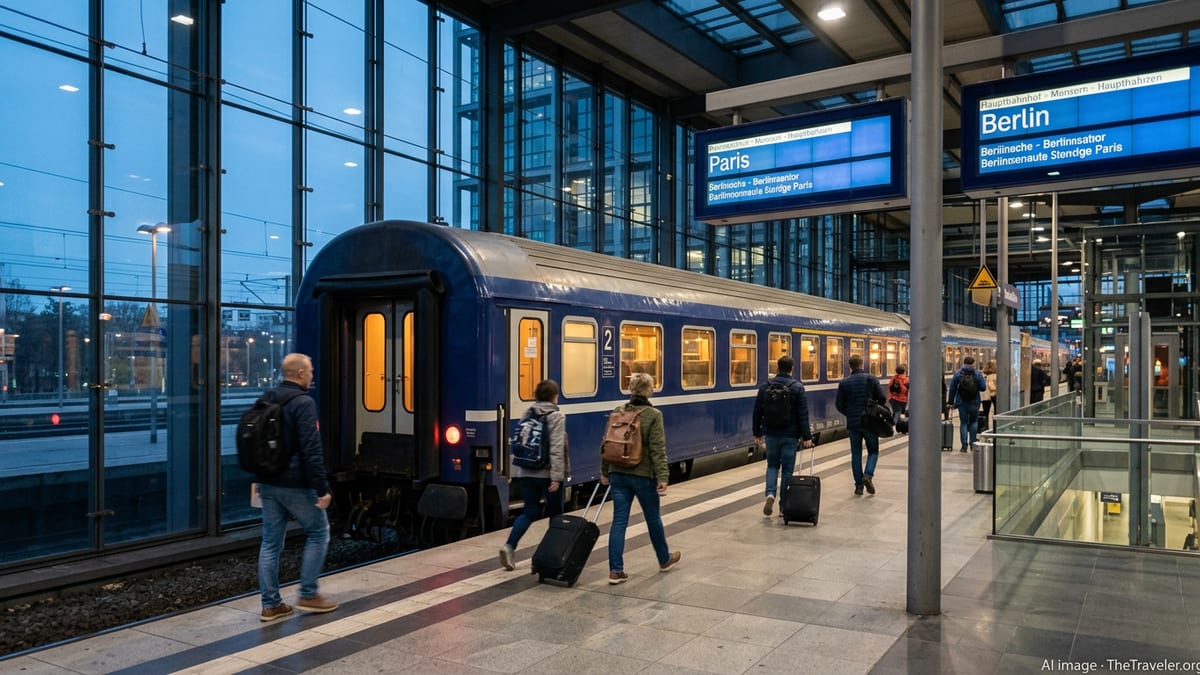
International examples are sharpening interest in how this model could be refined. In Europe, a visible revival of night trains has been driven by a combination of climate concerns, airport congestion and traveler demand for city-center to city-center journeys. Services such as Austria’s Nightjet and open-access operators like European Sleeper promote the ability to board in one city in the evening and arrive in another the next morning, often bypassing larger hubs while still delivering passengers directly to smaller urban cores. Published coverage notes that passengers see value in waking up in walkable downtowns rather than landing at distant airports.
For small US cities, a comparable approach would mean trains timed to depart larger hubs in the late evening, traversing overnight and setting down passengers in regional centers around breakfast time. Unlike daytime corridors, these services could give smaller markets access to early-morning meetings, onward flights or same-day tourism without the cost of a hotel stay in the gateway city. The appeal is particularly strong in regions where highway drives stretch well beyond four or five hours and commercial air options are limited or expensive.
Analysts of European sleeper operations have also pointed out that night trains work best when coaches can be configured to carry many passengers in a compact footprint, through couchettes or shared cabins, and when rolling stock is modern enough to keep maintenance costs in check. As US agencies and private players evaluate new equipment, those lessons are increasingly part of the conversation about how to design trains that can reliably serve low-density corridors without requiring premium fares that would price out most travelers.
Private Concepts Signal a Market for New Overnight Experiences
The most ambitious overnight ideas in the US are emerging from outside the traditional national network, suggesting that there may be untapped demand for higher-comfort sleeper products that could eventually extend beyond major city pairs. One of the most closely watched examples is Dreamstar Lines, a private company that has released concept designs and interior details for an overnight service between the San Francisco Bay Area and the Los Angeles region. Public materials show lounge-style seating, modern berths and hotel-inspired finishes, aimed squarely at travelers who might otherwise fly or drive.
While Dreamstar’s initial focus is on a high-demand corridor between two large metropolitan areas, the project is being monitored by planners and advocates as a test case for a new generation of US night trains. If the concept can secure track access, financing and consistent ridership, it may open the door for similar models along other long-distance corridors where an overnight schedule makes sense. That, in turn, could create room for branch services or intermediate stops that bring smaller cities into what is currently a point-to-point market dominated by airlines and interstate highways.
The potential interaction between private operators and public funding is another emerging theme. Federal partnership programs now allow funding for projects that benefit privately operated intercity rail where an eligible public applicant is involved. This framework raises the possibility that infrastructure upgrades justified for a premium overnight service between major cities might also improve reliability and speed for publicly funded trains serving smaller communities on the same corridor.
For small urban areas, the presence of even a single overnight-capable track segment passing nearby could become a strategic asset. With the right timetable and station investment, a community that currently lacks any intercity passenger option might suddenly find itself on a north–south or east–west overnight chain, gaining direct access to national hubs without needing its own commercial airport.
Economic Stakes for America’s Smaller Destinations
Behind the technical details of rail grants and rolling stock, the stakes for smaller US cities are fundamentally economic. The FRA long-distance service work highlights goals such as enhancing connectivity and supporting rural and small-town prosperity, reflecting growing awareness that transportation gaps are closely tied to labor mobility and regional tourism. For college towns, heritage destinations and outdoor gateways, an overnight stop on a national route could translate into weekend visitors arriving car-free in the morning and departing the following night, spending two full days on the ground without the cost or congestion associated with more driving.
Tourism officials and local business groups in Europe frequently credit night trains with extending the reach of sustainable travel beyond major capitals, as routes connect secondary cities with each other and with resort areas. Although the US context is different, the same principle applies: when a traveler can board a train in a coastal hub and wake up in a historic inland town or near a national park gateway, the visitor economy spreads out rather than concentrating only in the biggest metros and airport cities.
There are also potential workforce benefits. Reliable overnight rail links can allow residents of smaller cities to access job markets in larger metros for a limited number of days each week, reducing the need for costly relocations. In regions with growing logistics and manufacturing hubs, an overnight train arriving before the workday begins could support shift workers and business travelers alike, particularly if coordinated with local transit or shuttle services.
Publicly available performance reports on existing US rail corridors already show strong ridership growth where service has become more frequent and reliable, especially on lines connecting strings of mid-sized cities. Advocates argue that introducing overnight segments to these corridors could compound the effect, giving travelers more choice of departure times and turning once-a-day trains into continuous, round-the-clock arteries for both people and local economies.
Challenges That Will Shape Which Cities Benefit First
Despite the potential upside, overnight trains remain complex to operate and expensive to equip. Studies of European sleeper markets have underlined the high fixed costs of running night trains, from staffing to maintenance and specialized rolling stock. In many cases, operators have needed a mix of public support, favorable track access charges and strong brand positioning to keep services viable. These realities suggest that in the US, only corridors that combine sizable demand, supportive host railroads and coordinated public backing are likely to see new night trains in the near term.
Capacity on key freight routes is another constraint. Many of the long-distance lines that pass through smaller US cities are owned by freight railroads, which must agree to host additional passenger services. Infrastructure upgrades funded by federal partnership programs can help ease bottlenecks, but they require years of planning and negotiation. Communities that organize early, assemble regional coalitions and align their land-use plans with potential stations may be better positioned to attract investment when funding cycles open.
There is also a question of passenger expectations. Contemporary travelers increasingly compare all modes of transport not just on price and schedule, but on comfort, privacy and digital connectivity. Amtrak’s existing private-room products and international sleeper services show that overnight trains can meet these expectations, but scaling that standard across new US routes will require sustained investment. For smaller cities, this means that simply having a train stop may not be enough; stations, wayfinding and ground connections will need to present a seamless experience comparable to that of a small airport.
Even with these hurdles, the policy and market signals emerging in 2025 and 2026 point to a renewed interest in using the night as productive travel time. If that interest translates into new overnight trains, the unexpected winners may not be the coastal megacities that already dominate the travel map, but the smaller US cities that find themselves, for the first time in decades, directly linked to the national network while the country sleeps.
Amtrak Daily Long-Distance Service Study – FRA
Federal-State Partnership for Intercity Passenger Rail – FRA
Nightjet European night train destinations