


More news on this day
Across North America, the rise of Precision Scheduled Railroading in the freight sector is colliding with a renewed push for passenger rail, reshaping timetables, travel times and political priorities from Washington to Ottawa and Mexico City.
Get the latest news straight to your inbox!
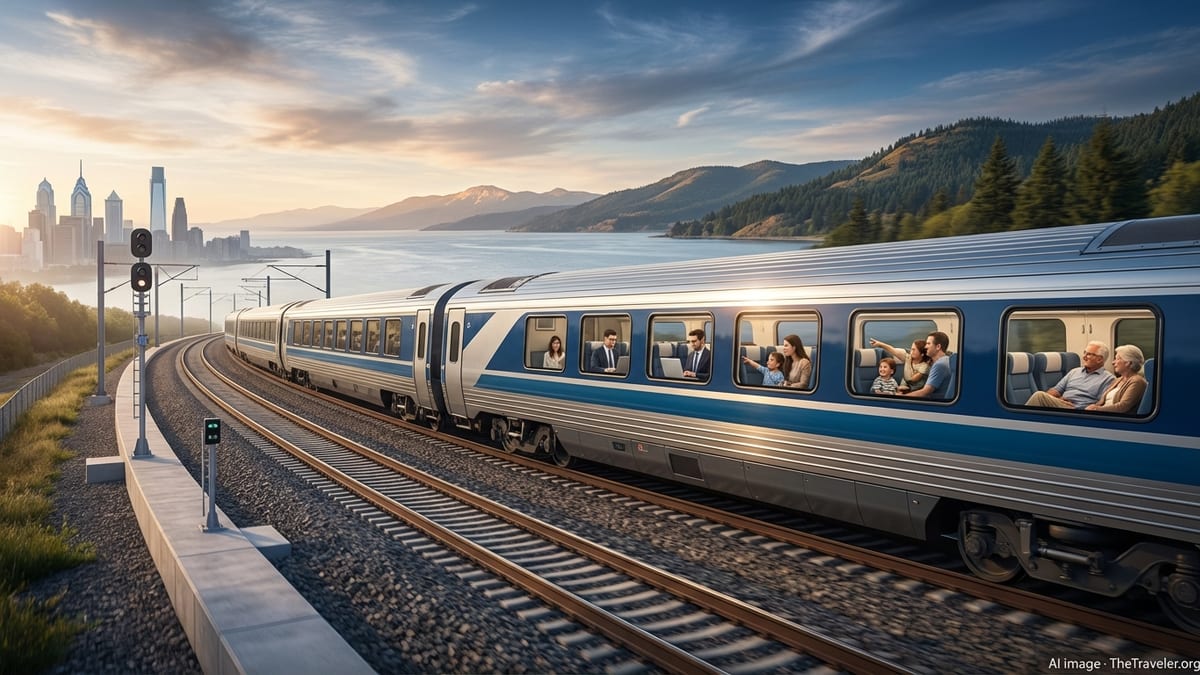
Freight-first railways and the logic of PSR
Precision Scheduled Railroading, widely adopted by major freight carriers over the past decade, has transformed how trains move across North America. The model focuses on running fewer, longer trains on tighter schedules, cutting yard time, locomotives and labor to boost asset utilization and shareholder returns. Publicly available industry data indicates that the largest Class I railroads now move similar or higher freight volumes with significantly leaner workforces and longer trains than they did just a few years ago.
For freight customers, PSR can mean more predictable service and lower operating costs for the railways. Trains depart on fixed schedules rather than waiting to be filled, and networks are optimized to favor through-movements over complex yard operations. Analysts note that these changes have helped sustain record freight revenues and margins, even as railways contend with economic swings and competition from trucking.
The same characteristics that make PSR attractive to freight railroads, however, tend to reduce flexibility on mixed-use corridors where passenger trains depend on access to privately owned tracks. Freight dispatchers focused on moving long, heavy consists efficiently have less room to fit in shorter, faster passenger trains, especially on single-track or capacity-constrained main lines. As a result, the PSR revolution is increasingly visible not only in freight balance sheets but also in the arrival boards of passenger stations.
United States: Congestion pressures and new federal leverage
In the United States, Amtrak operates the majority of its miles over tracks controlled by freight railroads, which are legally required to give passenger trains preference. Amtrak’s own performance reports for 2024 highlight how difficult that principle can be to uphold on PSR-optimized networks. The company attributes roughly 850,000 minutes of delay in 2024 to freight train interference, describing dispatching decisions that prioritize long freight trains over scheduled passenger services.
On long-distance routes in particular, the combination of very long PSR freight trains and limited passing sidings has translated into hours of accumulated delay for passengers. Publicly available host railroad scorecards show some freight carriers performing better than others, but overall, delays linked to freight operations remain the single largest cause of Amtrak lateness outside the Northeast Corridor. Consumer advocates argue that as PSR tightens freight timetables, there is less slack in the system to recover from disruptions, amplifying the impact of even minor incidents.
At the same time, the federal government is deploying new tools meant to rebalance the relationship. In recent years, regulators have finalized metrics and minimum standards for Amtrak on-time performance, giving passenger rail a clearer basis to seek enforcement when chronic delays are traced to host railroads. Combined with billions of dollars in new infrastructure funding, that framework is intended to increase pressure on freight carriers to add capacity, adjust dispatching practices or negotiate capital investments that protect passenger schedules as PSR-driven operating models continue to evolve.
Canada: VIA Rail’s on-time crisis under PSR-era freight
Canada offers one of the clearest windows into how PSR-era freight priorities affect a national passenger operator with limited control over its own infrastructure. VIA Rail owns only a small fraction of the tracks it uses and relies heavily on Canadian National and Canadian Pacific Kansas City, both major freight carriers that have embraced PSR principles. According to Canada’s 2024 federal transportation report and VIA’s recent corporate plans, the passenger railway carried about 4.4 million riders in 2024, up from 2023 but still below pre-pandemic levels.
That ridership recovery has coincided with a steep deterioration in punctuality. An audit released in early 2025 reported VIA Rail’s on-time performance plunging to around 30 percent in the first quarter of that year on its core Quebec City–Windsor corridor, with internal documents and public coverage pointing to new speed restrictions and freight-related constraints on key stretches of Canadian National’s main line. VIA’s own planning documents flag host railway interference as a central obstacle to delivering reliable service.
Independent trackers compiling real-time arrival data in 2026 suggest that Canada’s corridor trains are still struggling, with many departures arriving significantly behind schedule due to congestion and dispatching conflicts with freight traffic. While these trackers are unofficial, their findings broadly mirror VIA’s published figures and underline the difficulties of operating passenger services on infrastructure controlled by PSR-focused freight railways. The Canadian government is funding studies and incremental infrastructure projects aimed at improving on-time performance, but a fully dedicated high-frequency passenger corridor remains years away.
Mexico: Reviving passengers on a freight-optimized network
South of the border, Mexico’s rail system illustrates a different phase of the PSR story. Since freight privatization in the 1990s, private concessionaires have largely focused on cargo, with most of the country’s 20,000-kilometer network reserved for freight trains operated under efficiency-driven models similar to PSR. Passenger services were largely discontinued after 1997, aside from a handful of tourist and regional trains.
In recent years, however, the federal government has moved to reintroduce long-distance passenger rail on existing freight lines, including those operated by concessionaires now linked to Canadian Pacific Kansas City. Policy documents and market analysis from late 2023 and 2024 describe a strategy that would add passenger operations to corridors already optimized for heavy freight, raising questions about how effectively the two can coexist on a network shaped by PSR-style priorities.
Constitutional amendments approved in 2024 and subsequent investment announcements in 2025 indicate that Mexico is committed to expanding passenger services, potentially through a mix of public and private operations. Yet capacity on many freight lines is finite, and PSR practices that prioritize long, efficient freight trains could limit the available windows for frequent, fast passenger service unless substantial new infrastructure is built. How the country negotiates trackage rights, scheduling and compensation with its freight concessionaires will be a key test of whether PSR-era freight railways can accommodate a large-scale passenger revival.
Balancing efficiency with public mobility
Across the continent, the PSR revolution has underscored a fundamental tension in North America’s largely freight-owned rail networks. For private railroads, the shift to precision scheduling has delivered tangible gains in efficiency and profitability. For passengers, the same shift can mean more crowded networks, fewer passing opportunities and longer or less reliable journeys when passenger trains must operate in the margins of freight timetables.
Governments in the United States, Canada and Mexico are responding in different ways, from regulatory standards for on-time performance and enforcement mechanisms, to public investment in dedicated passenger corridors and new legal frameworks for sharing rail infrastructure. Advocates for passenger rail argue that sustained, predictable service requires not only funding for trains and stations but also structural changes to how capacity is allocated on PSR-driven freight networks.
As travel demand returns and climate policies encourage shifts from air and road to rail, the stakes for getting that balance right are rising. Whether the PSR revolution ultimately supports or constrains a new era of North American passenger rail will depend on how quickly infrastructure can be expanded, how assertively passenger performance standards are enforced and how willing freight operators are to treat public mobility as a core part of the rail business rather than a competing claim on their carefully scheduled main lines.