


More news on this day
France’s SNCF has been cleared to launch its first domestic high-speed rail services in Italy, after the Italian competition authority ordered network manager Rete Ferroviaria Italiana to guarantee access on two of the country’s busiest routes.
Get the latest news straight to your inbox!
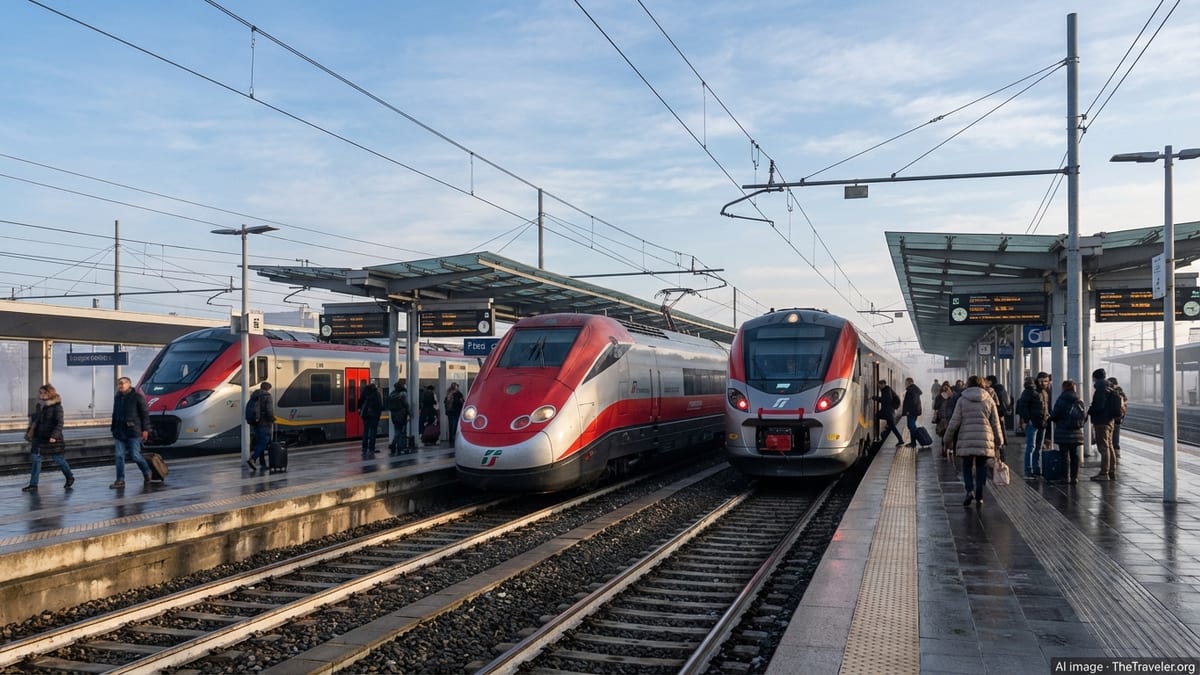
Regulators order RFI to open key high-speed corridors
According to recent decisions by Italy’s antitrust authority, RFI must provide SNCF Voyageurs with a minimum package of daily train paths on the Turin–Milan–Rome–Naples and Turin–Milan–Venice high-speed corridors. The move follows an investigation into RFI’s handling of capacity requests that examined whether the infrastructure manager limited access to the network for new entrants in the premium passenger market.
Published summaries of the ruling indicate that regulators concluded RFI’s previous allocation practices risked slowing or, in some cases, hindering the entry of SNCF Voyageurs Italia, the French group’s local subsidiary, despite Italy’s formal liberalisation of high-speed passenger services. The authority has now formalised binding commitments that oblige RFI to guarantee a specific number of daily slots to the newcomer over a multi-year period.
Publicly available documents point to a framework in which SNCF is assured at least 18 daily train paths on the two high-speed axes, to be maintained for around ten years. The guaranteed access is designed to give the operator sufficient capacity to plan a full commercial offer, rather than sporadic or marginal services, and to address concerns that incumbents could otherwise protect their market position through control of scarce infrastructure capacity.
The decision effectively clears the last major regulatory hurdle to SNCF’s entry into Italy’s domestic high-speed market, adding a third operator alongside state-owned Trenitalia and private challenger Italo – Nuovo Trasporto Viaggiatori. Italy was the first country in Europe to introduce on-rail competition in high-speed passenger services, and regulators have framed the latest move as a further step in consolidating that model.
New French services to challenge Frecciarossa and Italo
With guaranteed track access now in place, SNCF Voyageurs is preparing a network of Italian high-speed services that will compete head-to-head with Trenitalia’s Frecciarossa and Italo’s AGV and Pendolino fleets. Reports in Italian and French media indicate that SNCF plans to deploy double-deck high-speed trains, aligned with its Ouigo low-cost concept and next-generation TGV platforms, on the main north-south and east-west spines.
The planned services are expected to link Turin, Milan and Rome, extending to Naples on the southbound corridor and to Venice in the northeast. This would give SNCF a presence on the densest section of Italy’s high-speed grid, where demand from both business and leisure travellers has supported high frequencies and a broad spread of fares. Industry coverage suggests that initial operations could begin around 2027, allowing time to align rolling stock certification, maintenance arrangements and station access agreements.
Analysts note that the new services will arrive in a market that is already relatively competitive by European standards. Since Italo’s launch a decade ago, Italy’s high-speed passengers have benefited from more frequent departures and generally lower average ticket prices compared with the period of a single operator. SNCF’s entry adds a further layer of competition that could put pressure on yields but may also expand the overall market by stimulating demand through new pricing strategies and product types.
For cross-border travellers, the development complements SNCF’s long-running international TGV connection between Paris, Turin and Milan, operated via its Italian subsidiary. The new domestic routes would allow the French group to build an integrated network that connects international passengers more seamlessly with internal Italian destinations, particularly along the Turin–Milan–Rome axis.
Antitrust case reshapes access rules for Italy’s rail network
The green light for SNCF follows a multi-year competition case in which Italy’s antitrust authority analysed how RFI handled capacity requests from new entrants on the high-speed network. Public documents and corporate filings summarize the findings as identifying a pattern in which access for SNCF Voyageurs Italia was delayed or constrained, in a context where Trenitalia, part of the state rail holding FS Group, was already well established.
The authority’s decision required RFI to adopt a series of structural and behavioural commitments. Among them are clearer, more transparent procedures for managing conflicting slot requests, and a requirement to document how capacity is allocated when demand exceeds the infrastructure’s maximum available paths. The commitments also involve long-term guarantees for new operators that meet financial and technical criteria, addressing concerns that short time horizons could deter large-scale investment in trains and support facilities.
Legal briefings on the case highlight that Italy’s regulators sought to align practice with European Union rules on non-discriminatory access to rail infrastructure. While Italy’s high-speed market has been cited as an early example of successful on-rail competition, the case underscored that regulatory oversight remains essential where the infrastructure manager and an incumbent operator share a common holding structure.
The outcome is being watched by other European markets contemplating broader high-speed liberalisation. Observers point out that the Italian decision provides a reference for how regulators might intervene where infrastructure capacity is technically available but commercial newcomers claim they cannot secure the slots needed to operate a viable timetable.
Implications for travelers, fares and service patterns
For passengers, the arrival of SNCF on Italy’s domestic high-speed routes is expected to translate into more options on already busy city pairs, particularly at peak times and on weekends. Travel industry analysts anticipate that the new operator may follow a strategy similar to its low-cost Ouigo brand in France and Spain, using simplified onboard service and yield-managed pricing to attract price-sensitive travellers while maintaining high seat density.
In practical terms, travellers could see additional early-morning and late-evening departures between Milan and Rome, as well as new through services linking Turin or Venice with Naples. Increased capacity may ease pressure on some of the most in-demand departures, where load factors have typically been very high, and provide more flexibility for last-minute bookings.
Competitive dynamics are also likely to influence fare structures. Past experience in Italy suggests that when a new operator enters a route, incumbent carriers respond with promotional offers, loyalty programme enhancements and differentiated service tiers. Industry coverage indicates that Trenitalia and Italo may adjust their timetables and product positioning once SNCF’s exact schedule and brand in Italy are confirmed.
There could also be impacts on intermediate cities served by the high-speed network, such as Bologna, Florence and Verona. Depending on the final path allocations and stopping patterns, some stations may gain additional services or new direct connections, while others could see timetable reshuffles as operators vie for the most commercially attractive time slots.
Operational challenges and investment plans ahead of launch
Although the regulatory pathway has been clarified, SNCF still faces several operational hurdles before its first domestic Italian high-speed trains can enter service. Technical compatibility between rolling stock and Italian infrastructure, particularly in relation to tunnel clearances and signalling specifications, has been the subject of discussion in local media and sector reports, highlighting the need for detailed engineering checks and, where necessary, modifications.
Maintenance and depot arrangements represent another critical issue. Public statements by the company in recent years have referred to planned investments running into the hundreds of millions of euros to support expansion in Italy, covering both train acquisition or adaptation and the creation of local support facilities. Securing suitable locations for depots and workshops, and agreeing track access to reach them, will be central to reliable day-to-day operations.
Meanwhile, RFI is continuing to upgrade sections of the national high-speed grid, including the corridor between Milan and Verona, which is still partly under construction. As these projects are completed, available capacity and journey times on some routes are expected to improve, potentially opening up further commercial opportunities for all operators active on the network.
Industry observers note that SNCF’s progress in Italy will be closely monitored by other foreign operators considering cross-border or domestic high-speed ventures elsewhere in Europe. The combination of regulatory clarity, guaranteed capacity and a demonstrably contestable market could make Italy a test case for a new phase of international competition on the continent’s flagship rail corridors.