


You do not need a Palme d'Or invitation or a couture gown to experience Cannes as a true cinema city. Beyond the famous red carpet, Cannes offers film lovers year-round screenings, immersive multiplexes, evocative shooting locations and quiet corners where cinema history still feels close. With a bit of planning, you can build an unforgettable Cannes cinéma itinerary that fits a normal travel budget and does not miss the essential highlights.
Get the latest updates straight to your inbox!
Understanding Cannes Beyond the Red Carpet
The Cannes Film Festival dominates global headlines every May, but the city’s relationship with cinema runs all year. The 79th Cannes Film Festival is scheduled for 12 to 23 May 2026, yet if you visit outside those dates you will still find a full cultural calendar of screenings, exhibitions and cinema-themed walks. The key is to stop thinking of Cannes solely as a two-week event and start seeing it as a small Mediterranean city shaped by almost eight decades of film culture.
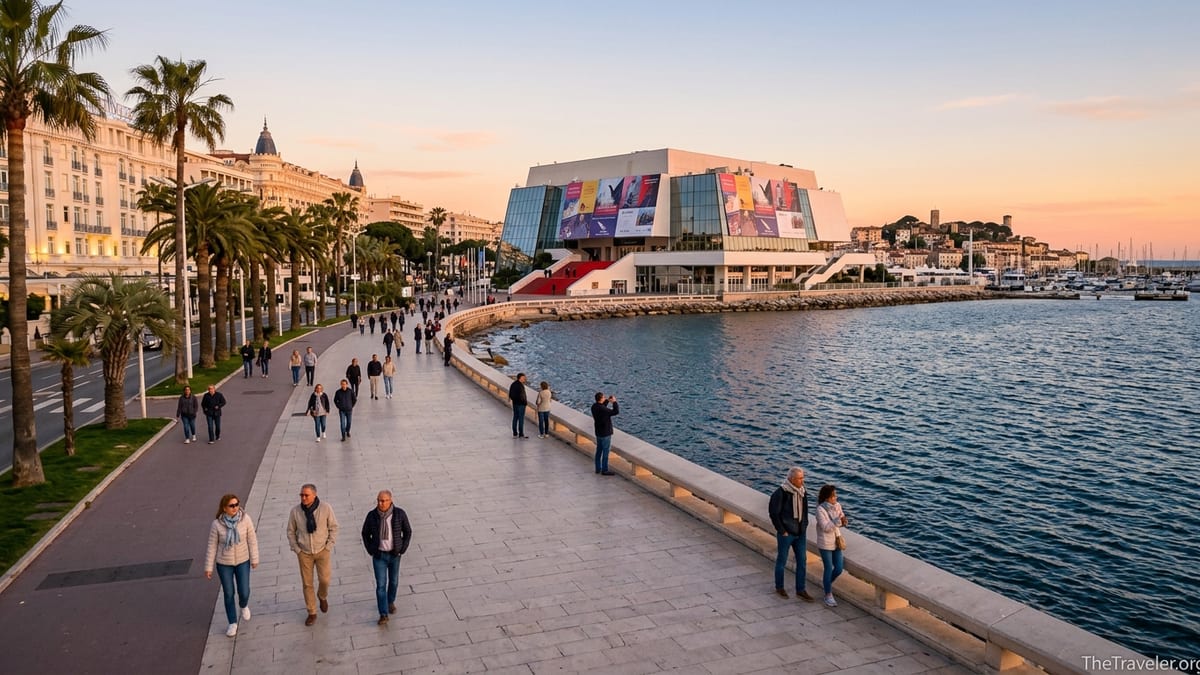
Much of this history clusters around La Croisette, the seafront boulevard lined with grand hotels. Even on a random evening in October, standing outside the Palais des Festivals et des Congrès, you will see tour groups pausing on the steps where stars climb for premieres. The red carpet is rolled away, but the staircase, spotlights and festival logos on the façade are still unmistakable. Many visitors take a short detour after dinner to stand on the stairs and recreate the famous pose.
Inside the Palais, the festival theaters such as the Grand Théâtre Lumière and Debussy are closed to casual visitors for most of the year, but the exterior is always accessible. Large movie-themed billboards often cover the walls, promoting current French releases or upcoming cultural events in Cannes. Simply walking this stretch of the Croisette helps you understand how deeply movie imagery is woven into the city’s identity.
This broader view is important because it frees you from obsessing about accreditation, screening schedules and red carpet access. Instead, you can focus on experiences: watching a film with locals in an art-deco cinema, discovering an exhibition about costume design, or wandering streets that once doubled as sets for French and international productions.
When to Visit for Maximum Cinema Atmosphere
Timing your trip is the first big decision. If you visit during the Cannes Film Festival itself in May, the city changes character. Hotel rates can easily double or triple, budget rooms vanish months in advance, and security cordons restrict access around the Palais. For most travelers, that means either committing to high prices and planning well ahead, or choosing to come just before or after the festival for a more relaxed but still cinematic stay.
Arriving a few days after the closing ceremony, typically late May, lets you enjoy warm weather and a quieter city while temporary festival installations are still being dismantled. The famous red carpet is usually removed quickly, but banners, billboards and sponsor decorations often remain. In recent years, travelers have reported finding festival posters still hanging in side streets in early June, perfect for photos without the crush of photographers.
Autumn and winter bring a different cinema mood. Local venues like Les Arcades and Olympia in the city center continue to program French and international films, often in their original language with French subtitles. On a rainy November evening you can join residents for a new American release or an auteur film that has just circulated from another European festival. Ticket prices are typically in the range of about 8 to 12 euros, varying by time of day and format, far less than a gala seat in May but with the same Cannes audience that cares about cinema.
If you prefer combining beach time with moviegoing, consider late September or early October. The water is still warm enough for a swim, terraces are open, and the big summer crowds are gone. At this time of year, Cannes often hosts smaller festivals and industry events inside the Palais, which can add pockets of glamour without overwhelming the city.
Watching a Film Like a Local: Cinemas You Should Not Miss
To really experience Cannes cinéma, plan at least one screening in a classic city-center cinema. Les Arcades, just behind the Croisette, is known for its cozy auditoriums and mix of commercial and arthouse programming. You might catch a Hollywood film in English one night and a subtitled Korean drama the next. Buying a regular ticket at the counter, grabbing a paper program and settling into a plush seat surrounded by locals gives you a grounded sense of how Cannes residents watch movies outside festival season.
A few streets away, the Olympia cinema offers a similarly local experience, often used by distributors for special previews and one-night-only concert films or live comedy events broadcast to theaters. On a random week you might find a French comedy, a live recording of a singer’s Paris arena show and an American superhero film sharing the same marquee. Expect standard multiplex-style concessions, assigned seating, and prices broadly comparable to other French cities, typically around 10 to 13 euros for an adult evening ticket, with slightly cheaper matinées.
For the most high-tech cinema experience, head west to the La Bocca district and the Cinéum Cannes multiplex, which opened as a flagship complex with 12 screens and about 2,450 seats. Designed by renowned architect Rudy Ricciotti with interiors by artist Arik Levy, the building has a sculptural concrete façade that looks almost like a futuristic set. Inside, several auditoriums feature laser projection, immersive multi-channel sound such as DTS:X, and premium seating with reclining chairs.
Cinéum also offers special formats like ScreenX, where images spill onto side walls for a 270-degree effect, and an “Aurore” premium large-format auditorium with a huge non-perforated screen. Tickets for these premium experiences cost more, often in the 14 to 18 euro range, but for movie fans they can be a highlight of a trip. If you are staying in central Cannes, local buses connect the Croisette area with La Bocca in about 20 to 25 minutes, so an evening show at Cinéum can be easily combined with a late seaside dinner back in town.
Following the Footsteps of the Festival Without a Badge
Even if you are not accredited, you can still experience several elements of the festival world. Start at the Palais des Festivals in the morning, when light is softer and coach tours have not fully arrived. Security barriers usually mark off the front entrance even outside festival dates, but you can stand on the lower steps, look up at the glass façade and imagine the camera flashes. On non-festival days the square in front, the Esplanade Georges Pompidou, is open for strolling and people-watching.
Just in front of the Palais, look down to find bronze handprints embedded in the paving stones. This “Chemin des Étoiles” is Cannes’s answer to the Hollywood Walk of Fame, with directors, actors and technicians who have left their mark on the festival. It is fun and free to spend half an hour searching for names you recognize. Many travelers snap photos of their shoes next to the hands of a favorite director, or of children comparing their hands to those of an international star.
Behind the Palais, the old quarter of Le Suquet offers another side of Cannes cinema. Narrow, steep streets lined with pastel houses have appeared in numerous French productions. Climb to the top near the church of Notre-Dame d’Espérance in the late afternoon for a panoramic view: the Palais, harbor, Croisette and the bay framed by the Esterel hills. Standing there, it is easy to understand why location scouts keep returning. If you watch French dramas or European co-productions set on the Riviera, you may suddenly recognize the curve of a street or a terrace.
Guided cinema-themed walks are sometimes organized by local guides, particularly around festival time or during heritage days. These can include behind-the-scenes stories such as how certain hotels became unofficial headquarters for press junkets, or anecdotes about memorable premieres that ran past midnight. If formal tours are not running when you visit, you can still create a self-guided version by mapping a route from La Croisette’s famous hotels through the backstreets of Le Suquet and down to the port, stopping anywhere that feels like a ready-made establishing shot.
Cinema in the Museums: Exhibitions and Immersive Galleries
Cannes’s cinema culture is not limited to projection rooms. The recently renovated La Malmaison Contemporary Art Center, housed in the last surviving pavilion of a 19th-century grand hotel on the Croisette, hosts exhibitions that often intersect with photographic and visual storytelling. After major renovation works, the center has expanded its exhibition space across three levels, tripling the area available for shows. Programs change several times a year and can include retrospectives of renowned painters, photography centering on celebrity culture, or installations that explore image and identity.
Even when exhibitions are not directly about film, they can add depth to your understanding of how images are constructed and circulated, which is central to Cannes’s identity. Admission fees are usually modest compared with large national museums, often in the single-digit euro range, making this a manageable stop on any budget. The building itself, overlooking the sea, feels like a set from a stylish European drama and is worth a visit simply to step inside its bright halls and staircase.
Back in La Bocca, the Cinéum complex includes an immersive gallery that pulls back the curtain on how films are made. Temporary installations occupy this space, from interactive sound exhibits to displays about costume design and visual effects. As you move between screens and the gallery, you get a sense of cinema as a craft, not just a glamorous premiere moment. For families, this part of Cinéum can be as engaging for children as the movie itself.
Elsewhere in the city, smaller cultural venues occasionally devote exhibitions to poster art, festival photography or iconic advertising campaigns. Paying attention to local posters and the programming calendars distributed by the tourist office at the Palais can reveal short-term shows celebrating anniversaries of famous films or the work of a particular director associated with Cannes.
Planning a Cinema-Themed Day on a Realistic Budget
Experiencing Cannes cinema does not have to be extravagant. A carefully planned day can combine screenings, sightseeing and casual meals without straining your wallet. One example itinerary starts with a morning coffee in the backstreets near Rue d’Antibes, where prices are noticeably lower than on hotel terraces along the Croisette. Order an espresso and a croissant at a neighborhood bakery counter and you will likely spend close to what you would in any mid-sized French town, rather than resort prices.
From there, walk to the Palais des Festivals for photos on the steps and a circuit of the harbor. If the weather is clear, take in the handprints in front of the Palais and then climb up to Le Suquet for the panoramic view. A casual lunch on one of the side streets, away from the seafront, might be a simple plat du jour or salade niçoise in the 15 to 20 euro range, especially if you avoid prime locations with direct sea views.
After a rest on the public beach or a stroll along the Croisette’s western end, where the promenade is less crowded, head to an early evening screening at Les Arcades or Olympia. Check showtimes in advance and choose an original-language film if you do not speak French. A standard ticket plus a small popcorn and soft drink will usually keep the total under 20 euros. If you are eager to splurge just once, pick a premium screening at Cinéum on another night and budget a few extra euros for the upgraded seat and format.
End your day with a late walk along the Croisette, when hotel façades are illuminated and the bay is calm. Even without festival searchlights, there is a sense of quiet glamour: people leaving restaurants, hotel bars humming gently and the silhouette of the Palais in the distance. It is a reminder that in Cannes, cinema is not confined to one fortnight in May but lingers in the way the city lights itself, dresses its windows and talks about culture.
Navigating Practical Details: Tickets, Language and Access
For regular screenings in Cannes cinemas outside the festival, buying tickets is straightforward. You can purchase at the box office shortly before showtime or, for popular weekend evening shows, use the cinema’s online booking system to choose your seats in advance. Most venues offer reduced prices for students, seniors and sometimes for specific days, such as discounted Monday or Tuesday screenings. If your schedule is flexible, taking advantage of these cheaper days can free up budget for another experience, such as a museum visit.
Language is a common concern for visitors. Many films are screened in their original language with French subtitles, indicated as “VOST” or “VOSTFR” on schedules, while “VF” signals a dubbed French version. If you want to follow the dialogue easily, look for VOST listings, especially for English-language films. For major blockbusters, Cannes cinemas often program both dubbed and subtitled versions on different screens, so checking the notation carefully will prevent surprises once you are seated.
Accessibility has improved in recent years. Newer complexes such as Cinéum are designed with step-free access, lifts and reserved seating for wheelchair users, and some auditoriums offer audio description or assistive listening technologies for visually or hearing-impaired guests. Older city-center cinemas may have more constraints, such as narrow staircases or limited accessible seating, so it is worth contacting them directly if you have specific needs.
During the film festival itself, access rules tighten significantly around the Palais, and regular tourists cannot walk freely into most festival screenings. However, outdoor events such as open-air projections on the beach, when scheduled, are generally free but require arriving early to queue. The city and festival occasionally run programs that allow local residents and selected visitors to attend certain screenings with invitations won through lotteries or cultural initiatives, so checking the official tourist office information in the months leading up to May can reveal opportunities beyond standard accreditation.
The Takeaway
Experiencing Cannes cinéma is less about chasing star sightings and more about immersing yourself in a city that has grown up with film. Whether you attend a cutting-edge screening in the laser-equipped theaters of Cinéum, sink into a worn velvet seat at Les Arcades, or pause on the Palais steps imagining the glare of festival spotlights, you are participating in a living film culture that exists long before and after any single premiere.
With realistic expectations about budget, timing and access, you can craft a stay rich in cinematic moments without the stress of accreditation or gala tickets. Choose your season carefully, mix screenings with exhibitions and strolls through film-familiar streets, and pay attention to the everyday details that make Cannes feel like a movie set in slow motion. In doing so, you will not just visit the city that hosts the Cannes Film Festival. You will experience Cannes as a cinema city in its own right.
FAQ
Q1. Can I attend Cannes Film Festival screenings without industry accreditation?
Outside special public programs and beach screenings, most festival screenings in the Palais require accreditation or an official invitation, so casual visitors generally cannot walk in.
Q2. Is it worth visiting Cannes outside the festival dates for cinema experiences?
Yes. Local cinemas run strong year-round programs, Cinéum offers immersive formats, and the city maintains a film-focused atmosphere even when the festival is over.
Q3. How expensive are regular movie tickets in Cannes?
Standard tickets at city-center cinemas typically cost around 8 to 13 euros, while premium formats at Cinéum often range from about 14 to 18 euros depending on the show.
Q4. Will I find English-language films in Cannes cinemas?
Many international films are shown in their original language with French subtitles, marked as VOST or VOSTFR on schedules, especially for English-language releases.
Q5. How do I reach the Cinéum multiplex from central Cannes?
Cinéum is in the La Bocca district west of the center and can be reached by local bus in roughly 20 to 25 minutes from stops near La Croisette or the train station.
Q6. Are there cinema-related attractions for children in Cannes?
Yes. The immersive gallery at Cinéum, occasional outdoor screenings, and simple activities like hunting for celebrity handprints near the Palais can all engage children.
Q7. Do I need to book movie tickets in advance?
For most off-season screenings you can buy tickets on the day, but for weekend evenings, holidays or special events, booking online ahead of time is a safer option.
Q8. What should I wear to a regular cinema screening in Cannes?
Dress codes are relaxed for everyday screenings. Casual attire is fine, though some people opt for slightly smarter outfits during festival season or evening shows.
Q9. Can I tour the inside of the Palais des Festivals?
Access to the main auditoriums is generally restricted, but at certain times of year guided tours are offered or events open limited sections to the public.
Q10. Is Cannes walkable for a cinema-themed visit?
Yes. The Palais, Croisette, Les Arcades, Olympia and Le Suquet are all within walking distance, with only the Cinéum multiplex requiring a short bus or taxi ride.