


Cannes is famous for its flashbulbs, red carpet and yacht parties, yet most visitors sweep through the city without noticing the quieter details that tell its real cinema story. Away from the TV cameras, the film festival has left fingerprints on facades, staircases, pavements and forgotten salons all over town. With a little curiosity and a willingness to look up, down and behind the main sights, you can experience a far richer version of Cannes cinéma than the glossy postcards suggest.
Get the latest updates straight to your inbox!
The Other Palais: Ghosts of the First Cannes Festival
For many visitors, Cannes cinema begins and ends with the concrete bulk of the Palais des Festivals et des Congrès on the waterfront. Yet the city’s film story actually starts a few hundred meters along La Croisette, in a building almost everyone walks past without a second glance. Tucked behind gardens in front of the Mondrian Cannes hotel, the villa known as La Malmaison is the last surviving fragment of the original Grand Hôtel complex where the very first Cannes Film Festival opened in September 1946. Today it operates as a contemporary art center, but its Belle Époque façade and terraces once hosted the earliest festival parties, press gatherings and jury deliberations.
Most people crossing the Croisette are focused on the beach clubs opposite and never realize that this quiet cream‑colored building was once the social heart of world cinema. Step inside on a regular day when no big exhibition is opening and you will often find only a handful of visitors in the galleries. Information panels, mainly in French and English, outline how the Grand Hôtel gardens and Malmaison salons welcomed filmmakers when Cannes was still an experiment and Venice dominated the festival circuit. Standing on the sea‑facing terrace, with cruise ships on the horizon and deckchairs on the lawn below, it is surprisingly easy to picture evening receptions where post‑war stars and producers weighed the future of European cinema.
Even if you are not an art enthusiast, it is worth paying the modest admission fee, typically the price of a cinema ticket, just to wander the stairways and corridors and imagine those first festival evenings. The contrast with the high‑security entrance gates at today’s Palais is striking. At La Malmaison, there are no barriers or accreditation checks, only a small desk, a bookshop specializing in art and cinema, and staff who are often happy to point out old photographs of the building in its Grand Hôtel days if you ask.
Red Carpet Secrets: What the Palais Hides in Plain Sight
Every May, television images of the Cannes steps loop around the world: 24 shallow stairs under an intense red carpet, flanked by photographers and a forest of mobile phones. Outside the festival period, those steps revert to ordinary concrete, sometimes dotted with locals taking a lunch break. Yet the building around them contains subtle details that quietly celebrate cinema all year, and most casual visitors stroll past without registering them.
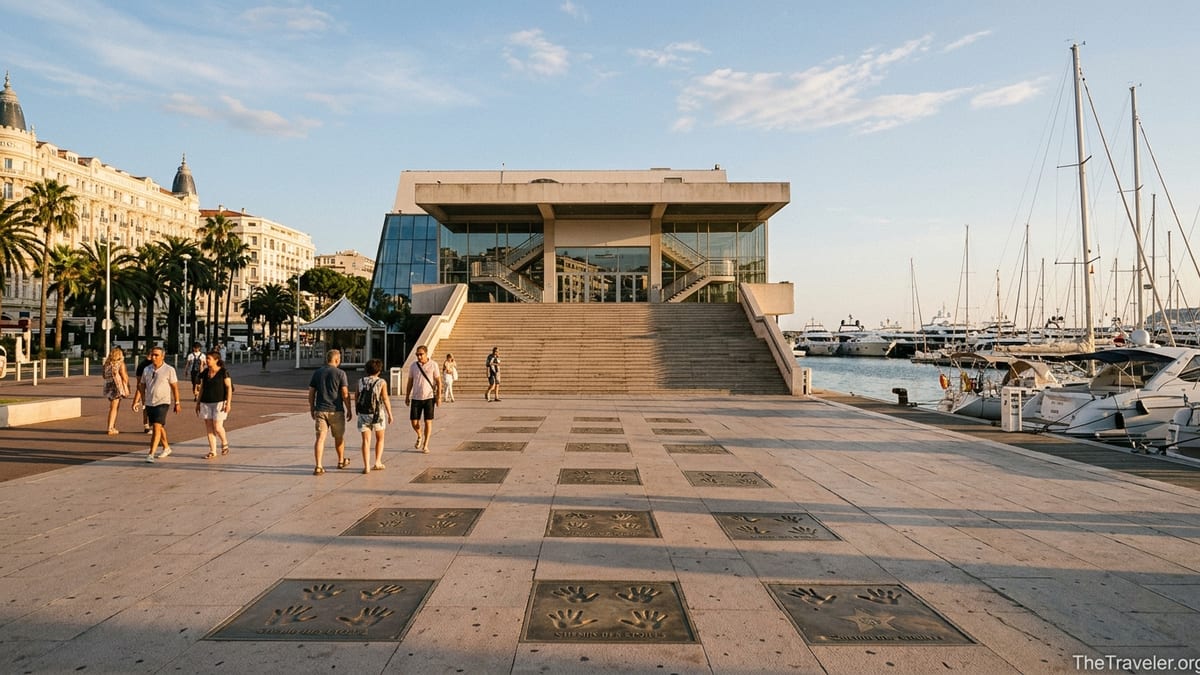
Start at the forecourt directly in front of the Palais. It looks like a standard plaza of pale paving stones, but set into the ground are metal plates bearing the handprints and signatures of film icons. This Chemin des Étoiles, Cannes’ answer to the Hollywood Walk of Fame, winds around the building and now includes hundreds of imprints. Because there is no single “start” or “finish,” it is easy to miss entire clusters if you only approach from the harbor side. A more rewarding tactic is to walk a complete loop of the Palais, scanning the slabs. You might stumble on the handprints of directors like Quentin Tarantino or actors such as Catherine Deneuve outside a side entrance where festival staff smoke on their break.
Look up from the famous stairs and you will notice the double spiral of the interior staircase that curves behind the glass facade. When the lobby is lit in the evening, the twin ribbons of white stone become a sculptural backdrop for the red carpet photographs. During the quieter months, you can enter the building during public events and see how this staircase funnels guests to the Grand Auditorium Louis Lumière. It is one of the few moments where the convention center’s otherwise functional architecture feels tied to the grandeur cinema likes to project.
On the harbor side of the Palais, by the long terrace that overlooks the marina, you may also see temporary artworks and posters that relate to recent festival editions. In recent years, the city has encouraged large‑scale photo exhibitions here, often dedicated to past winners or behind‑the‑scenes images. These displays are free to access and make a good pause point if you are walking between the old port and the beaches. Many visitors treat the terrace simply as a shortcut, never realizing they are strolling through an open‑air gallery curated by the festival itself.
The Painted Walls That Tell Cannes’ Film Story
One of Cannes’ most distinctive cinema experiences is hiding in full view on blank building facades. Across the city, large murals transform ordinary apartment blocks and utility structures into tributes to famous films and actors. These “murs peints” are a municipal project, scattered from the bus station near the center to residential districts in La Bocca, yet few short‑stay visitors see more than one or two by accident.
The easiest way to encounter the murals is to leave the Croisette for an hour and wander in a slow loop between the station, the old port and the main shopping streets. Near the bus station, look up to find a huge adaptation of a film noir poster, with shadowy figures leaning out of painted windows. Further along, a towering image of Marilyn Monroe in billowing dress seems to float above parked scooters, echoing her enduring connection to the festival. There are homages to French classics that won the Palme d’Or, to Charlot the tramp character of Charlie Chaplin, and even to animation, including references to beloved Japanese films that have screened to great acclaim at Cannes.
Because the murals are integrated into the city’s everyday life rather than fenced off as separate attractions, they reward slow observation. A supermarket customer might queue at a checkout without ever glancing at the cinema scene covering the exterior wall above; a commuter might hurry to catch a train while a dramatic chase sequence plays out in paint over their head. As a visitor, pausing to trace the murals’ details can turn an ordinary walk to dinner into an impromptu film history tour.
If you are interested in photographing the murals, plan for late afternoon or early morning when the Mediterranean sun is softer. The city’s tourism office publishes updated maps that show mural locations, but you do not need a perfect checklist. Some of the most satisfying finds come from turning down a side street and spotting a painted director’s chair or clapboard where you least expect it.
Historic Cinemas Beyond the Croisette
Despite its global image as a festival city, Cannes has relatively few traditional cinemas in the historic center, and many visitors assume that filmgoing is confined to private industry screenings in May. Yet just beyond the core, you will find venues that keep cinema alive for locals all year, often in ways outsiders overlook. Experiencing a regular screening can be as revealing as catching a premiere, and it usually costs no more than a standard multiplex ticket in France.
In the La Bocca district to the west, for example, the Cineum multiplex has become a new focal point for film in the region. Its contemporary design, with angular concrete volumes and large glass surfaces, often surprises travelers who only know the city center. The complex hosts mainstream releases in French and original versions with subtitles, and includes an IMAX auditorium that draws audiences from across the Côte d’Azur for major blockbusters. On a weeknight outside school holidays, you might find tickets priced only slightly higher than a regular screen, offering a very different atmosphere from the black‑tie premieres in May but the same big‑image spectacle.
Back closer to the festival zone, smaller cultural cinemas and screening rooms operate in partnership with local associations. These spaces host retrospectives, national film weeks and debates throughout the year. Schedules can be irregular and tend to be advertised in French on posters around town or on municipal bulletin boards. If you spot posters for themed weeks dedicated to Italian, Spanish or African cinema while walking around the station or town hall, consider setting aside an evening. Sitting in a modest auditorium with local cinephiles, watching a restored classic that once premiered at Cannes, can offer a deeper connection to the city’s film identity than jostling a selfie on the red carpet.
Practical details matter here. Many of these screenings start earlier than American showtimes, often around 7 or 8 p.m., and some smaller venues do not offer online booking, so you buy tickets on site half an hour before. Prices are generally reasonable compared to big coastal resorts, and discount cards for under‑26s or seniors are common. Ask at the tourist office for current partner cinemas if you want to prioritize venues that program festival classics.
Cannes Old Town: Traces of Cinema in Le Suquet
Climb up from the marina into the steep lanes of Le Suquet, and the festival glare fades quickly. Yet even here, amid medieval stones and bougainvillea, cinema has left its mark in subtle ways. During May, banners and temporary installations appear along the main ascent to the church, but for the rest of the year you have to look harder to find film references woven into old town life.
One example is the open‑air screenings hosted on the square in front of the church during certain cultural events and summer festivals. When those giant temporary screens are packed away, visitors see only an empty terrace with a panoramic view of the bay. However, if you examine the ground you may notice discreet metal anchor points and electrical boxes tucked against the walls. Those are the invisible infrastructure that transforms the square into a hilltop cinema each season, continuing a local tradition of watching films under the stars that predates home streaming by decades.
As you wander the narrow streets, pay attention to small shopfronts used by festival organizations, casting agencies and film schools. Many hide behind plain doors for most of the year, but their letterboxes bear the names of film associations, and their windows might display photographs from past editions in between sessions. It is easy to walk straight past these spaces on the way to a restaurant and never realize that young filmmakers and critics are pitching projects here each spring.
Finally, take time to sit on the stone ramparts at dusk and look back down towards the Palais. From this vantage point, the city’s cinema geography becomes clearer: the modern festival complex, the line of luxury hotels including the Carlton where industry deals are made, the quieter strip around La Malmaison where the festival was born, and the residential quarters where locals still watch films in small community halls. It is one of the best places in Cannes to understand how deeply cinema is woven into the city’s fabric, even when the spotlight is not shining.
Hotels, Lobbies and Lounges with Quiet Film Legends
The grand hotels that fringe the Croisette are stars in their own right. Even travelers who are not staying in them often walk into the lobbies to admire chandeliers and marble floors. What most people miss are the quiet cinematic details that line their corridors and lounges. Many properties maintain small photographic archives or themed suites that recall decades of festival guests, yet the displays are rarely signposted beyond a plaque on the wall.
Take the Carlton Cannes, for example, whose ornate domes are among the city’s most recognizable silhouettes. The hotel became globally famous in part thanks to Alfred Hitchcock’s To Catch a Thief, and it played a crucial role in real‑life cinema history when Grace Kelly stayed there during the 1955 Cannes Film Festival. A press photo shoot at the hotel with Prince Rainier III of Monaco led to their marriage the following year, forever linking the Riviera, royalty and film celebrity. Today, black‑and‑white photographs in the interior corridors and certain lounges quietly document that era. Guests and non‑residents nursing a coffee on the terrace often fail to notice the images just inside the doors that show Cannes in the 1950s, with fewer yachts and more modest festival set‑ups.
Other hotels along the Croisette and in the streets behind it host similar displays. Framed portraits of directors stepping out of vintage cars, candid shots of actors leaning on balcony railings between interviews, and group photos of festival juries hang in hallways that are open to anyone who politely walks in during the day. In many cases, reception staff are used to film fans wandering around to look at the pictures, as long as you are discreet and avoid private guest floors. This informal gallery circuit costs nothing and reveals how the festival has evolved from black‑tie galas to today’s mix of luxury branding and hashtag‑driven publicity.
If you are staying in a mid‑range hotel or rental apartment rather than a palace, you can still tap into this history by choosing places that participate in cinema‑themed events. Some smaller hotels and bars host unofficial sidebar screenings or Q&A sessions with independent filmmakers during the festival weeks. Posters and flyers appear on noticeboards and stairwells in early May; asking staff about them can lead to unexpected encounters, from a short‑film showcase in a breakfast room to a late‑night discussion with a documentarian at the bar.
Living With the Festival: Everyday Cinema Details Locals Notice
For Cannes residents, cinema is not limited to gala nights. The presence of the festival and the industry market that accompanies it has shaped daily routines in subtle ways that visitors only glimpse. These small details, from traffic patterns to temporary signage, tell their own story about how a global film event coexists with a medium‑sized Mediterranean city.
In the weeks leading up to the festival, for instance, locals start checking municipal notices about street closures and parking restrictions around the Palais, the train station and key Croisette intersections. Blue and white signs appear on lampposts announcing future tow‑away zones for security reasons. To an outsider arriving on a random spring day, they might look like generic parking rules; to residents, they are the first sign that the city is about to switch into festival mode.
Inside the Palais itself, areas that tourists experience as neutral conference spaces have specific meanings for professionals. During the market, for example, hallways and terraces transform into stands for national film agencies, and a simple carpet color can indicate which section you are in. Months later, when a trade‑show unrelated to cinema occupies the same halls, trace elements remain: wall plugs labeled with the names of film companies, stickers on doors indicating previous accreditation checkpoints, even scuff marks on pillars where temporary screens were mounted. If you attend a general public event or concert at the Palais and look closely, you can detect these ghosts of film markets past.
Food is another everyday angle. During the festival, queues outside the fast‑food outlets near the Palais, including the chain restaurant just opposite the main entrance, swell with badge‑wearing attendees grabbing a quick meal between screenings. Local staff have learned to anticipate these waves, and some cafés adjust opening hours and menus accordingly, adding quick‑serve options and staying open later. Outside May, those same places revert to a slower rhythm, but if you ask longtime employees about festival weeks, they will often have stories of half‑recognizable actors ordering burgers at midnight, or directors taking over a corner table to rewrite dialogue on their laptops.
FAQ
Q1. Can I visit the Palais des Festivals when the Cannes Film Festival is not on?
Yes. Outside the festival period, parts of the Palais are open during trade shows, concerts and guided tours. You can usually access the forecourt, see the famous steps and walk around the exterior to explore the handprints on the Chemin des Étoiles even when the building itself is hosting private events.
Q2. Where exactly can I find the celebrity handprints in Cannes?
The handprints are set into the pavement around the Palais des Festivals, mainly on the square in front of the main entrance and along the sides of the building. There is no ticketed entrance for them, so you can visit freely at any time, though they are easiest to spot in daylight when the engravings cast small shadows.
Q3. Is La Malmaison open to the public, and is it worth visiting if I am not an art expert?
La Malmaison operates as a contemporary art center on the Croisette and is open to the public with a modest entry fee. Even if you are not deeply into art, it is worth visiting for its role in the birth of the Cannes Film Festival, its Belle Époque architecture and the chance to see archival photos that show how the first festival unfolded in its gardens and salons.
Q4. How can I see the painted cinema murals without joining a tour?
You can explore the murals independently by walking a loop between the train station, the main bus station, the old port and the central shopping streets. Look up at gable walls and facades, especially near public squares and transport hubs. Tourist information offices often provide simple maps showing mural locations, but wandering and discovering them by surprise is part of the experience.
Q5. Are there regular cinemas in Cannes where I can watch a movie like a local?
Yes. Beyond festival screenings, Cannes has multiplexes and smaller cinemas that show films throughout the year, including in the La Bocca district and near the city center. They program mainstream releases and occasional retrospectives, with some sessions in original language with French subtitles. Ticket prices are comparable to other French cities, and schedules are listed on local cinema websites and at the box offices.
Q6. Can non‑guests enter the big Croisette hotels to see their cinema memorabilia?
In most cases, yes, as long as you behave respectfully. Many luxury hotels allow visitors to enter the lobby, bars and some public corridors during the day. This gives you a chance to see historical photographs of festival guests, film shoots and past juries that line the walls. Avoid restricted guest‑only floors and be discreet when taking photos.
Q7. Is it possible to experience Cannes’ cinema atmosphere outside the main festival dates?
Absolutely. While May is the most intense period, cinema shapes Cannes year‑round through murals, historic sites like La Malmaison, film‑themed exhibitions and smaller festivals. Open‑air screenings in summer, curated retrospectives at local cinemas and hotel photo archives all offer ways to connect with the city’s film heritage without dealing with red‑carpet crowds.
Q8. Do I need to speak French to enjoy film‑related activities in Cannes?
Not necessarily, though it helps. Many exhibitions, hotel displays and tourist information materials are bilingual in French and English. Commercial cinemas often screen major international releases in original language with French subtitles. Staff in central areas are used to international visitors, so basic English is widely understood.
Q9. How much time should I set aside to explore Cannes’ hidden cinema details?
If you are interested in more than a quick photo on the red carpet steps, plan at least a full day. That allows time to visit La Malmaison, walk the Chemin des Étoiles, search out several painted murals, browse hotel photo galleries and perhaps attend a regular cinema screening in the evening. With two days, you can explore more of Le Suquet and venture to venues in La Bocca.
Q10. Is it easy to combine a beach day with exploring Cannes’ cinema history?
Yes. Many of the key cinema sites run parallel to or just behind the Croisette, directly opposite public and private beaches. You can spend part of the day on the sand, then cross the boulevard to visit La Malmaison, stroll to the Palais forecourt to see the handprints, or detour into nearby streets to spot murals and hotel archives before returning to the waterfront for sunset.