


Most travelers step off the ferry at Marina Grande, glance around the harbor for a minute or two, then join the queue for the funicular to Capri town. It is understandable: photos of the Piazzetta and the high-end boutiques pull hard. Yet by rushing uphill, you skip one of the island’s most atmospheric corners. Marina Grande is not just a transit point. It is a working fishing village, a beach, a boat harbor, and a perfect place to ease into the rhythm of Capri before the crowds close in above.
Get the latest updates straight to your inbox!
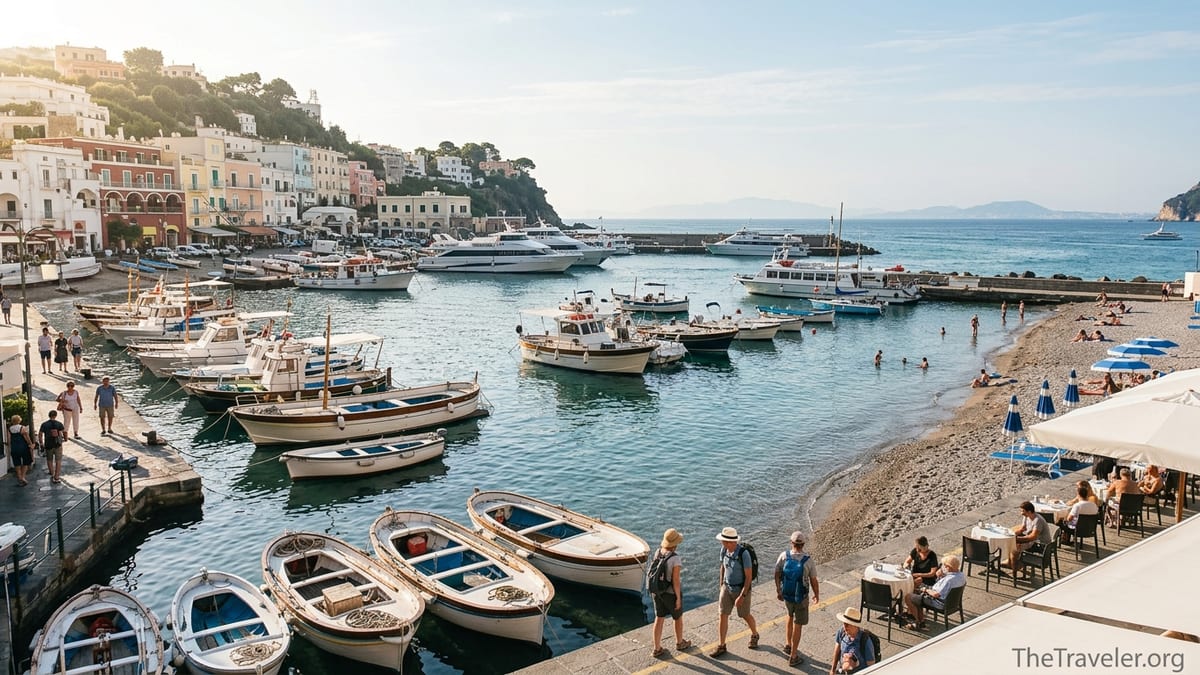
Why You Should Linger in Marina Grande
Marina Grande is the island’s main arrival port, but it is also Capri’s largest beach, a pocket-size fishing village, and the jumping-off point for many of the best boat experiences around the island. Ferries from Naples, Sorrento, and the Amalfi Coast pull in alongside small fishing boats, private yachts, and excursion vessels, so you get an instant snapshot of Capri life in a single glance. Instead of treating it as a bottleneck to fight through, think of Marina Grande as your decompression chamber between mainland chaos and island calm.
The scale is immediately more human than in Capri town. You can watch locals loading crates of vegetables and cases of mineral water for the hotels up above, see school kids hopping onto the bus to Anacapri, and hear Neapolitan accents drifting from the cafés. If you arrive on a morning ferry, pausing here for an espresso, a swim, or a stroll lets you adjust to the light, the heat, and the tempo of the island before you tackle the steeper lanes and busier piazzas higher up.
From a practical point of view, slowing down at Marina Grande can also help you avoid the worst of the queues. The funicular typically runs every 15 minutes or more frequently at peak times, costs about 2.40 euros one way, and climbs from the harbor to Capri town in about four minutes. In high season, however, the line for those four minutes can easily stretch to 20 or 30 minutes. Spending your first hour or two by the harbor, then heading up once the big mid-morning wave of day-trippers has dispersed, can make your whole day feel more relaxed.
Finally, you can build in buffer time for delayed ferries or last-minute changes. If you know that your return hydrofoil leaves at 18:00, planning to be back in Marina Grande by 16:30 gives you space for a final swim or aperitivo instead of a stressful dash. The port has everything you need within a few hundred meters: bars, simple restaurants, luggage storage, ticket offices, and access to buses, taxis, and the funicular.
Arriving Well: Timing, Luggage, and First Impressions
How you manage your arrival in Marina Grande often determines whether you feel harried or unhurried. If possible, choose a morning ferry that gets you in before 10:00. At that time the light is soft, temperatures are lower, and many of the large tour groups have not yet arrived. Stepping off an 08:35 or 09:00 hydrofoil from Naples or Sorrento into a still-waking harbor feels very different from arriving with the 11:00 wave.
Luggage is the first concern for many travelers. If you are staying overnight in Capri or Anacapri, you can either roll your bags to your hotel yourself or pay for a porter service at the port. Porters with small motorized carts collect luggage by the quay and deliver it up to hotels for a fee that usually starts around 10 to 15 euros per bag, depending on distance and the location of your accommodation. This can be money well spent, especially in summer heat, because it frees you to explore Marina Grande unencumbered while your luggage heads uphill separately.
If you are only on Capri for the day, luggage storage in or near Marina Grande is usually the most efficient solution. A long-running left-luggage facility operates close to the ferry ticket offices, identified by “deposito bagaglio” signage, and independent storage services now have points around Via Marina Grande and the port area. Recent traveler reports and local guides put prices in the rough range of 4 euros per item for simple storage during the day, with slightly higher rates for large suitcases. Opening hours commonly run from around 09:00 to late afternoon, with extended times in high season. This allows you to drop your bags, carry only a daypack, and avoid dragging wheels on cobblestones or squeezing suitcases into crowded buses.
Once your luggage is sorted, resist the instinct to join the funicular line immediately. Take five minutes just to stand on the quay and orient yourself. To one side you will see the arc of Marina Grande beach curving away from the port. Behind the harbor, pastel houses climb the lower slopes of the island. Fishing boats bob opposite sleek charter vessels. This is Capri at its most layered, with working harbor and holiday scene colliding in one compact space.
Cafés, Breakfast Spots, and Harborfront People-Watching
One of the simplest ways to experience Marina Grande is to do what locals and ferry crews do between crossings: sit down for a coffee or a quick snack. Several long-standing bars line the waterfront, steps from the arrival pier. A place like Bar Corallo, for example, faces directly onto the harbor and serves classic Italian coffees, cornetti, bruschette, panini, salads, and gelato from morning until evening. You can order a cappuccino and a pastry for roughly the price you would pay in Naples, with a small premium for the setting, and watch hydrofoils glide in while fishermen mend nets nearby.
If you arrive close to lunchtime, simple harborside trattorias and pizzerias in Marina Grande offer an easy first meal on the island without needing to go uphill. At Ristorante Pizzeria Da Peppino Buonocore, right in the heart of the marina, the menu focuses on fresh seafood, pizzas, and straightforward plates of pasta. Expect mid-range prices that reflect Capri’s waterfront location but a laid-back atmosphere: no dress code, families in flip-flops straight from the beach, and service comfortable with guests coming and going around ferry times.
Using Marina Grande for your first or last meal often works better than trying to squeeze into overbooked restaurants in Capri town at peak times. On a day trip, for instance, you might grab a late lunch back at the port after exploring the upper town, when many visitors are queuing for buses or ferries. This timing lets you sit on a shaded terrace with a plate of spaghetti alle vongole and a glass of white wine, then stroll a few minutes to catch your boat rather than eating in a rush.
Even if you are not hungry, a quick espresso at the bar is a useful ritual when you arrive. It gives you an excuse to slow down, to ask the bartender casually about the weather or sea conditions, or to confirm your understanding of ferry times. Moments like this do not appear in glossy brochures, but they are the interactions that make a visit feel anchored in the place rather than just staged for tourists.
Enjoying Marina Grande’s Beach and Seafront
Few people realize that the island’s largest beach sits right next to the hydrofoil docks at Marina Grande. A short stroll from the piers brings you to a pebble beach where locals and visitors share the same stretch of shoreline. Parts of the waterfront are free public beach, where you can spread a towel, and other sections are managed by beach clubs that rent out sun loungers and umbrellas for a daily fee.
If you arrive in mid-morning with no fixed schedule, this can be the perfect place to start your Capri experience. Swim for half an hour to wash off the stress of the mainland trip, let children play in the shallows while one adult keeps an eye on the bags, or simply sit on the rocks at the edge of the free area and take in the view of the bay of Naples. The water here is often clearer and calmer in the early hours, before boat traffic peaks and the afternoon wind picks up.
For a slightly more secluded swim, water taxis run from Marina Grande to nearby spots such as Bagni di Tiberio, a historic bathing area along the coast. The small shuttle boat picks up guests at the port and drops them at a pebble beach backed by low cliffs and a simple restaurant. This is not a remote castaway cove, but it is a noticeable step more peaceful than the main beach next to the ferry arrivals. Spending two or three hours there before heading up to Capri town can turn a rushed day trip into a mini seaside holiday.
Remember that sun in Capri can be intense, especially from June through early September. If you plan to linger by the water in Marina Grande, pack reef-friendly sunscreen, a hat, and water shoes for pebbly sections. Public showers and changing cabins are limited, so come ready to manage modestly with a towel and a bit of improvisation. A small dry bag is useful if you want to go for a swim while keeping phones and documents safe.
Boat Tours, Island Circuits, and Blue Grotto Side Trips
Marina Grande is the main departure point for boat tours around Capri. Many travelers rush to the funicular and only later double back to the harbor for a boat trip, causing them to zigzag and lose time. By putting your boat experience first, before going up to Capri town, you can use your morning light on the water and keep the afternoon for wandering the lanes above.
You will find a row of ticket booths and kiosks along the port offering small-group island circuits, shorter coastal cruises, and transfers to specific beaches or the Blue Grotto. Standard shared tours that circle the island typically last about two hours, with commentary from the skipper and short stops for photos or swimming if sea conditions allow. Prices vary by operator and season, but as of mid-2020s you can expect a basic group circuit to cost somewhere in the range of 25 to 40 euros per person, not including any separate entry ticket for the Blue Grotto itself.
Private boat charters from Marina Grande give you more flexibility in timing and route. Families or small groups sometimes find that a two-hour private rental shared between four to six people works out at a similar per-person cost to a premium group tour, especially at shoulder-season rates. Companies based in Marina Grande offer simple gozzo boats with local skippers, as well as more powerful speedboats. Meeting points are usually numbered piers, often around the upper pier numbers on the “banchinella,” so factor in five to ten minutes to find the exact spot. Sailing straight after arrival can be magical: you leave the crowds at the dock and, within minutes, are under the cliffs with only sea and rock around you.
If the Blue Grotto is on your list, check conditions before committing. Local boatmen and kiosk staff in Marina Grande will usually tell you by late morning whether sea levels and swell are allowing entries that day. On days when the grotto is closed, you can still enjoy a full island circuit that passes the entrance. When it is open, remember that the small rowboats that take you inside charge a separate fee at the grotto entrance, collected in cash. Planning for this in your budget avoids surprises and lets you decide calmly on the day whether the experience sounds worthwhile given the queue and conditions.
Exploring the Village Side Streets and Local Life
Just behind the main harborfront at Marina Grande you will find a web of narrow side streets that still feel like a small village. Many visitors never step off the quay, but spending half an hour wandering a block or two inland reveals a quieter, more local Capri. Follow Via Marina Grande away from the busiest cluster of bars and shops and you will soon pass the church of San Costanzo, one of the oldest churches on the island, often surrounded by children playing after school or elderly residents chatting on benches.
These backstreets are where you are most likely to stumble across small alimentari selling fruit, water, and picnic supplies at prices noticeably lower than those in Capri town. You might see laundry hanging from balconies, scooters wedged into tiny parking spaces, and cats stretched out on cool stone steps. This is the everyday fabric that supports the tourist-facing waterfront. Taking a few photos here requires sensitivity: avoid photographing people at close range without permission and treat doorways and stoops as private spaces.
Walk uphill a little and you can find viewpoints back over the harbor, with ferries pulling in below and the vivid blue of the bay beyond. Some visitors skip the funicular entirely on the way up and take the old mule path and stairways that lead from Marina Grande to Capri town. The climb takes around 30 minutes and is steep in places, but it offers continuous views and several quiet corners where you can catch your breath. An unhurried compromise is to ride the funicular up, then walk down these steps in the late afternoon when temperatures are cooler and the crowds heading back to the port are queuing for transport.
Along the way, small guesthouses and family hotels line the slopes above Marina Grande. Even if you are not staying there, noticing how the port connects to the rest of the island on foot changes your mental map. Capri stops feeling like a series of disconnected viewpoints and becomes a place with layers, each one linked by paths and stairways that locals use every day.
Smart Timing: Beating Crowds and Making the Port Work for You
Capri’s popularity means that at certain times of year Marina Grande can feel crowded and hectic, especially between late morning and mid-afternoon in high season. Rather than fighting this, you can use timing and the layout of the port to your advantage. Early morning and late afternoon are the best windows if you want to enjoy a calmer atmosphere around the harbor and the beach.
On a typical summer day, day-trip ferries from Sorrento and the Amalfi Coast arrive heavily between about 10:00 and 11:30. If you have stayed overnight on the island, treat that window as your time to be somewhere else: maybe on a boat tour already out at sea, or up in Anacapri riding the chairlift to Monte Solaro. Come back down to Marina Grande between 13:30 and 15:30, when some visitors are already queuing to leave, to enjoy a late lunch or a swim with slightly thinner crowds.
In the afternoon, queues build again at the funicular and bus stops as day-trippers return from the upper town to catch their ferries. This is where thinking ahead pays off. Aim to be back in Marina Grande at least an hour before your scheduled departure, especially in July and August. That cushion of time lets you manage any delays, buy last-minute limoncello or ceramics from harbor shops, or simply sit with a gelato looking at the water. If lines for the funicular are intimidating, remember that walking down from Capri town to the port typically takes around 15 minutes on the stairway path, a steady but manageable descent if you are reasonably fit and wearing sensible shoes.
Transport prices are relatively straightforward around Marina Grande. A single ride on the funicular or local buses costs roughly 2.40 euros, payable with tickets bought from booths near the port or via tap-and-go systems at turnstiles. Taxis from the harbor up to Capri or Anacapri are more expensive but offer open-top cars and door-to-door convenience, which can make sense for small groups with luggage or limited mobility. By deciding in advance how you want to move around, you avoid last-minute haggling or confusion in the busier moments of the day.
The Takeaway
Marina Grande is far more than a crowded arrival point at the base of Capri’s cliffs. It is a compact slice of island life where fishing boats and ferries share space, where locals still go about their routines, and where you can swim, eat, and set out on unforgettable boat trips without ever stepping onto the funicular. By planning to spend at least an hour or two here at the start or end of your visit, you add texture to your Capri experience and reduce stress in one move.
Slow travel on Capri does not require elaborate itineraries. It can be as simple as checking your ferry times carefully, dropping your bags in a left-luggage office, taking a slow coffee at a harbor bar, and choosing a morning boat tour before you head up to the Piazzetta. When you treat Marina Grande as a destination in its own right, not just a gateway, you give yourself the luxury of arriving fully rather than just passing through.
Whether you are on a day trip or staying several nights, think of Marina Grande as bookends to your time on Capri. Let your first memory be the smell of coffee and sea spray at the harbor and your last memory a final swim or aperitivo by the water. The island’s famous views will still be there above, but the port is where Capri first introduces itself, if you give it the time.
FAQ
Q1. Is it worth spending time in Marina Grande instead of going straight to Capri town?
Yes. Marina Grande has the island’s main beach, easy boat tours, working harbor life, and relaxed cafés. Spending even an hour here gives a more rounded sense of Capri before you head up to the busier town.
Q2. How long should I plan to stay in Marina Grande on a day trip?
If you are on a tight schedule, aim for at least one to two hours, ideally split between a swim or boat tour and a drink or snack by the harbor. With a full day available, you could easily spend a relaxed morning here before going up to Capri town.
Q3. Are there places to store luggage at Marina Grande?
Yes. There is a dedicated left-luggage office near the ferry ticket area, and additional storage services operate around Via Marina Grande. Expect to pay a modest fee per bag for daytime storage, with longer opening hours during the main tourist season.
Q4. Can I swim near the port, or is the water too busy with boats?
You can swim at Marina Grande’s beach, which lies just beyond the main ferry docks. Designated swimming areas are set apart from boat traffic, and additional options like Bagni di Tiberio are accessible by short water-taxi rides from the port.
Q5. What is the best time of day to enjoy Marina Grande without heavy crowds?
Early morning and late afternoon are generally the calmest. Try to arrive before 10:00 for a quieter harbor or come back down after 16:00 for a more relaxed swim or aperitivo as the sun softens.
Q6. How much do boat tours from Marina Grande usually cost?
Prices vary by operator and season, but a shared two-hour circuit of the island often falls in the approximate range of 25 to 40 euros per person. Private charters cost more overall but can be economical for small groups sharing the boat.
Q7. Is Marina Grande suitable for families with children?
Yes. The beach, short walking distances, abundant cafés, and easy access to boat tours make Marina Grande very family friendly. Just be prepared for pebbly shorelines, bring sun protection, and keep children close in crowded areas around the ferry piers.
Q8. Do I need to book boat tours from Marina Grande in advance?
In high season, it is wise to reserve popular small-group tours and private boats ahead of time, especially for mid-morning departures. Outside peak months or for basic shared circuits, you can often buy tickets on the day from kiosks along the harbor.
Q9. Is it possible to walk between Marina Grande and Capri town?
Yes. A steep but scenic stairway connects the port to Capri town, taking roughly 30 minutes uphill and about 15 minutes down if you are moderately fit. Many visitors ride the funicular up and enjoy walking back down in the cooler late afternoon.
Q10. Are prices for food and drinks in Marina Grande higher than elsewhere on Capri?
Prices at waterfront bars and restaurants in Marina Grande carry a small premium for the view, but they are often comparable to or slightly lower than those in Capri town’s most central spots. Venturing a block or two into the backstreets can reveal more local-oriented places with simpler pricing.