


For most visitors, Marina Grande is little more than Capri’s hectic front door: a place to disembark, buy a funicular ticket, and hurry uphill toward the Piazzetta. Yet if you slow down instead of rushing past the chaos of ferry queues and taxi horns, this compact harbor reveals a quieter side of Capri life. From hidden beach clubs and family fishing boats to backstreet trattorias and low-key sunset spots, Marina Grande rewards anyone willing to look beyond the terminal.
Get the latest updates straight to your inbox!
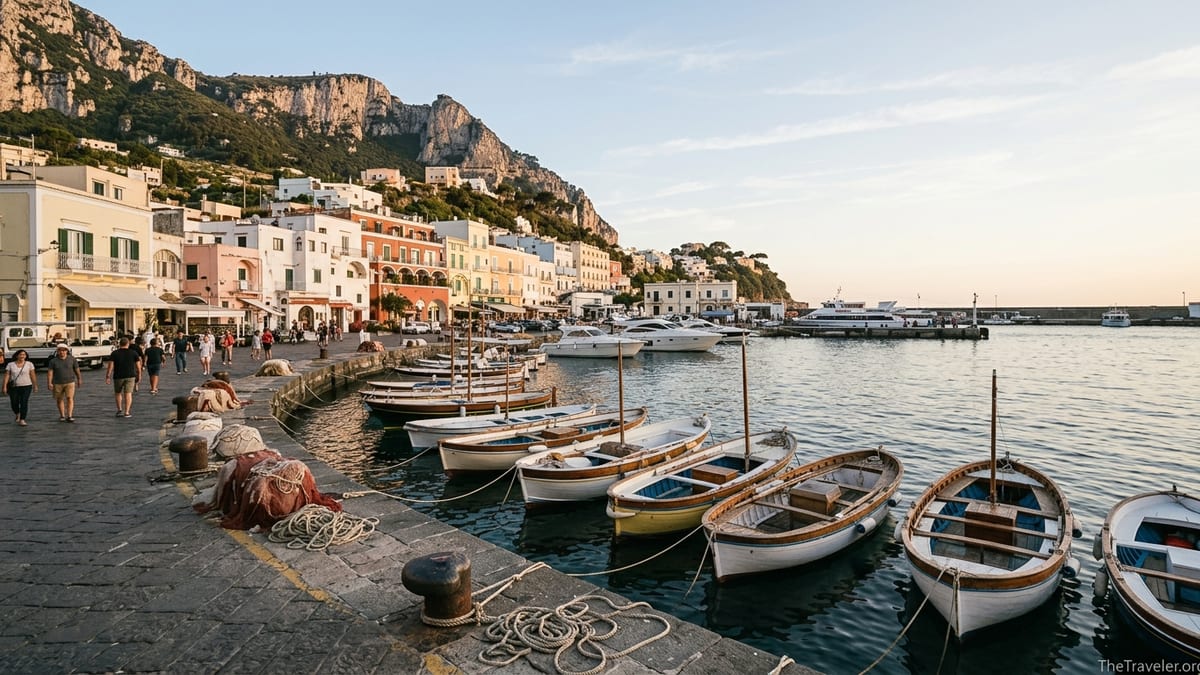
The Real Marina Grande Behind the Ferry Crowds
The first impression of Marina Grande is rarely flattering. Ferries from Naples and Sorrento pull in, loudspeakers blare, porters weave through the crowds, and a long line forms almost instantly at the funicular that climbs to Capri town. It feels purely functional, a transport hub to escape as quickly as possible. Yet this same waterfront has been an active harbor since Roman times, when emperors used it as the island’s main port and built their seaside villas nearby. Today, the pastel houses on the slopes above the quay are still home to local fishing families, shopkeepers, and boat captains who experience the harbor very differently from hurried day-trippers.
To see that other side, step away from the main pier where the hydrofoils dock and follow the curve of the bay in either direction. Within a few minutes, the bus tours and day-trip groups thin out and you start to notice simple details: nets drying over railings, laundry fluttering from tiny balconies, and fishermen chatting in Neapolitan dialect as they repair their lines. If you arrive on a morning ferry, give yourself at least 30 to 60 minutes before taking the funicular. That small pause can transform Marina Grande from a forgettable transit point into a surprisingly atmospheric introduction to Capri.
Even practical logistics look different when you slow down. Instead of joining the crush at the funicular immediately, you can buy your ticket at the small kiosk near the station and then wander the harbor while you wait for the line to shorten. The funicular runs frequently and the ride takes only about three minutes, with a one-way ticket currently just a few euros, so there is usually no need to sprint there straight off the boat. Treat your arrival as a soft landing rather than a race, and Marina Grande starts to feel like a place worth staying in for its own sake.
Exploring the Fishing Lanes and Everyday Harbor Life
Most people never see the narrow back lanes that form the historic fishing quarter just behind the waterfront bars. If you stand facing the sea and then turn inland near the small church and taxi rank, you will find quiet alleys lined with low, whitewashed houses. This is where the fishermen of Marina Grande live and store their gear, and in the early morning it feels more like a working village than an international resort. You might pass a garage stacked floor-to-ceiling with lobster pots, or a doorway where someone is cleaning a basket of small anchovies destined for the day’s lunch service.
These lanes are not an official attraction, but they are one of the easiest places on Capri to sense the rhythms of everyday island life. You may notice small shrines set into the walls, dedicated to the Madonna or local saints, decorated with fresh flowers and votive candles. Around mid-morning, local children trot down to the harbor for a quick swim before lunch, while older residents sit outside their front doors chatting in the shade. It is a very different world from the designer boutiques of Via Camerelle in Capri town, even though they are only a short funicular ride apart.
If you are comfortable with a little unstructured wandering, follow any gentle uphill lane from the harbor and let it lead you through this neighborhood for fifteen or twenty minutes. You do not need a map: the streets eventually loop back toward the sea, and the sound of the ferries guides you. Along the way, you might spot handwritten signs advertising fresh limoncello, homemade jams, or rooms to rent. These micro enterprises rarely appear in glossy guides, but they hint at how residents patch together a living from tourism while still maintaining local traditions.
The Beach at Marina Grande and Hidden Bagni Tiberio
Another thing many travelers miss is that Marina Grande has the island’s largest accessible beach. Walk to the left as you face the sea, away from the main ferries, and you will find Spiaggia di Marina Grande, a strip of pebbles and bathing platforms that locals use for quick swims. There are public areas where you can simply spread a towel as well as sections run by stabilimenti with paid sunbeds and umbrellas. On a summer weekday, you might see families from Capri gathering here in the late afternoon, after the hottest hours have passed, while day-trippers are already queuing to leave.
For a quieter experience, look for the small shuttle boats that depart from a private pier behind the hydrofoil ticket offices and head to Bagni Tiberio, tucked around the headland. This beach club sits on a clear, protected bay where an ancient Roman villa once stood, which gives it a historical charm as well as a more relaxed atmosphere than the main beach. The pebbly shore and low platforms are suitable for families, and there is a snack bar and restaurant serving classic island dishes such as spaghetti with clams or fish of the day grilled simply with lemon. A ticket for the beach club with a sun lounger is typically priced in the tens of euros per person, comparable to other Capri beach clubs but with a more intimate scale.
Even if you do not plan to spend a full day by the water, catching the brief boat ride to Bagni Tiberio offers a new perspective on Marina Grande. You look back at the harbor framed by cliffs, see the little funicular car climbing toward Capri town, and realize how close everything actually is. For travelers on a tight schedule, a practical approach is to visit Bagni Tiberio for a half-day: arrive on a late-morning ferry, drop your luggage at your accommodation or a left-luggage service at the port, and then shuttle over for lunch and a swim before continuing on to Capri town in the late afternoon.
Local Food and Waterfront Dining Beyond a Quick Slice
Because Marina Grande is packed with arrivals and departures, many travelers assume the food here must be generic and touristy. They grab a quick slice of pizza from a takeaway window and head upstairs to Capri town, never realizing that some of the island’s more relaxed seafood meals happen right along this harbor. Sit-down restaurants like Lo Zodiaco and L’Approdo, set slightly away from the main ferry gangways, specialize in fresh fish and shellfish delivered daily by the same boats moored just outside. While menus certainly cater to visitors, regulars come back for simple, well-executed dishes rather than novelty.
A typical waterfront lunch here might start with an antipasto of marinated anchovies or octopus salad, followed by a plate of scialatielli ai frutti di mare, a Southern Italian fresh pasta piled with clams, mussels, and prawns. Expect main courses like whole grilled seabass or pezzogna baked in a salt crust, often priced at a market rate per kilogram rather than a fixed figure, so it is wise to ask the approximate cost when you order. With a glass of local white wine from the Campania region and a view of the boats swinging in their moorings, the experience can feel far removed from the hectic ferry queues only a few minutes’ walk away.
If you are looking for something more informal, the bars along the harbor pour strong espressos in the morning and spritzes in the late afternoon, often with small complimentary snacks. Grabbing a table here is one of the easiest ways to observe the changing tempo of Marina Grande: around midday, porters wheel luggage carts past with impressive speed; later, small groups gather by the docks to negotiate last-minute private boat tours; by early evening, crews clean their decks and load crates of supplies for the next day. Rather than rushing straight to Capri town for your first coffee or last aperitivo, consider taking at least one drink right on the waterfront to watch this theater unfold.
Private Boat Tours and Life on the Water’s Edge
The most common boat experience for visitors to Capri is a crowded group excursion that circles the island in a large vessel, often with recorded commentary in several languages. These tours are convenient but can feel anonymous. Marina Grande, however, is also the base for dozens of local skippers who offer private or small-boat tours in traditional wooden gozzo boats. Companies such as Capri Island Tour, Mistral Capri Boat, and independent captains who advertise at small kiosks along the quay can arrange two to four hour circuits of the island, with swimming stops in sheltered coves and time to approach sea caves like the famous Blue Grotto when conditions allow.
Prices for private gozzo tours vary by season, group size, and boat type but often start in the mid hundreds of euros for a half day, which can be reasonable when split between a group of four or six. In return, you gain flexibility: your skipper can time the circuit to avoid the worst queues at the grottos, adjust the route if the wind picks up on one side of the island, and point out rock formations or villas that large-group tours barely mention. Many boats provide soft drinks and towels, and some can organize a stop for lunch at a seaside restaurant on the Amalfi Coast or in Nerano, turning your outing into a full-day coastal cruise.
Even if you do not book a tour, it is worth spending a few minutes simply watching how Marina Grande functions as a working small port. In the morning, fishermen return with crates of squid and small fish that will show up on menus within hours. Later, staff from larger yachts anchored offshore come ashore for provisions or to transfer guests. By late afternoon, you may see charter boats cleaning decks and rinsing snorkel gear, evidence of the many invisible hands that support a single day of summer tourism. Observing this activity can deepen your appreciation of the island and give you topics to discuss with local captains, who often have strong opinions about preserving Capri’s fragile coastline.
Practical Ways to Slow Down at Marina Grande
One of the simplest ways to appreciate Marina Grande is to plan for it in your itinerary instead of treating it as dead time. If you are arriving from Naples or Sorrento, consider choosing a mid-morning ferry rather than the earliest possible boat, then earmark your first hour on Capri for a harbor walk and swim. Drop larger luggage at your hotel if it offers port pickup, or use a porter service from the quay so that you are free to move around unencumbered. With that taken care of, you can stroll from one end of the bay to the other in about twenty minutes, stopping for a coffee, a photo of the pastel houses, or a quick dip at the public section of the beach.
Transportation costs and timings also matter. From the port, the funicular runs frequently throughout the day and takes only a few minutes to reach Capri town, with a ticket price that has remained relatively modest compared to the cost of private taxis. Buses toward Anacapri and Marina Piccola leave from stops just inland from the waterfront and are a budget-friendly alternative, though often crowded in high season. Renting a convertible taxi for the ride up is an experience in itself but comes at a noticeably higher price, especially once luggage surcharges are added. Knowing these options in advance means you can choose calmly on arrival rather than jumping into the first line you see.
Finally, consider how you leave Capri. Many travelers book the last possible ferry and then find themselves stuck in a crush at the terminal, tired and sunburned. A more pleasant alternative is to aim for an earlier departure and use the extra time at Marina Grande for a farewell swim, a plate of seafood by the harbor, or an unhurried aperitivo watching the light fade on the cliffs. Allowing that final hour or two not only reduces stress but also gives Marina Grande a chance to bookend your visit with something more memorable than a scramble for a seat on the hydrofoil.
The Takeaway
Marina Grande will probably always be busy in high season, with ferries docking, luggage trolleys rattling across the pavement, and streams of visitors lining up for the funicular. Yet this does not mean it has to remain a forgettable blur at the start or end of your Capri trip. Within a few hundred meters of the terminal, you can swim at the island’s main beach, slip into a quieter cove at Bagni Tiberio, wander centuries-old fishing lanes, share a seafood lunch overlooking moored gozzi, or charter a small boat to circle the island.
The key is to treat Marina Grande as a neighborhood rather than a bottleneck. Build an extra hour or two into your schedule, look beyond the obvious queues, and follow your curiosity along the waterfront and up the side streets. In doing so, you will see an authentic slice of Capri life that most travelers never notice, and you may find that some of your most vivid memories of the island are not from chic hilltop terraces but from this humble, colorful harbor at sea level.
FAQ
Q1. Is it worth spending time in Marina Grande, or should I go straight to Capri town?
It is worth setting aside at least an hour at Marina Grande. A short walk reveals the fishing quarter, the main beach, and relaxed waterfront bars and restaurants that most day-trippers ignore.
Q2. Can I swim near the ferry terminal at Marina Grande?
Yes. Walk along the bay to Spiaggia di Marina Grande, where there are public areas and paid beach sections with sunbeds and umbrellas, all within easy reach of the port.
Q3. How do I get to Bagni Tiberio from Marina Grande?
Small shuttle boats to Bagni Tiberio usually depart from a private pier behind the hydrofoil ticket offices. The ride takes only a few minutes and deposits you directly at the beach club.
Q4. Are there good restaurants in Marina Grande or is it mainly tourist food?
Marina Grande has several solid seafood-focused restaurants facing the harbor, along with simpler bars and snack spots. Menus are tourist friendly but rely on fresh local catch, especially at sit-down trattorias.
Q5. How expensive are private boat tours from Marina Grande?
Prices vary by season and boat type, but private gozzo tours around Capri typically cost in the mid hundreds of euros for a half day, which becomes more affordable when shared among several people.
Q6. Is it better to take the funicular, bus, or taxi from Marina Grande to Capri town?
The funicular is usually the most efficient and budget-friendly option, with frequent departures and a ride of only a few minutes. Buses can be crowded, while open-top taxis are more expensive but offer a scenic, door-to-door ride.
Q7. Can I store luggage at Marina Grande while I explore?
Many hotels arrange porter services from the port, and there are often left-luggage options or storage services near the harbor, which make it easier to swim or walk around before checking in or after checking out.
Q8. When is Marina Grande least crowded?
Early morning before the first major wave of ferries and late afternoon after day-trippers leave are generally quieter times, making it easier to enjoy the beach, bars, and backstreets.
Q9. Is Marina Grande a good place to stay overnight on Capri?
Staying in Marina Grande can be convenient if you plan to use boats frequently or prefer easy access to the beach. It is less glamorous than Capri town but feels more like a real harbor neighborhood.
Q10. Do I need to book restaurants or beach clubs in Marina Grande in advance?
In high season and on weekends, it is wise to reserve ahead for popular waterfront restaurants and for sunbeds at beach clubs such as Bagni Tiberio, especially if you want specific times or front-row spots.