


For most visitors, Marina Grande is little more than a blur of ferry ramps, suitcase wheels and the rush to reach Capri Town. Yet if you slow down and look closer, the island’s busy port reveals an older, quieter story. From traces of Roman engineering to tiny shrines wedged between fishermen’s sheds, Marina Grande hides details that locals pass every day and most travelers never notice. Spend even an hour exploring beyond the main pier and this “gateway” to Capri becomes a destination in its own right.
Get the latest updates straight to your inbox!
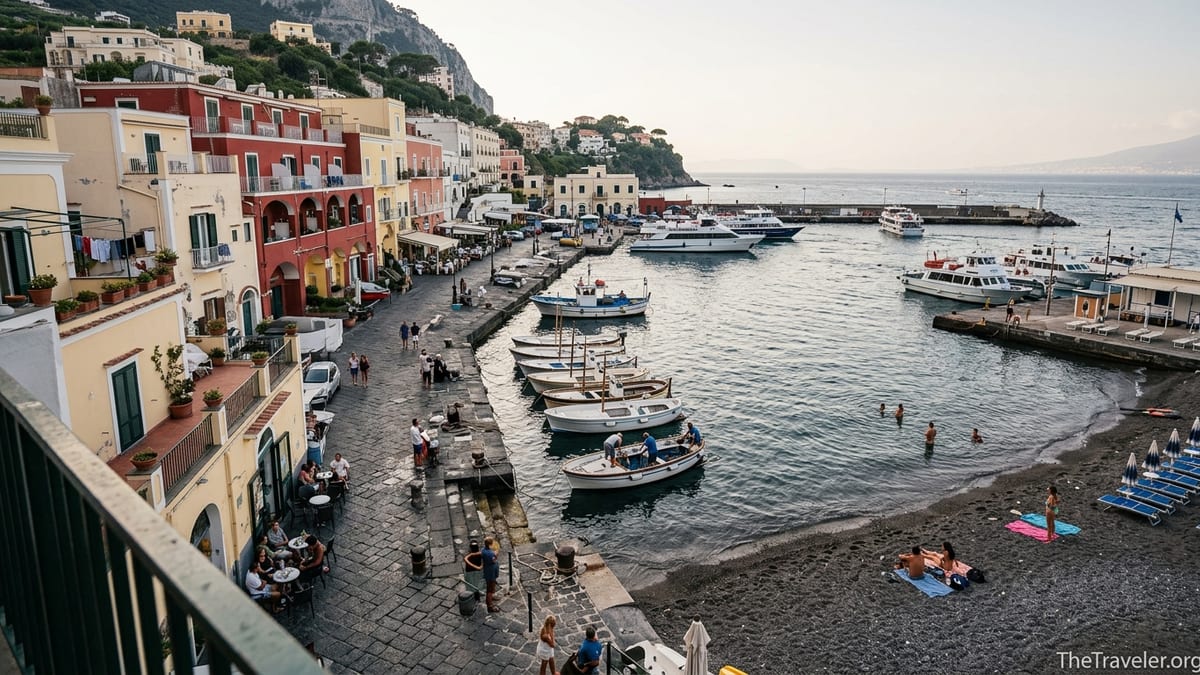
The First Impression Most Travelers Miss
When you step off the hydrofoil from Naples or Sorrento, it is tempting to see only the practical side of Marina Grande: ticket booths on one side, the funicular entrance above, lines of taxis and open-deck tour boats jostling for attention. Yet even on the main arrival pier there are clues that this port is much older and more layered than it appears. Look up instead of straight ahead and you will see steep terraced slopes dotted with pastel houses and kitchen gardens, a reminder that Marina Grande began as a compact fishing hamlet clinging to the base of Mount Solaro long before the first cruise passengers arrived.
Many visitors are focused on catching the next funicular up to the Piazzetta and never notice how the buildings lining the small square in front of the harbor differ from the architecture on the rest of the island. Here, facades are painted in saturated “Pompeian” reds and warm yellows, with deep balconies and open loggias designed to catch sea breezes. Walk just a few meters back from the waterfront and you will find laundry strung between houses, crates of lemons on doorsteps and narrow lanes where electric carts, not cars, do the heavy lifting. It feels more like a living village than a glossy resort, especially early in the morning before the first ferries arrive.
If you arrive on one of the early hydrofoils from Naples, usually around 7.00 to 8.00 in the morning in high season, linger on the pier for a few minutes. You will see local commuters greeting each other, café owners hosing down terraces and fishermen returning from the night’s work, long before day-trippers stream through the turnstiles. The contrast between this everyday rhythm and the midday rush is one of Marina Grande’s most revealing, yet easily missed, details.
Roman Echoes in a Modern Port
Capri’s glamorous image can make it easy to forget that Marina Grande has been a working harbor since Roman times. Near the end of the western wharf, away from the busiest ferry gates, stands a weathered Corinthian capital set on a high pedestal. It is easy to walk right past it while checking your phone or watching the boats, yet this carved stone is one of the clearest reminders that emperors once used this same bay. Archaeologists believe it belongs to the Roman phase of the port, when Marina Grande served as a secondary harbor while aristocrats built villas along the coast.
If you take one of the small shuttle boats from Marina Grande to the Bagni di Tiberio beach, a ten-minute ride that typically costs roughly the price of a short taxi trip in Naples, you pass low ruins along the shore. These are the remains of the imperial complex known as Palazzo a Mare, where Emperor Tiberius is thought to have created terraced pools directly at sea level. Many visitors treat the boat ride simply as a way to reach a beach club, yet from the waterline you can clearly see masonry foundations and fragments of ancient walls built into the rocks. On a calm day, look down through the clear water and you may spot squared stones that once formed Roman jetties.
Back in today’s harbor, the layout of the modern marina also hints at older engineering. Before the 20th century, boats anchored directly in the bay and passengers were shuttled ashore in smaller craft. The protective arms of the current port, with their curved breakwaters and sheltered basin, follow roughly the natural contours of the original cove. If you stand at the far end of the quay and look back toward the beach, you can imagine how the scene might have looked when Capri received supplies and fresh water by ship, long before the era of roll-on ferries and megayachts.
The Beach That Locals Call “Democratic”
Most visitors know that Marina Grande contains Capri’s largest beach, but few notice how it is quietly divided into different worlds. Immediately to the right of the hydrofoil dock, beyond the cluster of ticket offices, a curve of pebbles and gravel stretches for a few hundred meters. Locals sometimes refer to it as the island’s most “democratic” beach because it includes a generous free area alongside paid establishments with sunbeds and umbrellas. On a summer afternoon you might see families from Naples picnicking on the public stretch while hotel guests relax a few meters away on rented loungers.
Look more closely at the shoreline and you notice why water quality remains surprisingly good despite the proximity to the commercial port. The bay opens directly toward the Gulf of Naples and is flushed by currents, and the seabed slopes gently, which helps disperse boat traffic. The beach itself is not the fine, pale sand of a tropical postcard but a mix of dark pebbles and grit, more comfortable with water shoes than bare feet. That rocky texture is a reminder of the volcanic origins of the Bay of Naples and links Marina Grande more closely to its mainland neighbors than many tourists realize.
Marina Grande’s beach also offers one of the most expansive everyday views on the island, yet many travelers never step onto it. From the shoreline you can see the cone of Mount Vesuvius on clear days, and to the west the silhouettes of Ischia and Procida. Early in the morning, local swimmers cross the bay in slow, steady strokes, cutting through water colored deep blue by the depth just beyond the shallows. In late afternoon, as the sun drops behind the peninsula, the facades along the harbor glow a soft gold. Taking twenty minutes for a swim between ferries or before your return boat can turn a purely functional transit point into one of your strongest visual memories of Capri.
Hidden Lanes, Shrines and Everyday Rituals
Well before you reach the funicular, Marina Grande hides a network of quiet lanes that most visitors miss in their dash uphill. If you walk inland from the harbor square, following the gently rising streets toward the residential quarter, you pass a series of tiny votive shrines set into walls. Many are no larger than a window box, filled with candles, ceramic tiles of the Madonna and small bunches of plastic flowers. These shrines reflect the seafaring character of the neighborhood: fishermen and ferry crews still stop to touch the glass or cross themselves before heading out on rough days.
The backstreets of Marina Grande also reveal how tightly daily life is woven around the port. You may notice narrow tracks sized perfectly for Capri’s signature electric carts, which deliver everything from linen and luggage to crates of mineral water up from the docks. The absence of cars here is not a design choice for tourists but a practical response to the steep, stepped terrain. When you see hotel staff carefully maneuvering a loaded cart through an alley barely wider than an outstretched arm, you understand how much effort lies behind the island’s effortless glamour.
If you have an hour between boat connections, take a simple loop: from the harbor square, walk inland past the minimarket and pharmacy toward the residential streets above, then circle back down a different lane. You will likely pass small workshops where nets are repaired, modest guesthouses where room prices are markedly lower than in Capri Town, and balconies overflowing with geraniums. This short stroll replaces the anonymous transit-zone feel of Marina Grande with a sense of intimacy many visitors associate only with Anacapri’s quieter quarters.
The Funicular, Steps and Forgotten Viewpoints
For most travelers, the funicular that connects Marina Grande to Capri Town is simply a means to an end. You buy a ticket at the kiosk near the arrival pier, queue under the awning and in a few minutes you are whisked up the slope to the Piazzetta. Yet even here there are details worth noticing. The route of the funicular follows the natural curve of the valley that once channeled rainwater down to the harbor, and along the tracks you can glimpse terraced citrus groves and vegetable plots. If you sit near the lower windows, you catch brief, almost cinematic flashes of everyday island life: a woman hanging laundry, a cat sunning on a wall, a row of tomato plants staked along a narrow ledge.
Hidden in plain sight is an older way of reaching Capri Town from Marina Grande: the Scala Fenicia, or Phoenician Steps, which climb from just above the port up toward Anacapri. Many visitors never realize that this ancient stairway, with its hundreds of stone steps carved into the cliff, begins near the same waterfront where they disembark. You do not need to climb the entire route to appreciate its history. Even walking a short section gives a sense of how people and goods moved between harbor and village long before funicular cables and bus engines.
There are also modest viewpoints around Marina Grande that most people overlook in their rush toward the main sights. If you follow the road that curves eastward around the harbor toward the small lighthouse and boatyards, you reach a low terrace where locals often pause with an espresso from a nearby bar. From here the view back across the bay takes in the full amphitheater of pastel houses, the profile of the port’s breakwaters and, beyond, the open sea. It is the kind of everyday panorama that rarely appears on postcards but tells you far more about how the island breathes from day to day.
Small Churches, Patron Saints and Maritime Faith
Marina Grande’s religious landmarks are easily overshadowed by the more famous churches in Capri Town and Anacapri, yet they hold clues to the port’s identity. A short walk inland from the harbor brings you to modest churches and chapels tied to the island’s maritime traditions, many associated with Marian devotions that resonate deeply with seafaring communities. On certain feast days in late summer, processions wind down toward the waterfront, statues carried on the shoulders of parishioners while fishing boats sound their horns in greeting.
Even if you do not visit during a festival, subtle signs of this maritime faith are everywhere. Look for ceramic plaques of the Madonna mounted on house fronts, often lit by a small bulb at night. Step into a harbor-side bar early in the morning and you may notice a framed image of a patron saint tucked between bottles behind the counter, sometimes surrounded by model boats and old black-and-white photographs of local fishermen. These are not decorative touches added for tourists but living symbols in a community where storms, mechanical failures and sudden fog banks are part of working life.
When you see a fisherman pause briefly in front of a small shrine on his way down to the quay, or a family lighting a candle in a side chapel after a relative returns safely from a rough crossing, Marina Grande’s religious details stop being abstract. They become part of the fabric that binds together a neighborhood built on the uncertain edge between land and sea.
Reading the Working Harbor Behind the Glamour
From the deck of an arriving ferry, Marina Grande can look like an almost theatrical set: rows of restaurants with outdoor tables, boat excursion kiosks, polished yachts in the tourist marina. Yet if you watch closely for a few minutes, you start to see the choreography that keeps a small island supplied. Forklifts move pallets of bottled water and boxes of fresh produce from cargo ferries to covered storage areas. Porters in bright vests weave through the crowd with trolleys stacked with suitcases bound for hotels perched high above. Small utility boats shuttle fuel and supplies to the far corners of the island.
This constant logistics work is reflected in subtle details that travelers often ignore. The painted lines on the quayside, for example, mark not only passenger lanes but also reserved berths for different categories of vessels: commercial ferries, high-speed hydrofoils, tour boats, local fishing craft. In the tourist marina section, you may notice how mooring posts and bollards vary in size and spacing, revealing the range of yachts Capri can accommodate. Even the distinctive electric carts parked in neat rows by the dock each morning are carefully organized according to hotel or service, ready to collect guests and goods as soon as the gangplank drops.
Prices in the harbor reflect this dual identity as both working port and tourist showcase. An espresso at a bar set one or two streets back from the water typically costs closer to mainland rates than the slightly higher prices charged at waterfront tables with full views of the bay. Boat excursions sold at kiosks range from relatively inexpensive group tours around the island to private charters priced for luxury travelers, all departing from the same busy quay. Understanding that behind every glossy experience lies an infrastructure of small-scale, everyday labor can help visitors appreciate Marina Grande with a more nuanced eye.
The Takeaway
Marina Grande is far more than a holding area between ferry and funicular. Hidden in its crowded waterfront are traces of Roman engineering, the island’s most accessible “democratic” beach, ancient stairways carved into the cliffs and quiet backstreets where laundry flutters above electric carts. Its shrines, processions and modest churches reveal a deep maritime faith, while the constant movement of porters, forklifts and utility boats reminds you that everything on Capri arrives by sea.
If you give yourself even an extra hour before heading uphill, you can add layers to your understanding of the island that no panoramic terrace can match. Swim where locals do before work, follow a lane inland to glimpse everyday life, or simply stand by the Corinthian capital at the end of the pier and imagine the ships that once docked here under imperial rule. By noticing these hidden details in Marina Grande, you start to see Capri not only as a spectacular viewpoint, but as a living community shaped by its harbor.
FAQ
Q1. Is it worth spending time in Marina Grande, or should I go straight up to Capri Town?
Yes, it is worth at least an hour. Marina Grande offers the island’s largest beach, traces of Roman history, local backstreets and everyday harbor life that you do not see in Capri Town.
Q2. Where can I see Roman remains near Marina Grande?
Look for the Corinthian capital on a pedestal near the western end of the main pier, and consider a short boat trip from Marina Grande to the Bagni di Tiberio area, where you can view ruins of an imperial villa along the shore.
Q3. Is the beach at Marina Grande free to use?
Yes. There is a free public section of the beach alongside paid areas with sunbeds and umbrellas. You can swim at no charge, though you may want to rent a lounger in high season for comfort.
Q4. How long does it take to walk from the harbor into the quieter backstreets?
Within five to ten minutes on foot you can leave the busiest part of the waterfront and reach residential lanes with shrines, small workshops and everyday island life.
Q5. Are there any good viewpoints in Marina Grande without a long hike?
Yes. Short walks along the harbor road toward the boatyards or slightly uphill behind the main square offer broad views of the bay, the pastel houses and, on clear days, the mainland coastline.
Q6. What should I wear for swimming at Marina Grande’s beach?
Water shoes or sturdy sandals are helpful because the beach is mostly pebbles and coarse sand. A light cover-up is useful for moving between the beach and nearby cafés.
Q7. Can I use the funicular and still explore Marina Grande?
Absolutely. You can explore the harbor and backstreets either before riding the funicular up to Capri Town or after coming back down, as the lower station is just above the waterfront.
Q8. Is Marina Grande a good place to stay overnight on Capri?
For travelers who prefer easier access to ferries and lower room prices than in Capri Town, Marina Grande can be a practical base, with small hotels and guesthouses within walking distance of the port.
Q9. Are there quieter times of day to see Marina Grande without big crowds?
Early morning before about 9.00 and late afternoon after many day-trippers have left are generally calmer, making it easier to notice local routines and enjoy the waterfront.
Q10. How do I find the old steps from Marina Grande toward Anacapri?
Ask locally for the Scala Fenicia, or Phoenician Steps. The lower access is a short walk uphill from the harbor and marked by signs; you can walk a short stretch for the views without climbing the entire route.