


Visiting Berat from Tirana by public bus is straightforward, affordable and rewarding, but it is not a quick city-hop. In 2026, door-to-door travel commonly approaches three hours each way once you factor in reaching Tirana’s South and North Bus Terminal and the final stretch from Berat’s intercity station up to the historic quarters. That makes a same-day visit possible but compressed. For most travelers, Berat’s lanes, castle quarter and riverfront atmosphere feel noticeably more special with at least one night in town, especially if you want sunset light on the “city of a thousand windows” and time to wander after the day-trippers have left.
Get the latest updates straight to your inbox!
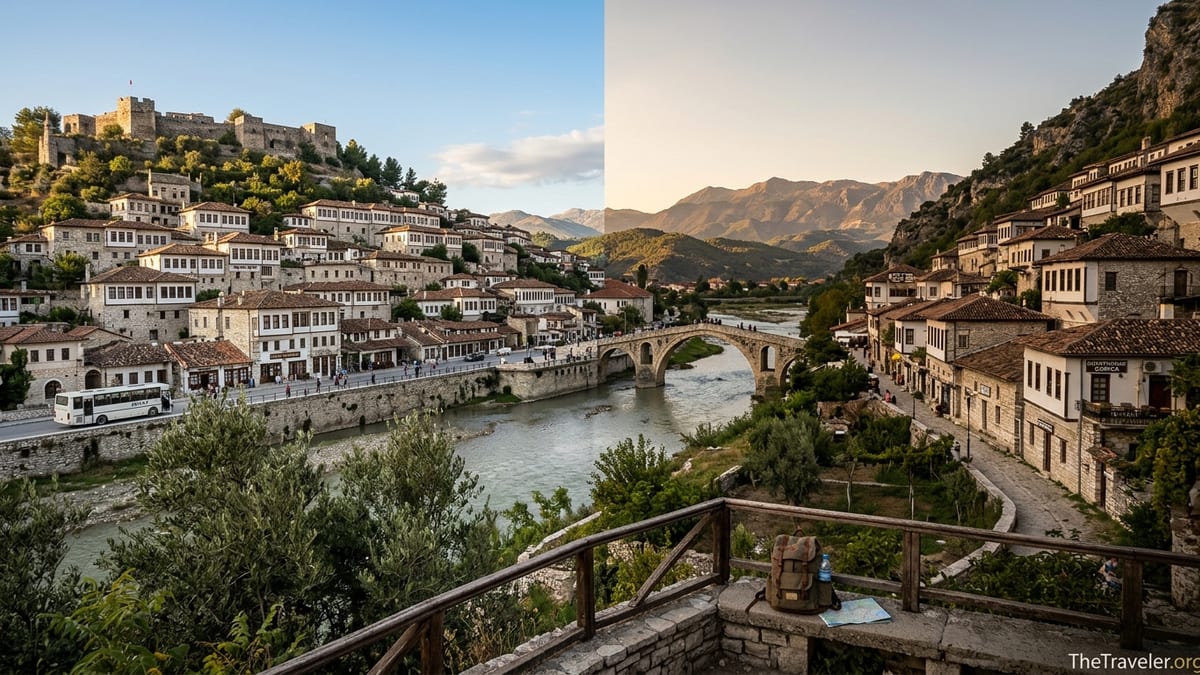
Is Berat Better as a Day Trip or Overnight Stay?
The bus ride between Tirana and Berat in 2026 is usually about 2 hours 15 to 2 hours 20 minutes on the road, but the practical journey from a central Tirana hotel to a guesthouse in Berat’s historic Mangalem or Gorica quarters is closer to 2.5 to 3 hours in each direction. This includes getting to Tirana’s South and North Bus Terminal at Kthesa e Kamzës on the western edge of the city, waiting for a departure and then covering the final 3 kilometres from Berat’s out-of-town bus station into the old town.
For disciplined travelers who are happy to leave Tirana around 06:00 and cap sightseeing by mid-afternoon, a day trip works. You can see the riverfront, walk part of Mangalem and Gorica, and visit Berat Castle and the Onufri Iconographic Museum with a firm eye on the clock. However, any delays, full buses or heat slowdowns quickly squeeze the day.
An overnight stay changes the rhythm completely. You can climb to the Kala (castle quarter) in the cooler evening, enjoy sunset views over the Osum River, have an unhurried dinner in Gorica or Mangalem and explore quieter cobbled alleys after tour groups depart. In practice, most recent independent reports and schedule checks suggest that a 1-night or 2-night stay delivers a substantially richer experience than a compressed day trip, particularly in high summer when midday heat makes the steep castle climb punishing.
If your Albania itinerary is tight, think of Berat as an early-start, early-finish day trip. If you value slower exploration, photography, or café time, plan one or two nights and treat the bus ride as part of the journey rather than a daily commute.
Step-by-Step: Tirana to Berat by Public Bus in 2026
Intercity buses from Tirana to Berat depart from the combined South and North Bus Terminal, often labeled “Tiranë Veri-Jug” or simply “South & North Terminal,” near the Kamza Overpass on the western approach to the capital. It is a dedicated regional bus area, not within walking distance of Skanderbeg Square for most visitors. Albanian transport registers and current timetable aggregators list around 23 direct buses per day, with the first departure at about 06:10 and the last around 17:30, each scheduled at roughly 2 hours 20 minutes.
To reach the terminal from central Tirana, you have two realistic options. The simplest is a taxi or ride-hailing car from the Skanderbeg Square area, normally taking 15 to 25 minutes depending on traffic. Recent traveler data suggests fares of roughly 800 to 1,200 lek in 2026 for this journey; always confirm the price before setting off or use a metered city taxi. The cheaper but more confusing option is a city bus such as line 13 toward the Kamza Overpass area, which costs a small flat fare paid in cash to the onboard conductor, but this involves locating the correct stop and sometimes changing buses in the center.
At the South and North Terminal, look for buses labeled “Berat” on windshields or small signs. Operators listed on Albanian e-transport platforms in late 2026 include TIBE and Mangalemi, among others. Official registers and ticketing sites describe frequencies of roughly every 30 to 60 minutes from early morning until the late afternoon, and no seat reservations are required for most services. It is wise to arrive at least 20 to 30 minutes before your intended bus to allow for buying a ticket, finding the correct bay and occasional queues.
Fares have risen from the 400 to 500 lek level often quoted in older guidebooks. In autumn 2026, current listings typically show around 550 to 600 lek when paying cash on board for the Tirana–Berat route, which is still good value for more than two hours of travel. Several online ticketing platforms sell advance tickets quoted in euros, usually 6 to 7 euros for the same journey. Where you still see a 400–500 lek price advertised, treat it as outdated and budget closer to 600 lek one way, with cash payment as the norm.
Arriving in Berat: Local Transfers, Terrain and Time Costs
The intercity bus from Tirana delivers you not to the riverfront quarter of Berat, but to the Berat Bus Station a few kilometres west of the historic centre, near the main approach road. The distance to Mangalem, Gorica and the main boulevard is about 2.5 to 3 kilometres. Walking is physically possible in around 30 to 40 minutes, but the route is exposed to traffic and sun, and is not especially scenic until you reach the river.
Most travelers either take a local bus or a taxi from the Berat terminal. A local city bus connecting the terminal with the centre usually stops just outside the station and costs a small fare in cash, paid directly to the conductor. It tends to drop passengers along the main boulevard close to the river bridges. This adds around 10 to 15 minutes, depending on where you get off and how busy the road is.
For those with luggage or limited time, taxis are common in front of the Berat Bus Station. A ride to guesthouses in Mangalem or Gorica generally takes 8 to 12 minutes. Drivers typically quote fares in the range of 400 to 700 lek for the short transfer in 2026, but there is no strict meter culture here, so agree on a price before leaving. This short hop can be worthwhile if you have backpacks and want to start sightseeing quickly rather than walking along the highway shoulder.
When comparing day-trip versus overnight timings, build your calculations on door-to-door reality. From a central Tirana hotel to standing on the Gorica Bridge often involves 15 to 25 minutes to the South and North Terminal, 2 hours 15 minutes on the road, 10 to 20 minutes at the Berat side with either a local bus or taxi, and margins for waiting at both ends. In practice, a conservative estimate is close to 2 hours 45 minutes one way. That leaves roughly 5 to 6 effective sightseeing hours in Berat on a day trip if you depart Tirana around 07:00 and target a mid-afternoon return bus.
Return to Tirana: Why You Should Not Rely on Late Buses
While timetable aggregators list a formal “last bus” from Tirana to Berat around 17:30, return services from Berat to Tirana are less clearly documented online and are influenced by demand, traffic and how quickly buses fill up. Recent traveler reports describe buses leaving at intervals of about 30 to 60 minutes through the day but often mention the last comfortable return being mid to late afternoon, and that a scheduled last service can leave early if the bus fills before the stated time.
This practical uncertainty is critical for anyone contemplating a same-day trip with sightseeing into the early evening. If you plan to leave Berat after 17:00, you are assuming that a bus will not only run but also have seats available, and that it will depart late enough to match the published timetable. In reality, the safest strategy is to aim for a return no later than about 15:30 or 16:00, providing at least one backup departure if your chosen bus is full or delayed.
At the Berat Bus Station, you usually buy your ticket directly from the driver or conductor when boarding. Cash in lek is still the expectation; online tickets are less often used in the reverse direction, and not all operators accept a digital booking shown on a phone. Arrive at least 30 minutes before your target bus, especially in July and August when day-trippers and locals alike fill seats. If a bus arrives already mostly full from an earlier stop, you might need to wait for the next departure.
If you miss the last practical bus back to Tirana, your realistic options are limited to arranging a private transfer or taxi (which is expensive for the 100-plus kilometre journey), or staying the night in Berat. There are no late-night trains or guaranteed shared taxis. This is another reason why, unless your schedule is inflexible, planning at least one night in Berat reduces stress and avoids the need to constantly watch the clock and bus bays.
Designing a Realistic Sightseeing Route in Berat
Once in central Berat, most independent visitors follow a simple loop that connects the riverfront, the historic lower quarters of Mangalem and Gorica, and the hilltop Berat Castle with the Onufri Iconographic Museum and its surrounding churches. A practical starting point is the pedestrian bridge near the modern boulevard, from where you can cross into Mangalem and appreciate the famous stacked Ottoman-era houses that give Berat its “city of a thousand windows” nickname.
From the river, you can walk through Mangalem’s narrow streets towards the base of the castle hill. This climb to the Kala is steep and involves uneven cobblestone paving; in summer the sun can be intense by late morning. Fit walkers usually reach the main castle gate in 20 to 30 minutes, but those unused to hills or traveling with children may need 40 minutes or more with rest stops. There are taxis in town that will drive you up most of the way to the castle entrance, which many travelers choose in the mid-afternoon heat before walking back down later.
Inside the walled castle quarter, you find a living neighborhood of stone lanes, ruins and viewpoints as well as the Onufri Iconographic Museum housed in the Church of the Dormition of St Mary. Official museum information for 2026 lists summer opening hours (roughly May to September) from 09:00 to 18:00, reduced winter hours and an individual adult ticket of about 400 lek, with reduced rates for students and children. Combined with a castle entry fee published by cultural authorities at around 200 lek, this makes the Kala and Onufri a modestly priced highlight.
Back at river level, cross the historic Gorica Bridge, a stone arch bridge that leads into the quieter Gorica neighborhood. Gorica’s streets are less busy than Mangalem’s and offer good photo angles back towards the famous “window” houses across the river. A simple walking loop is to start in Mangalem, climb the castle during the cooler morning or late afternoon, explore Onufri and nearby churches, then descend to stroll Gorica and return over the bridge as the light softens.
Practicalities: Heat, Terrain, Tickets and Opening Hours
Berat’s historic quarters reward slow walking but are not gentle. Streets in Mangalem, Gorica and especially the castle quarter are paved with irregular stone that can be slippery when dusty or wet. Flat sandals and thin-soled shoes are a poor choice; trainers or light hiking shoes make a noticeable difference, particularly on the descent from the Kala. The steepest sections feel more challenging in July and August when afternoon temperatures often exceed 30 degrees Celsius. Planning your castle visit early in the morning or later in the day reduces both sun exposure and fatigue.
The Onufri Iconographic Museum and Berat’s Ethnographic Museum each have defined seasonal hours. Onufri’s museum authority states that from May to September it is open roughly 09:00 to 18:00, with shorter hours in the low season and slightly later Sunday starts. The Ethnographic Museum, located lower in town, is typically open during daytime hours with tickets in the 300 lek range for adults. Both museums note that they remain open on major national holidays, although unexpected closures for maintenance or events are always possible, so confirm at the local tourist information office or with your guesthouse on arrival.
Berat’s historic centre is part of a broader UNESCO World Heritage Site that also includes Gjirokastër, celebrated for their well-preserved Ottoman-era urban architecture. This designation does not affect entry formalities but does contribute to occasional conservation work at churches and mosques. You may find individual religious buildings closed at short notice for restoration even when the quarter itself is fully accessible.
Religious observances do not usually shut the city, but some mosques may be busier at prayer times on Fridays, and church services may limit access to interiors briefly on major Orthodox and Catholic feast days. Plan interior visits flexibly, and allow yourself time to appreciate exterior architecture and viewpoints even if one particular building is closed during your visit window.
One-Day, Two-Day and Optional Third-Day Itineraries
A tight but achievable one-day independent itinerary from Tirana might begin with a 06:10 or 07:00 bus from the South and North Terminal, arriving in Berat between approximately 08:30 and 09:20. Factoring in a short taxi ride from Berat’s bus station, you could be on the riverfront by around 09:00 to 09:45. Spend the rest of the morning exploring Mangalem on foot, pausing for a quick coffee on the boulevard before starting the climb to Berat Castle late morning or just after lunch.
Assuming entry to the castle around 12:00 to 13:00, you can visit the Onufri Iconographic Museum and wander the upper quarter for views and photographs for 1.5 to 2 hours, then descend to the riverfront by 14:30 or 15:00. This leaves a comfortable margin to walk across the Gorica Bridge, sample the quieter lanes on the opposite bank and sit for a light late lunch or early snack before taking a taxi or local bus back to the Berat terminal in time to target a 16:00-ish departure to Tirana, keeping a backup bus around an hour later as insurance.
A more relaxed two-day plan allows you to invert the hottest hours. On Day 1, travel on a mid-morning bus from Tirana, settle into a guesthouse in Mangalem or Gorica, have a long lunch and explore the lower quarters without rushing. In the late afternoon or early evening, take a taxi up to the castle to stroll the lanes and viewpoints as the sun lowers, descending on foot after the main heat. Enjoy a slow dinner in Gorica or Mangalem, then a riverside walk under the illuminated façades.
Day 2 can focus on museums, specific churches and unhurried café time. Visit the Onufri Museum or Ethnographic Museum right after they open, when crowds are light, then spend the late morning shopping for local products or simply watching daily life from a shaded terrace. With an overnight stay, you can comfortably target a mid-afternoon bus back to Tirana, again giving yourself one more departure as a fallback in case of full buses.
If you have a third day and want an excursion beyond the city limits, consider short trips such as to local wineries or viewpoints in the surrounding hills. These almost always require private transport, whether arranged through your guesthouse, a local driver or a small-group tour, because regular public buses rarely line up conveniently with sightseeing needs. Destinations that combine vineyards and rural scenery are ideal for a lazy day, but they should be organized with clear pricing and timing so you can still make your onward connections.
Where to Stay: Mangalem, Gorica, Kala or Modern Centre
Mangalem is the classic postcard Berat neighborhood, directly facing the river with its slope of white Ottoman houses. Accommodation here ranges from simple guesthouses to small boutique hotels, many in restored traditional buildings. Staying in Mangalem means you are close to restaurants, bars and the main pedestrian bridge, and the hill is manageable though still sloping. Expect mid-range nightly rates for double rooms, with some increase in high summer.
Across the river, Gorica feels quieter and slightly less touristed but still offers several atmospheric guesthouses in old stone houses. It is a little more residential and has fewer dining choices than Mangalem, but the views back towards the “thousand windows” are excellent. The hill in Gorica can be steeper in parts, so guests with mobility difficulties should confirm access and steps with their chosen property. Parking here is somewhat easier than directly in Mangalem if you arrive by car later in your trip.
Staying in the Kala, inside Berat Castle’s walls, is an evocative experience but not suitable for everyone. Guesthouses in the castle quarter sit among cobbles and steep lanes, and vehicles cannot always reach the door. This area suits travelers who prioritize atmosphere over convenience and who are happy to walk up and down the hill at least once a day. Restaurants at the top are fewer, so some visitors prefer to dine in Mangalem or Gorica and return uphill earlier in the evening.
The modern town centre, around the main boulevard and newer buildings away from the river’s immediate banks, provides flatter access, easier parking and quick access to everyday services like supermarkets and banks. Hotels here are often slightly more affordable than in the prime historic quarters and may offer larger rooms. You trade some of the picture-book scenery for practicality, but you are usually only a few minutes’ walk from the river and bridges, making this area a good option for travelers with mobility or budget concerns.
Costs, Cash, Accessibility and Summer Travel Considerations
For a realistic 2026 independent day trip for two adults from Tirana to Berat, budget roughly as follows. Return bus fares at around 550 to 600 lek per person each way come to approximately 2,200 to 2,400 lek in total. Add 800 to 1,200 lek each way for a taxi between central Tirana and the South and North Terminal, plus about 400 to 700 lek per ride for taxis or local transport at the Berat end if you do not walk. Museum and castle entries for two, visiting the Kala and Onufri plus perhaps the Ethnographic Museum, add roughly 1,400 to 2,000 lek. Light meals, drinks and coffee might reasonably total 2,000 to 3,000 lek over a day. In round terms, a careful but comfortable independent day trip for two is often in the 7,000 to 10,000 lek range, depending on taxi usage and restaurant choices.
For an overnight stay, add the cost of accommodation. A mid-range double room in Mangalem, Gorica or the modern centre in 2026 frequently runs between 4,000 and 8,000 lek per night, with breakfast often included. With two full days of meals, museum entries and occasional taxis, a realistic overnight budget for two is more like 15,000 to 22,000 lek, with scope to spend more if you choose higher-end dining or private excursions.
Cash remains important. Although more restaurants and guesthouses accept card payments each year, bus fares, taxis, small cafés and some museum tickets are still easiest to pay in lek notes and coins. Withdraw enough cash in Tirana or at ATMs in Berat’s modern centre before heading into the castle quarter, where ATM availability is patchier. Keep small denominations for bus conductors and taxi drivers to avoid delays over change.
Accessibility is mixed. The intercity buses themselves usually require a couple of steps up from the ground and may not have wheelchair lifts. The South and North Terminal has paved surfaces but can feel chaotic, with luggage, vendors and buses moving at once. In Berat, the riverfront and main boulevard are relatively flat and manageable, but Mangalem, Gorica and the Kala are built on slopes, with uneven stones, steps and narrow passages that pose challenges for anyone with mobility impairments. During summer, plan early starts, long lunch breaks in shade and carry water; simply shifting your castle visit to early morning or late afternoon will significantly improve comfort.
Independent Bus vs Organized Tour vs Overnight Stay
Traveling independently by public bus from Tirana to Berat gives you maximum flexibility at the lowest cash cost. You can choose your departure time, linger longer in a museum or café, and adjust your route without coordinating with a group. The trade-offs are the need to navigate the South and North Terminal, to manage cash payments, and to keep track of return bus schedules that are frequent but not perfectly predictable. For budget-conscious travelers, long-term backpackers and those who enjoy figuring out local systems, this is generally the best-value approach.
Organized day tours from Tirana, by contrast, remove almost all logistical burden. A typical minibus or coach tour picks you up from a central point or hotel, drives directly to Berat’s historic centre with a guide, includes a structured walking tour of Mangalem and the castle and sometimes includes museum tickets or lunch. Prices are higher than the sum of public bus fares and independent meals, but you gain commentary, door-to-door transport and a fixed timetable that guarantees a return to Tirana the same evening. This option suits visitors with very limited time in Albania, those who prefer guidance over independent navigation, or travelers who feel uncomfortable with loosely documented bus systems.
The overnight independent stay offers a third path that many experienced travelers consider the sweet spot. By combining public bus travel with at least one night in a local guesthouse, you keep costs moderate while gaining time for quieter exploration and evening atmosphere. You can still join a short locally run walking tour in Berat if you want context, without being bound to a full-day group schedule. This is particularly attractive for photographers, history enthusiasts and anyone visiting during the long days of summer, when dusk in Berat can be one of the highlights of a trip to Albania.
In simple terms, choose a same-day independent bus trip if your schedule is tight and you are comfortable with early starts and conservative return times. Opt for an organized tour if convenience and guaranteed same-day logistics matter more than budget and flexibility. If you can spare the time and want to experience Berat at its best, travel independently by bus but plan to stay at least one night, ideally two, in Mangalem, Gorica or the castle quarter for a fuller sense of this UNESCO-listed city.