


The Blue Mosque in Istanbul is one of the world’s most beautiful religious buildings, but it is first and foremost an active place of worship. Visitor dress rules are taken seriously, and security staff will not hesitate to turn you away or wrap you in an unflattering cover if your outfit does not meet the standards. With a little planning, though, you can walk straight in, feel at ease and show respect without sacrificing comfort or style.
Get the latest updates straight to your inbox!
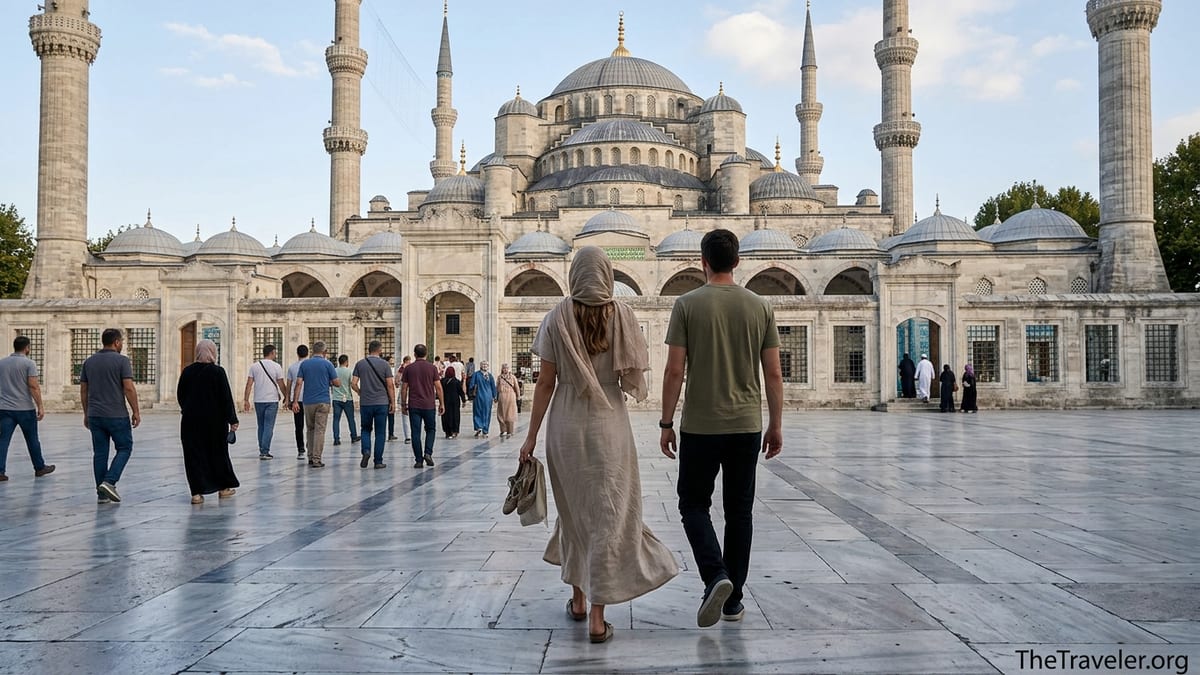
Understanding How the Blue Mosque Welcomes Visitors
The Blue Mosque, officially Sultanahmet Camii, is free to enter and open daily to visitors outside the five daily prayer times, generally between about 8:30 a.m. and early evening in 2026. Tourist access pauses roughly 30 minutes before each call to prayer and resumes about 90 minutes after, with a longer closure around midday on Fridays when the main congregational prayer takes place. Plan on arriving mid morning or mid afternoon on a weekday for the calmest experience and the shortest security queues.
For non Muslim visitors, the mosque is both a historic monument and a functioning religious space. That dual role shapes everything about the visit: shoes must be removed, certain areas are for worshippers only, flash photography is discouraged, and dress codes are enforced at the entrance. Unlike some smaller neighborhood mosques where rules may be looser, here staff are used to international tourism and apply a clear, consistent standard regardless of where you are from.
Dress rules inside the mosque are not primarily about fashion; they are about modesty and creating a space where worshippers can focus on prayer. That is why you will see Istanbul locals arriving in office clothes that still cover shoulders and knees, as well as tourists in jeans, maxi dresses and loose shirts. If you copy what a typical Istanbul family might wear here on a weekend visit, you will almost always be fine.
The Core Dress Code Rules in Plain Language
The practical rule set at the Blue Mosque can be summed up simply: shoulders and upper arms covered, knees covered, no plunging necklines or transparent fabrics, and a generally modest silhouette. This applies to all adults and to children who are old enough to walk around independently. Security staff at the visitor entrance scan for exposed shoulders, short shorts, mini skirts, low cut tops and tight sportswear that looks more like gym clothing than streetwear.
For men, this means no sleeveless tops or tank shirts, no shorts above the knee and no see through football jerseys. A man arriving in a black Uniqlo crew neck T shirt and straight leg Levi’s jeans will be waved straight through. A traveler in a basketball singlet and mid thigh running shorts will be stopped and either asked to change or given a wraparound cover.
For women, the mosque asks for arms and legs to be covered down to at least the ankle or just above, with loose trousers, long skirts or dresses that are not transparent. A traveler in a linen maxi dress from Zara with a light cotton cardigan and sneakers will comply perfectly with the rules. Someone in a spaghetti strap summer mini dress or cropped top with cycling shorts will be pulled aside and given a shawl or skirt cover, which can be hot and uncomfortable on a humid Istanbul afternoon.
The rules also extend to footwear and general appearance. You will remove your shoes at the threshold and carry them in a plastic bag or tote, so wear socks if you prefer not to walk barefoot on the carpet. Beachwear, swimsuits worn under open shirts, and any clothing with offensive slogans are not acceptable. If your outfit would feel too revealing for a conservative family lunch, it is too revealing for the Blue Mosque.
Headscarves, Hair and What Is Actually Required
Head coverings are the area that causes the most confusion, especially for non Muslim women who want to behave respectfully but are unsure what is mandatory. The most up to date guidance from visitor information sources around the mosque indicates that female visitors are strongly encouraged to cover their hair in the prayer hall. Staff may offer a scarf if your head is uncovered, and many women find it more comfortable to bring their own lightweight scarf or pashmina rather than use the communal ones provided at the entrance.
In practice, you will see a mix. Some non Muslim women choose to cover fully with a traditional rectangular scarf. Others use a simple cotton bandana or wrap a thin H&M or Mango pashmina loosely over their head and shoulders. A practical real world option is a neutral colored viscose scarf that you can fold into your day bag and throw on just before you enter, then remove when you step back outside into Sultanahmet Square.
For men, there is no expectation of head covering. Baseball caps and beanies can be kept on in the courtyard, but it is courteous to remove them once you enter the main prayer space, much as you might take off a hat when entering a church. If you are visiting as part of a mixed group, it helps to talk through this in advance so that everyone understands what will be expected at the door and there are no surprises or awkwardness in front of staff.
Remember that the mosque staff are not trying to embarrass anyone. Their job is to keep the space consistent with Islamic norms of modesty. If they ask you to adjust your scarf or pull your shirt a little lower, take it as a cue, not a criticism. Adjusting your outfit gracefully also sets a good example for the tour groups waiting behind you in line.
Outfit Ideas for Different Seasons and Travel Styles
Istanbul’s weather changes dramatically between seasons, so what feels like an easy modest outfit in April can be stifling in August. In summer, when daytime highs often sit around the high twenties or low thirties Celsius, airy fabrics become your best friend. Many travelers opt for loose linen trousers from brands like Muji or Uniqlo, paired with a breathable cotton T shirt and a light scarf. A common summer look in the Blue Mosque courtyard is a long printed kaftan or maxi dress over flat sandals, with a gauzy scarf that can be thrown over the hair at the door.
In winter, the challenge is less about covering up and more about managing layers. Outside, you may be wearing a thick wool coat, but inside the mosque you will remove your shoes and sometimes feel a noticeable temperature difference on the carpeted floor. Jeans or dark trousers with warm socks, a turtleneck or long sleeved top, and a mid length coat work very well. If you are carrying a bulky parka, be prepared to hold it or fold it over your arm so it does not drag on the floor or block narrow walkways.
For budget travelers carrying only a small backpack, versatility matters. A single pair of dark, loose fit trousers made from quick drying synthetic fabric can take you from a Bosphorus ferry ride to the mosque and then to dinner. Add a long sleeved button down shirt that can be rolled to the elbow outside and unrolled inside, plus a thin scarf that doubles as a pillow on overnight buses. This approach avoids the need for “special” mosque clothes while still respecting the rules.
Families with children should pack at least one full length outfit for each child old enough to explore independently. A realistic example: an eight year old in Decathlon jogging pants and a long sleeved cotton T shirt with sneakers will have no problem, while a child in a sleeveless dress and tiny shorts may be stopped. Because children are more likely to spill ice cream or get splashed on a Bosphorus cruise, having a backup outfit in a daypack is wise if the mosque is scheduled later in the day.
What Happens If You Get the Dress Code Wrong
Even with careful planning, it is common to see visitors arrive in clothing that does not meet the standard, especially on very hot days when shorts and strappy tops are tempting. The mosque is prepared for this. Near the visitor entrance on the south side, staff keep a supply of wraparound skirts, poncho like gowns and scarves in basic colors. These are usually offered free of charge or for a small cleaning contribution, and you return them when you exit.
The catch is that these communal covers are designed for coverage, not style or comfort. They are often synthetic, one size fits most garments that can feel clingy in the heat. A visitor who has arrived in mid thigh denim shorts may find themselves walking around in a heavy navy blue wrap skirt that drags on the ground. A woman in a cropped top might end up in a thick polyester poncho that covers her torso and upper arms. Bringing your own scarf and longer layers lets you avoid this and feel more at ease in photos.
If a staff member stops you at the entrance and explains that your outfit is not acceptable, the best approach is to respond calmly and ask what you can do to comply. Arguing about local norms will only delay your entry and creates tension for everyone in line. Many visitors report that when they show willingness to adjust, staff are patient and helpful, suggesting small fixes like pulling a T shirt down, buttoning a cardigan or swapping shorts for trousers you have in a day bag.
In more serious cases, such as very revealing clothing or visible offensive text on garments, you may be firmly told that you cannot enter even with covers. In that situation, the only realistic option is to return later in different clothes. To avoid losing time on a tight Istanbul itinerary, it is worth checking your planned outfit the night before against the simple rules of covered shoulders, covered knees and loose, opaque fabrics.
Timing Your Visit Around Prayer and Crowds
Dress code is only half the equation of a smooth Blue Mosque visit; timing is the other. The mosque closes to tourists five times a day for prayer, and during those windows visitors are asked to leave the main prayer hall. On Fridays, visitor access is typically suspended from late morning until mid afternoon so that the midday congregational prayer can take place without disruption. If you arrive at 11:30 a.m. on a Friday in July in perfect modest clothing, you may still find the gate closed and a sign advising you to return after 2:30 p.m.
To reduce stress, plan the Blue Mosque as the first or second stop of your day. For example, many travelers staying in Sultanahmet walk over just after opening, around 8:45 or 9:00 a.m., when the plaza is still relatively quiet and tour groups are forming up. Afterward they continue on to Hagia Sophia or the Basilica Cistern. Others prefer a late afternoon visit around 4:00 p.m., when the light is softer for photography and the marble courtyard cools slightly, then stay nearby for an early dinner on a side street away from the busiest souvenir stands.
Outside the mosque, you may encounter unofficial guides or touts who tell you that the building is “closed for prayer” or “closed for cleaning” when it is actually open, then offer to take you to a carpet shop or a paid rooftop viewpoint. The simplest response is a polite “no, thank you” and a walk to the official visitor entrance, where uniformed staff and clear signage indicate the true status. Checking prayer times on a reputable prayer time app before you leave your hotel helps you recognize when closures are genuine.
Whatever time you choose, factor in at least 30 minutes for security and queuing during shoulder seasons, and up to an hour in peak summer. During these waits, your choice of clothing matters: a long sleeved linen shirt, breathable trousers and a thin scarf are much easier to tolerate in a hot queue than thick denim and heavy synthetic ponchos borrowed at the door.
Practical Packing Tips and Real World Scenarios
To stay within the dress code without overpacking, think in terms of a “mosque capsule” that integrates easily into the rest of your trip wardrobe. For many travelers, that means two tops with elbow length or full length sleeves, one pair of full length lightweight trousers and one long skirt or dress, plus a neutral scarf. These items can be mixed and matched for other activities, such as visiting the Suleymaniye Mosque, dining in more traditional neighborhoods like Fatih or exploring conservative districts on the Asian side.
Imagine a three day Istanbul trip in June. On day one you explore Galata and Karakoy in a T shirt and cropped jeans. On day two you plan to visit the Blue Mosque and Hagia Sophia. Before breakfast, you change into wide leg navy trousers, a breathable long sleeved top and pack a pale grey scarf in your tote. After the mosque, you keep the same outfit for a ferry ride to Kadikoy, where modest but casual clothing helps you blend in with locals. On day three, you wear the long skirt with a different top and the same scarf to visit Dolmabahce Palace. You have complied with dress codes at multiple sites without clothes that feel “special” or costume like.
Another real world scenario involves travelers coming from coastal resorts like Bodrum or Antalya, where beachwear dominates. If you are flying into Istanbul for a day trip before or after a seaside holiday, make sure you move long trousers and proper tops into your carry on rather than leaving them in checked luggage. Many visitors have found themselves at the Blue Mosque in board shorts and bikini tops because all their modest clothes were in a suitcase still at the hotel.
Finally, do not underestimate the value of small accessories. A lightweight foldable tote or cloth bag makes it easy to carry your shoes once you remove them at the threshold. A pair of clean socks in your bag can be a comfort if you dislike walking barefoot on shared carpets. A simple hair tie or clip can help keep a scarf in place, especially on breezy days when the courtyard funnels wind between the minarets.
The Takeaway
Visiting the Blue Mosque without breaking dress code rules is less about memorizing a complicated list and more about adopting a mindset of modest respect. If your clothing covers shoulders and knees with opaque, reasonably loose fabrics, and if you carry a simple scarf to cover your hair if requested, you will already be far ahead of the average unprepared visitor in the summer queue.
The mosque’s staff are used to welcoming people from every corner of the world. They will guide you, offer loan garments when needed and point you toward the correct entrance. By doing a small amount of preparation and packing with the mosque in mind, you free yourself to focus on the real reasons to be there: the soaring domes, the blue Iznik tiles high above the prayer hall, and the feeling of stepping for a moment into the spiritual life of Istanbul rather than just photographing its skyline.
Dress code compliance is not simply about following rules; it is a practical expression of cultural sensitivity that enriches your travel experience. When you walk out of the Blue Mosque courtyard after your visit, you should feel not just that you “ticked off” a landmark, but that you entered with care, behaved thoughtfully and left with a deeper appreciation of the city that surrounds it.
FAQ
Q1. Do I have to wear a headscarf as a non Muslim woman at the Blue Mosque?
Non Muslim women are strongly encouraged to cover their hair in the main prayer hall. In practice, staff may offer you a scarf if you arrive bareheaded, so it is sensible to bring a lightweight scarf or pashmina you feel comfortable wearing rather than relying on communal loan scarves.
Q2. Can I wear shorts to visit the Blue Mosque if they are just above the knee?
Shorts that sit above the knee are usually not accepted for either men or women. To avoid problems at the entrance, choose full length trousers or a long skirt. If your shorts leave part of your thigh visible, staff will almost certainly ask you to cover them with a wraparound skirt.
Q3. Are leggings acceptable if I wear a long top or dress over them?
Thick, opaque leggings can be fine if they are fully covered down to mid thigh or lower by a loose dress, tunic or long shirt. Very tight sports leggings worn with a short top, on the other hand, are likely to be considered too revealing. When in doubt, opt for looser trousers or a longer skirt.
Q4. What happens if my outfit is not considered appropriate at the entrance?
If staff decide your clothing does not meet the mosque’s modesty rules, they will either offer you loan garments such as wrap skirts, poncho like gowns and scarves, or ask you to change into more suitable clothes if you have them with you. In rare cases of very revealing or offensive clothing, you may be refused entry until you return dressed differently.
Q5. Do children have to follow the same dress code as adults?
Children who are old enough to walk around independently are generally expected to follow the same basic rules of covering shoulders and knees. In practice, staff are often more flexible with very young children, but packing at least one long sleeved top and full length trousers or leggings for each child is the easiest way to avoid issues.
Q6. Can I visit the Blue Mosque straight from the airport with my luggage and travel clothes?
Yes, many travelers come directly from Istanbul Airport or Sabiha Gokcen with their bags, but you should make sure your travel outfit already meets the dress code. Comfortable full length trousers, a modest top and a scarf in your carry on will allow you to visit the mosque even if you cannot access your checked luggage or hotel room yet.
Q7. Is there any rule about colors or patterns in my clothing?
There is no restriction on bright colors or patterns, and you will see visitors in everything from neutral beige to bold florals. The key concern is modesty of cut and fabric. Avoid sheer materials that become see through in strong sunlight and any clothing with offensive language or imagery printed on it.
Q8. Can I keep my shoes on if I wear disposable shoe covers?
No, visitors are expected to remove their shoes completely before stepping onto the carpeted prayer area. The mosque typically provides plastic bags so you can carry your shoes with you. If you are uncomfortable barefoot, bring or wear socks, which are perfectly acceptable on the carpets.
Q9. Are there different dress expectations during Ramadan or on Fridays?
The core dress rules remain the same during Ramadan and on Fridays, but the mosque tends to be busier with worshippers and the atmosphere is more focused on prayer. Dressing a little more conservatively than the minimum standard, such as choosing looser garments and definitely covering your hair if you are a woman, is a considerate gesture at these times.
Q10. Can I wear a sleeveless dress and just throw on a scarf or shawl over my shoulders?
A shawl or scarf over a sleeveless dress can work if it fully covers your shoulders and upper arms and stays in place while you move around. However, wraps can slip easily, especially when you are taking photos or looking up at the ceiling. For a worry free visit, a dress or top with built in sleeves is usually more practical, with a scarf added only if you need to cover your hair.