


The Blue Mosque, officially the Sultan Ahmed Mosque, sits at the heart of Istanbul’s historic peninsula and is one of the easiest landmarks to reach if you are already in Sultanahmet. Yet many first-time visitors are surprised by how the old city’s pedestrian streets, tram lines, and taxi restrictions can make short distances feel confusing. This guide explains exactly where the Blue Mosque is, how to walk there from anywhere in Sultanahmet, and how to reach the area by tram, metro, bus, or taxi from other parts of Istanbul and from the airports.
Get the latest updates straight to your inbox!
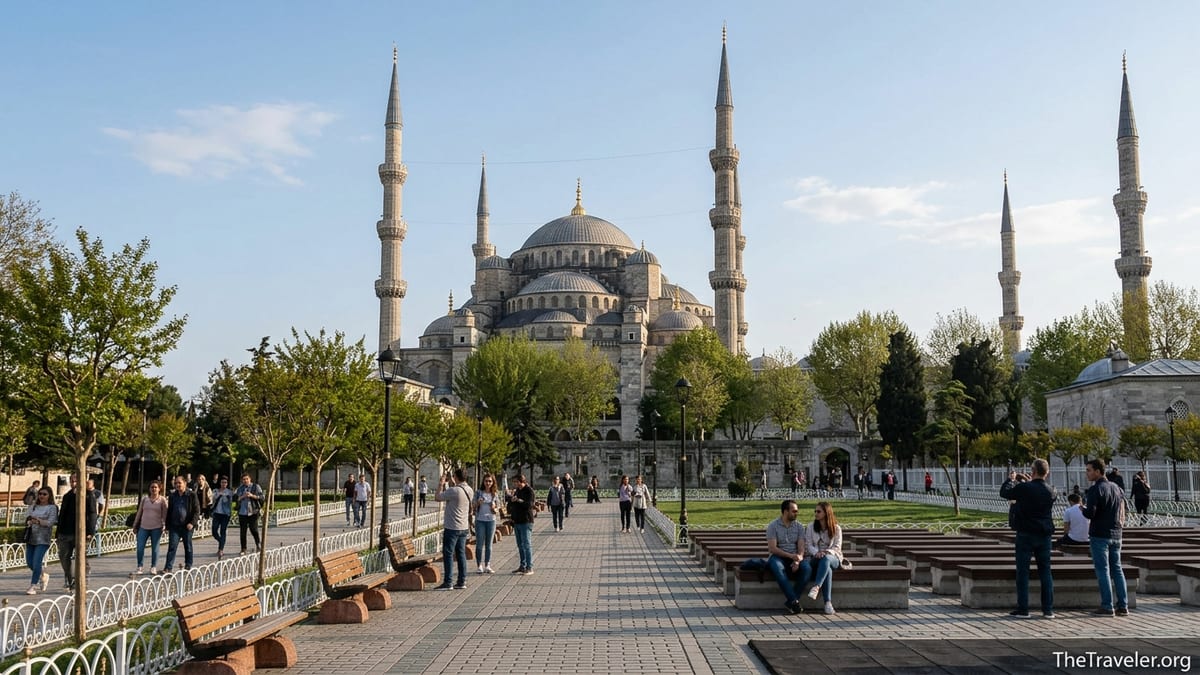
Where Exactly Is the Blue Mosque?
The Blue Mosque stands in the Sultanahmet neighborhood of Fatih district on Istanbul’s Historic Peninsula, facing the old Hippodrome square and looking directly across to Hagia Sophia. If you picture a rectangle, with Hagia Sophia on the north side and the Blue Mosque on the south, the tree-lined Sultanahmet Square and its fountains sit in between. This compact layout is what makes the area so walkable once you know the basic orientation.
On a practical level, most visitors approach the mosque from Sultanahmet Square itself. When you step off the T1 tram at Sultanahmet station, you emerge beside a small park with benches and a view of Hagia Sophia’s big central dome. Turning your back to Hagia Sophia and walking straight through the park for about 3 to 4 minutes brings you directly to the Blue Mosque’s main courtyard entrance, framed by six slender minarets.
The mosque occupies an elevated platform a few steps higher than the square. To reach the visitor entrance you typically follow signs for “Tourist Entrance,” usually on the western or southern side, separate from the doors used mainly by worshippers. Expect airport-style security with bag scanners and a short queue, especially in high season from roughly June to August or on busy weekend afternoons.
Because the Blue Mosque dominates the southern edge of Sultanahmet, it also serves as a useful landmark for navigating the entire old city. Streets running downhill from the mosque lead toward the Marmara Sea and the Kennedy Avenue coastal road, while streets to the north and northwest descend toward the tram line, Sirkeci, and the Golden Horn.
Walking to the Blue Mosque From Anywhere in Sultanahmet
If you are already staying in Sultanahmet, you can almost always reach the Blue Mosque on foot in 5 to 15 minutes. The key is to orient yourself to Sultanahmet Square and then walk toward the six minarets, which are visible from many streets and hotel rooftops in the area. Most guesthouses, small hotels, and apartments in Sultanahmet sit somewhere between the tram tracks and the coastal road, in a gentle maze of cobbled lanes.
For example, if your hotel is near the Basilica Cistern or the entrance of Topkapi Palace, you are on the northeastern side of the square. Walking downhill toward the tram and then crossing the square diagonally will lead you straight to the Blue Mosque. Travelers staying around Arasta Bazaar or the Mosaic Museum are actually directly behind the mosque. From there, following signs for “Blue Mosque” or “Sultan Ahmet Camii” and walking slightly uphill for about 3 minutes will bring you to the courtyard and visitor entrance.
Another common cluster of hotels lies along the streets of Küçük Ayasofya and Kadirga, southeast of the mosque. From this area, walking uphill toward the clearly visible minarets takes roughly 10 minutes at a relaxed pace. You will likely pass local tea houses, small grocery shops, and family-run restaurants before reaching the more formal facades of the mosque and its surrounding lawns.
Because most of Sultanahmet is paved with uneven stones and includes some mild hills, comfortable shoes are advisable, especially in wet weather when surfaces can be slick. If you are traveling with a stroller or someone with limited mobility, allow extra time. A realistic example is a family staying near Cemberlitas who takes 12 to 15 minutes to walk to the mosque with several pauses to look in shop windows and take photos along the way.
Reaching Sultanahmet and the Blue Mosque by Tram and Metro
For most visitors coming from other central neighborhoods such as Taksim, Karaköy, Galata, or Beyoğlu, the T1 tram is the simplest way to reach the Blue Mosque. The T1 line runs between Bağcılar in the west and Kabataş on the Bosphorus, passing through Eminönü, Sirkeci, Gülhane, and Sultanahmet along the way. You pay the fare using an Istanbulkart or a contactless bank card; as of mid-2026, a single tram ride with Istanbulkart typically costs the equivalent of only a few euros.
The nearest stop to the Blue Mosque is Sultanahmet station on the T1 line. After you exit the tram, cross toward the park and walk south through the square until you see the mosque directly ahead. This short transfer, usually 3 to 5 minutes on foot, is the standard route used by thousands of visitors every day. For example, someone staying in a hotel near Galata Tower can take the short walk down to Karaköy, board the T1 tram toward Bağcılar, ride for around 10 to 12 minutes, and get off at Sultanahmet for the mosque.
If you are coming from Taksim Square, there are two straightforward options. The most common is to ride the F1 funicular from Taksim down to Kabataş and connect to the T1 tram toward Bağcılar, getting off at Sultanahmet. In total, including transfers, the journey usually takes around 20 to 25 minutes during normal daytime hours. Alternatively, you can walk downhill from Taksim through the Cihangir neighborhood to Tophane or Karaköy, and board the T1 there if you prefer a longer but more scenic stroll.
From other parts of the city connected to the metro network, your goal is to transfer to the T1 line. For instance, a traveler staying near Şişli-Mecidiyeköy might take the M2 metro to Vezneciler or Haliç and then switch to a short taxi or tram ride, or continue by foot, depending on luggage and mobility. Many Istanbul transport maps distributed in 2026 highlight Sultanahmet as the key transfer point on the tram for visiting the Blue Mosque, Hagia Sophia, and the Grand Bazaar within a single day.
From Istanbul Airports to Sultanahmet and the Blue Mosque
Reaching Sultanahmet from Istanbul Airport (IST) involves choosing between the M11 airport metro, intercity buses such as Havaist, and taxis or private transfers. Istanbul Airport is roughly 35 to 40 kilometers northwest of the historic center, so even in light traffic it normally takes at least 45 minutes to an hour by road. Many travelers arriving with heavy luggage or after a long-haul flight opt for a taxi or prebooked transfer that drops them as close as possible to their hotel near the Blue Mosque.
For public transport, the M11 airport metro line currently connects Istanbul Airport with the urban rail network. A typical route in 2026 is to ride the M11 to Gayrettepe, transfer to the M2 metro toward Yenikapı, then change to the T1 tram at a central interchange and continue to Sultanahmet. This journey usually takes about 75 to 90 minutes, not counting potential waiting times between trains, and costs a fraction of a taxi fare. It suits budget-conscious travelers carrying smaller suitcases or backpacks who are comfortable making two or three transfers.
Airport coaches operated by companies such as Havaist run to several central hubs, including Aksaray or Beyazıt on the historic peninsula when routes are fully active. From there, it is a short tram ride on the T1 line to Sultanahmet or, in some cases, a 10 to 15 minute walk, depending on exactly where the coach stops. For example, a couple arriving midday might pay approximately the price of a mid-range restaurant meal for two for their combined bus and tram fares, instead of the much higher amount a taxi could cost during rush hour.
Sabiha Gökçen Airport (SAW) on the Asian side also connects to Sultanahmet via a combination of bus, metro, and Marmaray commuter rail. A common pattern is to take a shuttle or municipal bus from the airport to Kadıköy, then transfer to a ferry across the Bosphorus, followed by the T1 tram from Eminönü or Karaköy to Sultanahmet. Even though it requires more modes of transport, many travelers enjoy this route because it offers their first views of the historic skyline, including the minarets of the Blue Mosque, from the water.
Taking a Taxi or Ride Service to the Blue Mosque Area
Taxis are widely available in Istanbul, but vehicular access around Sultanahmet and the Blue Mosque is restricted due to pedestrianization and security measures. Taxis are usually allowed to drop passengers near the perimeter streets such as Alemdar Caddesi or Kennedy Avenue, but not directly in front of the mosque. This means the final part of your journey will usually involve a walk of 3 to 10 minutes through narrow cobbled lanes.
From central districts like Taksim, Beşiktaş, or Şişli, expect a taxi ride to Sultanahmet to take anywhere from 20 minutes in light traffic to 45 minutes or more in peak hours. Fares fluctuate with fuel prices and official tariff adjustments, but as a rough reference a trip from Taksim to near the Blue Mosque in 2026 can often cost similar to a casual dinner for one in a mid-range Istanbul restaurant. Always insist that the driver uses the meter, and check that you are getting out on the correct side of Sultanahmet to avoid an unnecessarily long walk.
Ride-hailing style services, where available, work in a similar way and may offer fixed-price estimates before you confirm. Some local transfer companies also provide prebooked private cars and vans from the airports directly to Sultanahmet hotels, which can be cost-effective for families or small groups. For instance, four friends arriving together might choose a private minivan that costs only slightly more than two individual taxis but drops them right outside their guesthouse near the Blue Mosque.
If you are staying very close to the mosque, remember to ask your hotel which drop-off point is easiest. Many properties provide small maps that show the nearest taxi-accessible corner, such as the intersection near Four Seasons Hotel Sultanahmet or the streets bordering the Hippodrome. Having a screenshot of your hotel’s location and name in Turkish on your phone also makes it easier to communicate with drivers who may not speak much English.
Practical Tips for Visiting the Blue Mosque Once You Arrive
Once you reach the mosque area, it helps to know what to expect at the entrance. Visiting hours are generally throughout the day, with closures during the five daily prayer periods and on Friday mornings for the main congregational prayer. A good rule of thumb is that non-Muslim visitors are usually welcome between mid-morning and late afternoon, avoiding roughly 30 minutes around each call to prayer and the longer break on Fridays before early afternoon.
Entry to the Blue Mosque is free. There is no official ticket desk; instead, you pass through a modest security screening and, if needed, borrow a headscarf or body covering provided near the entrance. Shoes must be removed before stepping onto the carpeted prayer hall, so many visitors carry a small plastic bag to keep their footwear with them. Modest dress is required, with shoulders and knees covered; this applies to both men and women. As a real-world example, travelers wearing shorts and sleeveless tops on a hot August day may be asked to wrap themselves in cover-up garments handed out at the gate.
Photography is permitted, but visitors are expected to remain quiet and avoid blocking areas used for prayer. Tripods and professional lighting equipment are typically discouraged or not allowed. The interior can be busy in the middle of the day during high season, so people hoping for calmer conditions often aim to arrive soon after the mosque opens to visitors in the morning, or in the late afternoon when tour groups start to thin out. These windows also tend to offer softer natural light filtering through the stained glass windows and domes.
Even if you are primarily focused on logistics, consider spending a little extra time in the surrounding courtyards once you arrive. Benches along the outer garden walls offer good views back toward Hagia Sophia, while the Hippodrome beside the mosque contains historic monuments like the Egyptian Obelisk and the Serpent Column. Because all of these sites lie within a short walk of each other, many visitors combine the Blue Mosque with Hagia Sophia and the Basilica Cistern in a single extended morning or afternoon.
The Takeaway
The Blue Mosque sits in one of the most compact and walkable historical centers in the world, directly across from Hagia Sophia on Sultanahmet Square. If you are already in Sultanahmet, reaching the mosque usually means a simple, slightly uphill walk of just a few minutes, guided by the unmistakable outline of its six minarets against the skyline.
From elsewhere in Istanbul, especially from Taksim, Karaköy, or Galata, the T1 tram to Sultanahmet station offers the most convenient and predictable route, with only a short stroll from the stop to the main courtyard. Travelers arriving from Istanbul’s airports can choose between a longer but inexpensive combination of metro and tram, airport coaches linked to the historic peninsula, or more direct but pricier taxi and private transfer options.
Whichever route you take, planning your arrival with walking distances, slopes, and entrance procedures in mind will make your first sight of the Blue Mosque both smoother and more memorable. Think in terms of transfers, short final walks through the old streets, and the daily rhythm of prayer times, and you will find that navigating to this landmark from Sultanahmet is far easier than it might look on the map.
FAQ
Q1. Where is the Blue Mosque located in Istanbul?
The Blue Mosque is in the Sultanahmet neighborhood of the Fatih district on the Historic Peninsula, facing Sultanahmet Square and directly opposite Hagia Sophia.
Q2. How far is the Blue Mosque from the Sultanahmet tram stop?
From Sultanahmet station on the T1 tram line, it is typically a 3 to 5 minute walk through the park and across the square to reach the main courtyard of the mosque.
Q3. Can I walk to the Blue Mosque from my hotel in Sultanahmet?
Yes. Most hotels and guesthouses in Sultanahmet are within a 5 to 15 minute walk of the mosque. Expect some gentle slopes and cobbled streets along the way.
Q4. What is the easiest public transport route from Taksim to the Blue Mosque?
A common option is to take the funicular from Taksim to Kabataş, then transfer to the T1 tram toward Bağcılar and get off at Sultanahmet, followed by a short walk uphill to the mosque.
Q5. How do I get from Istanbul Airport to the Blue Mosque area using public transport?
You can take the M11 metro from Istanbul Airport to connect with the city network, then transfer to the M2 metro and finally the T1 tram to Sultanahmet, from where it is a brief walk to the mosque.
Q6. Are taxis allowed to drop me directly at the Blue Mosque?
No. Due to pedestrian zones and security restrictions, taxis usually drop passengers on nearby streets around Sultanahmet, leaving a final walk of several minutes to reach the mosque itself.
Q7. Is there an entrance fee to visit the Blue Mosque?
No. Entry to the Blue Mosque is free for visitors. You will pass through a simple security check and may be offered free cover-up garments if your clothing is not considered modest enough.
Q8. What is the best time of day to visit the Blue Mosque?
Many visitors prefer weekday mornings soon after opening time or late afternoons, when crowds are usually thinner. Avoid the periods around prayer times, especially Friday midday prayers.
Q9. How long should I allow for a visit to the Blue Mosque?
A typical visit takes about 30 to 60 minutes, including security, time inside the prayer hall, and a brief look at the courtyards. Allow longer if you plan to take many photos or visit nearby sites.
Q10. Is the walk to the Blue Mosque suitable for people with limited mobility?
The area around the mosque includes slopes, cobblestones, and some steps, which can be challenging. However, with extra time and occasional rests, many visitors with limited mobility are still able to reach the mosque from nearby drop-off points.