


Stand in Istanbul’s Sultanahmet Square and the city’s great debate rises on either side of you: Hagia Sophia on one end, the Blue Mosque on the other. Both are working mosques, both dominate the skyline, and both appear on every postcard and tour brochure. Yet the experience, cost and atmosphere of visiting each in 2026 are strikingly different. If you only have time or energy for one, choosing wisely can shape how you remember Istanbul.
Get the latest updates straight to your inbox!
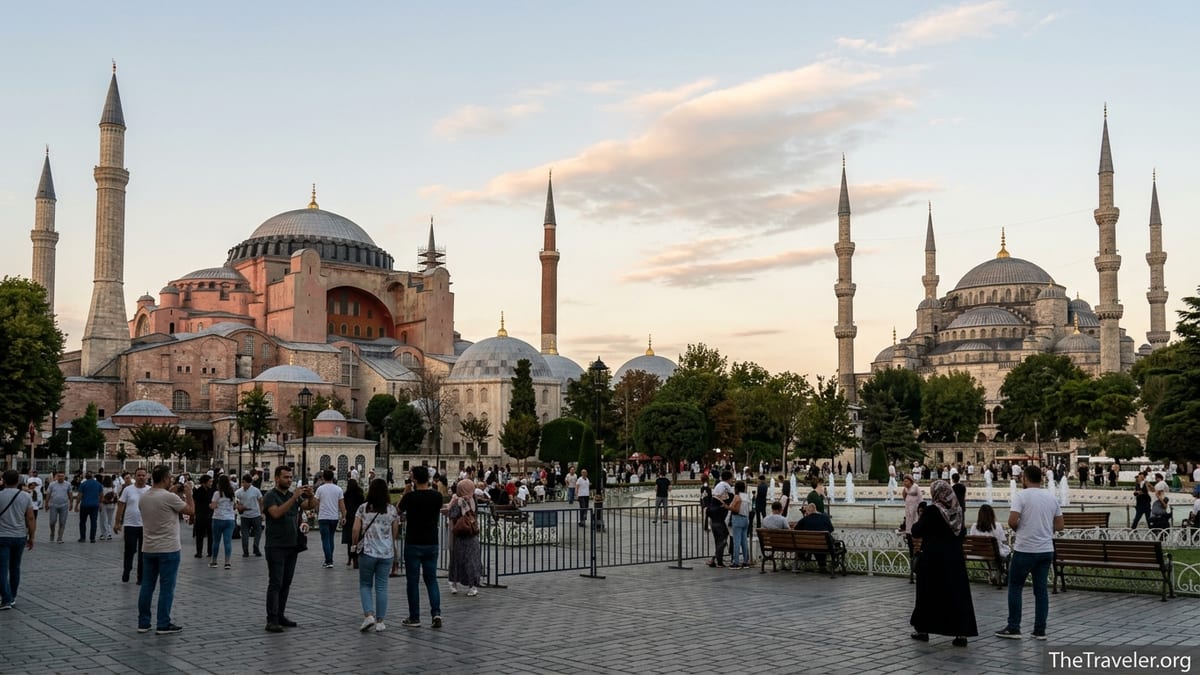
Hagia Sophia vs Blue Mosque at a Glance
Hagia Sophia is older, denser with history and, since 2024, significantly more expensive for foreign visitors. Completed in 537 as a Byzantine cathedral and later converted to a mosque and then a museum before becoming a mosque again, it now operates with a ticketed upper gallery route for tourists. Expect to pay around 25 euros per person for access to this gallery level, with prices usually displayed in Turkish lira at the entrance, and to go through airport style security. The ground floor prayer hall is generally reserved for worshippers.
The Blue Mosque, officially the Sultan Ahmed Mosque, is newer, built between 1609 and 1617 as a triumphant Ottoman response to Hagia Sophia just across the square. It remains free to enter as a mosque, with donations welcome but not mandatory. Visitor access is through a clearly signposted tourist entrance on the side, and after passing security you step directly into the main prayer hall visitor zone, beneath the famous cascade of domes.
In practice, this means Hagia Sophia offers a more curated, museum like visit from its upper gallery, where you walk a one way route above the nave, while the Blue Mosque delivers a shorter but more straightforward experience at ground level. Many visitors now report spending 60 to 90 minutes at Hagia Sophia including queues, and 20 to 40 minutes inside the Blue Mosque, not counting waiting time during prayers.
Standing in Sultanahmet today, a typical one day visitor might join the Hagia Sophia ticket line mid morning, spend their early afternoon in the gallery studying mosaics and the vast dome, then stroll the 250 meters across the square to the Blue Mosque once midday prayers are over. Understanding how each site actually works on the ground helps you decide which one feels "worth it" for your own trip.
History and Architecture: Two Visions of Sacred Power
If your priority is world changing history, Hagia Sophia is hard to beat. For nearly a thousand years it was the largest church in Christendom and the ceremonial heart of the Byzantine Empire, where emperors were crowned and great councils met. When the Ottomans conquered Constantinople in 1453, they converted the church to a mosque, adding minarets, mihrab and minbar, but leaving much of the original structure intact. Today, from the upper gallery, you can still see Byzantine mosaics of Christ and the Virgin Mary set beside large roundels bearing Arabic calligraphy with the names of Allah and the early caliphs.
The building’s main dome, roughly 31 meters in diameter and floating high above the nave, remains a technical marvel. While parts of the interior are often covered by scaffolding for ongoing restoration, the sheer scale of the space still shocks first time visitors. Even travelers who have seen major cathedrals in Rome or Paris often describe Hagia Sophia as uniquely disorienting, with its shifting light, layers of Christian iconography and Islamic ornament, and the sense of standing at the meeting point of two civilizations.
The Blue Mosque, by contrast, represents the classical high point of Ottoman mosque architecture. Commissioned by Sultan Ahmed I in the early 17th century, it was deliberately positioned opposite Hagia Sophia to demonstrate that Ottoman architects could match and reinterpret the older building’s grandeur. From the outside, its six slender minarets and cascading domes create one of the most recognizable silhouettes in the Islamic world. Inside, more than 20,000 hand painted Iznik tiles and painted floral motifs in shades of blue, turquoise and green give the mosque its popular name.
Architecturally, the Blue Mosque feels more unified and harmonious than its older neighbour. Where Hagia Sophia shows its age and the scars of adaptation, the Blue Mosque presents a single, coherent vision of Ottoman piety and royal prestige. If you are fascinated by the evolution of sacred architecture, many travelers find it rewarding to visit Hagia Sophia first to grasp the original model, then step into the Blue Mosque to see how Ottoman architects adopted the central dome idea and made it their own.
Visitor Experience in 2026: What It Actually Feels Like
In recent years, the experience of visiting Hagia Sophia has changed more dramatically than that of the Blue Mosque. Since January 2024, non Turkish visitors usually access Hagia Sophia through a dedicated tourist entrance on the northeast side and follow a one way route up to the upper gallery. You pass through metal detectors, join a queue that can range from 10 minutes on a quiet winter morning to well over an hour on a spring weekend, then climb a long sloping ramp to the gallery level.
Once inside, you walk along a U shaped balcony that wraps around much of the nave. From here you can see famous mosaics like the Deesis and imperial panels, look down onto the prayer hall below, and study the dome and semi domes from above. Parts of the floor and walls are sometimes obscured by restoration scaffolding or protective coverings, and the lighting can feel dim, especially on overcast days. Many visitors use an audio guide or phone app to make sense of what they see, because live guides are often restricted in where they can speak inside.
The Blue Mosque usually offers a more straightforward experience, with far less bureaucracy. Visitors enter through the main courtyard or a side gate, join a short security line, and are directed toward the tourist entrance. At busy times, such as just before sunset in high season, you might wait 15 to 20 minutes in the courtyard, but on many weekdays outside prayer times you can walk straight in. A carpeted visitor corridor keeps tourists to one side of the prayer space, separated by ropes, and mosque staff and volunteers circulate to remind people about photography etiquette and dress rules.
In practical terms, this means Hagia Sophia now feels closer to a controlled heritage site where you observe worship from above, while the Blue Mosque still feels like stepping quietly into an active neighborhood mosque that happens to be monumental. Travelers who dislike crowds and complex rules often report feeling more relaxed and welcomed in the Blue Mosque, while those who love museums and can tolerate queues tend to accept Hagia Sophia’s constraints as the price of seeing a one of a kind monument.
Cost, Time and Queues: Which Fits Your Budget and Schedule?
Cost is where the difference has become most obvious. As of mid 2026, foreign visitors to Hagia Sophia typically pay around 25 euros for the standard upper gallery ticket. Combined tickets that bundle Hagia Sophia with a small adjacent museum or audio guide can raise the total price further. For a family of four from North America or Europe, that can mean spending the equivalent of 100 euros or more to enter, not counting any guided tour fee.
By contrast, the Blue Mosque remains free. You may be encouraged to make a small donation, especially after leaving through the visitor exit, but there is no compulsory charge. For budget travelers or those visiting Istanbul on a long layover, this difference matters. A solo backpacker might decide to skip Hagia Sophia entirely and instead visit the Blue Mosque along with other free mosques like Suleymaniye or Rustem Pasha, then spend their ticket money on a Bosphorus ferry ride or museum pass elsewhere in the city.
Time planning also favors the Blue Mosque. Even in busy months, many visitors manage a complete Blue Mosque visit, including queuing and taking photos, in under an hour if they avoid prayer times. Hagia Sophia can easily demand half a day once you factor in security, queues, ticket purchase, and the slow shuffle along the balcony. On a hot July afternoon, standing in a tightly packed queue outside Hagia Sophia with limited shade can feel draining, while the Blue Mosque court offers more air flow and shaded arcades where you can sit and wait.
If you only have one full day in Istanbul, most independent travelers now either visit Hagia Sophia very early in the morning or in the late afternoon to minimize queue times, then slot the Blue Mosque in during a quieter mid morning or mid afternoon window. Travelers on tight schedules, such as cruise passengers in port for just a few hours, sometimes prioritize the faster and cheaper Blue Mosque over Hagia Sophia to avoid spending most of their shore time in line.
Atmosphere, Spiritual Feel and Photography Potential
Beyond logistics, the emotional atmosphere of each site often ends up determining which one travelers remember most fondly. Hagia Sophia, seen from the upper gallery, can feel almost theatrical. You look down on the worship space, separated by height and barriers, while a constant stream of visitors circles the gallery. The mixture of Byzantine mosaics, Islamic calligraphy and restoration tarps creates a layered but sometimes chaotic scene. During busy times, the noise level rises and it can be difficult to find a quiet corner to sit and reflect.
Yet when you catch a moment of relative calm, perhaps late on a winter afternoon, the space can still feel profoundly moving. Sunlight slants through high windows, catching dust in the air, and the call to prayer drifts faintly upward. For travelers who come with a strong sense of its history, Hagia Sophia can feel like standing at the crossroads of Christianity and Islam, empire and republic, museum and mosque. Many visitors describe it as an intellectual or historical highlight more than a meditative one.
The Blue Mosque’s atmosphere is usually more intimate. Because you enter at ground level and share the space with worshippers, the sense of being inside a living mosque is stronger. The blue tile work glows softly in natural daylight that filters through stained glass, and artificial lighting in the evening adds a warm amber tone. There is often a low murmur of recitation or conversation, but the volume is generally lower than in Hagia Sophia’s gallery, and visitors spread out more evenly across the carpeted area.
For photography, both have trade offs. Hagia Sophia gives you dramatic top down views of the nave and dome from the gallery, and close access to some mosaics, but scaffolding and low light can frustrate anyone expecting postcard perfect shots. Tripods are not allowed, and staff sometimes ask visitors to keep moving instead of lingering for long photo sessions. The Blue Mosque, with its symmetrical interior and brighter lighting, is easier to capture on a phone camera, especially if you position yourself near the center of the visitor zone and shoot upward to include the chandeliers and dome.
Dress Codes, Accessibility and Practical Details
Both Hagia Sophia and the Blue Mosque are active mosques, so dress codes are taken seriously. In practice, enforcement at the Blue Mosque tends to be clearer. At the main visitor gate you will find signs showing modest dress requirements: shoulders and knees covered, no low cut tops, and women asked to cover their hair. If you arrive in shorts or a sleeveless shirt, staff may hand you a free or low cost wrap to tie around your waist or shoulders. Visitors enter barefoot, leaving shoes in plastic bags or cubbies at the entrance.
At Hagia Sophia, the situation is more complex because tourists are routed to the upper gallery while worship continues below. Officially, modest dress is still requested, but checks at the gallery entrance can be more variable. Visitors report that headscarves are sometimes requested for women and sometimes not, and that security focuses more on bags and metal objects than clothing. To avoid last minute stress, it is wise to dress to mosque standards for both sites: long trousers or skirts, covered shoulders, and a light scarf in your day bag.
Accessibility differs noticeably between the two. The Blue Mosque’s main prayer hall is reached by a short set of steps, and inside the floor is fully carpeted but level. For visitors with limited mobility, mosque staff often allow entry through a slightly flatter side route. Hagia Sophia’s upper gallery, by contrast, is reached via a historic sloping ramp and additional stairs, with uneven stone surfaces. Official visitor information notes that the gallery route is not fully wheelchair accessible, and baby strollers are sometimes discouraged or refused at the entrance because of congestion.
Other small details also shape the visit. The Blue Mosque typically offers free information leaflets in multiple languages and sometimes short introductory talks by volunteers in the courtyard. Hagia Sophia’s upper gallery relies more on paid audio guides and private guides who provide commentary before or after entering the building, as speaking loudly inside can be restricted. Both sites have security checks that ban large suitcases, and both are surrounded by a dense ring of souvenir stalls and touts. Being aware of these details helps you plan a calmer, less pressured visit.
Who Should Choose Which? Matching Each Site to Your Travel Style
If you are a history lover, architect, or traveler who has dreamed about Hagia Sophia for years, the ticket fee and crowds are still likely to feel worthwhile. Standing in a building that has served as cathedral, imperial mosque, museum and mosque again over almost 1,500 years is an experience few other monuments can match. Visitors who arrive with context, perhaps after reading about Byzantine Constantinople or the Ottoman conquest, usually come away satisfied even if they find parts of the logistics frustrating.
On the other hand, if your budget is tight, or you are traveling with small children or older relatives who tire easily, the Blue Mosque may be the better choice. A short, free visit here can deliver a strong sense of Ottoman religious architecture without the same financial or physical demands. Families often appreciate that, if a toddler becomes restless, they can quietly exit after ten minutes without feeling they have wasted an expensive ticket. The quieter carpeted space also makes it easier for sensitive travelers to escape the noise and intensity of Sultanahmet’s streets.
Some visitors prioritize spiritual atmosphere over formal history. For them, the Blue Mosque’s calm interior, the soft chant of prayer and the clear orientation toward Mecca can feel more contemplative than Hagia Sophia’s crowded gallery, where tour groups squeeze past one another in narrow passages. Others appreciate Hagia Sophia precisely because it embodies the tensions and debates of modern Turkey, from secularism to religious revival, and want to witness that complexity firsthand.
In practice, if you can manage both, visiting both remains ideal. Seeing Hagia Sophia’s massive dome from above and then walking into the Blue Mosque to stand under a refined Ottoman dome helps you understand how Istanbul’s skyline came to look the way it does. However, if you must choose, many long term Istanbul residents now advise casual visitors who dislike crowds, are on layovers, or have mobility concerns to prioritize the Blue Mosque and supplement it with another historic mosque like Suleymaniye, while serious history enthusiasts accept Hagia Sophia’s compromises as the price of accessing a unique monument.
The Takeaway
In the debate between Hagia Sophia and the Blue Mosque, there is no single universal winner, only a better fit for different travelers. Hagia Sophia is older, denser with global significance and technically more impressive, but also more expensive, more regulated and sometimes more confusing to visit. Its upper gallery route offers powerful views of mosaics and the nave below, yet keeps tourists at a distance from the main prayer space.
The Blue Mosque is younger, stylistically unified and more serene, with a clear and free visitor flow that feels closer to the everyday life of Istanbul’s Muslims. Its interior may not carry the same sense of world historic drama, but it often leaves travelers with warmer, more personal memories, especially when visited outside the busiest hours.
If you care most about world changing history and can tolerate crowds and higher costs, choose Hagia Sophia. If you value a quieter, more accessible and budget friendly encounter with Ottoman mosque architecture, choose the Blue Mosque. And if you are lucky enough to have the time, energy and funds, plan carefully and see both. Together they tell the story of how Istanbul became a city balanced between empires, faiths and eras, with Sultanahmet Square as its open air stage.
FAQ
Q1. Is Hagia Sophia or the Blue Mosque better if I only have time for one?
If you prioritize deep historical significance and are willing to pay an entrance fee, Hagia Sophia is the stronger choice. If you prefer a calmer, free experience with simpler logistics, the Blue Mosque is usually more satisfying.
Q2. How much does it cost to visit Hagia Sophia compared with the Blue Mosque?
As of 2026, foreign visitors to Hagia Sophia generally pay around 25 euros for access to the upper gallery, with higher prices for certain combined tickets. Entry to the Blue Mosque remains free, though donations are appreciated.
Q3. Can non Muslims visit both Hagia Sophia and the Blue Mosque?
Yes. Non Muslims are welcome at both, provided they respect dress codes and visiting hours. At Hagia Sophia, non Turkish visitors are typically directed to the paid upper gallery, while the ground floor serves primarily for worship. At the Blue Mosque, non Muslims can enter the main prayer hall visitor area outside prayer times.
Q4. Which landmark is easier to visit with children or older travelers?
The Blue Mosque is usually easier. It is free, the visit can be short, and access involves only a few steps into a level, carpeted space. Hagia Sophia’s upper gallery requires walking a long sloping ramp and navigating crowds, which can be tiring for small children or those with mobility issues.
Q5. When is the best time of day to visit Hagia Sophia and the Blue Mosque?
For Hagia Sophia, early morning or late afternoon generally means shorter queues and slightly cooler temperatures in summer. For the Blue Mosque, aim for mid morning or mid afternoon and avoid the five daily prayer times, especially Friday midday prayers, when visitor access is restricted.
Q6. Can I take photos inside Hagia Sophia and the Blue Mosque?
Photography for personal use is usually allowed in both, but flash and tripods are discouraged or banned. In the Blue Mosque, avoid photographing people at close range while they pray. In Hagia Sophia’s gallery, staff may ask you to keep moving rather than block narrow passages for long photo sessions.
Q7. Do I need to cover my head and remove my shoes at both sites?
At the Blue Mosque, all visitors remove their shoes and women are expected to cover their hair with a scarf. At Hagia Sophia, visitors to the upper gallery also remove their shoes before entering, and modest dress is expected; head covering rules for women can vary in practice, so it is wise to bring a scarf for both.
Q8. Are guided tours worth it for Hagia Sophia and the Blue Mosque?
A guided tour can add significant value at Hagia Sophia, where much of the meaning lies in historical details and mosaics that are easy to miss. For the Blue Mosque, many travelers are satisfied with a short explanation from a guide outside or a self guided visit, though combined walking tours of Sultanahmet often include both sites with commentary.
Q9. Which site is better for photography, Hagia Sophia or the Blue Mosque?
Hagia Sophia offers dramatic overhead views and close ups of mosaics from the gallery, but low light, scaffolding and crowds can make photography challenging. The Blue Mosque has brighter interiors and more consistent symmetry, making it easier for most visitors to capture pleasing shots on a phone camera.
Q10. Is it realistic to visit both Hagia Sophia and the Blue Mosque in one day?
Yes. Many visitors see both on the same day because they are only a few minutes’ walk apart. Plan for a longer, ticketed visit at Hagia Sophia and a shorter, free visit at the Blue Mosque. Starting early, avoiding peak prayer times and being prepared for queues at Hagia Sophia make the combination manageable.