


Central Pula is one of Croatia’s easiest small cities to explore without a car. The compact Roman core is walkable, several beaches sit within a short bus ride, and Brijuni National Park is reachable via regular boats from nearby Fažana. The trade-off is that more remote Istrian highlights, such as Cape Kamenjak or hill towns inland, become slower and less flexible to visit if you rely solely on public transport.
Get the latest updates straight to your inbox!
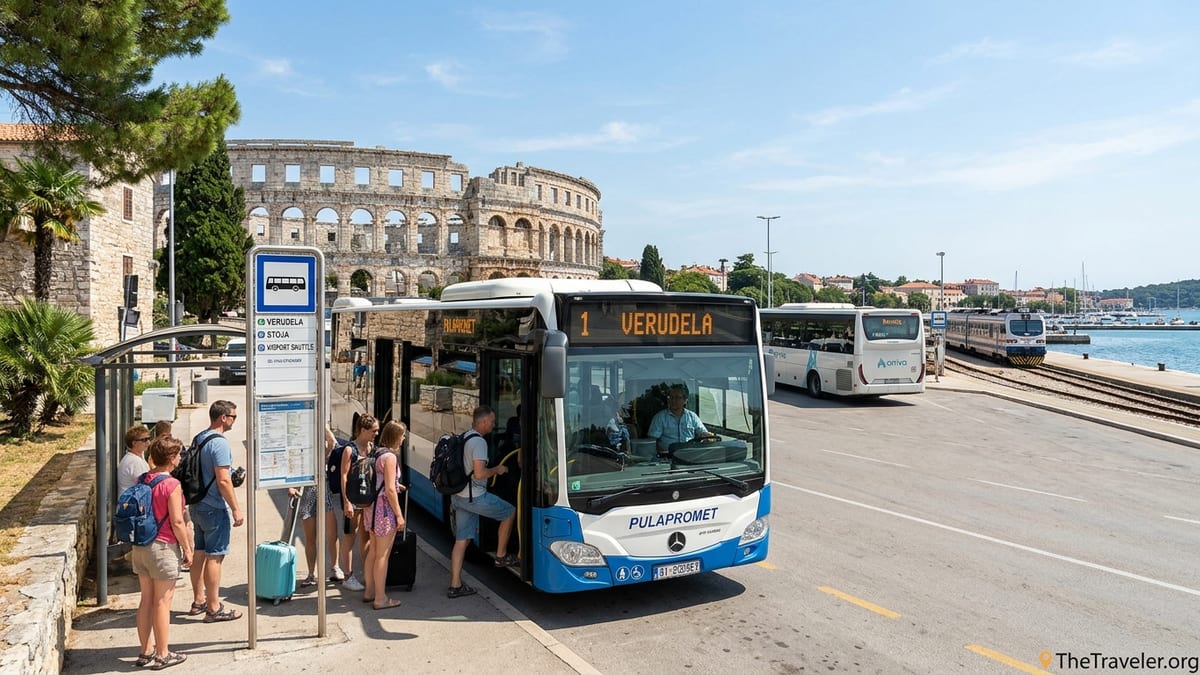
Arriving in Pula without a car
Pula Airport lies roughly 8 kilometres from the city centre. There is no regular Pulapromet city bus to the terminal; instead a dedicated airport shuttle links the main bus station in central Pula with the airport. Recent schedules show this service departing from platform 16 at the bus station and costing about 6 euros one way, timed to match arrivals and departures rather than running every hour. In peak season from late spring through early autumn more departures are added, while in winter you may find only a handful of shuttles on days with flights.
Pula’s main bus station is the key arrival point if you are coming from elsewhere in Istria or from Zagreb, Rijeka or Ljubljana. It sits just north of the old town, around 10 to 15 minutes on foot from Pula Arena and the Forum. Many regional and national operators serve this station, and from here you can connect to local Pulapromet buses for Verudela, Stoja or other neighbourhoods. If you arrive in the evening, walking to central hotels is straightforward, but for Verudela or Stoja it is worth checking the last city-bus departures in advance.
The railway station is less central, around a 20-minute walk from the Arena, on the northern side of the harbour. Rail connections are comparatively limited, with a few trains towards Ljubljana and Zagreb via Istrian and Slovenian junctions. For most visitors, intercity buses remain faster and more frequent than trains. Travellers arriving by train can either walk along the waterfront into town or transfer onto a local bus where available, though the walk is simple with light luggage.
Regional buses make it realistic to base yourself in Pula without a car while still visiting nearby coastal towns. There are direct buses to Rovinj, Medulin, Vodnjan and Fažana, with more frequent services in July and August and noticeably fewer in the low season. Services to places like Premantura for Cape Kamenjak or smaller inland villages can be infrequent, so if those are priorities you need to plan around limited departure times or consider a private transfer for one day.
Understanding Pulapromet city buses
Pula’s urban bus network is operated by Pulapromet and organised into tariff zones that cover the city and nearby settlements. As of mid 2026 the official price list shows that a single ride within zone 1 bought as a QR ticket in advance costs around 1.50 euros, while purchasing directly from the driver costs about 2.20 euros. Using a stored-value prepaid card brings the per-ride cost down to under 1 euro in zone 1. Additional zones cost more per ticket but are still modest sums, making buses good value for reaching beaches and suburbs.
Tickets can be bought in several ways. QR tickets are available at kiosks and ticket machines or via an online webshop, then validated on board by scanning at a reader. Prepaid contactless cards are sold at Pulapromet sales points and selected outlets and can be topped up with credit. Paying the driver in cash remains possible on most lines but is the most expensive option and may require small denomination euro notes or coins. For short-stay visitors who expect only a few rides, buying QR tickets as needed is usually the simplest approach.
When boarding, you normally enter through the front door and either validate your QR ticket or tap your prepaid card at the validator. If you bought a paper ticket from the driver, keep it until the end of the journey in case of inspection. Zone boundaries are fixed, and on longer lines you may need to select the correct zone on the validator before tapping, but most tourist rides between the historic centre, Verudela and Stoja fall entirely within zone 1.
Service frequencies vary by route and time of year. Lines linking central Pula with Verudela and Stoja run at short intervals in the daytime, often every 15 to 20 minutes in summer and slightly less frequently in winter, with reduced late-evening services. Buses to Fažana, Štinjan or Medulin tend to be less frequent, especially outside July and August, and might run only every hour or a few times per day. The most reliable timetable sources are the official Pulapromet website and posted schedules at bus stops; third-party timetable aggregators are useful for planning but can lag behind seasonal updates.
Using buses to reach beaches and coastal areas
The most popular car-free beach area from Pula is Verudela, a peninsula south of the old town lined with hotels and rocky coves. City buses run from the centre to Verudela, with the ride taking around 15 to 20 minutes depending on traffic. Ambrela Beach, a small cove with pebbles and relatively easy sea access, lies just below the main hotel complex and is reached by a short downhill walk from the bus stop. Nearby Hawaii Beach is more dramatic, framed by rocks and small cliffs, but requires care underfoot as paths can be uneven and polished limestone can be slippery when wet.
West of the centre, Stoja is another accessible coastal area served by city buses. Journeys from downtown to Stoja take about 15 minutes, with buses running through residential districts and ending close to the rocky shoreline. The area around Stoja and the neighbouring Valkane beach offers a mix of concrete bathing platforms, rocky sections and some small pebbly entries into the water. There are showers and simple changing facilities near parts of Valkane, and you can usually find a patch of natural shade under pines behind the shoreline, though umbrellas are helpful in high summer.
To reach Fažana, the departure point for Brijuni National Park, you combine regional and local transport rather than walking. Regional buses from Pula bus station reach Fažana in roughly 20 to 25 minutes, running along the main road via Štinjan and other small communities. Recent operator notices confirm that lines numbered 5 and a series of 21 variants serve this corridor, with vehicles returning to their usual route along Fažanska road after roadworks were completed in 2026. Services are relatively frequent in summer but can be limited to a few daily departures in the low season, so day trippers should plan their return in advance.
Other accessible coastal spots include Medulin to the southeast, reachable by interurban bus in around 30 minutes, and smaller settlements along the Fažana road. Cape Kamenjak at the tip of the Premantura peninsula, while famous for wild coves and clear water, is notably more complicated without a car. Buses can get you as far as Premantura village; from there, reaching specific beaches requires walking long distances along dusty roads or hiring a bike. For many travellers, a guided tour or a one-day transfer arranged through a local operator is more realistic than trying to explore Kamenjak independently by bus alone.
Reaching Brijuni National Park from Pula
Brijuni National Park is not accessed directly from Pula’s harbour. Regular visitor boats depart from the small coastal town of Fažana, about 8 kilometres northwest of Pula, so the first step is to travel from Pula to Fažana by bus or taxi. The bus journey usually takes 20 to 25 minutes and costs only a few euros each way; a taxi will be faster but much more expensive. From the bus stop in Fažana it is a short walk to the waterfront and the national park’s reception area where tickets are sold and boats board.
Crossings from Fažana to Veliki Brijun, the main island, take about 15 minutes. The official national park boats are clearly branded and tied to fixed departure times that correspond to ticketed visits, which typically include the return boat journey, a guided or audio-guided island tour by small tourist train, access to the safari park and entrance to the island’s museums and exhibitions. Price lists for recent seasons show adult tickets in high season costing several tens of euros, with discounted rates for children and families. Exact amounts vary by date and ticket category, so it is worth checking the current official tariff before visiting.
Individual visitors can usually buy half-day or full-day tickets that bundle boat transport and on-island services into one package. In peak summer there are multiple departures each day from morning until early evening, including some later sailings for shorter evening visits at reduced prices. In winter and the shoulder seasons, departures are fewer and may be limited to weekends, and in January and February individual tickets are often unavailable with access restricted to pre-booked groups only. Travellers visiting in the off season should confirm operating dates and times in advance and build flexibility into their schedule.
It is important to distinguish between the official Brijuni National Park boats and private sightseeing cruises that operate along the Istrian coast. Private boats departing from Pula or Fažana may advertise Brijuni panoramas, but many of these only circle the islands without allowing passengers to disembark. They can be pleasant as sunset or dolphin-watching outings but do not grant access to the national park itself. If your goal is to walk on the island, visit the safari park or tour the historical sites, you must hold an official national park ticket that specifies a departure from Fažana and includes disembarkation on the island.
Walking Pula’s Roman history route
Pula’s main Roman and historical sights are concentrated within a small area and can easily be covered on foot in a day. A realistic walking circuit begins at the Pula Arena, the city’s remarkably well-preserved Roman amphitheatre, then continues into the old town via the Forum and surrounding streets. From the Arena to the Forum is about a 10 to 15 minute walk with a gentle uphill section. Entrance to the Arena is ticketed, with adult prices in recent years around the low-teens in euros, and opening hours that extend into the evening in summer when the interior can be beautifully lit.
From the Forum, dominated by the Temple of Augustus and the adjacent city hall, you can continue on foot through narrow streets to the Arch of the Sergii. The distance is only a few hundred metres and takes about 5 to 10 minutes at a leisurely pace. The Temple of Augustus has a modest entrance fee for those who want to see the interior, although many visitors simply admire the exterior from the square. The Arch of the Sergii itself is free to view and forms a lively gateway between the pedestrianised old town and more modern shopping streets.
Climbing higher, you reach the remains of the Roman Theatre tucked beneath the slopes of the Kaštel fortress. Access involves some short but sometimes steep cobbled paths, which can be slippery in wet weather due to smooth limestone underfoot. Entry to the theatre and to the Historical and Maritime Museum housed in the Kaštel carries separate charges, typically a few euros each. The Kaštel courtyard is a pleasant place to pause, offering wide views over the harbour, and visiting both sites plus walking time from the Forum will take roughly one to one and a half hours including stops.
Elsewhere in the centre, the Gate of Hercules and other fragments of Roman walls lie only a few minutes’ walk from the main squares. Because distances are so short, most visitors can comfortably cover Arena, Forum, Temple of Augustus, Arch of the Sergii, Roman Theatre, Gate of Hercules and Kaštel in a single day without using any transport at all. In high summer, however, it is wise to start early in the morning or shift part of the sightseeing to the late afternoon or evening to avoid the strongest heat in the early afternoon.
Beach options without a rental car
For swimmers and sunseekers staying in central Pula without a car, Verudela is the most straightforward choice. Ambrela Beach offers pebbles and gradually deepening water, with sunbed and umbrella rental, showers and simple changing cabins in season. Hawaii Beach, a short walk away, has coarse pebbles and rocky shelves leading into deeper water and is especially popular with younger travellers who enjoy jumping from the lower cliffs. Buses from the city centre stop near the main Verudela entrance, from which both coves are reached in about 5 to 10 minutes on foot along paved paths and some stairs.
Closer to the city centre, Valkane is a partially developed bathing area with concrete terraces and some pebbly sections, backed by trees that offer natural shade. It is reachable in around 30 minutes on foot from the Arena area or by a short city-bus ride along the coast. Facilities include showers and cafés in the summer months, and the promenade makes it easy to stroll further towards Stoja if you prefer quieter spots on the rocks. Evening bus services from this area back into the centre are reasonably frequent in summer, though after about 22:00 departures thin out, so checking the last bus is advisable.
Stoja itself is a mixture of campsite shoreline, rocky coves and small inlets. Without a car, you rely on city buses that stop close to the entrance of the Stoja complex. Some parts of the coast here have ladders fixed into the rock for water access, but families with small children may prefer flatter, more gently shelving areas such as Ambrela or parts of Medulin’s sandy bay. Footpaths around Stoja can be uneven, and flip-flops are not ideal on jagged rocks; sturdy sandals or water shoes make moving around and entering the sea more comfortable.
Medulin, reached by regional bus, adds variety with its long shallow bay and a small sandy section that is attractive for children who want to paddle and play at the water’s edge. Services run more often in high season and drop you within walking distance of the waterfront. Evenings in Medulin bring a lively promenade atmosphere, but returning to Pula relies on checking the last buses or booking a taxi. Overall, visitors prepared to use buses and walk a little can access several different beach styles from Pula, though rocky and concrete shores are more common than long sandy stretches.
Day trips and where to stay without a car
From Pula, the easiest public-transport day trip is Rovinj, connected by frequent intercity buses that take a little over an hour each way depending on stops. Buses start in the morning and continue into the evening in summer, allowing enough time to stroll Rovinj’s old town, climb to the church of St Euphemia and enjoy dinner on the waterfront before returning. Vodnjan and Fažana are closer and can be combined with shorter visits; Vodnjan’s churches and street art sit a short walk from its bus stop, while Fažana adds a compact seafront and views towards Brijuni.
Medulin is practical as a day trip for beaches and a different evening atmosphere, but services to Premantura and Cape Kamenjak require more care. You can reach Premantura by bus in roughly 40 minutes when connections are available, yet onward access into the protected cape area is restricted for vehicles and requires significant walking or cycling. Limited departure times and sparse off-season services mean that those determined to explore Kamenjak without a car may prefer joining an organised excursion from Pula that bundles transfers, guiding and sometimes kayaking or boat trips.
Accommodation choices shape how dependent you feel on buses. Staying in Pula’s old town or near the Arena offers the richest restaurant and bar selection, short walks to all historical sights and straightforward access to the main bus station for day trips. The trade-off is that you will ride buses or walk more for beach time. Prices for mid-range hotels and apartments here vary widely by season, but in high summer many double rooms start in the low hundreds of euros per night, with lower rates available in spring and autumn.
Verudela and Stoja are better for those who prioritise swimming and relaxed evenings by the sea. Large resort complexes in Verudela give immediate access to Ambrela and other coves but command higher prices in peak months and rely on regular buses or taxis to reach the historic centre in the evening. Stoja tends to be quieter and a little more local in feel, with campsites and simpler apartments and slightly fewer dining options. Both areas are tied to bus schedules at night, so late diners or those wanting nightlife in the old town should factor in the cost and availability of taxis for the return journey.
Sample three-day car-free itinerary and costs
A realistic three-day plan without a rental car starts with history. On day one, explore Roman Pula on foot, beginning early at the Arena to avoid queues and heat, then continuing to the Forum, Temple of Augustus and Arch of the Sergii before a lunch break in the old town. In the afternoon, climb to the Roman Theatre and Kaštel fortress, pausing at viewpoints over the harbour. With all distances short, walking time between sites rarely exceeds 10 to 15 minutes, though you should allow longer for breaks and museum visits.
Day two is dedicated to Brijuni National Park. Catch a morning bus from Pula to Fažana, aiming to arrive at least 30 to 45 minutes before your chosen boat departure so you can buy tickets and avoid stress. After the 15-minute crossing, join the organised island tour included in your ticket, visit the small museum and walk some of the shaded paths. Depending on your departure time back to Fažana, you may have time for an ice cream or early dinner on the waterfront before returning by bus to Pula.
On day three, focus on the sea. Take a city bus to Verudela to swim at Ambrela and Hawaii Beach or head to Stoja and Valkane for a mix of rocky coves and promenades. In summer you can easily split the day, spending the morning at one beach, resting during the hot mid-afternoon, then heading back out for an early-evening swim. If you are comfortable with a slightly longer bus journey, Medulin is an alternative coastal destination for this final day, though you will spend more time in transit.
For travellers with only two full days, one compact option is to combine Pula’s Roman sites and a short beach visit on the same day, then devote the second day to Brijuni. This means starting early at the Arena, covering the main monuments by early afternoon, and then catching a bus to Verudela or Valkane for a late swim before dinner back in town. Rough budgeting for three nights for two people, excluding flights, might include a mid-range central apartment, several dozen euros per person for Brijuni tickets, around 10 to 20 euros per person for bus and local transport over the stay, and a daily food budget ranging from modest self-catering to restaurant meals that can easily reach similar sums per person in high-season tourist areas. Exact figures shift each year and by season, so it is best to check accommodation and official ticket prices for your specific dates.
Seasonal realities, accessibility and who should consider a car
Summer in Pula and on Brijuni can be very hot, especially in July and August when afternoon temperatures often climb well above comfortable walking levels in the sun. Many historical streets are paved with pale limestone that reflects light and heat, and steps around the Arena, Kaštel and coastal paths can become slippery with sunscreen and sea spray. Good footwear with grip is important, as are hats, water bottles and planning your heaviest walking for the morning and late afternoon. Families with children may find midday siestas helpful between sightseeing and beach sessions.
Pula’s centre is relatively gentle for those with limited mobility, but some key viewpoints and minor ruins involve uneven surfaces and stairs. Access at the Arena includes defined entrances and, in some areas, ramps, though not all sections are fully step-free. On the coast, many beaches around Pula and Verudela are rocky or have concrete platforms with ladders; these can be challenging for visitors with mobility issues. Ambrela and parts of Medulin offer more gradual entries into the sea, but it is wise to research individual beaches for accessibility features such as ramps or handrails if this is a priority.
Off season, typically from late October through April, brings quieter streets, cooler temperatures and fewer crowds, but also reduced services. Some beach facilities, kiosks and smaller restaurants close or keep limited hours, and bus frequencies on tourist-heavy routes can drop. Brijuni National Park’s public boat departures are cut back outside the main season and in midwinter may operate only for groups that book in advance. Visitors travelling in these months should check timetables for buses and boats close to their travel dates and allow extra flexibility for weather-related changes.
For history-focused travellers content to explore Pula’s monuments, spend a day on Brijuni and enjoy a couple of accessible beaches, public transport is sufficient and a rental car would likely sit parked most of the time. Families staying mainly in Verudela or Stoja with young children who need naps and flexible beach times may also manage well with the bus network, especially if they choose accommodation close to a frequent line. However, visitors keen to explore multiple Istrian hill towns, chase sunset dinners in scattered villages or spend full days hopping between remote coves on Cape Kamenjak will find that a car significantly expands their options and cuts down on waiting for infrequent buses. Deciding whether to rent ultimately depends on how wide a slice of Istria you hope to cover in the days you have.