


More news on this day
Hundreds of passengers across Australia’s three busiest gateways have been caught in a fresh wave of disruption, as Sydney, Melbourne and Brisbane airports collectively recorded more than 500 delayed services and a cluster of cancellations affecting major carriers including Qantas, Virgin Australia and Jetstar.
Get the latest news straight to your inbox!
Heavy Delays Ripple Across Sydney, Melbourne and Brisbane
Publicly accessible flight boards and aviation tracking data show that operations at Sydney, Melbourne and Brisbane have been significantly affected, with a combined 529 flights reported late to depart or arrive and at least 15 services cancelled across the three hubs. The disruption has primarily impacted busy domestic corridors linking the east coast capitals, with knock-on effects for regional and international connections.
Reports indicate that passengers have faced extended waits at departure gates, rolling schedule changes and missed onward connections as airlines worked to reposition aircraft and crews. Congestion at these major hubs has been compounded by the concentration of traffic on key trunk routes, where high flight frequencies mean even minor disruptions can quickly cascade.
Information published by airport operators highlights how caps on hourly movements at Sydney and tightly sequenced schedules between Sydney, Melbourne and Brisbane can limit the system’s ability to recover once delays build up. Under such conditions, airlines increasingly resort to consolidating services and selectively cancelling lower-demand flights to stabilise operations.
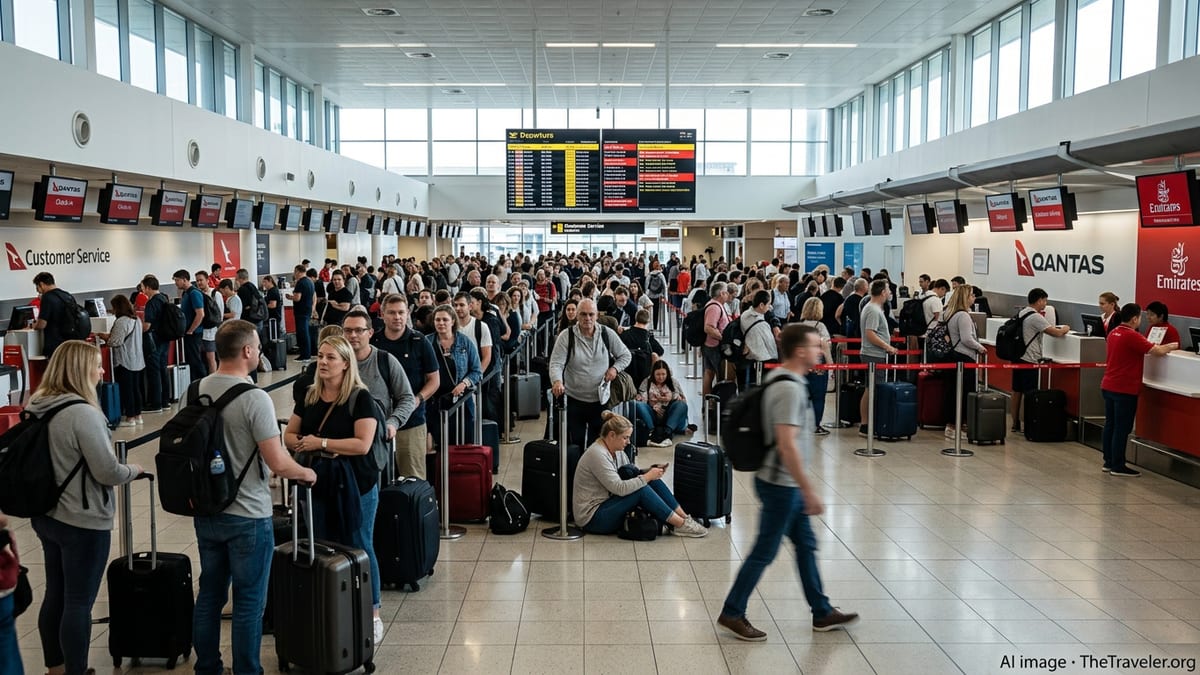
Travelers caught in the disruption wave have shared accounts on social platforms of crowded terminals, long queues and last-minute gate changes, underscoring the human impact behind the statistics. Many reported delays ranging from 30 minutes to several hours on flights that normally take less than two hours between the east coast capitals.
Major Carriers Struggle to Keep Schedules On Track
The bulk of affected flights involve Australia’s primary domestic airlines, including Qantas and Virgin Australia, along with low-cost offshoots such as Jetstar. Published flight histories on key routes between Sydney, Melbourne and Brisbane show a pattern of late arrivals and departures, with some services arriving more than half an hour behind schedule and select flights cancelled outright.
On the busy Sydney to Melbourne and Sydney to Brisbane routes, which are among the country’s most heavily trafficked domestic corridors, airline performance data already points to persistent punctuality challenges. Government and industry reports over recent years have documented elevated cancellation and delay rates on these sectors, reflecting the pressure on both airline networks and ground infrastructure.
Recent on-time performance summaries for the broader Australia and New Zealand region also indicate that, while overall cancellation rates remain comparatively low on some international city pairs, disruptions tend to concentrate on high-density routes and peak travel days. This aligns with the pattern now being observed on the east coast, where any single delayed aircraft can trigger a chain reaction across multiple subsequent legs.
Virgin Australia and Qantas have both been adjusting their networks in response to shifting demand and operational constraints, including earlier decisions to trim selected domestic services and re-time international connections. As schedules tighten and aircraft utilisation increases, the margin for absorbing unexpected disruptions becomes smaller, heightening the risk that a single bad day can lead to large numbers of delayed passengers.
Weather, System Strain and Structural Constraints Blamed
Several factors appear to be converging to produce the current wave of disruption. Publicly available material from Sydney Airport and government submissions describe how air traffic flow restrictions, adverse weather conditions and regulatory caps on movements can all reduce the number of aircraft allowed to arrive and depart in a given hour. Once in place, these restrictions tend to create backlogs that can persist well into the day.
Recent commentary from travelers and aviation observers points to a mixture of strong winds, low cloud and intermittent technical and staffing issues across airline and airport operations. In past events of this kind, high winds and low visibility at Sydney have led to extended ground holds, forcing flights bound for the airport to depart late or circle in holding patterns, while outbound services wait for available slots on departure.
Airports and airlines are also navigating broader system pressures as air travel returns to or exceeds pre-pandemic levels. Industry analyses note that, while passenger volumes have surged, recruitment and training of specialist staff, as well as aircraft maintenance and spare capacity, have not always kept pace. This imbalance makes the network more vulnerable to shock events and amplifies the scale of disruption when they occur.
In addition, the east coast triangle formed by Sydney, Melbourne and Brisbane carries an outsized share of Australia’s domestic traffic, with multiple carriers operating dense shuttle-style schedules on these routes. With aircraft often turning around in under an hour, even routine operational hiccups can cascade quickly across the network, particularly on Fridays and Sundays when leisure and business travel peaks.
Passenger Rights and Political Scrutiny Intensify
The latest difficulties come as Australia’s aviation sector faces mounting scrutiny over reliability and customer treatment. A federal proposal known as the Airline Passenger Protections (Pay on Delay) Bill has drawn attention to high-profile cancellation spikes on routes such as Sydney to Melbourne and Sydney to Brisbane, and seeks to strengthen compensation rules for disrupted travelers.
Background documents associated with the bill point to patterns of cancellations that cannot always be attributed purely to weather or safety, raising questions in policy circles about how airlines schedule and manage capacity on the nation’s busiest routes. While the legislation has not yet been fully implemented, ongoing disruptions at major airports are likely to fuel public debate about whether stronger consumer protections are needed.
Consumer advocates have long argued that clearer, more consistent compensation standards would bring Australia closer to regimes in other regions where passengers are entitled to automatic payments when disruptions are within an airline’s control. Industry representatives, by contrast, have cautioned that rigid rules could reduce flexibility and ultimately lead to higher fares or reduced capacity on marginal routes.
For now, passengers affected by the latest wave of delays and cancellations remain largely dependent on individual airline policies, which typically offer rebooking on the next available service or refunds when flights are cancelled. However, those options can still mean significant inconvenience when alternative seats are scarce and onward connections are at risk.
Travellers Urged to Prepare for Ongoing Disruption
Aviation observers suggest that, given current pressure on the domestic network, disruptions of the scale seen in Sydney, Melbourne and Brisbane may continue to occur periodically, particularly during peak travel periods and adverse weather. Travelers are being encouraged by consumer groups and travel advisers to allow extra time for connections and to monitor flight status closely in the hours leading up to departure.
Advice commonly shared by experienced passengers includes booking longer layovers where possible, travelling with carry-on baggage only when feasible to speed rebooking, and registering for airline notifications so that schedule changes are received immediately. On days when widespread delays are evident on airport boards, some travelers also opt to switch to earlier departures to increase their chances of reaching critical events or international connections.
Looking ahead, planned infrastructure developments such as the opening of Western Sydney International Airport and incremental upgrades at existing terminals are expected to provide some long-term relief by adding capacity and distributing traffic more evenly. However, analysts note that infrastructure alone cannot resolve punctuality issues unless accompanied by resilient scheduling, adequate staffing and robust contingency planning by airlines.
For passengers caught in the current disruption, the focus remains on getting to their destinations as airlines, airports and air traffic managers work to gradually restore their timetables. With hundreds of flights running late and services under sustained pressure, the episode serves as a reminder of how quickly Australia’s tightly wound domestic network can become stretched when conditions turn against it.