


More news on this day
Hundreds of travelers were left stranded at Amsterdam Schiphol Airport after a fresh wave of disruption saw 353 flights delayed and 34 canceled, snarling operations for major European and long haul carriers and triggering missed connections across multiple continents.
Get the latest news straight to your inbox!
Heavy Disruption Across a Key European Hub
The latest operational snapshot from Amsterdam Schiphol shows a sharply elevated level of disruption, with 353 delayed flights and 34 cancellations recorded across a single day. The figures position the Dutch hub among Europe’s most affected airports in recent weeks as airlines continue to navigate a mix of tight schedules, capacity constraints and intermittent weather challenges.
The disruption has affected both departures and arrivals, compounding the impact on connecting travelers who rely on Schiphol as a transfer point between regional European cities and long haul destinations in North America, the Middle East, Asia and Africa. Publicly available tracking data indicates that delays ranged from modest schedule slippages of 30 to 45 minutes to multi hour waits that pushed some services deep into the night.
Amsterdam Schiphol is one of Europe’s busiest hubs, handling tens of millions of passengers per year on a dense network of short, medium and long haul routes. When an operational spike of this magnitude hits the schedule, even a relatively small proportion of cancellations can leave large numbers of travelers without immediate alternatives as aircraft, crews and available seats are already heavily utilized.
Major Airlines See Schedules Unravel
The wave of delays and cancellations has rippled across a long list of airlines operating at Schiphol. KLM, which uses Amsterdam as its primary hub, has seen feeder and long haul services disrupted, affecting passengers traveling under both its own brand and those of alliance and codeshare partners. Delta Air Lines, United Airlines and other transatlantic carriers have also faced interruptions on key routes linking the Netherlands with New York and other North American gateways.
On the European side, British Airways, Lufthansa, Air France and easyJet have experienced schedule knock on effects as aircraft arriving late into Amsterdam departed behind schedule for London, Frankfurt, Paris and a range of regional cities. Low cost operators, which often run tight turnarounds and high aircraft utilization, have been particularly vulnerable to cascading delays once the morning wave of flights is disrupted.
Long haul services operated by Emirates and other Gulf and Asian carriers have not been immune. While many of these flights have ultimately departed, late departures from Amsterdam have increased the risk of missed onward connections in Dubai, Singapore and other major transit hubs. For travelers booked on complex itineraries involving multiple carriers, a delay at Schiphol has frequently meant missed long haul segments and unplanned overnight stays.
Scenes in the Terminals as Travelers Wait
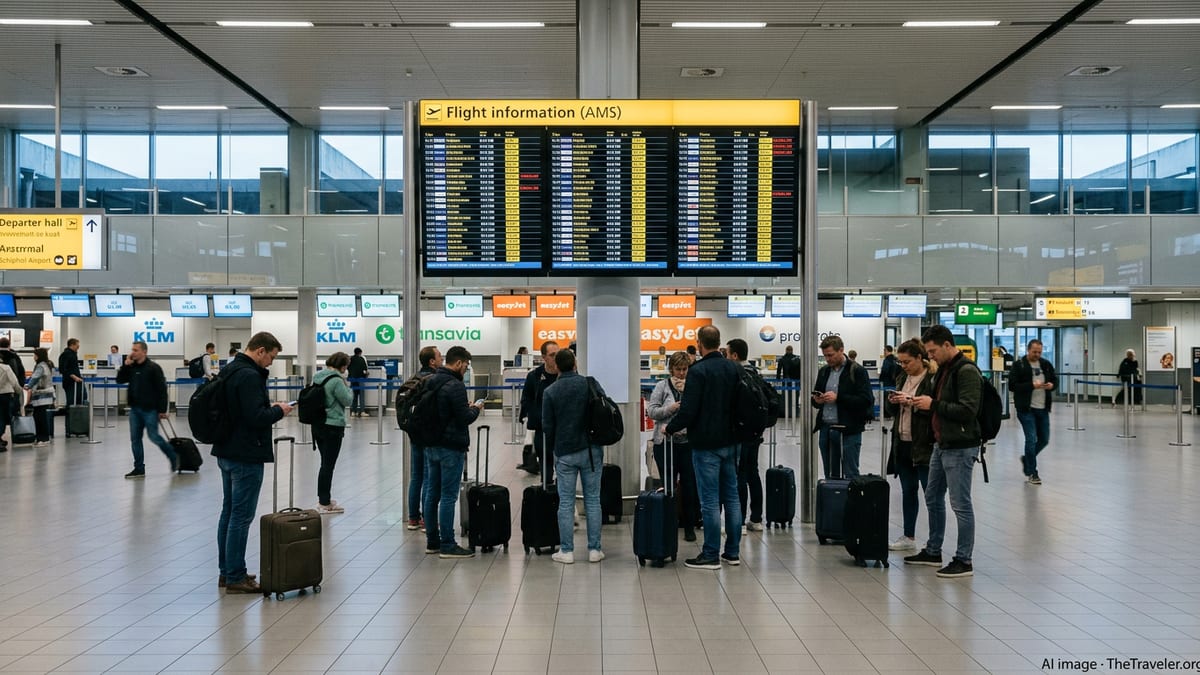
Inside the terminals, the uneven flow of flights has quickly translated into crowded departure areas and long lines at customer service desks. Public coverage and social media posts from passengers describe extended waits for rebooking assistance, with some travelers queueing for hours to secure alternative routings after their original flights were canceled or delayed beyond useful connection windows.
Families and solo travelers alike have been pictured resting on terminal floors and occupying every available seat in departure halls as they wait for new departure times. With many flights operating at or near capacity at this time of year, same day rebooking has been difficult on some routes, forcing passengers to accept alternative destinations, multi stop itineraries or travel dates that are one or more days later than originally planned.
Baggage handling has presented additional challenges. When flights are canceled after bags have been checked, ground teams must retag and store luggage for reloaded departures or arrange for later forwarding. This process can add hours to already extended travel days and leaves some passengers temporarily separated from essential items while they navigate overnight accommodation and meal arrangements.
Knock On Effects Across European and Global Networks
The impact of 353 delayed flights and 34 cancellations at Schiphol has not been contained within the Netherlands. Because Amsterdam functions as a major transfer node, disruption has propagated along connecting routes to London, Paris, Frankfurt, Rome, Barcelona, New York, Dubai and Singapore, among many others. Aircraft departing late from Amsterdam have arrived behind schedule at downline airports, where turnaround times are often insufficient to fully recover the timetable.
For airlines, this kind of disruption can trigger a domino effect across their networks. A delayed aircraft arriving from Amsterdam may force schedule changes on subsequent rotations, potentially affecting airports that experienced no local operational issues of their own. This dynamic is particularly pronounced for carriers that base aircraft at Schiphol and rely on precise rotation planning to cover dense daily schedules.
Travel industry analysts note that recent months have seen repeated episodes of concentrated disruption at several major European hubs, including Amsterdam. Factors cited in public reporting include periodic staffing shortages in air traffic control and ground handling, aircraft availability constraints, and seasonal weather patterns that periodically reduce capacity. When these factors coincide, the margin for recovery within a single operational day can evaporate quickly.
What Stranded Travelers Can Do
For passengers caught up in the latest disruptions at Schiphol, publicly available guidance from consumer advocates and aviation watchdogs continues to emphasize several practical steps. Travelers are encouraged to monitor airline apps and flight tracking tools frequently, as digital platforms may offer self service rebooking options that are faster than waiting in long airport lines.
Under European Union air passenger protection rules, travelers departing from or arriving into Amsterdam may be entitled to assistance when flights are significantly delayed or canceled. This can include meals and refreshments after certain waiting periods, hotel accommodation for overnight delays, and transport between the airport and a hotel when necessary. Eligibility for financial compensation depends on the cause of the disruption and the length of the delay on arrival.
Consumer organizations also advise documenting all expenses incurred while stranded, including receipts for food, local transport and accommodation, in case these costs can be reclaimed later. Passengers are further encouraged to keep records of communications with airlines, such as confirmation emails and updated itineraries, which can support any subsequent claims.
With schedules at Amsterdam Schiphol remaining sensitive to further operational pressures, travelers booked to pass through the airport in the coming days are widely advised in public information notices and news reports to check their flight status before leaving for the airport, allow extra time for security and transfer formalities, and prepare for the possibility of last minute changes to their plans.