


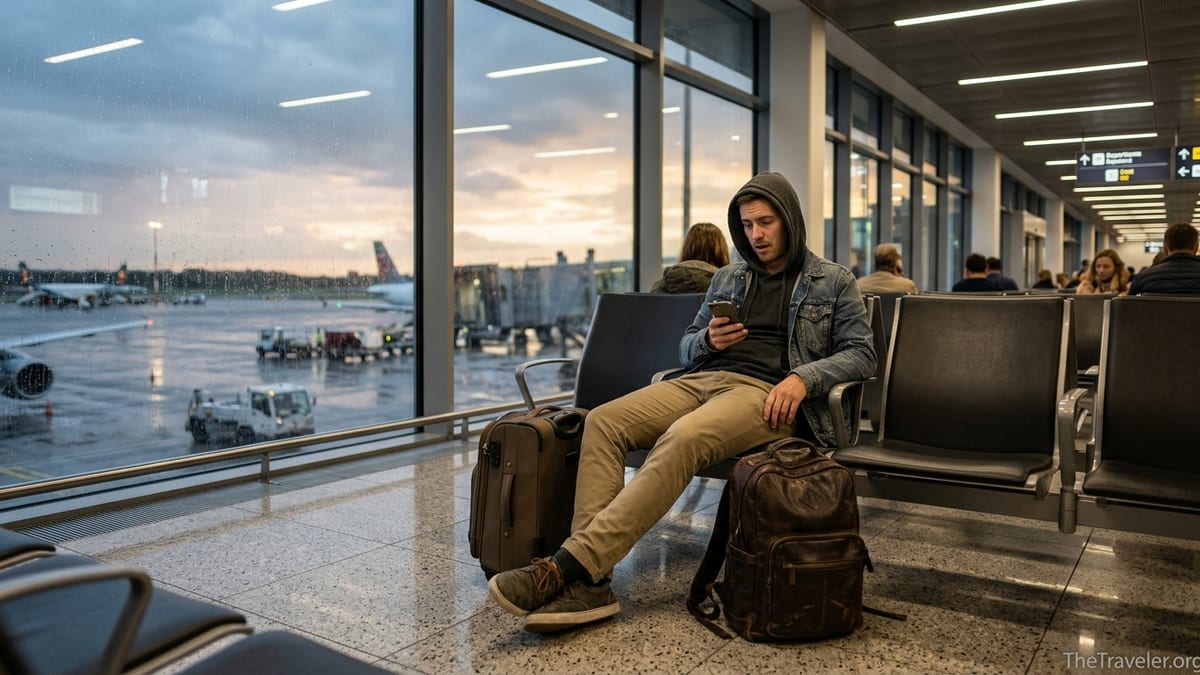
When my Berlin to Barcelona flight landed nearly five hours late one rainy night, I did what most tired travelers do: I grumbled, grabbed my bag and went straight to my hotel. Somewhere in the back of my mind I knew EU passenger rights might entitle me to compensation, but the idea of filling out forms and chasing an airline across borders felt exhausting. So when a friend mentioned a company called Refund.me that would handle the claim for me, I was ready to dismiss it as just another middleman. I almost ignored it entirely, until I actually looked at how the claim process worked.
Get the latest updates straight to your inbox!
Who Is Refund.me and What Do They Actually Do?
Refund.me is a Germany based legal tech company created to help air passengers claim compensation when flights are cancelled, heavily delayed, overbooked or connections are missed under European air passenger rules such as EU Regulation 261/2004 and the similar UK261 framework. Instead of the traveler arguing directly with an airline, Refund.me takes over the dispute and pushes the claim on the passenger’s behalf. The company uses a no win, no fee model, which means you do not pay anything upfront and they take a percentage only if the claim is successful.
In practice, this can cover a surprisingly wide range of flights. Any departure from an airport in the European Union, plus Iceland, Norway and Switzerland, can fall under EU261, regardless of whether you are a European citizen or not. For a traveler from the United States connecting through Frankfurt on the way to Cape Town, or a Canadian on holiday between Paris and Rome, a delay of three hours or more on arrival that is the airline’s fault could trigger compensation. Refund.me positions itself as the tool that turns that right into actual money in your bank account.
The core service is fairly straightforward. You share your flight details and basic personal information, Refund.me checks whether the disruption is likely to be covered, and if so it pursues compensation, often between 250 and 600 euros per person depending on distance and length of delay. For a family of four on a long haul itinerary, that can quickly become a four figure sum. The promise is not only the money itself, but the fact that someone else handles the legal language, regulation references and negotiation with an airline that may be on another continent.
Initially, I assumed this was something I could do for free in a spare hour with the airline’s web form. Looking more closely at the way Refund.me structures its claim process, and the hurdles they remove, changed my calculation.
Looking Inside the Refund.me Claim Process
The turning point for me came when I actually walked through Refund.me’s online claim flow instead of just reading the marketing headline. The process is built around a guided form that asks for the same details an airline or regulator would eventually need, but presents them in the plain language a tired traveler can manage from a phone in an airport café. You start with the flight number, the date and the route, then specify what happened: a cancellation, a long delay at arrival, a denied boarding at the gate or a missed connection.
Behind the scenes, the system checks whether the flight falls under EU261 or UK261 and whether the circumstances look eligible. For example, a three hour delay on a London to Lisbon flight caused by a late arriving aircraft or an airline staffing issue is treated very differently from a similar delay caused by an airport closure due to a snowstorm. If the disruption is likely covered, you are asked to upload your boarding pass, booking confirmation and any written communication from the airline. The tool highlights that screenshots of app notifications or airport departure board photos can also help, something many travelers do not think of keeping.
Once everything is submitted, Refund.me sends you a summary of the claim and the projected compensation amount based on distance and length of delay. It then takes over all communication with the airline, including follow up emails and, when necessary, escalation to legal partners in the departure country. You can track status updates online instead of wondering whether your complaint vanished into a generic inbox. In my Berlin to Barcelona case, the estimate showed 250 euros as the likely payout, which closely aligned with what consumer advocates generally state for short haul flights under the regulation.
Crucially, the process is structured so that your time investment is short. Filling in the form, attaching documents and signing the mandate took me under 15 minutes. That was the moment I realized why so many frequent travelers, even the ones comfortable dealing with airlines, quietly hand this work off.
Real World Scenarios Where A Service Like Refund.me Helps
The value of Refund.me becomes clearer when you look at concrete itineraries instead of abstract rights. Consider a couple from Chicago who book a single ticket on a major European airline from Chicago to Rome via London. Their transatlantic leg operates roughly on time, but the London to Rome connection is cancelled the morning of departure due to an aircraft technical issue. They are rebooked the next day and arrive in Rome more than 12 hours late for a prepaid Amalfi Coast hotel. Under EU261, that second leg, which departs from the United Kingdom and is operated by an eligible carrier, can trigger compensation for each traveler if the reason is within the airline’s control.
In theory, the couple could read through the airline’s conditions of carriage, identify the correct complaint channel, file a detailed claim in writing and then argue back and forth if the airline responds with a generic refusal. Each exchange may take several weeks, especially if the airline is facing heavy disruption. A company like Refund.me streamlines this into a single submission. The couple enters their London to Rome flight details, uploads both boarding passes showing the long delay, and lets the service handle the legal references. If compensation is ultimately paid, the couple receives money that can offset the lost hotel night and extra meals.
Another common situation involves missed connections on multi leg trips. Picture a traveler flying from New York to Athens via Paris on one ticket. A ground handling issue at the departure airport causes a significant delay in leaving New York, and they miss the last Paris to Athens connection of the day. The airline puts them up in a simple airport hotel and rebooks them the next morning. The passenger arrives more than three hours late into Athens. In this scenario, EU261 can still apply to the European segment of the journey, and a claim service can help clarify which leg, which airline and which regulation apply, something that confuses many travelers when codeshares and alliance partners are involved.
There are also cases where airlines respond inconsistently. Travelers on online forums often describe submitting EU261 claims themselves, only to receive partial vouchers, generic apologies or denials based on vague references to operational issues. A specialized company can recognize when the justification does not meet the legal standard for extraordinary circumstances and can push back with targeted questions or references to official guidance from European regulators. For an individual business traveler trying to juggle work and home life, that persistence can be hard to maintain alone.
Refund.me Fees, Payouts and How It Compares With Doing It Yourself
No win, no fee sounds appealing, but it naturally raises the question of cost. Refund.me, like its competitors in the field, typically works on a percentage of the recovered compensation plus applicable taxes or administrative fees. While exact percentages can vary over time and by jurisdiction, travelers should expect that a meaningful share of the final amount will go to the service in exchange for handling the case. On a 400 euro compensation for a delayed medium haul flight within Europe, for example, the portion retained by the claim company might cover both its own work and any legal partners involved.
For some travelers, especially those who are organized, comfortable writing formal emails and willing to wait, handling a claim directly with the airline can result in keeping the full compensation. Many major European carriers now have online claim forms where you can submit flight details, select the reason for disruption, and upload documents. When the case is straightforward, such as a clearly documented four hour delay on a Paris to Madrid flight with many other passengers affected, airlines sometimes pay compensation willingly once they see a well documented claim referencing the correct regulation article and flight times.
However, the do it yourself route also has hidden costs. It requires you to know which regulation applies, to preserve boarding passes, to keep your own record of actual arrival times, and to recognize when an airline’s explanation is legally sufficient to deny compensation. You may have to send reminders if the airline does not respond within statutory time limits, and in some countries you might need to escalate to a national enforcement body or an alternative dispute resolution scheme. That can mean filling out additional forms, attaching correspondence and, in some cases, writing in a language that is not your own.
From this perspective, the fee you pay to Refund.me or a similar provider becomes a trade off between time, stress and the risk of abandoning a valid claim out of frustration. A family juggling children, work deadlines and connecting transfers may reasonably decide that giving up a portion of the compensation is worth gaining back hours of their life and avoiding arguments with a distant customer service department.
How Refund.me Fits Into a Growing Claims Industry
Refund.me is part of a broader ecosystem of companies that have emerged across Europe since EU261 took effect. Names like AirHelp, SkyRefund, AirRefund, MyflyRight and others all focus on turning passenger rights into actual payments. They compete on factors like success rates, speed of payout, customer service, and how aggressive they are in pushing cases to court when airlines push back. For travelers, this competition has two practical effects: it keeps service quality under scrutiny and it increases awareness that compensation is possible at all.
In many ways, airlines and consumers have a different understanding of how likely a claim is to succeed. Airlines may view a regulation as a cost center and rely on a certain number of passengers never filing. Claims companies, on the other hand, rely on volume and efficiency. They analyze flight disruption data, public rulings and enforcement trends to decide which types of cases to pursue. When they see that a specific route or airline often denies legitimate claims, they may adapt their approach or push cases to external dispute bodies more quickly.
For a traveler trying to navigate all of this, the presence of multiple players can be confusing. It is worth checking a few basic points before choosing a service: how clearly they disclose their fee structure, whether they require an exclusive mandate that prevents you from also contacting the airline, and what happens if the airline partially settles or offers vouchers instead of cash. Some travelers prefer established brands with a long track record, while others choose based on language availability or the simplicity of the online dashboard.
Refund.me’s niche has been its emphasis on technology driven automation combined with legal partnerships in multiple countries. For someone flying regularly between secondary European cities where smaller carriers operate, that network can matter. The underlying lesson, though, is that you have options. You can pursue compensation directly, use a claims company like Refund.me, or in some cases turn to national enforcement bodies or consumer groups for help.
New Rules, Evolving Rights and Why Timing Matters
European passenger rights are not static. Lawmakers and regulators continue to adjust how compensation works, how airlines must inform passengers and how easily people can exercise their rights. Recent discussions at the European Parliament have focused on clarifying what counts as extraordinary circumstances and strengthening enforcement so that passengers get consistent treatment across member states. For travelers, this means that a disruption in 2026 may be handled differently than a similar disruption was five or six years ago, both by airlines and by claims services that follow the evolving rules closely.
There is also a parallel evolution in other jurisdictions. In the United States, for example, the Department of Transportation has introduced stronger requirements around automatic refunds when airlines cancel or significantly change flights, even if compensation in the European lump sum sense is not guaranteed. For travelers whose trips involve both North American and European segments on a single ticket, the interaction between these systems can be complex. A claim company that understands both can help you avoid giving up rights in one jurisdiction while accepting a resolution in another.
Timing plays a crucial role. Under EU261 and UK261, passengers usually have several years to bring a claim, but the precise deadline depends on the national law of the country where the claim is filed. Some travelers wait too long, either because they are unsure whether their case qualifies or because they keep meaning to send that one more email to customer service. Services such as Refund.me benefit from being contacted early, when evidence like boarding passes, rebooking confirmations and delay screenshots is easiest to gather and when airlines’ internal records are fresh.
It is equally important not to confuse refunds with compensation. If your flight is cancelled and you choose not to travel, airlines generally must refund the unused ticket. That refund is separate from the standard compensation under EU261 and UK261, which is aimed at the inconvenience of cancellation or delay. A claim service can help you distinguish between the two and ensure you are not accepting a simple ticket refund as a final settlement when you might also qualify for compensation.
The Takeaway
When I first heard about Refund.me, I lumped it together with countless travel add ons that promised convenience at the cost of another cut of my wallet. Only when I walked through the actual claim process did I understand why so many seasoned travelers quietly rely on companies like this. The form was structured around the way travelers actually remember their trips, the system handled the heavy lifting of legal references, and once I signed the mandate I was no longer the one chasing an overseas airline for answers.
That does not mean Refund.me is the right choice for every disrupted flight. If you are comfortable drafting a detailed email, know your exact arrival times, and are dealing with a major airline that has a solid record of honoring EU261 or UK261 claims, you may prefer to keep the full compensation by handling the process yourself. But for complex itineraries, stubborn denials or simply those times when you lack the bandwidth to argue, handing the case to a specialist can turn rights written in a regulation into money in your account that you might otherwise never see.
The key is to treat services like Refund.me as tools, not magic fixes. Check fee structures, understand what you are signing, and keep your own records of what happened on the day of disruption. When used thoughtfully, these companies can balance the scales between individual travelers and large airlines, making sure that the protections lawmakers designed for air passengers actually work in the real world.
FAQ
Q1. What kinds of flight problems can Refund.me help with?
Refund.me typically focuses on flights that are cancelled, significantly delayed on arrival, overbooked with denied boarding, or where a missed connection leads to a long delay. The key factor is usually whether the disruption falls under European or similar passenger rights rules and whether it was within the airline’s control.
Q2. Do I have to live in Europe to use Refund.me or benefit from EU261?
No. EU261 and similar rules apply based on where your flight departs and which airline operates it, not your citizenship. A traveler from the United States, Canada or Asia can be eligible for compensation on covered routes just like a European resident.
Q3. How much money could I realistically receive for a valid claim?
The amount depends on the flight distance and the length of the delay at final arrival. Under European rules, compensation often ranges from a few hundred euros on short haul flights to higher amounts on long haul routes, especially when delays are long and caused by issues under the airline’s control.
Q4. What information do I need to start a claim with Refund.me?
You generally need your booking confirmation, flight number, travel date, routing, and evidence of the disruption such as boarding passes, rebooking messages, or screenshots of delay notices. The more accurate your records, the stronger your claim will be.
Q5. How long does the Refund.me process usually take?
Timelines vary widely. Some straightforward claims may resolve in a few weeks, while more complex cases that require escalation or legal action can take several months or longer. Refund.me keeps handling the communication with the airline during this time so you do not have to.
Q6. What fees does Refund.me charge if my claim succeeds?
Refund.me works on a no win, no fee basis, so you usually pay nothing if the claim fails. If it succeeds, the company takes a percentage of the recovered compensation to cover its work and any legal partners. Exact figures can change over time, so it is important to review the current terms before signing.
Q7. Can I still file a claim myself if I already contacted Refund.me?
Once you sign a mandate or agreement with Refund.me, you may be giving them the exclusive right to pursue the claim on your behalf for that disruption. If you later also try to claim directly with the airline, it can create confusion. It is best to decide on one approach and stick with it for each specific flight problem.
Q8. Are all delays covered, or do airlines sometimes have valid reasons to refuse compensation?
Not all delays qualify. Disruptions caused by extraordinary circumstances, such as severe weather, air traffic control restrictions or certain security issues, may fall outside the compensation rules. Airlines can lawfully refuse compensation in those cases, although they still have obligations to care for passengers with meals or accommodation in many situations.
Q9. How far back can I claim compensation through Refund.me?
The time limit for bringing a claim depends on the national law in the country where the claim is filed, and it can range from a couple of years to longer periods. Refund.me will usually check whether your flight falls within the applicable limitation period once you enter your travel date and route.
Q10. Is using Refund.me worth it compared with getting a full payout by claiming directly?
It depends on your situation. If you value your time, find the rules confusing, or have a complex itinerary or a reluctant airline, paying a share of the compensation for professional help may be worthwhile. If your case is simple and you are comfortable handling formal correspondence yourself, you might prefer to claim directly and keep the full amount.