


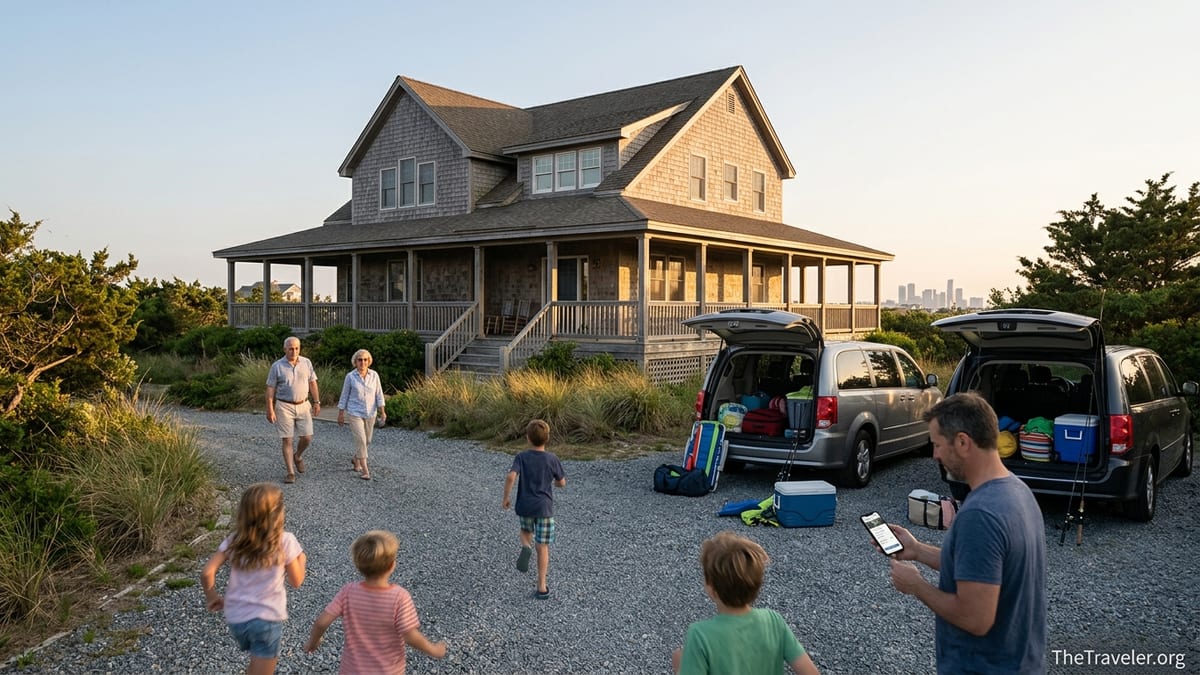
When I first opened Vrbo, it felt like déjà vu. Same map view, same price bubbles, same glossy photos of pools and bunk beds. I assumed it was just another Airbnb alternative and started searching without thinking much about it. But a week into planning a multigenerational family trip, the experience felt surprisingly different in ways that mattered both to my budget and to how the stay would actually unfold.
Get the latest updates straight to your inbox!
Whole Homes Only Changes the Mood of the Trip
The first difference I felt on Vrbo was what I did not see. There were no basement studios attached to someone’s main house, no curtained-off lofts in a shared apartment, no couch-in-the-living-room “experiences.” Vrbo’s inventory is built around entire homes and condos, which quietly changes the kind of trip you end up planning. On a beach search near Destin, Florida for a long weekend in September, every Vrbo result that caught my eye was a full house or a self-contained condo, many in resort-style communities with shared pools.
That contrasted with running the same dates and rough budget through Airbnb, where the first page of results mixed entire houses with private rooms inside occupied homes and a few quirky outbuildings. Those can be great for solo travelers or couples who enjoy meeting locals, but for a group of eight that included kids and grandparents, the Vrbo catalog felt more aligned with what we needed. The listings assumed privacy, space and a “move-in for the week” mindset rather than dropping into someone else’s life.
In practice, this shows up at check-in. At a three-bedroom Vrbo townhouse in Scottsdale I booked earlier this year, there was no chance we would run into an owner coming home from work or hear someone else’s TV through the wall. We parked in the attached garage, punched in the smart lock code, and the place was wholly ours in a way that felt closer to a traditional vacation rental agency than to the looser, anything-goes side of home sharing.
That focus does not mean every Vrbo is a sprawling villa. Urban listings include compact condos near Denver’s Union Station or one-bedroom apartments in Seattle high-rises. But even there, the assumption is that you control the whole unit. If you are used to Airbnb’s grab bag of everything from yurts in Utah to shared rooms in Brooklyn, Vrbo’s narrower scope feels calmer, more predictable, and better suited to family-style trips.
Pricing Feels More Straightforward, Even When It Is Not Cheaper
The next surprise was how the numbers behaved. Neither platform is simple. Both layer cleaning fees, taxes and service fees on top of a base nightly rate. But Vrbo leans heavily into upfront, itemized pricing. The total you see, once you plug in dates and guest count, includes required fees so there are fewer late-stage shocks at checkout, even though you still have to click into a listing to see the full breakdown.
On a sample five-night stay in a three-bedroom condo in Gulf Shores, Alabama for July, a Vrbo listing showed a base of around 360 dollars per night. When I clicked through, the total climbed to roughly 2,300 dollars once a cleaning fee, a traveler service fee and taxes were added. Running a very similar condo on Airbnb brought me to a slightly lower nightly rate at first glance, closer to 340 dollars, but the final total once cleaning, host and guest fees and taxes were factored in landed in almost the same place. The emotional difference was that Vrbo got me to that reality faster, instead of letting me fall in love with a lower nightly price first.
Under the hood, the fee logic is different. Vrbo typically charges travelers a variable service fee as a percentage of the booking subtotal and charges hosts a commission and payment processing fee. Airbnb has been moving toward a model where many hosts pay a higher all-in service fee on their side while guests see fewer separate Airbnb-branded surcharges. For you as a traveler, that means an Airbnb total may be more heavily influenced by how the host has chosen to absorb or shift fees into the nightly rate, while Vrbo’s breakdown more often shows a distinct traveler service fee on your receipt.
In real bookings, that difference can matter most on shorter stays. A two-night Vrbo stay in a mountain cabin near Asheville might carry a 200 dollar cleaning fee and a noticeable traveler fee that make the per-night cost feel steep. On Airbnb, the same cabin could display a higher nightly rate but a similar total once their service fee structure kicks in. Vrbo did not consistently save me money, but the way its pricing surfaced made it easier to compare options like a hotel: you pick dates, you see something close to the real bill, you decide whether it fits.
Vrbo Still Feels Closer to the Old-School Vacation Rental World
There is also a cultural difference that becomes obvious once you start messaging hosts. Vrbo’s origins are in classic vacation rentals, especially in North America’s beach and mountain markets. Many listings are managed by professional companies that also advertise on their own sites or through local agencies. When I messaged about an oceanfront house in Corolla on North Carolina’s Outer Banks, the reply came from a local vacation rental firm that had office hours, a maintenance crew and even a printed arrival packet waiting at check-in.
On Airbnb, I am more likely to encounter individual hosts managing a single apartment or someone juggling a small portfolio of places alongside a day job. That can be delightful, with personal restaurant recommendations and hand-drawn maps, but it can also mean slower response times or ad hoc policies. During a spring trip to Austin, the Airbnb host I booked with apologized for replying late because they were on a work trip in another city. By contrast, a Vrbo condo I rented in Breckenridge was clearly part of a professionally run group with a 24/7 phone line and a front desk that handled extra parking passes without any drama.
This tilt toward professional management shows up in rules and expectations. Vrbo listings in resort destinations often mirror traditional weekly rental norms: check-in on Saturday or Sunday, minimums of five to seven nights in peak season and clear house rules around occupancy and pets. Airbnb stays in the same towns are more likely to offer flexible two- or three-night stays, which can be a major advantage for a quick getaway. But if you are planning a week-long family vacation and want the reassuring structure of set arrival days and established procedures, Vrbo’s old-school streak can feel comforting.
The trade-off is personality. An Airbnb loft in Lisbon might be filled with the host’s art books and handwritten café suggestions, while a comparable Vrbo apartment a few blocks away is more likely to be neutrally furnished, stocked with hotel-style white linens and house manuals created from a template. For some trips, especially with extended family in tow, that neutral, professionally standardized approach might be exactly what you want.
How It Actually Feels to Book and Stay With Vrbo
On the surface, Vrbo’s interface looks familiar: a big map, filters for bedrooms and price, photo grids. But the flow feels slightly more transactional and slightly less about discovery. You are guided almost immediately to choose exact dates and guest counts before you can see a realistic price. Reviews are present but less visually dominant than on Airbnb, where star ratings and host profiles often anchor the entire experience.
On a recent search for a pet-friendly cabin in the Smoky Mountains, toggling filters on Vrbo felt very much like working with a traditional travel site. I filtered for two bedrooms, fenced yard, Wi-Fi and allowed pets, then went straight to the total price for my target dates in October. When I repeated the search on Airbnb, the interface nudged me toward “amazing views” and “cabins with hot tubs” categories and emphasized overall vibe. That can be great fun if you are building inspiration for a future trip, but when you are trying to reconcile three different school schedules and a dog that needs a yard, Vrbo’s more utilitarian focus felt like a relief.
During the stay, the differences continued. At an ocean-view Vrbo condo in Maui, check-in instructions arrived from a local management office with detailed arrival info, including gate codes, parking notes and a reminder about quiet hours. The tone was friendly but firm, much like a resort. When a ceiling fan started clicking loudly on the second night, a maintenance tech showed up the next morning after a quick phone call. On a comparable Airbnb stay in San Diego, the host handled a similar issue with a detailed message and a promise to send someone “in the next few days,” which worked for a relaxed couple’s trip but would have been stressful on a shorter, tightly scheduled family vacation.
Neither experience was universally better, but the Vrbo stays tended to feel more like renting from a small, established company and less like sharing space with an individual. If your comfort level tilts toward predictable procedures and businesslike communication, that difference is not minor. It shapes how secure you feel booking a high-cost week at a property you will not see in person until you arrive.
Policies, Protection and What Happens When Things Go Wrong
Digging into policies was where I expected the two platforms to converge, but Vrbo again felt distinct. Both sites allow hosts to set their own cancellation policies within a menu of options that range from very strict to relatively flexible. On Vrbo, it is common to see policies like 100 percent refunds if you cancel 30 or 60 days before arrival, dropping to 50 percent as you get closer and then zero inside a shorter window. Some properties opt for nonrefundable bookings, especially in peak seasons or at popular ski and beach destinations.
Airbnb offers similar structures, but it has also experimented with more flexible options and occasionally introduces targeted programs that let guests cancel more freely in exchange for higher overall pricing. Vrbo has emphasized that your ability to get its service fee refunded is typically tied to whether your booking qualifies for a full refund under the property’s stated cancellation rules. That makes it vital to read the exact policy on the listing page and in your confirmation email instead of assuming all stays work the same way.
Both platforms market “book with confidence” style guarantees and customer support. Vrbo’s traveler fee helps fund 24/7 support and payment protection if a host cancels last minute or a property is significantly misrepresented. Airbnb has its own AirCover branding with promises around last-minute host cancellations and listing accuracy. In real-world terms, travelers on both platforms report mixed experiences: some have had rebooking handled smoothly at equal or better properties, while others have spent hours on the phone or in chat, especially during peak travel disruptions like storms or airline meltdowns.
The main practical takeaway is to treat both platforms as intermediaries rather than direct accommodation providers. On Vrbo, because many listings are run by professional managers, you may find that the fastest way to solve an issue is through the local company’s phone line rather than through the platform’s central support. On Airbnb, where more hosts are individuals, the platform’s resolution center and messaging system tend to be the primary path. Knowing which lever to pull when something goes wrong can be the difference between losing a vacation day to logistics and getting back to the pool.
When Vrbo Quietly Becomes the Better Choice
After using both platforms for years, the biggest shift in my own planning is how I match each one to the type of trip. For a solo workcation in a city like Montreal, where I might want a quirky loft, a host who lives nearby and a short stay of three nights, Airbnb still wins for selection and variety. For a full-house beach week in places like the Jersey Shore, the Florida Panhandle or the Oregon coast, Vrbo often becomes my starting point because it is geared toward exactly that use case.
Consider a family of six booking a house near Disney World. On Vrbo, your search results will be filled with entire homes in gated communities around Kissimmee and Davenport, many with private pools, game rooms and parking for multiple cars. The booking process feels like working with a vacation rental specialist: clear minimum stays, professional photos, standardized amenities like pool heat and grill rentals. On Airbnb, those homes exist too, but they are mixed into a sea of townhouses, condos and even individual bedrooms near the parks, and it takes more filtering to isolate the same style of property.
Vrbo also tends to shine for trips that involve sharing costs among multiple families. When two or three households are splitting a week at a large lakefront house in Minnesota, the stakes feel high. You want predictable cancellation terms, detailed invoices that show exactly how the fees break down and a sense that there is an office you can call if the dock lights fail or the water heater goes out. In those scenarios, Vrbo’s vacation-rental DNA feels like an asset rather than an afterthought.
All of that said, availability and pricing change quickly, and in many destinations the two platforms list the exact same properties. It is not unusual to find a downtown Nashville condo appearing on both Vrbo and Airbnb, sometimes with slightly different fees or minimum stays. Checking both before you commit, and taking screenshots of total prices for your exact dates, remains one of the simplest ways to be sure you are genuinely getting a better deal rather than reacting to how the price is presented.
The Takeaway
What began as a casual test of “that other vacation rental site” ended with Vrbo taking a real place in my planning toolkit. It did not replace Airbnb, and it did not consistently beat it on price. What it offered instead was a different feel: a platform oriented around full homes, family trips and more traditional vacation rental norms, with pricing and policies that felt easier to decode once you knew where to look.
If you enjoy the personality and variety of Airbnb and tend to book short, flexible city breaks, that platform will likely stay your default. But if you are organizing a once-a-year beach house for a big group, need clear rules around refunds, or simply prefer the sense that you are renting from an established operation rather than dropping into someone’s side hustle, Vrbo is worth more than a passing glance. The two sites may look almost identical at first, yet the way they shape your trip can be quietly, meaningfully different.
FAQ
Q1. Is Vrbo usually cheaper than Airbnb for the same property?
Not necessarily. For properties listed on both platforms, total costs are often similar, but the way fees are displayed can make one seem cheaper at first glance.
Q2. Why does Vrbo feel better for family trips?
Vrbo focuses on entire homes and condos, often in traditional vacation areas, which suits multi-bedroom, multi-generational stays where privacy and space matter.
Q3. Can I book a private room on Vrbo like I can on Airbnb?
In most markets, Vrbo emphasizes whole properties rather than shared spaces, so you will see far fewer private-room listings compared with Airbnb.
Q4. How do Vrbo’s service fees work for travelers?
Vrbo typically adds a traveler service fee as a percentage of your booking subtotal, on top of cleaning fees and taxes, and shows it in your total price at checkout.
Q5. Which platform has clearer cancellation policies?
Both outline policies on each listing, but Vrbo often uses structured categories like relaxed or firm, while Airbnb mixes standard and more flexible options. Always read the exact terms.
Q6. Who responds if something goes wrong during a Vrbo stay?
In many Vrbo bookings, a local property manager or rental company is your first point of contact, with Vrbo support available if major issues or cancellations arise.
Q7. Are Vrbo properties more professionally managed than Airbnb listings?
In classic vacation markets like beach and ski towns, Vrbo has a higher share of professionally managed properties, though both platforms host a mix of individual hosts and companies.
Q8. Does Vrbo charge more fees for short stays?
Vrbo’s cleaning and traveler fees can feel proportionally higher on one or two night stays, since fixed costs are spread over fewer nights, similar to how it works on Airbnb.
Q9. Should I check both Vrbo and Airbnb before booking?
Yes. Many popular homes appear on both, sometimes with different fees or minimum stays, so comparing totals for your exact dates can reveal meaningful savings.
Q10. Is Vrbo available in as many destinations as Airbnb?
Airbnb has broader global coverage, especially in cities and emerging destinations, while Vrbo is strongest in established vacation rental regions and resort areas.