

I thought I knew what “busy” meant. I write about travel for a living, I have elbowed through Times Square on New Year’s Eve and watched the Trevi Fountain at sunset. But nothing prepared me for what it felt like to arrive in Europe in late July 2024, just as the continent quietly broke tourism records again and every Instagram-famous spot seemed to be hosting the entire planet at once. I went anyway, right into the heart of peak season, and the reality was wild.
The Summer Europe Decided to Break Records
When I landed in Rome in late July, the first thing I noticed was the heat. The second was the line. It curled around the block outside Termini station, a solid wall of rolling suitcases and sunhats waiting for taxis and ride-hails that never seemed to arrive. It was peak season layered on top of a record year: across the European Union, tourist nights in 2024 passed the three billion mark, with Italy, Spain, and France alone accounting for well over half of them. July and August remained the crammed core of the calendar, roughly a third of all overnight stays compressed into just eight weeks. Suddenly the chaos in front of me made sense.
Italy itself had just celebrated its own record, with around 68 million international arrivals in 2024 and close to 460 million overnight stays spread across its hotels, agriturismos, and short-term rentals. Yet statistics do not convey what it feels like to drag a suitcase over cobblestones while every metro platform is packed and restaurant hosts juggle three languages just to tell you there is no table until 10:30 p.m. It felt less like a vacation and more like joining a moving city, an improvised metropolis made entirely of visitors.
On paper, I knew all this. As a travel writer, you read about “record-breaking seasons” and “post-pandemic rebounds” so often that the phrases blur together. On the ground, that rebound had a sound: the chorus of rolling hard-shell luggage in every underpass, the hiss of portable fans misting red-faced travelers, the constant digital shutter of smartphones capturing the same angle of the same landmark. High season had returned to Europe with a vengeance, and I had chosen to walk straight into it.
Amalfi Coast: Beauty on a Traffic Jammed Cliff
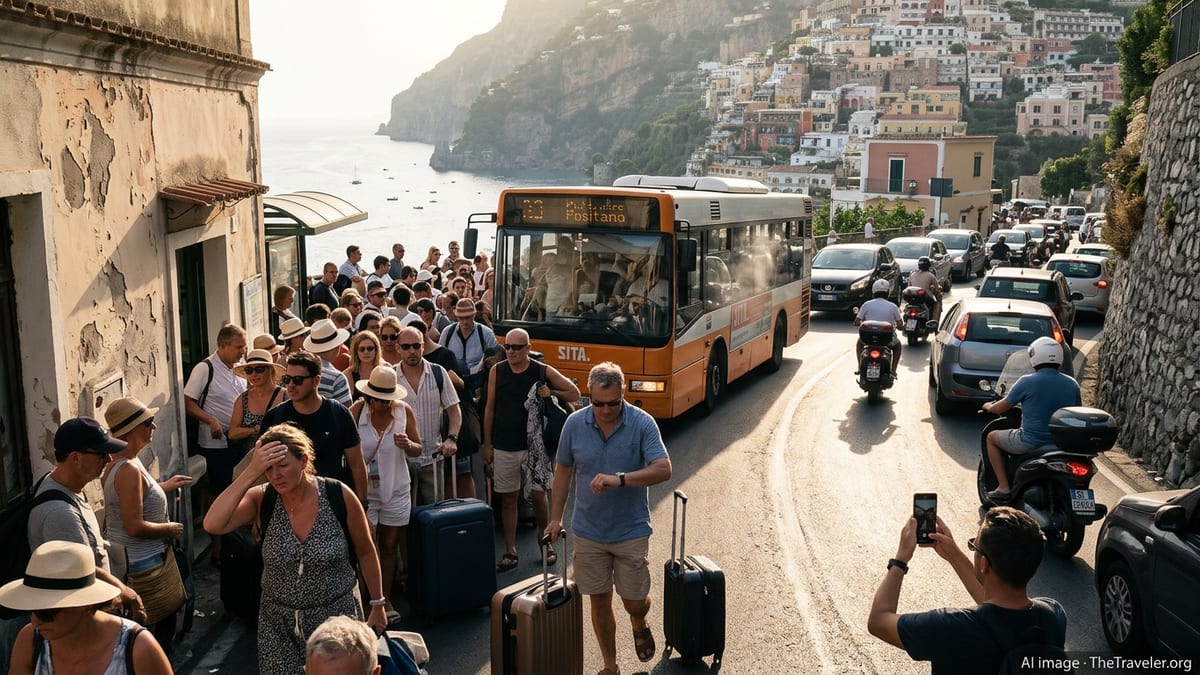
I had always imagined the Amalfi Coast as a watercolor: pastel villages spilling down cliffs, lemon groves tumbling toward the sea, small buses curling along a quiet road. The reality in August was closer to a rush-hour experiment. Even before reaching Positano, the regional train from Naples to Sorrento was so full that people were pressed into the doorways and aisles, backpacks stacked like bricks. When I stepped off at Sorrento, there was a queue of more than a hundred people for the SITA bus that crawls the hairpin road toward Positano and Amalfi. Each bus that pulled in was already half full.
This is the coast that has become a case study in overtourism. Local officials have tested number plate restrictions on cars along the Amalfi Drive on peak summer days, effectively telling certain license plates they could not use the road on alternating dates, in an attempt to relieve the gridlock that leaves residents stuck behind rental Fiats and tour coaches. In 2024, some ferry companies reported fully booked sailings days in advance on the Sorrento–Positano–Amalfi triangle, particularly during heatwave weeks when the only wind seemed to exist out on the water.
In Positano itself, the narrow pedestrian street to the main beach felt like a conveyor belt. At midday, I timed the walk from the top of town to the shore: twenty minutes in March, forty-five in August. The famous staircase down to Spiaggia Grande was a moving queue, everyone pausing for the same photo in front of the same view. From the sand, the beach clubs were a maze of sun loungers priced like front-row concert seats, starting around 80 to 100 euros per person for the day at some of the most sought-after spots, all of them sold out by mid-morning.
Yet even inside the madness, there were pockets of sanity. I learned to treat noon as curfew and rise before six. At 6:15 a.m., I watched a delivery boat unload crates of tomatoes and cases of mineral water onto an empty dock while a handful of joggers shared the beach with fishermen mending nets. By eight, the first day boats started to appear on the horizon; by ten, the sand was a quilt of towels. Peak season did not erase the magic of the Amalfi Coast, but it demanded that you negotiate for it hour by hour.
Crowds in Kyoto and a Mountain Begging for Space
From Italy I flew to Japan, trading one form of overtourism for another. Kyoto, which had been starved of visitors during the border closures earlier in the decade, now found its narrow streets in Gion once again clogged with tour groups, rented kimono, and camera lenses. Officials there have spent the past few years trying to protect residents and cultural workers from the worst behavior, even introducing fines for people who stalk geisha and banning tourists from certain alleys entirely. Walking those streets in October, I was part of the problem and I knew it.
One afternoon, near Kiyomizu-dera, I watched a sign language conversation between an elderly shopkeeper and a pair of confused visitors who had stepped into a private driveway to take photos. She pointed to a laminated sign in English asking people not to sit on the stone wall. They apologized, flustered, and moved along. Multiply that moment by the tens of thousands who now fill Kyoto’s most famous streets on a peak-season day and you begin to understand why frustrations run high. The city relies on tourism, but it also risks losing the very atmosphere people come to find.
Over in Yamanashi Prefecture, Mount Fuji became a different kind of symbol. In 2024 authorities introduced new crowd-control measures on the popular Yoshida Trail to address what local officials bluntly called an environmental and safety crisis. There is now a daily cap of around 4,000 climbers on that route, along with a mandatory fee in the low thousands of yen and a rule that closes the trail in the late afternoon to anyone without a reservation at a mountain hut. It is a mountain that, in recent years, saw conga lines of hikers pushing for the summit in the dark, some in sneakers and cotton hoodies as if they were heading to a shopping mall rather than a 3,776-metre volcano.
At Kawaguchiko, the now-infamous convenience store view of Fuji, local authorities went so far as to install a barrier to block a particular photo angle after crowds, drawn by social media, repeatedly trampled flowerbeds, ignored traffic, and climbed onto nearby roofs. The message was not subtle. Peak season here was no longer just about personal inconvenience. It was about whether a place could physically and socially withstand the weight of its own popularity.
Barcelona’s Breaking Point
I arrived in Barcelona on a hot September weekend, just as another cruise ship eased into port. From my room in Poble-sec, I could see its bulk dwarfing the warehouses, a floating hotel depositing thousands of passengers into a city that already receives tens of millions of visitors a year. In the historic center, the flow from the ship blended seamlessly into the existing crowd along La Rambla and around the Gothic Quarter. Souvenir shops, tapa bars, phone repair kiosks, and mini-markets selling sangria in plastic liters formed a continuous ring around every main square.
Barcelona has been one of the loudest cities in Europe in pushing back against overtourism. Local authorities have introduced a series of measures aimed at managing visitor numbers, particularly at the port, which in recent years has seen hundreds of cruise calls and several million passengers annually. The city has set capacity limits on cruise operations and is moving toward consolidating terminals, while from 2026 it plans to further reduce the number of ships that can dock. Walking around in peak season, it is easy to see why residents demanded change.
On a guided walk through El Born, our guide did a small experiment. She stopped talking for a full minute and asked us to just listen. Around us, I counted at least six different languages. A delivery scooter rattled over ancient stones. A garbage truck squeezed down a lane barely wider than its mirrors. Above, laundry flapped from the balconies of apartments where people still actually live. The point, she said later, was that Barcelona is not a theme park. For every traveler ordering a third round of patatas bravas at 11 p.m., there is a nurse trying to sleep before an early shift, a child doing homework, a chef catching a short break between services.
In that moment I realized that at peak times, my presence has a cost that is not captured on my credit card bill. It sits instead in a rental contract a local lost to a higher-paying holiday let, in a bus seat that a commuter cannot find, in the quiet that vanishes from a neighborhood square because four walking tours arrived at once. Barcelona remained intoxicating in spite of the crowds, but it also made me question what it means to love a city that is visibly struggling under the weight of its visitors.
Heatwaves, Exhaustion, and the Physics of Too Many People
All of this unfolded against another backdrop: heat. The European summer of 2024 was among the hottest on record, with heatwaves hitting Italy, Spain, Greece, and much of the continent earlier and more intensely than usual. In Rome, the stone around the Colosseum seemed to radiate heat back up into your lungs. In Seville, the afternoon streets emptied as the temperature nudged past what many travelers from cooler climates were prepared for. Tourists huddled in the limited shade of bus stops and gelato shops, clutching melted cones and handheld fans bought from enterprising vendors who appeared with cardboard boxes of portable salvation.
Heat changes the way crowds behave. It slows everything down while fraying tempers. Lines for a simple cappuccino stretched farther because baristas needed more time to mop sweat from their foreheads between orders. Security queues at airports moved in slow motion as people fumbled with reusable water bottles and fans, trying not to pass out. In Florence one afternoon, the Uffizi had to limit entry for a period to keep indoor temperatures at a safe level for both visitors and the priceless paintings on the walls.
Physically, traveling in those conditions felt like wading through warm, invisible syrup. The walk from my guesthouse in Trastevere to the Vatican Museums became a tactical operation: zigzagging from one patch of shade to the next, timing arrival to a prebooked entrance slot, carrying salt tablets and a collapsible water bottle that I refilled at every nasoni fountain I could find. The crowds compounded the heat, and the heat amplified the feeling of being one more body adding to the strain on a city that was not built for this many summer visitors.
Finding the Quiet: Small Shifts That Changed Everything
For the first week of this peak season experiment, I reacted to the chaos. I complained about lines and full buses, sent exasperated messages to friends, and promised myself I would “never travel in August again.” Then, somewhere between Kyoto Station and a ferry dock in Salerno, I realized I needed to adjust instead of resist.
The first adjustment was time. I became an early-morning person almost by necessity. In Rome, I walked into the Pantheon just after it opened and stepped into a chamber that still felt like a place of worship, not a backdrop. By 11 a.m., the queue outside already snaked around the square. In Barcelona, I booked the very first slot of the day at the Sagrada Familia and emerged two hours later into streets that were just beginning to thrum. In Kyoto, I reached Fushimi Inari before sunrise, and for thirty minutes the famous torii tunnel belonged to a handful of commuters and one elderly man walking his dog.
The second adjustment was scale. When the main sights felt impassable, I shifted my gaze one notch smaller. On the Amalfi Coast, I skipped a second day in Positano and took a morning boat from Amalfi to the quieter village of Minori, where umbrellas still rented for less and locals lingered over espresso at the bar. In Spain, I traded a full weekend in Barcelona for a day trip by train to Girona, where I could actually hear my own footsteps in the Jewish Quarter. In Japan, I added a night in Kanazawa, whose samurai district and gardens offered a reminder that not every beautiful place has become an Instagram battleground.
The third adjustment was attitude. Once I stopped expecting an empty piazza in front of the Trevi Fountain at sunset, I began to pay attention to different details: the way Roman teenagers perched on the steps comparing sneaker brands, the precision with which a Japanese station attendant reorganized a queue on a crowded platform, the resignation and humor of a Barcelona bartender who had learned to say “maybe try back at midnight” in four languages. The crowds became part of the story, not an obstacle to it.
The Takeaway
Traveling during absolute peak season in 2024 was chaotic, occasionally infuriating, and often uncomfortable. It was also illuminating. I saw firsthand what abstract numbers like “three billion overnight stays” and “record arrivals” actually look and feel like when translated into daily life in Rome, Barcelona, Kyoto, or on the flank of Mount Fuji. It is sweaty, loud, and logistically complicated. It can be harmful to the places we say we love if managed badly, and it can still be deeply rewarding if approached with humility and a willingness to adapt.
Would I recommend avoiding peak season altogether? If your schedule and budget allow, absolutely. Shoulder seasons exist for a reason, and in a warming climate they are becoming more pleasant and sustainable windows for both travelers and host communities. But not everyone can travel in October or May. School calendars, work constraints, and life events mean that, for many people, July and August are non-negotiable. The answer cannot simply be “do not come.”
What I learned instead is that how we travel matters just as much as when. Arrive early, step to the side of the obvious, spend money with local businesses beyond the most crowded streets, and remember that the neighborhood you are photographing is also someone else’s home. Respect the rules, even when they mean a cap on climbers or a blocked view of a mountain you flew halfway around the world to see. Peak season will probably keep getting busier in the years ahead. The wild reality I walked through in 2024 may become the baseline.
What we can control, as travelers, is our footprint and our expectations. If we accept that a summer visit to the Amalfi Coast or Kyoto will come with lines, heat, and crowds, then each unexpected quiet moment becomes a gift rather than an entitlement. And if we listen to what local residents and authorities are telling us, from Barcelona’s cruise limits to Mount Fuji’s new caps, we might help ensure that these places remain worth visiting at all, in any season.
FAQ
Q1. Is it ever worth visiting Europe in July and August anymore?
Yes, but you need to adjust your expectations and habits. Book key sights in advance, travel at off-peak hours, and consider basing yourself in smaller towns with day trips into major cities.
Q2. How bad are the crowds on the Amalfi Coast in peak season?
They are intense. Expect full buses, sold-out ferries, and premium prices for beach clubs. Staying in quieter villages like Minori or Praiano can make the experience more manageable.
Q3. Are the new Mount Fuji rules making it less accessible for hikers?
The new caps and fees add planning steps, but they improve safety and help protect the environment. Booking early for the Yoshida Trail is essential in the main climbing season.
Q4. Is Kyoto really suffering from overtourism or is it overhyped online?
Crowding is concentrated in specific districts and at certain times of day. If you visit early, spread out your sightseeing, and respect local rules, you can still have a meaningful experience.
Q5. What can I do to be a more responsible traveler in Barcelona?
Stay in licensed accommodation, avoid noisy late-night behavior in residential streets, support local businesses beyond the main tourist corridors, and walk or use public transport instead of taxis when possible.
Q6. How do heatwaves affect peak season travel plans?
They can cause attraction capacity limits, health risks, and disrupted schedules. Plan indoor visits for midday, hydrate constantly, and be prepared to slow down your pace.
Q7. Are shoulder seasons really that much better for popular destinations?
Often yes. Late spring and early autumn usually mean fewer crowds, milder weather, and more availability, though specific events or holidays can still create localized spikes.
Q8. Is it still necessary to book everything in advance during peak season?
For high-demand attractions, trains, and ferries, advance booking is strongly recommended. For meals and smaller museums, you can often mix reservations with spontaneous finds.
Q9. How can I find quieter alternatives near famous hotspots?
Look for secondary towns on the same train or ferry lines, visit residential neighborhoods, and ask locals for their usual cafes or parks instead of sticking only to what you see online.
Q10. What mindset helps most when traveling in peak season?
Flexibility and patience. Accept that lines and crowds are part of the experience, focus on small, authentic moments, and remember you are sharing the destination with its residents, not just other tourists.