


More news on this day
Europe’s new biometric border regime is colliding with peak travel demand, with aviation groups warning that the European Union’s Entry/Exit System could turn routine summer holidays into hours-long airport ordeals for millions of non-EU travelers.
Get the latest news straight to your inbox!
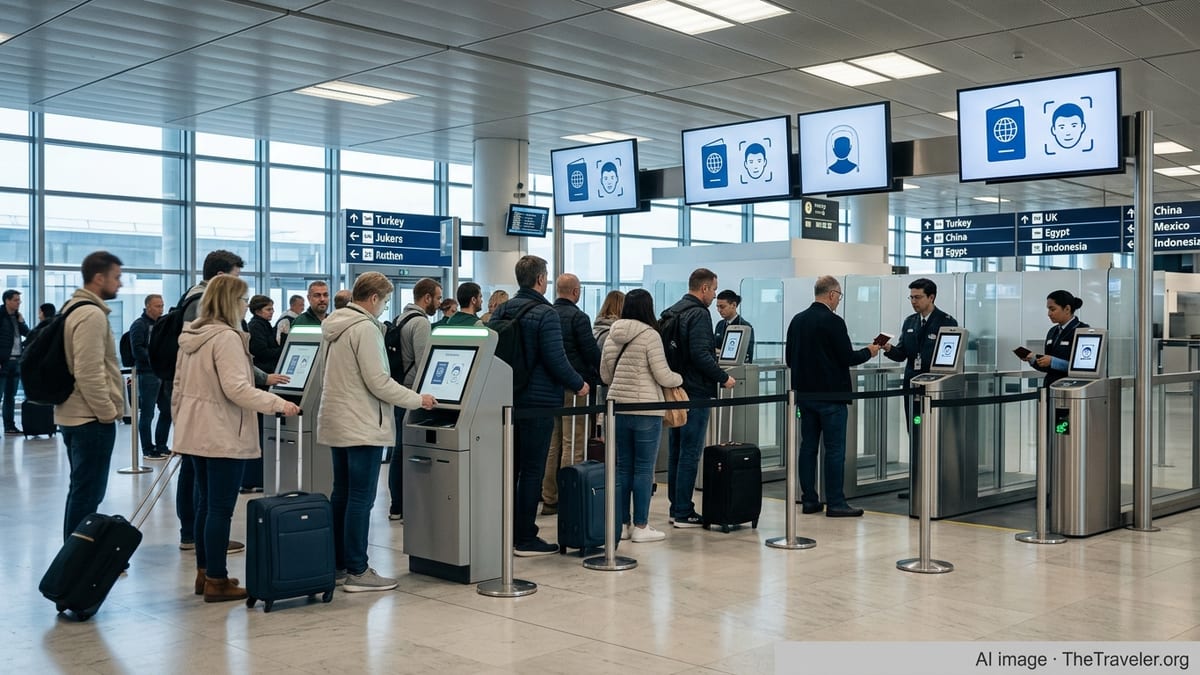
Biometric Border Rollout Collides With Peak Season
The EU’s Entry/Exit System, a long-planned biometric database for non-EU nationals entering and leaving the Schengen area, became operational at air borders in April 2026 after a phased introduction that began in October 2025. The system replaces manual passport stamping with electronic registration, including facial or fingerprint biometrics and personal data captured at automated kiosks or traditional booths.
Publicly available information from EU agencies describes EES as a cornerstone of the bloc’s effort to tighten external border controls while modernising checks. Each time a non-EU visitor crosses an external Schengen border, their entry and exit are logged and matched against previous records, with the aim of spotting overstays and identity fraud more efficiently.
The change is significant because the first registration can take considerably longer than a routine passport stamp, especially for travellers unfamiliar with the process or arriving in large numbers. Aviation analysts have been warning for several years that if the system came fully online just as summer demand peaks, even small increases in processing times could translate into very long queues at crowded hubs.
That scenario is now beginning to play out at airports across Europe, just as outbound travel from markets such as the United Kingdom, the Gulf and North America ramps up for the main holiday season.
IATA Flags Risk of Serious Disruption
The International Air Transport Association has put EES near the top of its risk radar for the 2026 northern summer, warning that the combination of biometric enrollment and already stretched border infrastructure could trigger severe congestion. Public remarks from IATA’s European leadership this week highlighted concerns that, without additional staffing and flexibility, new checks could undermine the recovery of air travel in the region.
Industry presentations around IATA’s annual meeting point to a pattern already emerging at some gateways: longer border-control transaction times, bottlenecks at first-entry airports for connecting passengers, and confusion when travellers are unsure whether they have been registered previously in the system. In the most affected terminals, reports indicate that queues at peak periods are stretching well beyond pre-EES norms.
IATA has repeatedly argued that while digital border systems can ultimately streamline travel, the short-term reality is more complex. The association is urging European institutions and national governments to use every available contingency tool, including temporarily relaxing EES obligations where necessary, to prevent breakdowns during the busiest weeks of July and August.
Several aviation groups have also warned that unmanaged disruption could damage Europe’s competitiveness as a long-haul destination, if travellers decide to connect via non-Schengen hubs perceived as less congested.
Evidence of Longer Queues Across Key Markets
Data gathered by airport groups and consumer-rights organisations since spring 2026 indicate that EES-related delays are already significant at a broad range of European airports. Reports from airports in at least 15 EU countries describe waiting times at border control rising noticeably since the system went live, with some hub and leisure airports recording queues of two to three hours during busy periods.
Travel-industry coverage from several countries points to particular strain at major tourist gateways in Spain, France, Italy and Greece, where summer arrivals from the United Kingdom and other non-EU markets are heavily concentrated. In some cases, local authorities and airport operators have advised non-EU passengers to arrive significantly earlier than before for outbound flights, anticipating knock-on effects from inbound congestion and staff redeployments.
Consumer-facing travel services monitoring disruption across Europe have likewise documented spikes in missed connections and delayed departures linked to prolonged border procedures since mid-April. While not all of these events can be attributed solely to EES, the pattern has strengthened arguments from airlines and airports that the system is adding pressure to operations that were already running close to capacity.
National police forces and border agencies remain responsible for staffing passport control, and capacity varies widely between countries and individual airports. Industry bodies argue that where resources are tight, the added complexity of biometric checks makes it harder to recover from even short-lived surges in arrival volumes.
Airlines and Airports Push for Flexibility
Well before full activation of EES, airline and airport associations across Europe called for a cautious approach, warning that processing-time increases of even 30 to 70 percent could prove unmanageable at the height of summer. Joint letters from Airports Council International Europe, Airlines for Europe and IATA urged the European Commission to allow member states to partially suspend or scale back use of the new system if queues began to escalate.
Those appeals have grown louder in recent months as real-world experience has replaced modelling. Statements from airport groups suggest that some terminals are already deploying workarounds, such as limiting use of kiosks when they slow the flow of passengers, or shifting more staff to manual booths during peak arrival waves.
Several national industry associations have also pressed for what they describe as “flexibility mechanisms” that would let border authorities temporarily revert to simpler checks at short notice. They argue that a clear legal and operational framework for pausing or modifying EES obligations would help prevent ad hoc decisions at individual airports, reducing uncertainty for airlines and travellers.
So far, European institutions have maintained that EES is essential to modern border management but have acknowledged the need for close monitoring and additional support for the most affected airports. The coming weeks are likely to test how far that flexibility can stretch if bottlenecks intensify.
What Summer Travelers Should Expect
For passengers planning trips to the Schengen area this summer, the most immediate impact of EES is likely to be at the first EU airport they encounter, whether or not it is their final destination. Non-EU travellers who have not previously been enrolled in the system can expect to provide fingerprints or facial images, as well as confirm personal and travel details, before their passport is cleared.
This initial registration is expected to be the slowest step, with later trips through the same border expected to be faster because the traveller will already be in the database. However, industry observers caution that widespread summer travel by first-time visitors, including many who last flew to Europe before the pandemic, means a large share of passengers will be new to the system in 2026.
Airports and airlines are urging customers to allow extra time for border formalities, particularly at popular holiday gateways and during peak arrival windows on Fridays, weekends and school-holiday dates. Travellers connecting onward within Europe may face tighter margins to make their next flight if inbound border queues are longer than expected.
At the same time, border authorities and airport operators across the region are racing to refine their procedures, adjust layouts and add staff where possible before the busiest weeks of the season. How successfully they can adapt will determine whether IATA’s warnings of severe disruption materialise as widespread chaos, or remain confined to a series of localised flashpoints during the first summer of Europe’s new biometric border era.