


Milan Malpensa (MXP) is the main international gateway to northern Italy, and for many travelers it can feel busy and confusing after a long flight. This guide walks you step by step through what happens after landing, from clearing passport control and collecting your bags to finding SIM cards, ATMs, trains, buses, taxis and onward connections into Milan and beyond. The aim is to help you land with confidence, avoid common pitfalls, and choose the best option for your budget, schedule and travel style.
Get the latest updates straight to your inbox!
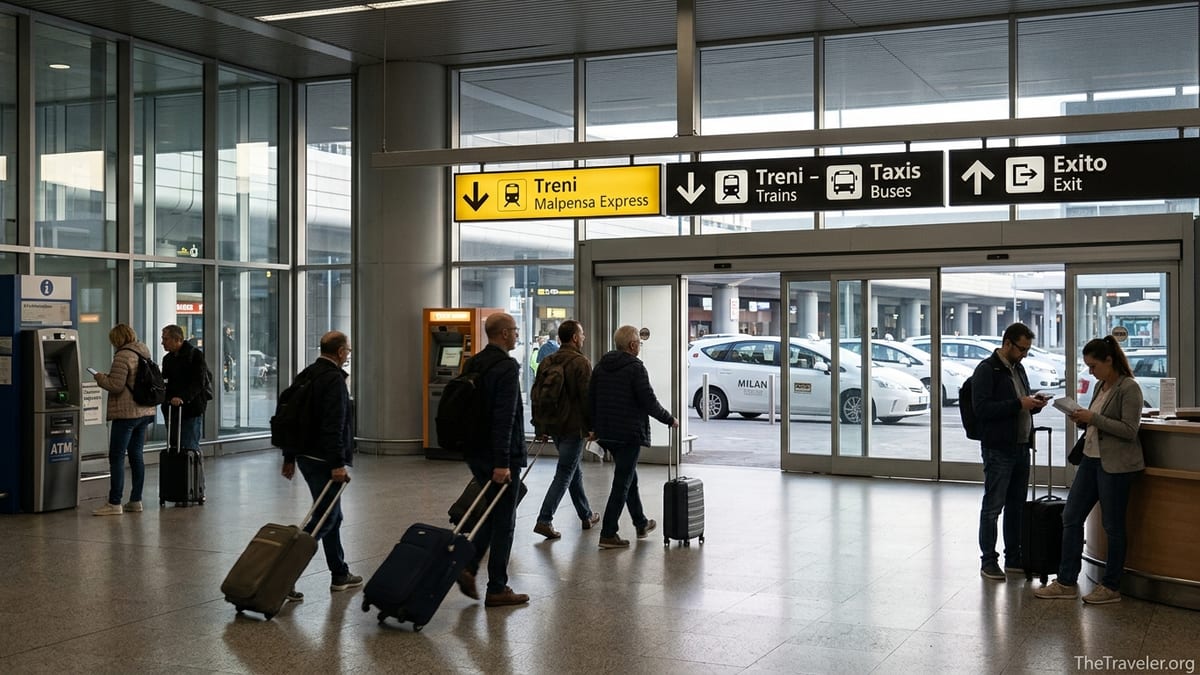
Understanding Malpensa’s Layout and What Happens After Landing
Most long haul international flights arrive at Terminal 1, the main and more modern terminal at Milan Malpensa. Terminal 2 is smaller and used primarily by low cost and leisure carriers. Both terminals have similar arrival flows, but the largest range of services, including the main train station, is in Terminal 1. When the aircraft doors open, you may walk directly into the terminal via a jet bridge or board a shuttle bus from a remote stand, especially at peak times.
Inside the terminal, the first thing you see is a set of overhead signs in Italian and English pointing you toward “Baggage claim / Ritiro bagagli” and “Exit / Uscita.” International flights will also show “Passport control / Controllo passaporti.” You do not need to rush: immigration and baggage claim can take time, especially in the morning when many transatlantic flights arrive, so assume around 45 to 90 minutes from landing to exiting into the arrivals hall, and avoid booking trains or onward tickets too tightly.
If you are connecting onward by air on a single ticket, follow the “Transfer / Transiti” signs instead of exiting. However, many budget and regional connections to other Italian cities depart from Milan’s central railway stations rather than from Malpensa itself. In that case, plan to exit the secure area, pick up your luggage and use the train or bus to reach Milano Centrale, Milano Cadorna or other city stations.
For orientation, the arrivals level at Terminal 1 is on the ground floor, while the Malpensa Express train station sits one level below, on floor -1, accessible by escalators and elevators within the terminal. Bus stops and taxi ranks are just outside the arrivals exits. Knowing that everything is stacked vertically around the arrivals level makes navigating much less stressful once you step into the public area.
Clearing Passport Control and Customs
After leaving the aircraft, passengers from non Schengen destinations queue for passport control. European Union, EEA and Swiss citizens will see separate lines marked “EU / EEA / CH,” while all other nationalities join the “All passports / Tutti i passaporti” line. Automated e‑gates are often available for eligible travelers with biometric passports, which can significantly speed up the process during busy periods, but staffing levels and queues still vary by time of day and season.
Immigration officers typically ask standard questions about your purpose of visit, length of stay and accommodation. Have your passport, any required visa, and a copy of your accommodation details ready. If you are heading straight to another city such as Florence or Venice by train, it is useful to know the name of your first night’s hotel and city, even if you do not stay in Milan itself.
After passport control you walk straight into the baggage reclaim hall. Customs at Malpensa is usually low key for arriving travelers. Once you have collected your luggage, follow signs toward the green channel marked “Nothing to declare / Nulla da dichiarare” if you are not carrying restricted goods. Officers conduct spot checks, but most passengers simply walk through to the public arrivals area. If you are carrying items that exceed duty free allowances or restricted goods such as large amounts of cash, you will need to use the red channel and make a declaration.
Because Malpensa is one of Italy’s main hubs, expect queues at passport control at peak times, particularly early morning arrivals from North America and late morning flights from Asia. If you plan to buy a non refundable train ticket or book a car service, build in at least two hours from scheduled landing time to reaching the arrivals hall to allow for delays at the border and baggage belts.
Baggage Claim, Lost Luggage and First Essentials
In the baggage hall, large overhead screens list flights and the corresponding belt numbers. Look for your flight number and origin city, for example “MXP from New York JFK,” then head to the indicated carousel. Trolleys are free and widely available, which is helpful if you are dealing with heavy suitcases after a long haul flight. While you wait, this is a good moment to visit nearby restrooms and refill a water bottle at a drinking fountain if available, as the next stage of your journey may involve a longer walk to the train station or bus stop.
If your bags do not appear after the carousel stops, go directly to the lost luggage or baggage assistance desk near the carousels. These desks are run by ground handling companies on behalf of airlines. You will be asked for your passport, your boarding pass and the baggage tag number stuck to it. Staff will give you a reference report and explain how and where the bag will be delivered, usually to your hotel or local address in Italy. If you are continuing swiftly to another city such as Bologna or Verona, provide that address and a mobile phone number that works in Italy.
Once you exit through customs, you are in the public arrivals hall. Here you will find information desks for the airport operator, airline offices, car rental counters and the first essential services such as ATMs, currency exchange booths and convenience shops. A small café area and seating allow you to regroup, check messages using airport Wi Fi, and confirm the best transport option into Milan based on your arrival time, budget and destination.
Many travelers find it helpful to pause for ten minutes here, especially if arriving with children or older relatives. You can double check your hotel address, compare train and bus times, and decide whether you need to buy a local SIM card or if roaming on your existing plan is sufficient before heading downstairs or outside to the transport area.
Getting Cash, Using ATMs and Buying a SIM or eSIM
In the arrivals hall at Terminal 1 you will see several ATMs from Italian banks and international providers. Using an ATM to withdraw euros is usually more cost effective than exchanging cash at a bureau de change, although fees depend on your own bank. When using ATMs, decline any offer of “conversion” or “withdraw in your home currency.” Choose to be charged in euros so that your home bank applies its own, usually better, exchange rate. Withdraw a modest amount first, such as 100 to 150 euros, until you are familiar with your bank’s fees.
Credit and debit cards are widely accepted in Milan, and contactless payments via phone and smartwatch work on most public transport in the city, but you will still want some cash for small cafés, tips or rural areas if you are traveling beyond Milan. ATMs in the official arrivals area are safer than those in isolated corners of the car park, so it is better to withdraw money before leaving the terminal building.
If you need local mobile data, you have three realistic options on arrival. First, if your phone supports eSIM, you can purchase an Italy or Europe eSIM in advance from well known providers and activate it as soon as you land, using the airport’s Wi Fi. Many travelers choose this route to avoid queues and language barriers. Second, you can rely on international roaming from your home provider; this is convenient but can be expensive for heavy data use, so check your plan before departure. Third, you can buy a physical Italian SIM from brands such as TIM, Vodafone, WindTre or iliad.
Dedicated mobile operator stores and multi brand phone shops are clustered mainly in the departures level at Malpensa, but you occasionally find kiosks or vending style machines accessible from the public area, especially in Terminal 1. Staff can help you choose prepaid plans that typically include several dozen gigabytes of data for a fixed monthly fee. Be prepared to show your passport, as Italian regulations require ID for SIM activation. Activation times vary; in many cases your SIM will work within minutes, but it is wise to assume up to an hour before full service, especially for cheaper plans.
Reaching the Malpensa Express Train and Other Rail Connections
The Malpensa Express train is the fastest and most predictable way to reach central Milan from the airport. The dedicated station for Terminal 1 is directly connected to the arrivals and departures levels via escalators and elevators down to floor -1. Clear signs labeled “Trains / Treni” guide you from the arrivals hall to the ticket machines and platforms. Trains run frequently, typically every 15 to 30 minutes, and serve key city stations such as Milano Centrale and Milano Cadorna in around 50 minutes.
Tickets for the Malpensa Express cost roughly 15 euros for a one way adult journey to Milano Centrale, with small discounts sometimes available for children or round trips. You can buy tickets from touch screen machines in the station area using cards or cash, at staffed ticket counters during operating hours, or via official apps. The price does not usually change based on purchase time, so there is no financial advantage to buying weeks in advance. Many experienced travelers prefer to buy once they are in the station, which avoids the stress of missing a specific departure after a delayed flight.
Onboard, trains are modern and comfortable, with luggage racks near the doors and above seats, and a mix of table and airline style seating. There is no reserved seating; you simply sit where you like. If you are heading to other Italian cities, Milano Centrale is usually the best terminus because it connects directly to high speed Frecciarossa and Italo services as well as regional trains. For example, you might land at Malpensa in the morning, take the Malpensa Express to Centrale, then continue by high speed train to Florence, Rome or Venice on the same day.
If you are arriving at Terminal 2, the Malpensa Express has its own station a short walk from the arrivals hall via a covered walkway. All airport trains call at both Terminal 2 and Terminal 1. If you land at Terminal 2 but your onward transport or rental car is at Terminal 1, the frequent train or airport shuttle buses between terminals are an easy way to transfer without going into the city.
Airport Buses, Coaches and When They Make Sense
Several bus companies operate direct services between Malpensa and Milan’s main railway stations. These include brands such as Terravision, Malpensa Shuttle and other coach operators that connect Terminal 1 and Terminal 2 with Milano Centrale, and in some cases with secondary stops like Milano Cadorna or metro hubs on the way into the city. Bus stops are located just outside the arrivals area, with clear signs and, increasingly, electronic boards showing the next departures.
Prices for these airport buses are typically around 10 euros for a one way adult ticket and about 16 euros for a return, valid for a flexible period such as several months. Because the bus runs on Milan’s motorways, journey time can range from about 50 minutes in light traffic to 70 or 80 minutes during rush hour or if there are roadworks. Many services operate from early morning until late at night, often with departures every 20 to 30 minutes, which is reassuring if your flight is delayed.
Buses can be a good option if you are staying within walking distance of Milano Centrale and want to avoid changing levels in the airport to reach the train. They are also useful if you arrive very late or during periods when rail services are partially disrupted, for example overnight engineering works. Tickets can usually be purchased at staffed kiosks in the arrivals hall, from self service machines near the bus stops, or directly from the driver, though buying ahead online sometimes guarantees a seat at peak times.
If you have significant luggage or mobility concerns, note that coaches generally have large underfloor luggage compartments and a few steps to climb when boarding. Staff will load your bigger suitcases into the hold and you keep small bags or valuables with you inside. For travelers heading directly to other airports or cities, some regional coach lines connect Malpensa to Bergamo, Monza and other towns, where you can transfer to local buses or trains for onward journeys.
Taxis, Ride Services and Private Transfers
The official taxi rank at Malpensa is just outside the arrivals exits. Licensed Milan taxis are white, with a roof sign and an official license number on the side. Fares into central Milan operate on a regulated fixed price for airport rides, which is designed to provide clarity and protect visitors from overcharging. Expect to pay a flat fee that is higher than the train or bus but still reasonable when shared between three or four passengers with luggage, especially late at night or after a very long journey.
In ordinary traffic, a taxi from Malpensa to central Milan takes around 45 to 60 minutes. Travel times can rise during weekday rush hours or in bad weather. Most taxis accept card payments, but it is still wise to confirm this with the driver before starting the journey. Give the driver the exact name and address of your hotel or apartment, ideally written down, as some smaller streets and boutique hotels can be hard to pronounce for first time visitors.
Pre booked private transfers are another option, particularly attractive for families, groups with several large suitcases or travelers arriving late at night who simply want someone waiting with a sign in the arrivals hall. Many companies offer door to door transfers in standard sedans, minivans or larger vehicles for set prices depending on distance. While these services are usually more expensive than a standard taxi, they remove uncertainty and can be cost effective for groups splitting the fare.
App based ride services and local chauffeur companies also operate in the Milan area, though they may not be allowed to pick up directly at the terminal in the same way as regular taxis. Often you will need to meet your driver in a designated parking area a short walk from the exits. If you plan to use an app, ensure your phone has data coverage or pre download maps and instructions before leaving home, because the arrivals hall can be busy and noisy when you are trying to coordinate a meeting point.
Planning Onward Travel Throughout Italy
Many visitors use Malpensa as a starting point for wider trips across northern Italy, from the lakes region to the Ligurian coast. The most common pattern is to travel first to Milano Centrale by Malpensa Express or airport bus, then transfer to a national or regional train. From Centrale, frequent trains head north to Lake Como, east to Verona, Venice and the Dolomites, and south to Bologna, Florence, Rome and Naples.
If you have pre purchased high speed rail tickets, allow generous time between your scheduled landing at Malpensa and your departing train from Milano Centrale. Flight delays, long queues at passport control and slow baggage delivery can quickly eat into your connection time. Many experienced travelers leave a margin of at least three to four hours between landing and an important rail connection, especially if it is non refundable.
For the Italian lakes, you might take the Malpensa Express to Milano Cadorna, then change to a regional train to Como Nord Lago, which drops you right by the lakefront. For Lake Maggiore and towns such as Stresa, regional trains depart from Milano Centrale or from smaller stations reachable by commuter rail. If your accommodation is in a smaller town without a direct rail connection, you may combine a train to the nearest city with a local bus or taxi.
Car rental is available at Malpensa’s terminals and can be convenient if you plan to explore rural areas or several lakes in one trip. Rental desks are signposted in the arrivals hall. Collecting a car directly at the airport saves carrying luggage through city stations, but driving into central Milan itself involves restricted traffic zones and expensive parking. Many travelers therefore stay car free while in Milan and only rent later from city locations or at regional hubs.
The Takeaway
Arriving at Milan Malpensa does not have to be daunting. Once you know the sequence passport control, baggage claim, basic essentials like cash and connectivity, and then a clear choice between train, bus, taxi or private transfer the airport becomes surprisingly manageable. Terminal 1 in particular is compact and logically laid out, with the train station one level below arrivals and buses and taxis right outside.
For most visitors heading into the city, the Malpensa Express train to Milano Centrale or Cadorna offers the best balance of speed, predictability and cost. Airport buses provide a useful alternative, particularly late at night or when you want a direct link to Milano Centrale without changing levels. Taxis and private transfers are the simplest, though most expensive, choices and work especially well for groups, families or those with heavy luggage.
Whichever option you choose, building in a comfortable time buffer after landing, carrying your accommodation details and having at least one working payment method card plus some euros will smooth your arrival. With a little preparation, your first steps through Malpensa can set exactly the relaxed, confident tone you want for your time in Milan and the rest of Italy.
FAQ
Q1. How long does it usually take to get from landing at Malpensa to central Milan?
In typical conditions, allow around two to three hours from scheduled landing to reaching central Milan. That includes 45 to 90 minutes for immigration and baggage claim, then about 50 minutes on the Malpensa Express train or roughly an hour by bus or taxi, plus time to buy tickets and walk to the station or stop.
Q2. Is the Malpensa Express train better than the bus to Milano Centrale?
The Malpensa Express train is generally faster and more predictable because it avoids traffic, reaching Milano Centrale or Cadorna in roughly 50 minutes for around 15 euros. Buses are slightly cheaper, at about 10 euros, and can be convenient if you prefer a direct coach to Milano Centrale, but journey times vary more with traffic.
Q3. Do I need to buy Malpensa Express tickets in advance?
No. The fare is usually fixed, so there is no price advantage to buying weeks ahead. Many travelers purchase tickets from machines or counters in the station area after landing, which avoids stress if your flight is delayed. Trains run frequently, so you rarely have to wait long for the next departure.
Q4. Where can I find ATMs and should I exchange cash at the airport?
ATMs from major banks are located in the arrivals hall at Terminal 1 and Terminal 2. Withdrawing euros from an ATM is usually better value than using currency exchange desks, but fees depend on your bank. Always choose to be charged in euros rather than your home currency when the ATM offers “conversion.”
Q5. Can I buy a local SIM card at Malpensa Airport?
Yes, you can usually buy Italian SIM cards from operators such as TIM, Vodafone, WindTre or iliad at shops or kiosks in the terminal, especially around the departures level. However, many travelers now prefer to activate an eSIM before arrival or rely on pre arranged roaming, which can be easier than queuing at a store right after landing.
Q6. Are taxis from Malpensa to Milan safe and how much do they cost?
Licensed Milan taxis from the official airport rank are generally safe and reliable. They operate with a regulated flat fare for rides into central Milan, which is higher than the train or bus but often reasonable when shared. Always use the official taxi queue outside arrivals and avoid unlicensed drivers who approach you inside the terminal.
Q7. What is the best option if my flight arrives very late at night?
If you land late at night, check the last Malpensa Express departures for your date, as evening services may be less frequent. Airport buses often run later than trains, and taxis or pre booked private transfers are available around the clock. For very late arrivals, a taxi or pre arranged transfer to your hotel can be the most straightforward choice.
Q8. How do I reach other cities like Florence or Venice from Malpensa?
The usual route is to take the Malpensa Express train or an airport bus to Milano Centrale and then transfer to a high speed train. From Centrale, frequent Frecciarossa and Italo services connect to Florence, Bologna, Rome, Naples, Verona and Venice. Allow several hours between your flight’s scheduled arrival and your long distance train, especially if the rail ticket is non refundable.
Q9. Is it easy to connect from Malpensa to the Italian lakes?
Yes. For Lake Como, many travelers take the Malpensa Express to Milano Cadorna, then a regional train to Como. For Lake Maggiore, trains from Milano Centrale and other city stations serve towns along the lake. Depending on your final destination, you may combine a train with a short local bus or ferry ride.
Q10. Should I rent a car at Malpensa or wait until I reach the city?
If you plan to explore rural areas or multiple lakes, collecting a rental car at Malpensa can be convenient and avoids carrying luggage through city stations. However, driving and parking in central Milan can be stressful and expensive, and certain areas are restricted to residents. Many visitors stay car free while in Milan and only rent a vehicle later from city branches or regional towns.