

More news on this day
India’s air links to West Asia have been severely disrupted as publicly available data shows Indian carriers have cancelled more than 10,000 flights since the latest conflict in the region began on February 28, throwing travel plans into disarray and deepening financial pressure on airlines already grappling with detours and higher fuel costs.
Get the latest news straight to your inbox!
Sharp Cut in India–West Asia Connectivity
Reports from multiple Indian business and aviation outlets indicate that more than 10,000 flights operated by Indian carriers on routes connecting India with West Asia have been cancelled since late February. The tally has built up over just a few weeks of hostilities, reflecting how quickly geopolitical tensions can unravel one of India’s busiest international corridors, particularly links to the Gulf.
The cancellations span a network that normally carries millions of Indian migrant workers, business travelers and tourists each year. Routes to major hubs including Dubai, Abu Dhabi, Doha, Muscat and other Gulf cities have been particularly affected, as airspace closures and military activity have forced carriers to ground services entirely on some sectors and sharply curtail frequencies on others.
Published coverage notes that the conflict, triggered by a confrontation involving the United States, Israel and Iran, prompted airspace closures or tight restrictions in several West Asian states. That has not only suspended some point-to-point links, such as services to Israel, but has also complicated access to traditional overflight corridors used to reach the broader Middle East and beyond.
India’s Ministry of Civil Aviation has framed safety as the overriding priority, with airlines rerouting or cancelling flights where necessary. However, the scale of disruption shows how exposed India’s aviation sector is to instability in West Asia, given the region’s role as both a destination in its own right and a critical bridge between India, Europe and Africa.
Airlines Face Higher Costs, Longer Routes and Fuel Surcharges
For flights that continue to operate, carriers have had to adopt longer, more circuitous routes to avoid sensitive airspace. Publicly available flight-tracking data and industry analysis show that services linking Indian cities with the Gulf and onward to Europe are flying extended trajectories that add hundreds of nautical miles to some journeys.
Longer flying times translate directly into higher fuel burn, increased crew costs and tighter aircraft utilization. Business media reports highlight that the combination of the West Asia conflict and ongoing closure of Pakistani airspace to Indian airlines has created a double bind, removing traditional shortcuts both westward over Pakistan and across parts of the Middle East.
To partially offset higher operating expenses, major Indian carriers have introduced or increased international fuel surcharges on West Asia and other long-haul routes. Coverage in Indian financial newspapers notes that Air India, for example, has raised surcharges after aviation turbine fuel prices for international operations more than doubled in the current environment.
Despite these measures, analysts cited in recent reporting suggest that airlines are unlikely to fully recover their additional costs. Competitive pressures on fares, especially in price-sensitive Gulf markets, limit the scope for passing on increases, leaving carriers to absorb a significant portion of the financial impact even as they deal with capacity losses from outright cancellations.
Passengers Confront Disruptions, Rebookings and Fare Volatility
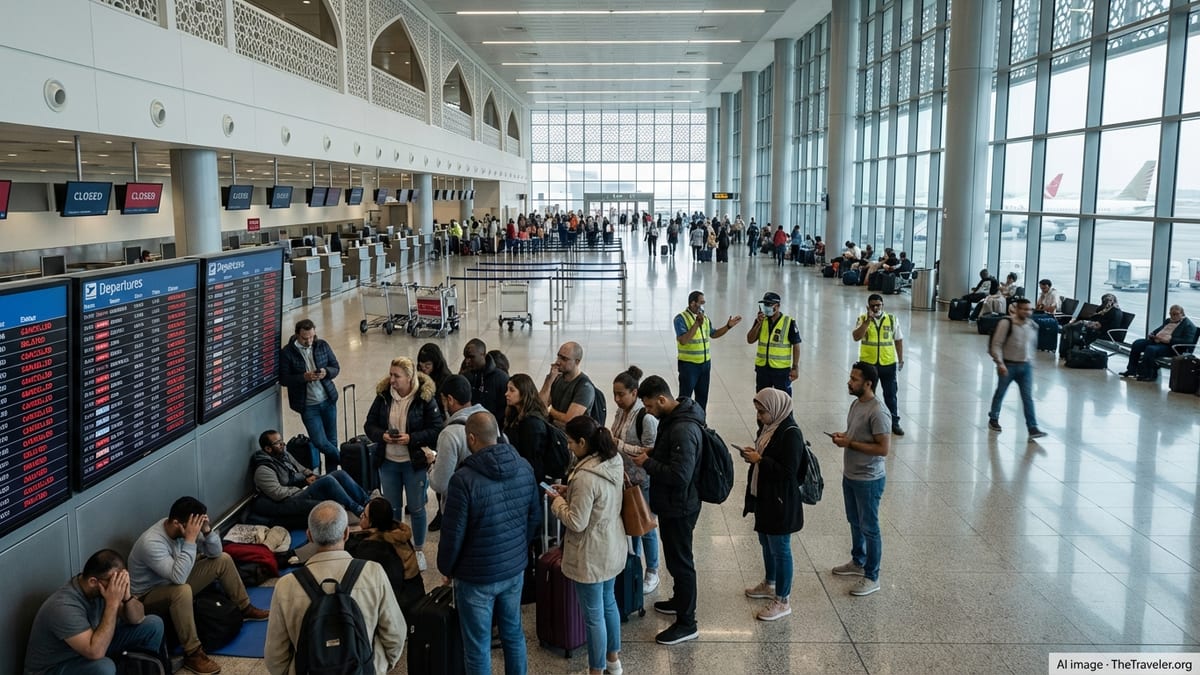
For travelers, the cancellation of more than 10,000 India–West Asia flights has translated into missed connections, extended layovers and last-minute itinerary changes. News coverage from the past month describes thousands of passengers stranded at hubs such as Dubai, Abu Dhabi and Doha on peak disruption days, particularly when regional airports briefly halted operations or diverted large numbers of flights.
Indian government updates and airline advisories have urged passengers to closely monitor flight status, often recommending that travelers check directly with carriers before proceeding to airports. In some instances, special recovery flights have been mounted between India and Gulf destinations to clear backlogs and return stranded passengers, but capacity has remained tight on several high-demand routes.
Alongside availability issues, travelers are confronting significant fare volatility. As airlines cut frequencies and reroute aircraft, the number of seats offered on popular India–Gulf city pairs has fluctuated, with reduced supply contributing to higher prices on many dates. Travel agents quoted across Indian media have reported sharp spikes in last-minute fares, especially from smaller Indian cities that rely on one-stop connections via Gulf hubs.
Some passengers have opted to postpone nonessential travel or switch to alternative routings via Southeast Asia or Europe where available, often at higher cost and with longer journey times. Others, particularly migrant workers traveling on fixed schedules, have had little choice but to pay elevated fares or endure multi-stop itineraries stitched together across several airlines.
Regulatory Moves and Operational Flexibility
As flight disruptions mounted, publicly accessible regulatory notices show that India’s aviation regulator, the Directorate General of Civil Aviation, introduced temporary relaxations in flight duty time limitations for pilots operating long-haul services to and from western sectors. The stated intent is to give airlines additional flexibility to manage crews on extended routings created by airspace closures.
These short-term relaxations are framed as a response to extraordinary circumstances, with authorities signaling that they are time-bound and subject to ongoing review. Aviation safety specialists cited in media discussions have emphasized the need to balance operational flexibility with rigorous oversight of crew fatigue, particularly when flights are consistently operating near the upper limits of permissible duty times.
In parallel, India’s civil aviation ministry has highlighted broader efforts to stabilize the sector, including monitoring airfare trends and aviation turbine fuel prices. Earlier government interventions to moderate fuel cost pass-through on domestic routes have been referenced in recent commentary as a factor helping to keep internal Indian fares more stable than some international sectors affected by the conflict.
Industry observers note that the episode underscores the importance of resilient contingency planning, including diversified routing options, flexible crew scheduling frameworks and clear communication protocols with passengers when large-scale disruptions occur.
Economic Ripple Effects for India and the Gulf
The India–West Asia air corridor is not only a major passenger market but also a crucial conduit for remittances, trade and tourism. Millions of Indian nationals work in Gulf economies, and regular, affordable air links underpin the flow of labor and income between the regions. Prolonged cancellations and higher fares risk weighing on these movements, at least in the short term.
Business press analysis points to potential pressure on sectors ranging from hospitality and retail in Indian cities that host outbound Gulf workers, to aviation-dependent services in Gulf hubs that rely on Indian traffic. Cargo operations have also faced disruptions as airlines juggle limited capacity and shifting routings, affecting the timely movement of high-value goods and perishables.
For Indian carriers, the conflict has arrived at a sensitive moment in the industry’s recovery and expansion cycle. Several airlines are inducting new aircraft and opening long-haul routes, counting on robust demand between India, West Asia and onward markets in Europe and North America. The loss of more than 10,000 flights and the added burden of extended routings threaten to dent near-term profitability and slow network growth plans.
Analysts caution, however, that demand fundamentals remain strong, and that once airspace restrictions ease, connectivity between India and West Asia is likely to rebound quickly. The scale of the current disruption has nonetheless reinforced how central geopolitical stability in West Asia is to the smooth functioning of India’s international aviation network, and how rapidly turbulence in one region can cascade across global travel patterns.