


More news on this day
On a 12-hour long-haul flight, Singapore Airlines’ first class aims to turn the grind of ultra-distance travel into a curated hotel-in-the-sky experience, combining unusually spacious seating with high-end dining, attentive service and a level of quiet many travelers rarely encounter at 35,000 feet.
Get the latest news straight to your inbox!
A Small, Private Cabin at the Front of the Jet
Singapore Airlines operates two distinct first class products on long-haul routes: enclosed Suites on the Airbus A380 and a more traditional open-seat first class on the Boeing 777-300ER. Recent fleet information and route maps indicate that many 10 to 13 hour flights, including key services between Europe and Asia, are operated by the 777, where just four first class seats sit in a single row at the very front of the aircraft.
In practice, that layout creates a surprisingly private environment. With only one row, there is no through-traffic from other passengers, and the cabin feels more like a secluded lounge than part of a 300-plus-seat jet. The 1-2-1 configuration means solo travelers in the window seats have direct aisle access, while those in the center can raise a divider to create a cocooned space.
The seat itself is notably wide, clad in leather and framed by a curved shell that provides additional seclusion. Aviation reviewers who have flown the 777 first class product describe it as closer to a mini-suite than a conventional armchair, with space to stretch legs into an ottoman, multiple storage compartments and a large entertainment screen. During a 12-hour overnight sector, that sense of space is one of the first signs that this cabin is meant for lingering, not just transiting.
One trade-off compared with the A380 Suites is the lack of a fully enclosed door and the separate swivel chair and bed combination. However, travellers who prioritize intimacy and a quieter cabin often point out that having only four passengers, rather than six Suites, can feel even more exclusive on certain routes.
From Champagne Welcome to Dine-on-Demand
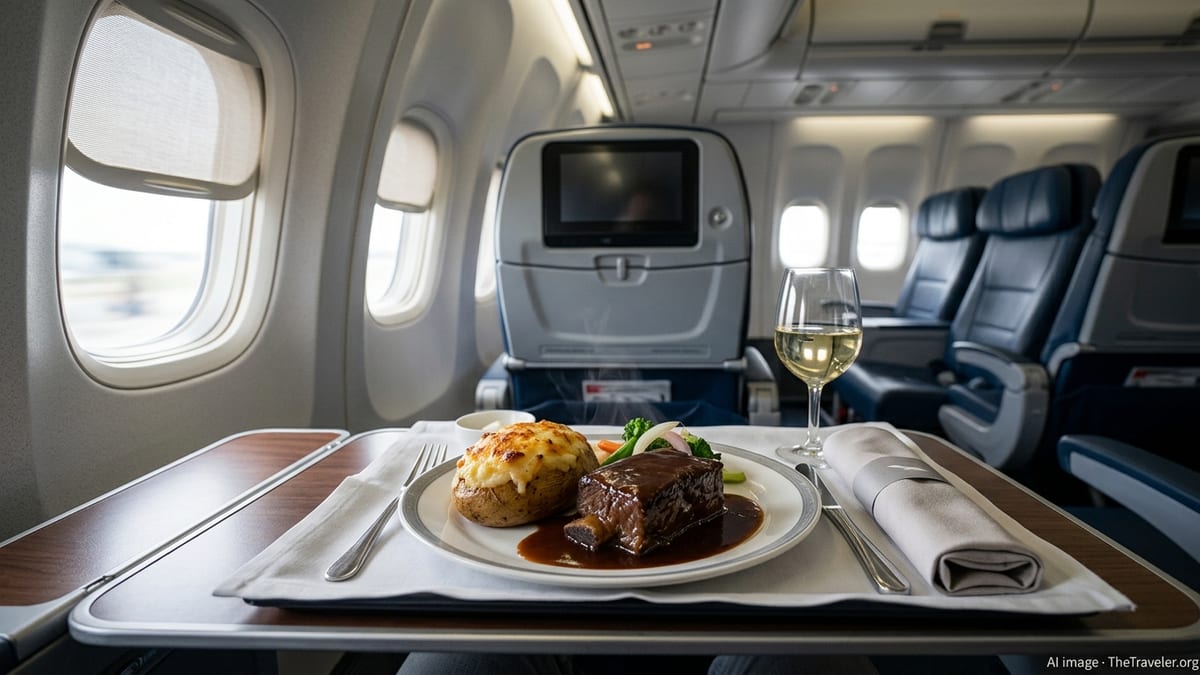
Once settled, the experience quickly shifts to food and drink. Publicly available menus and trip reports show that Singapore Airlines leans heavily into its culinary reputation in first class, starting with a choice of prestige champagne and, on many routes, caviar. Cabin crew set tables with linen, china and metal cutlery, recreating a restaurant-like setting at the seat.
On a 12-hour flight, this typically translates into several distinct meal services or a dine-on-demand approach. Travelers can pre-select main courses before departure using the carrier’s “Book the Cook” system on many routes, choosing from dishes such as lobster, regional curries or Western classics. Reports indicate that first class passengers often combine this pre-ordered main with on-board appetizers and desserts to tailor the timing and pacing of meals to their own sleep schedule.
The quality of execution tends to be a point of differentiation. Reviews of recent flights highlight carefully plated courses, warmed breads and consistent temperature control even on mid-flight snack orders. Garlic bread, a seemingly modest item, has taken on near-cult status among frequent flyers, appearing as a recurring detail in many accounts of the first class service.
For those using the flight as an extension of a workday, the steady but unobtrusive service rhythm also matters. Reports suggest cabin crew check in proactively but not intrusively, adjusting lighting, refilling drinks and clearing tables in a way that aims to maintain the calm atmosphere that first class buyers expect.
Turning the Seat into a Bedroom at 35,000 Feet
For an ultra-long sector, the true test comes when the cabin transitions from dining room to bedroom. On the 777-300ER, the first class seat flips over to form a separate, fully flat bed, topped with a mattress pad, duvet and large pillows. While this requires crew assistance to convert, travellers often describe the result as more like a proper bed than a reclined seat.
Across multiple reviews, the bed is routinely praised for its width and firmness, with enough room to sleep on one’s side without feeling constrained. During a 12-hour flight, that can allow for a full night’s rest, especially when combined with the low passenger count and the airline’s focus on dimmed lighting and quiet in the forward cabin.
Amenity kits, high-thread-count bedding and sleepwear on some routes reinforce the hotel analogy. Lavatories in the first class section are generally larger than those in the rest of the aircraft, with additional counter space and premium toiletries, although they stop short of the shower suites offered by some Gulf carriers on the A380.
No matter how refined, turbulence, time-zone changes and the inherent constraints of an aircraft still apply. Yet many travellers emerging from a 12-hour first class journey on Singapore Airlines report feeling closer to “well-rested” than “jet-lagged,” a contrast that becomes more apparent to those familiar with economy or even business class on similar routes.
Comparing Value Against Business Class and Rivals
The question of whether first class is worth the price hinges on how it compares to both the airline’s own business class and competitors’ top cabins. Singapore Airlines has a strong business class product, with wide lie-flat seats, direct aisle access and high service standards, which narrows the gap for many travellers. In cash terms, first class can cost several times more than business class on the same flight, particularly when demand is strong on popular routes.
Recent guides to premium cabins note that the biggest differentiators in first class tend to be space, privacy and personalized service. On the 777, that means a larger seat and bed, a more intimate cabin and a higher crew-to-passenger ratio. On the A380, the Suites product adds a separate bed, more floor space and, in some configurations, the ability to create a double suite for couples, placing it among the most luxurious commercial cabins currently flying.
Against Gulf and European rivals, Singapore Airlines’ first class is often positioned as less overtly flashy but more understated and consistent. There is no onboard shower or bar, but many travellers highlight the refinement of the soft product and the reliability of service standards as strengths on multi-leg journeys. Lounge access at the airline’s hub, including its private first class facilities at Singapore Changi Airport, also factors into the overall journey for those connecting on long-haul routes.
For passengers using points and miles, the equation can look different. Award space in first class is limited and highly sought after, but when redeemed at favorable rates, many frequent flyers argue that a once-in-a-lifetime 12-hour experience in Singapore Airlines first class becomes one of the most compelling uses of loyalty currencies.
Is a 12-Hour Singapore Airlines First Class Flight Worth It?
Whether the experience justifies its premium price ultimately depends on a traveler’s priorities. For those who value uninterrupted sleep, restaurant-quality dining and a near-private-cabin feel on an overnight long-haul, Singapore Airlines first class delivers a package that is difficult to match. The limited number of seats, especially on the 777, creates a sense of exclusivity that even some more elaborate products struggle to replicate.
Travellers who are primarily focused on reaching their destination rested and on time, and who are comfortable with a slightly denser cabin, may find the airline’s business class a more rational choice. In that cabin, lie-flat beds, strong service and solid food already exceed what many competitors offer, and the incremental gains of first class can feel more emotional than practical.
On balance, the 12-hour journey in Singapore Airlines first class is less about extravagant gimmicks and more about consistent, well-executed details: a cabin that feels like a sanctuary, expertly paced meals, a genuinely comfortable bed and attentive, polished service. For those willing to pay a significant premium, or able to secure a favorable mileage redemption, it stands out as one of the more rewarding ways to cross continents in a single night.