


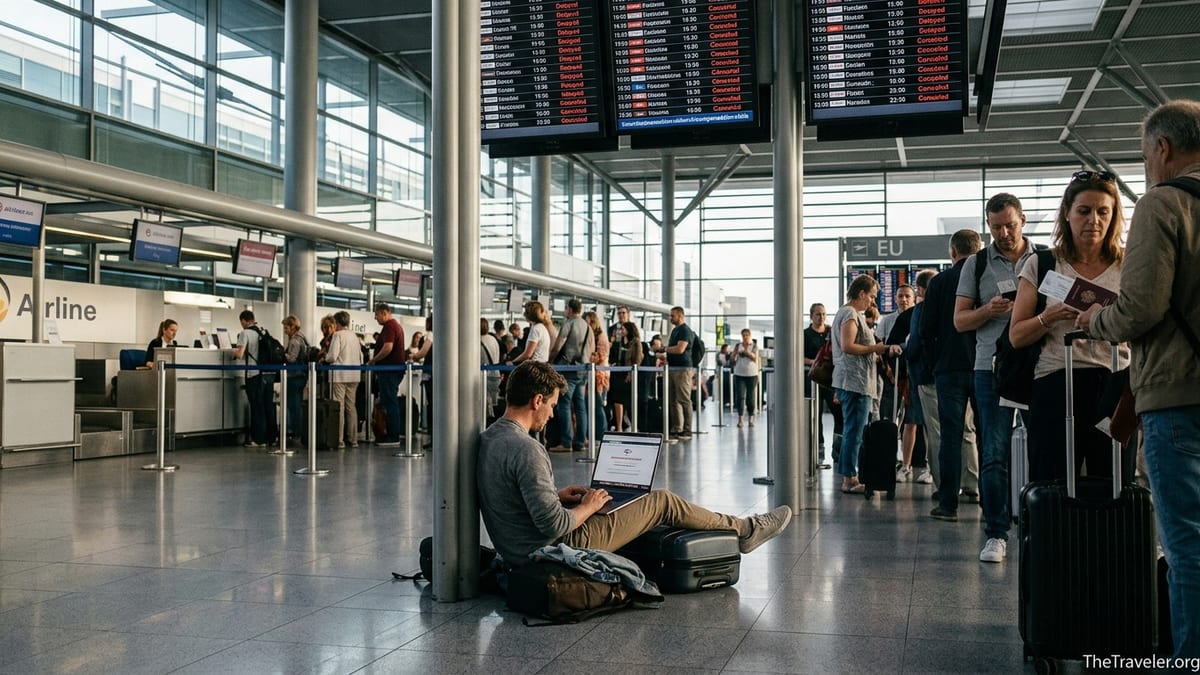
You have just stumbled off a severely delayed flight, your connection is gone, and the airline counter line is a mile long. Somewhere in the mess of emails and app notifications, an ad pops up promising up to 600 euros in compensation if you “let the experts handle it.” One of the names that increasingly appears in these moments is Compensair. But is it actually worth using after a flight disruption, or are you better off going directly to the airline or choosing a different service?
Get the latest updates straight to your inbox!
What Compensair Actually Does
Compensair is a flight compensation company that helps passengers claim money from airlines after disruptions such as long delays, cancellations, denied boarding because of overbooking, or missed connections on a single ticket. It focuses heavily on routes covered by passenger rights laws like EU Regulation 261/2004, UK261, and in some cases similar regimes in countries such as Turkey and Canada. In practice, that means your delayed Barcelona to Berlin flight on a European carrier or a missed connection in Frankfurt on your way from New York to Rome is the kind of case Compensair is built to handle.
The process is designed to be simple from a traveler’s perspective. You visit the Compensair site, enter your flight number and date into an eligibility checker, and answer a few questions about what happened: how long the delay was, whether you were rebooked, and what the airline told you. If the system believes you have a valid claim, you upload boarding passes and ID, sign a mandate authorizing Compensair to act on your behalf, and then wait while the company chases the airline for compensation.
For a typical eligible EU261 case, that might mean a potential payout of 250 to 600 euros per person depending on distance and delay length. A family of four stuck overnight in Lisbon after a canceled Lisbon to Paris flight, for example, could collectively be owed 2,400 euros in compensation, plus a refund or rerouting obligations that the airline must handle separately. Compensair’s role is to secure the compensation portion and transfer it to you after deducting its fee.
Crucially, Compensair works on a no win, no fee model. You pay nothing upfront; if the airline refuses to pay and the case is closed as unsuccessful, you are not billed. If the airline pays, Compensair keeps a percentage of the compensation as its service fee and sends the rest to your bank account.
How Fees Work and What You Really Take Home
Compensair’s business model is similar to other flight compensation companies: it keeps a substantial share of any money recovered. Public reviews and consumer sites indicate that Compensair typically charges around 25 to 30 percent of the compensation amount, sometimes including VAT where applicable. In real terms, that means if you are awarded 400 euros for a delayed Madrid to London flight, you might receive around 280 euros after Compensair’s fee. In higher-value cases, such as a 600 euro long-haul delay, your net payout might be closer to 420 euros.
Travelers often only feel this trade-off when they compare the outcome to going direct. Under EU261, for instance, a passenger delayed more than three hours on a Paris to Helsinki flight of over 1,500 kilometers might be owed 400 euros per person. If that passenger files the claim themselves through the airline’s online form and wins, they receive the full 400 euros. Using Compensair for the same claim could reduce the take-home amount to roughly 280 to 300 euros, depending on the exact fee percentage used at the time.
It is also important to understand how fees can evolve if a case becomes more complicated. While Compensair markets itself as a single percentage, some competitors charge a higher rate if the matter has to go to court. Other compensation firms, for example, publish fee tables where standard cases cost around 30 to 35 percent, but litigated cases can push effective costs to near 50 percent once legal surcharges and VAT are added. Even when Compensair does not explicitly advertise a higher litigation fee, travelers should read their contract carefully to see whether additional legal or administrative charges might apply if your airline digs in and refuses to pay.
For many travelers, that trade of time and complexity for a 30 percent cut feels acceptable, especially for a one-off claim where they are busy or intimidated by legal language. For others, especially frequent flyers or people comfortable with forms, losing a third of a 600 euro payout can feel like paying a steep premium for convenience.
Real-World Experiences: Success Stories and Red Flags
Reviews of Compensair are mixed, and real-world stories highlight both the benefits and the risks of outsourcing your claim. On the positive side, there are numerous accounts from travelers who received significant payouts with minimal effort. One Reddit user in early 2026 described how Compensair helped them secure around 600 euros after a canceled flight, noting that the process was straightforward: they uploaded documents, signed the mandate, waited several months while Compensair corresponded with the airline, and then had the money wired to their account. For someone who did not know where to start with EU261 law, the fee felt like a reasonable price for a successful outcome.
Another example, drawn from public review platforms, comes from an Irish traveler whose connecting flight was canceled, causing them to miss a long-planned trip. They reported that after roughly six months of back-and-forth handled entirely by Compensair, they finally received their compensation. While half a year is a long time, it is not unusual for more complex claims, especially when airlines contest liability or cite “extraordinary circumstances” such as bad weather or strikes. In this case, patience combined with Compensair’s persistence delivered money that might otherwise have required formal complaints to regulators or even court filings.
At the same time, there are troubling reports that raise questions about reliability and transparency. Some recent reviews describe situations where an airline reportedly confirmed payment to Compensair, but the traveler waited many months without seeing their share of the money, receiving only template responses about “ongoing legal actions.” In at least one public complaint, a passenger claimed that British Airways had sent more than 600 euros in compensation to Compensair, yet the payout to the traveler was delayed for over four months while the company allegedly created accounts in their name that the passenger could not access. Cases like this are still anecdotal, but they underline how much control you hand over when you authorize an intermediary to receive compensation on your behalf.
Other negative reviews focus on slow communication, vague updates, and difficulty obtaining clear timelines once a case drags on. One family affected by a British Airways cancellation described how three members of the group received their payouts through Compensair while a fourth was left waiting for months with inconsistent explanations. Scenarios like this do not mean every claim will go badly, but they reinforce the importance of reading the terms carefully and understanding that once Compensair becomes your representative, the airline will usually route all compensation and communication through the company, not directly to you.
How Compensair Compares to Rivals and Going Direct
Compensair operates in a crowded field. Well-known competitors include AirHelp, Flightright, AirAdvisor, and several regional specialists. Many of these companies focus on the same legal frameworks and disruption types, but they differ in fees, geographic coverage, and willingness to escalate claims. AirHelp, for example, often charges around 35 percent of compensation as a standard success fee and positions itself as a global brand with a large app-based ecosystem. Flightright, based in Germany, is known for aggressively taking airlines to court in tough EU cases, sometimes at total effective fee levels that rival or exceed 35 percent when legal surcharges are factored in.
Independent comparison sites that regularly review flight compensation firms typically highlight AirHelp for its global reach and polished interface, Flightright for its strong litigation record in Europe, and AirAdvisor or similar services for relatively transparent pricing. Compensair is often portrayed as a smaller or mid-sized player with decent coverage in Europe and parts of the Middle East, but not necessarily the broadest footprint or deepest legal bench. For a straightforward EU261 case, like a three-hour-plus delay on a Brussels to Rome flight operated by a European carrier, many of these companies can likely achieve similar outcomes: they either convince the airline to pay or they do not.
The more meaningful comparison is between using any compensation company and going direct to the airline. European Regulation 261 and its UK equivalent were created for passengers to use themselves. On most major airlines operating within or from the EU and UK, you can file a compensation request directly via an online form, attaching boarding passes, proof of delay, and any relevant correspondence. Some carriers, such as Lufthansa, British Airways, and Air France, also accept written letters or emails outlining your claim. If the airline rejects your request, you can escalate to national enforcement bodies or alternative dispute resolution services at no cost beyond your time.
In many simple cases, that direct route works. A traveler whose Paris to Barcelona flight was delayed five hours by a crew scheduling problem might fill out the airline’s web form and receive 250 euros in their bank account within a few weeks. In more contentious cases, however, airlines may cite weather when conditions were clear, or describe internal problems such as crew shortages as “extraordinary circumstances” to avoid paying. At that point, pursuing regulators or small claims court can feel daunting, especially for non-residents. It is precisely these gray-area and escalated disputes where a specialist company, whether Compensair or a rival like Flightright, can add genuine value by knowing the case law, writing legal arguments, and taking the matter to court if needed.
When Using Compensair Makes Sense
Compensair can be worth using in several specific situations. First, it can be useful when you have a clearly eligible EU261 or UK261 case, but you are too busy or too uncomfortable with paperwork to pursue it yourself. Imagine a consultant who spends most weeks on the road between London and European capitals. After a canceled London to Frankfurt flight causes an overnight stay, they may technically be owed 250 or 400 euros, depending on distance, but have neither the time nor patience to fill forms, chase responses, and escalate complaints. For them, handing the case to Compensair and collecting 70 percent of whatever comes back can be a rational trade-off.
Second, Compensair can help when the airline stonewalls or denies liability and you are not inclined to argue. Consider a family flying from Warsaw to Lisbon on a vacation whose flight is severely delayed. The airline tells them the cause is “operational reasons” yet later claims it was related to air traffic control congestion. The family files a direct claim and gets a boilerplate denial. At that point, having a company that knows how to challenge the airline’s justification, request internal logs, or interpret court precedents can tip the balance in your favor. Even if the final amount is reduced by a 30 percent fee, it may be money you would never have recovered alone.
Third, Compensair can be beneficial in cross-border situations where language and legal systems feel unfamiliar. A traveler based in the United States who experiences a long delay on a Rome to Copenhagen flight might not know that EU261 applies or how to complain to a European regulator in Italian or Danish. By submitting the claim through Compensair, they transfer that complexity to a specialist. For occasional visitors to Europe or people who travel primarily for leisure, the peace of mind can be worth the cost.
Finally, Compensair’s no win, no fee structure can be attractive if you are unsure whether you have a case at all. A passenger who missed a connection in Amsterdam because of a tight schedule and confusing gate changes might not be certain whether EU261 covers their specific itinerary. Using Compensair’s free eligibility checker and letting them decide whether to pursue the claim avoids the risk of investing time into a hopeless complaint. The downside is that if the case is strong and they succeed, you will only see a share of the money.
When You Might Be Better Off Without Compensair
There are also clear situations where Compensair is likely not the best option. If your case is straightforward and you are comfortable filling out online forms, you can often secure the full compensation amount by dealing directly with the airline. Common examples include a three- to four-hour delay on a relatively short-haul EU flight caused by a technical issue, or a cancellation notified with less than 14 days’ notice where the airline admits fault. In many such cases, travelers who submit well-documented claims through airline websites report receiving payments in a matter of weeks.
You may also wish to avoid Compensair if you are particularly concerned about transparency and control over your money. Because compensation usually flows from the airline to the company first, you rely on Compensair to promptly and accurately forward your share. The negative accounts described earlier of long delays between airline payout and customer payment, even if they represent a minority of cases, illustrate the risk of intermediation. If you prefer to have compensation paid directly into your own bank account from the airline, submitting your claim personally is the only way to guarantee that chain.
Travelers who are attentive to contract details should also think carefully about any clauses that limit their ability to pursue independent claims later. Some flight compensation companies require you to agree not to contact the airline yourself or accept alternative payments once you sign up, and may reserve the right to pursue you for their fee if you later receive compensation through other channels. Before using Compensair, you should read its terms to see whether similar restrictions apply. If they do, you must be comfortable effectively handing over control of the claim until it is resolved or abandoned.
Finally, Compensair is not a magic solution in countries with weaker passenger rights laws, such as domestic flights within the United States. While it promotes services related to regulations in regions like Europe and Canada, it cannot manufacture compensation where none is legally required. For example, if your Dallas to Miami flight on a US carrier is delayed five hours because of maintenance, you may receive meal vouchers or miles as a customer service gesture, but there is no equivalent of EU261 cash compensation for pure delay. Using Compensair or any similar service for such flights is unlikely to yield a payout.
Practical Tips If You Decide to Use Compensair
If you conclude that Compensair is worth trying for your situation, a few practical steps can improve your chances of a smooth experience. First, keep meticulous records from the moment disruption occurs: photos of departure boards, screenshots of airline app notifications, copies of rebooking emails, and receipts for expenses like food and hotels. The more documentation you provide, the easier it is for Compensair to prove the length and cause of the delay and to counter airline claims of extraordinary circumstances.
Second, read every clause of the mandate you sign with Compensair. Pay particular attention to the fee percentage, whether it changes if the case goes to court, how long the company may hold funds before remitting them, and what happens if you decide to withdraw your claim or pursue it independently. If there is a cooling-off period, as some competitors provide, note the deadline so you can change your mind if new information emerges, such as the airline suddenly offering a direct payout.
Third, set expectations for timing. While some travelers report receiving compensation in as little as a few weeks, many claims take months, especially when airlines are slow to respond or contest fault. If Compensair tells you that legal escalation is required, understand that the process can stretch to a year or more in some jurisdictions. Frequent status updates and clear explanations are signs of a healthy relationship; templated, repetitive responses with no detail may indicate it is time to press harder for information.
Finally, compare Compensair with at least one or two other firms before you commit. Even a quick scan of competitor sites can show you how their fees differ and whether they provide additional guarantees, such as no extra charge for court proceedings or a published average payout time. While you should avoid entering full personal details with multiple providers, you can often learn enough from public fee tables and independent review roundups to decide whether Compensair offers a fair balance of cost, speed, and support for your specific route and airline.
The Takeaway
Compensair is a legitimate player in the flight compensation market that can help passengers unlock money they might otherwise leave on the table after disruptive flights, particularly within Europe and other regions with strong passenger rights laws. Its biggest advantages are convenience, legal expertise, and a no win, no fee structure that minimizes financial risk for travelers who are unsure about their rights or unwilling to navigate airline bureaucracy alone.
At the same time, the service is not without drawbacks. The combination of relatively high fees, occasional complaints about communication and delayed payouts, and the loss of direct control over your claim means Compensair is not automatically the best choice for every traveler. Those comfortable with forms and willing to invest some effort often do better filing claims directly with airlines and, if needed, escalating to regulators, keeping 100 percent of the compensation owed.
In deciding whether Compensair is worth using after your next flight disruption, the key questions are how much you value convenience over cash, how complex your case appears to be, and how comfortable you feel dealing with cross-border consumer rights. For a simple, high-value EU261 claim where you have the time and confidence to push the airline yourself, Compensair’s fee may be hard to justify. For a contentious or confusing case, especially across languages and jurisdictions, paying a portion of your payout to let a specialist fight on your behalf can be a reasonable and even satisfying choice.
FAQ
Q1. Is Compensair a legitimate company for flight compensation claims?
Compensair operates as a legitimate flight compensation service that pursues claims under regulations like EU261 and UK261, but traveler reviews show a mix of success stories and concerns about communication and payout delays, so it is important to research recent feedback before using it.
Q2. How much does Compensair charge if my claim is successful?
Compensair typically works on a no win, no fee basis and keeps a percentage of any compensation it recovers, often around 25 to 30 percent, though you should check the exact rate and any potential extras in your contract.
Q3. How long does it usually take to get money through Compensair?
Timelines vary widely; some travelers report payouts within a few weeks for straightforward cases, while more complex or disputed claims can take many months and occasionally more than a year, especially if legal action is required.
Q4. Can I still contact the airline myself after submitting a case to Compensair?
Once you sign a mandate authorizing Compensair to act on your behalf, the airline will generally communicate and pay compensation only through the company, and some contracts limit your ability to negotiate separately, so you should read the terms carefully before signing.
Q5. Is Compensair better than going directly to the airline?
For simple, clearly eligible cases, going directly to the airline is often better because you keep 100 percent of any compensation, while Compensair can be more helpful in complex or contested situations where you value expert help more than maximizing the payout.
Q6. Does Compensair handle flight problems outside Europe, like US domestic delays?
Compensair focuses on jurisdictions with strong passenger rights laws such as the EU, UK, and some other regions, but it cannot create compensation where local regulations do not provide cash rights, for example on most purely domestic US flights.
Q7. What documents do I need to file a claim with Compensair?
You should expect to provide your booking confirmation, boarding passes if available, identification details, and any evidence of the disruption such as airline emails, delay notifications, or receipts for hotels and meals.
Q8. What happens if the airline already paid me and Compensair also claims a fee?
If you have signed a contract with Compensair and later receive compensation directly from the airline or another source, the company may still be entitled to its fee under the agreement, so it is important to disclose any payments and understand your obligations before signing.
Q9. Can I cancel my case with Compensair if I change my mind?
Your ability to cancel depends on the specific terms you agreed to; some services allow a short cooling-off period, while others may charge a fee or restrict cancellation once work has started, so you should review the cancellation section of your contract.
Q10. How does Compensair compare to competitors like AirHelp or Flightright?
Compared with rivals, Compensair is typically seen as a smaller player with similar fee levels; AirHelp emphasizes global coverage and a polished app, while Flightright is noted for strong litigation in Europe, so the best choice depends on your route, airline, and preference for price versus legal firepower.