


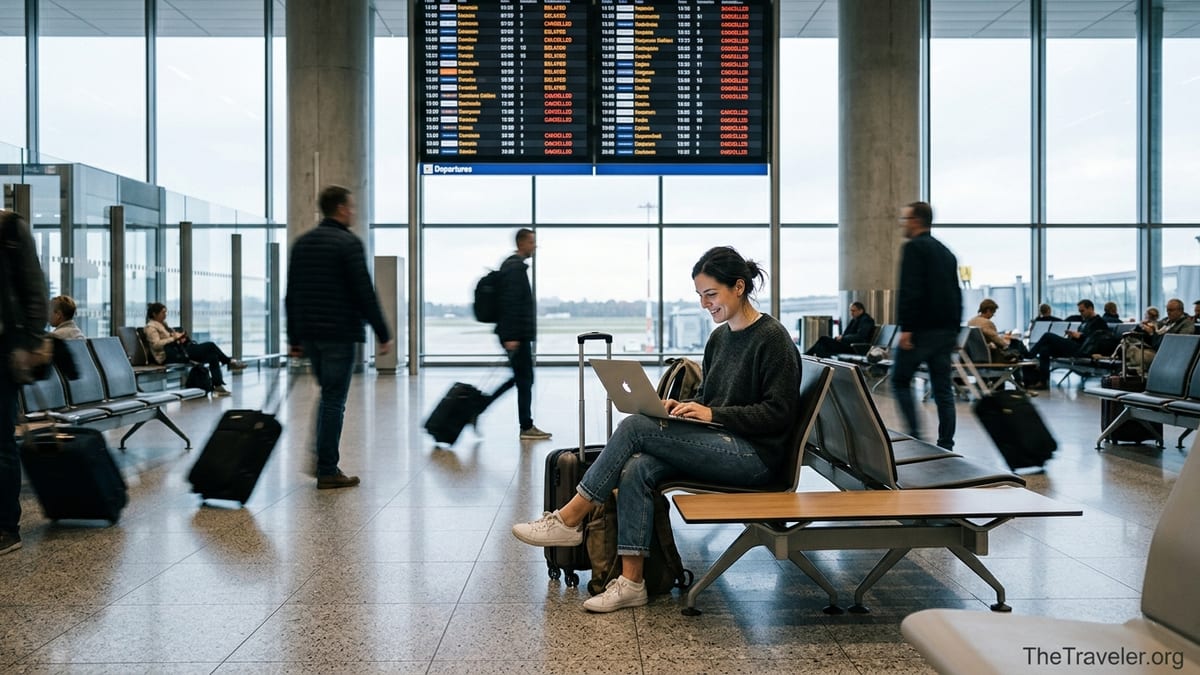
My breaking point came at 1:40 a.m. in a fluorescent-lit arrivals hall in Frankfurt. Our New York flight had been cancelled three hours after boarding, the rebooking line snaked around the terminal, and a harassed gate agent pressed a hotel voucher into my hand with a weary apology. I knew, vaguely, that European law might entitle us to compensation, but the idea of wrestling with airline forms, legal jargon, and months of follow-up sounded like a second trip nobody wanted. I resigned myself to shrugging it off. It was only later, when a friend mentioned he had claimed 600 euros per person through a service called Compensair, that I realised I was on the verge of leaving serious money on the table.
Get the latest updates straight to your inbox!
Why Airline Compensation Feels Impossible Until You Need It
If you have ever tried to read the fine print on an airline ticket, you know why most travellers give up on compensation before they begin. Flight delay and cancellation rules are an alphabet soup of policies: EU261 in Europe, UK261 in Britain, the Montreal Convention internationally, and various national consumer laws layered on top. Airlines rarely explain these rights clearly at the airport. The result is that many passengers assume compensation is a kind gesture, not a legal obligation.
The reality is quite different. Under EU Regulation 261/2004, for example, many passengers whose flights to or from Europe arrive at least three hours late, are cancelled at short notice, or are denied boarding due to overbooking are legally entitled to fixed cash compensation of roughly 250 to 600 euros per person, depending on distance and route. That means a family of four could be owed around 1,000 to 2,400 euros for a single ruined trip, regardless of what they originally paid for their tickets.
Despite that, industry analyses suggest only a small share of eligible passengers ever claim what they are owed. Airlines know this. A common pattern is an apologetic email offering miles, a voucher or a modest refund of fees, with no mention of the higher statutory compensation. Claiming your full rights usually means navigating web forms, waiting weeks for replies, and sometimes escalating complaints to national enforcement bodies or small claims courts. For occasional travellers, that process can feel overwhelming.
That was exactly my mindset as I looked at my cancelled flight from Frankfurt to New York. I had the boarding passes, the delay notices in my inbox and the hotel receipt, but no appetite for a months-long paper chase in a foreign language with an airline that, frankly, hoped I would forget about it. It was easier to grumble and move on, until I discovered there were companies whose entire business is doing that chase on your behalf.
How Compensation Really Works on European Flights
To understand what services like Compensair actually do, it helps to grasp the basics of EU261, the European regulation that underpins most of their cases. In simple terms, EU261 applies if your flight departs from an airport in the European Union, Iceland, Norway or Switzerland on any airline, or if you fly into one of those countries on an airline based there. It covers long delays at arrival, cancellations, and denied boarding due to overbooking when the cause is within the airline’s control, such as technical problems, crew shortages or operational mismanagement.
Compensation amounts are fixed by law and tied to distance, not ticket price. In practice, that usually means around 250 euros for short flights under about 1,500 kilometres, about 400 euros for medium-haul trips within Europe or up to roughly 3,500 kilometres, and about 600 euros for long-haul flights over that distance, such as New York to Paris or Los Angeles to London. The key threshold is delay on arrival: if you reach your final destination three hours or more late after a disruption that is the airline’s fault, you may qualify, even if your departure was only marginally delayed.
Real-world examples help make this concrete. A couple flying a low-cost airline from Barcelona to London on a Friday evening might pay 60 euros each for their tickets. If a technical fault keeps them on the ground and they ultimately arrive in London more than three hours late, EU261 can entitle each of them to about 250 euros, or roughly eight times the fare. On a longer route, such as Toronto to Rome on an Italian carrier with departure from the EU side, a family of four facing a significant delay could be looking at around 600 euros per person. In other words, a single disrupted trip can rival the cost of an entire future holiday if you follow through on the claim.
There are important exceptions. Airlines do not owe EU261 cash compensation when the disruption is caused by what the regulation calls extraordinary circumstances. That category includes things like severe weather, air traffic control restrictions, political unrest or unexpected runway closures. Even in those cases, however, airlines still owe passengers care such as meals, hotel rooms when necessary, and rebooking or refunds. The challenge for travellers is proving that a particular cancellation was within the airline’s control and not covered by the extraordinary circumstances defence, especially when the official explanation is vague.
Meet Compensair: A Middleman for Your Passenger Rights
Compensair is one of several companies that specialise in turning this complicated legal framework into a simple online service. Founded in the mid-2010s, it operates primarily in the European market, focusing on EU261 and similar passenger rights regimes. The model is straightforward: instead of you chasing the airline, Compensair evaluates your case, files claims in your name, negotiates with airlines and, if necessary, coordinates legal follow-up. In return, it takes a commission from any compensation actually paid.
From a traveller’s perspective, the process typically begins with entering your flight details on Compensair’s website: departure and arrival airports, dates, airline and booking reference if you have it. Behind the scenes, the company cross-checks that information against historical flight status data. If your flight arrived more than three hours late or was cancelled under conditions covered by EU261, the system flags your case as potentially eligible and invites you to submit supporting documents such as boarding passes and delay notifications.
Once you sign a limited power of attorney allowing Compensair to represent you in dealings with the airline, the company takes over. It sends formal claims letters, monitors deadlines and pushes back on initial denials by citing the regulation and case law. In practical terms, that might mean arguing that a “technical problem” was not extraordinary but a routine operational issue, or providing evidence that other flights operated on time in the same weather. For travellers who are not lawyers and do not speak the airline’s home language, that expertise can make a meaningful difference.
Compensair is far from the only player in this space. Other names, such as AirHelp, ClaimCompass and Skycop, run similar models and have been around for years. What caught my attention with Compensair was its focus on automation and a relatively low barrier to entry: filling in the initial form takes only a few minutes, and for many people, that convenience is the tipping point between claiming and giving up.
What It Is Like to Use Compensair in Practice
To see how the process feels from the inside, consider a real-life example that closely mirrors my Frankfurt ordeal. In spring this year, a traveller flying from Lisbon to Berlin via Frankfurt saw their first leg depart late due to a crew scheduling problem. They missed their connection and were rebooked to a flight the next morning, arriving in Berlin more than nine hours behind schedule. The airline provided a hotel room and meal vouchers but made no mention of cash compensation under EU261.
A few days later, back home, the traveller entered the flight numbers and dates into Compensair’s form. The system recognised that the flights departed from the European Union and that the missed connection caused an arrival delay well over three hours. It estimated potential compensation of around 400 euros because the overall distance from Lisbon to Berlin fell in the medium-haul band. After uploading boarding passes and accepting the commission terms, the traveller left the rest to Compensair.
Over the next couple of months, updates trickled in by email. The airline initially argued that the disruption was caused by air traffic control restrictions, which would have qualified as extraordinary circumstances. Compensair responded with flight data showing that other flights on the same route operated on time and that the recorded reason for the delay in the airline’s own system was crew-related. Eventually, the airline agreed to pay approximately 400 euros in statutory compensation.
From the traveller’s standpoint, the outcome was almost entirely passive. They never drafted a legal argument, never chased customer service by phone, and never read a word of the regulation itself. When the money finally arrived in Compensair’s account, the company deducted its agreed commission, typically in the range of 25 to 35 percent plus applicable VAT depending on jurisdiction, then forwarded the remainder to the traveller’s bank. Instead of 400 euros, the traveller received something closer to 260 to 300 euros. For them, that trade-off felt entirely worth it, especially compared to letting the airline keep the full amount.
The Pros and Cons of Letting a Service Fight for You
Using a company like Compensair is not the only way to claim compensation, and it is not the right choice for everyone. The main benefit is clear: you swap time, effort and uncertainty for simplicity and a clear percentage fee. If you are not confident in writing formal complaints, do not have the patience for repeated follow-ups, or are dealing with an airline based in a different legal system or language, outsourcing the process can turn a distant possibility into an almost automatic win whenever you are eligible.
That convenience comes at a cost. If you feel comfortable handling paperwork and have the time to pursue a claim yourself, going directly to the airline keeps every euro in your pocket. Many national enforcement bodies, particularly in Europe, also provide sample complaint letters and online forms in English. Travellers who fly frequently, or who have several high-value claims, may well find it worthwhile to invest a few hours in learning the basics of EU261 and filing on their own.
There is also an important trust element. By design, you grant Compensair authority to act in your name with airlines, and in some cases with partner law firms. Before you do that, it is worth reading the company’s terms of service carefully. Travellers on online forums have reported successful payouts through Compensair, but there are also occasional complaints about slow communication or disagreements over payout timelines. Because the company only earns money when you do, it typically has an incentive to push claims forward, but that does not mean every experience will be flawless.
In short, the question is not whether you can claim on your own, but whether you realistically will. For a solo traveller with one or two trips a year and limited free time, paying a cut of a 400 or 600 euro payout may be a reasonable price for having the entire unpleasant process handled by someone who does it daily.
When You Should Consider Handling the Claim Yourself
There are situations where going directly to the airline is both feasible and sensible. If your case is straightforward, the airline is based in your home country and you are comfortable communicating in its primary language, a simple written complaint can do the job. For example, imagine a London-based traveller whose Paris to London evening flight on a major European airline arrives four hours late due to a mechanical issue. The route clearly falls under EU and UK passenger rights rules, the delay is well over three hours, and the cause is plainly within the airline’s control.
In that scenario, the traveller could go to the airline’s website, find the customer relations or complaints section, and submit a claim referencing the regulation and requesting a specific amount based on distance. If the airline rejects the claim without a convincing explanation or fails to respond within a reasonable period, the traveller can forward the complaint to the relevant national enforcement body or, in some countries, to a recognised alternative dispute resolution scheme. Many passengers have successfully secured 250 or 400 euros per person this way without ever contacting a claims company.
The calculus shifts when complexity increases. If your itinerary involves multiple legs on different tickets, if the airline alleges extraordinary circumstances using technical language, or if months go by without any substantive response, the idea of third-party help becomes more attractive. This is where Compensair’s access to flight data, experience with airline internal codes and established relationships with partner law firms can make complicated cases more viable.
A hybrid approach is also possible. Some travellers first try a direct claim to the airline using simple templates freely available online. If that fails, they then turn to a service like Compensair, which in many cases accepts partially processed or previously rejected claims so long as there is still a realistic chance of success. This way you give yourself a chance to keep the full amount, while still having a backup plan.
How to Decide if Compensair Is Right for Your Situation
Ultimately, deciding whether to use Compensair comes down to three questions: eligibility, effort and expectations. First, you need to establish whether your flight is likely covered by EU261 or a similar regime. If you flew entirely outside Europe on a non-European airline, or your delay was clearly due to severe weather or air traffic control strikes, a claim service will not be able to conjure compensation where none is due. Compensair’s own online checker helps filter this out upfront, but it still pays to have realistic hopes.
Second, consider how much time and energy you are willing to invest. If you are juggling work, family and the normal chaos of modern life, the thought of navigating multi-page forms in a foreign language may be enough to make you abandon the claim entirely. In that case, handing everything over to a specialist for a commission may mean the difference between receiving a reduced payout and receiving nothing at all. For an economy passenger owed around 250 euros, even a 30 percent cut still leaves enough to cover a future weekend away or a few nights of accommodation.
Third, manage your expectations about timing. Even with Compensair or a similar service driving the process, airlines do not always pay quickly. Straightforward cases can sometimes resolve within a few weeks, but it is not unusual for complex claims to drag on for several months, especially if legal proceedings become necessary. What you gain is not speed but persistence: a company whose business model depends on following up relentlessly, long after a weary passenger might stop replying to emails.
As for my Frankfurt cancellation, the path I ended up taking was very similar to the Lisbon to Berlin example. Instead of shelving the idea, I ran my flights through a compensation checker, discovered that my long-haul itinerary clearly qualified for around 600 euros per person, and decided that in my case, paying a commission to avoid a paper battle in German was an entirely acceptable price.
The Takeaway
Most of us assume that claiming airline compensation will be a bureaucratic nightmare. Airlines, it must be said, do little to challenge that perception. Yet for travellers flying to or from Europe, the law is far more generous and clear-cut than many realise. Under EU261 and its British counterpart, a long delay or last-minute cancellation on an airline-controlled flight can be worth hundreds of euros per person, regardless of the original ticket price.
The barrier has never been the law itself but the energy required to enforce it. That is where services like Compensair come in. They do not create rights out of thin air, and they certainly are not free, but they lower the practical hurdles enough that many people finally claim what they were entitled to all along. For the exhausted family standing in a late-night rebooking queue, or the business traveller stranded between connections, that can be the difference between a bad memory and a partial silver lining when the money eventually lands in their account.
Whether you choose to pursue compensation on your own or let a specialist handle it, the key lesson is simple: do not assume it is pointless. Keep your boarding passes, note your actual arrival time and, once you are home, take a few minutes to check your eligibility. You might be surprised how often a supposedly minor delay is worth far more than the snack voucher you were offered at the gate.
FAQ
Q1. What kinds of flight problems can Compensair help with?
Compensair focuses mainly on delays of three hours or more at arrival, cancellations with short notice and denied boarding due to overbooking on flights covered by European or similar passenger rights rules, where the disruption was within the airline’s control.
Q2. How much money could I realistically get from a successful claim?
On flights covered by EU261, typical compensation ranges from about 250 euros for short routes to around 600 euros for long-haul trips, per person, depending on distance and route.
Q3. Does it matter how much I originally paid for my ticket?
No. Under EU261 and similar rules, compensation is based on flight distance and delay, not ticket price. A budget fare and a business class ticket on the same flight can qualify for the same amount.
Q4. What documents do I need before I contact Compensair?
It is helpful to have your booking confirmation or e-ticket, boarding passes if available, and any messages from the airline showing delay or cancellation details, including dates and times.
Q5. How long does the process usually take from claim to payout?
Timeframes vary widely. Some straightforward cases resolve in a few weeks, while more complex claims that involve disputes or legal follow-up can take several months before money reaches your account.
Q6. What happens if the airline says the delay was due to bad weather or other extraordinary circumstances?
If the disruption was genuinely caused by extraordinary circumstances such as severe weather or air traffic control restrictions, cash compensation under EU261 may not be owed, although the airline still owes care like meals and accommodation.
Q7. Do I have to pay Compensair if they do not win my case?
Compensair generally works on a success-based model, meaning its fee is charged only if compensation is actually paid by the airline, and comes as a percentage of the recovered amount.
Q8. Can I still use Compensair if I have already started a claim with the airline myself?
In many situations you can, as long as you have not signed a final settlement or accepted compensation that closes the case. Compensair will usually review your situation and decide whether it can still add value.
Q9. Is using Compensair better than claiming directly with the airline?
Neither option is universally better. Claiming directly lets you keep the full amount but demands more time and persistence, while using Compensair trades a portion of the payout for convenience and professional handling.
Q10. How do I know if my non-European flight might still qualify for compensation?
Eligibility depends on where your flight departed, which airline operated it and the applicable laws. Entering your route and dates into a compensation checker, such as the one Compensair offers, is a quick way to see if it is worth pursuing.