


Most travelers pass Sponza Palace on their way down Dubrovnik’s polished main street, pause for a quick photo of the graceful arcades, then hurry on toward the city walls or the harbor. That is a mistake. For anyone who wants to understand how Dubrovnik became one of the Mediterranean’s most remarkable city-states and how it has survived every crisis since, Sponza Palace is not a side sight. It is the missing piece that quietly makes the whole Old Town make sense.
Get the latest updates straight to your inbox!
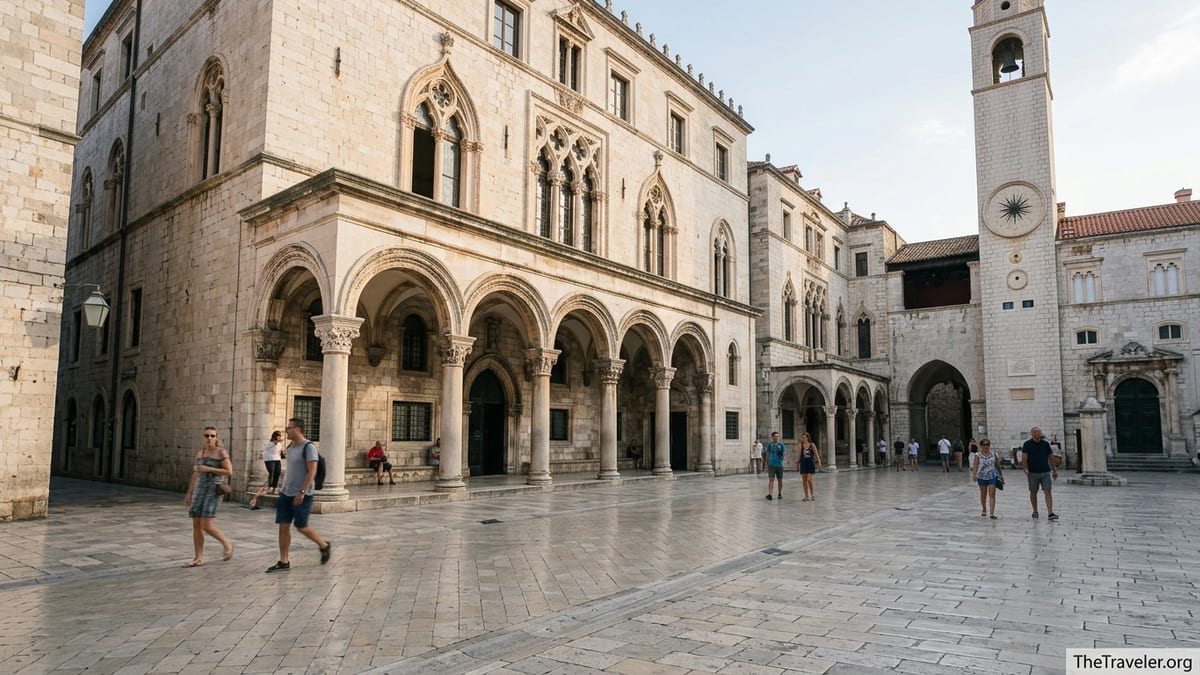
A Palace That Was Always About Real Life, Not Royalty
Unlike many European palaces, Sponza was never about kings and courtly ceremony. Built between 1516 and 1522 in a blend of late Gothic and early Renaissance styles, it was the working heart of the Republic of Ragusa, the maritime city-state that once rivaled Venice. Its original nickname, Divona, came from the word for customs. This was where goods were taxed, coins were minted, and the city’s wealth was counted, weighed, and protected.
Walk under the open loggia on Luža Square today and it is easy to imagine the scene in the 16th century: bales of wool from England stacked beside barrels of Balkan wine, sailors shouting in Italian and Croatian, and clerks carefully recording every transaction. A Latin inscription still carved into one of the arches roughly translates to “Our measures do not allow cheating; when I weigh goods, God weighs with me.” That one sentence captures how the republic tried to run trade on trust and strict rules, not brute power.
For modern visitors, this matters because Sponza turns Dubrovnik from a film-set backdrop into a living economic story. When you realize that this elegant building once housed the customs office, mint, armory, treasury, bank, and even a school, the Old Town stops feeling like a random collection of pretty stone buildings and starts to read like a compact blueprint of a functioning city-state.
Even if you are not a history buff, standing in that loggia and picturing chests of silver and rolls of silk arriving from all over the Mediterranean has a way of making your walk through the Stradun feel far more vivid and grounded in reality.
The Gothic–Renaissance Details You Actually Notice on the Street
Travelers often hear that Dubrovnik’s architecture blends Gothic, Renaissance, and Baroque, but it can feel abstract until you study Sponza up close. The palace is a textbook example of that transition, and because it faces a busy square rather than a narrow alley, you can see the details without straining your neck or fighting crowds pressed against a wall.
Look first at the lower loggia: slender columns, pointed arches, and delicate stone tracery with floral patterns speak the language of Gothic design. Above, the windows shift toward a more restrained Renaissance style, with cleaner lines and more regular proportions. Small carved figures and the statue of St Blaise, Dubrovnik’s patron saint, link the building not just to European art history but also to local identity that still shapes festivals and church processions today.
This architectural mix is not just an aesthetic detail. It reflects how Dubrovnik sat at a crossroads between Italian artistic trends and local craftsmen. If you have already visited Rector’s Palace a minute’s walk away, you will notice similar Gothic–Renaissance elements there, but Sponza’s open facade and rectangular, compact form make the contrasts easier to pick out even on a short stop.
In practice, this means Sponza is one of the best buildings in town for travelers who want to improve their eye for architecture without reading a textbook. Spend ten minutes here before you walk the streets, and you will start seeing familiar patterns on other palaces, churches, and even small doorways all over the Old Town.
The Rare Survivor That Explains Dubrovnik’s Earthquake Story
One of the most dramatic turning points in Dubrovnik’s past was the catastrophic earthquake of 1667, which destroyed much of the city, killed thousands of residents, and forced a huge rebuilding effort. Sponza is famous locally as one of the few major Renaissance buildings that survived essentially intact. That survival is not just a technical point for historians. It gives today’s visitor a rare before-and-after comparison in stone.
When you stand in Luža Square and look from Sponza to the nearby Baroque Church of St Blaise and other later facades, you are literally looking at two different Dubrovniks: the pre-earthquake republic and the city rebuilt afterward. Sponza’s carved balconies and tracery show you what more of the Old Town once looked like, while the heavier Baroque curves around it tell the story of adaptation and recovery.
This contrast explains why Sponza matters more than its size would suggest. Many cities along the Adriatic claim grand Baroque churches or defensive walls, but very few can show you a single civic building that both predates a major disaster and still sits in the center of public life. Because Sponza was spared, it became a vital reference point for later rebuilding, influencing proportions and details across the city.
For a traveler, this makes Sponza one of the best places to pause and think about how fragile historic cities really are. When you later walk the city walls or look back at the Old Town from a kayak or boat trip, you can pick out Sponza’s pale stone rectangle and understand that the skyline you see today is as much about survival and careful reconstruction as it is about medieval glory.
The State Archives: A Quiet Powerhouse Behind the Scenes
Inside Sponza today sits an institution most tourists never think about but that quietly underpins everything written about Dubrovnik: the State Archives. The archives hold hundreds of years of records, with documents reaching back to the 12th century and even earlier references to 1022. Those ledgers, letters, and contracts reveal everything from grain prices and shipping routes to diplomatic correspondence with distant courts.
Most visitors will not handle these fragile manuscripts, but knowing they are stored here changes the way you see the building. When a guide on a walking tour mentions that Dubrovnik once negotiated with the Ottoman Empire and the Papal States in the same week, or that it banned slavery long before many neighbors, the evidence for those claims sits just a few meters away behind secure doors in Sponza.
Occasionally, the archives support small public exhibitions, such as displays of old maps, seals, or maritime documents in the palace’s halls. If you are visiting in high season and already planning to use the Dubrovnik Pass or a combined museum ticket, it is worth asking at the tourist information office or checking current listings to see whether any temporary archive-related exhibition is open there.
Even without stepping inside, simply realizing that the city chose to store its most precious papers in Sponza tells you how solid and respected the building has been considered for centuries. In a region prone to earthquakes, fires, and war, making this palace the vault for official memory is the strongest possible vote of confidence.
The Memorial Room That Brings the 1990s Siege Into Focus
For many travelers, the Croatian War of Independence and the siege of Dubrovnik in the early 1990s feel distant or abstract. Sponza Palace changes that. Inside is the Memorial Room of the Dubrovnik Defenders, a simple exhibition that shows portraits of more than 300 soldiers and civilians who died defending the city during the war and siege.
The room is not large, but it is emotionally heavy. Floor-to-ceiling photographs list names, ages, and dates. In one corner, you may find a short film or a small display explaining the shelling of the Old Town and the damage to the city walls and rooftops. Travelers who have just walked through the postcard-perfect streets outside often describe this as the moment when they realize how recently those same stones were scarred by artillery fire.
From a travel perspective, the Memorial Room matters because it anchors your visit in the very recent past. After seeing those faces and dates, walking back out into Luža Square feels different. When you buy a coffee for about 3 to 4 euros at a nearby café or browse a souvenir shop selling framed photos of pre-war Dubrovnik, you understand that the city’s current tourism success is built on a recovery that is still within living memory.
It is easy to move through Old Town Dubrovnik collecting pretty views and Game of Thrones references. Sponza’s memorial space quietly insists that you also acknowledge that local families paid a high price to keep this city alive. Many travelers find that even a brief visit here becomes one of the most meaningful experiences of their time in Dubrovnik.
The Cultural Stage: Concerts, Festivals, and Everyday Life
Beyond archives and memorials, Sponza remains a working cultural venue. Its central courtyard, with perfect stone acoustics and open sky above, is often used for chamber concerts, small theatrical performances, and art exhibitions. During the Dubrovnik Summer Festival, the square right in front of Sponza hosts the opening ceremony, with banners, costumed performers, and local dignitaries filling Luža Square while music spills out into the streets.
For visitors, this means the palace is not just a static monument. On a random July evening, you might wander past and find a classical quartet rehearsing in the courtyard, or arrive to see chairs being set up for a poetry reading. The experience feels closer to stumbling on a neighborhood event than attending a large commercial show, and tickets for smaller performances are often reasonably priced compared to the city walls or major tours.
If you like to build travel days around atmosphere rather than checklists, Sponza’s surroundings are ideal. In the morning, the arcades offer shade just when the Stradun starts to glare. Around midday, nearby cafés fill with cruise passengers; late afternoon brings a slower, local rhythm as shopkeepers lean in the doorways and children run across the square. In the evening, festival lights or simple up-lighting on the stone give the palace a gentle glow that most photographers prefer to harsh midday sun.
Checking for events here can also change how you plan your budget. Rather than book an expensive, formal concert at a large venue, many travelers end up preferring a 15 to 25 euro ticket for a chamber recital in Sponza’s courtyard, followed by a simple dinner of grilled fish or pasta at a konoba tucked into the nearby side streets.
Practical Ways Travelers Can Make the Most of Sponza
One reason many people underestimate Sponza is that it does not present itself as a grand, ticketed attraction in the same way as the city walls or Rector’s Palace. Exterior access is free, and at the time of writing, admission to the Memorial Room and basic exhibition areas is typically free or modestly priced. Opening hours can vary by season, but daytime access often runs from morning into the early evening, and the palace loggia itself is open to the square around the clock.
If you are working with a tight budget, that makes Sponza one of the best-value cultural stops in Dubrovnik. A smart route for a first morning in town might be: walk the Stradun early, pause at Onofrio’s Fountain, continue to Sponza for a closer look at the facade and a visit to the Memorial Room, then carry on to Rector’s Palace and the cathedral. Later, you can decide whether to spend on the city walls ticket, which in high season is around 40 euros and also covers Fort Lovrijenac within a three-day window.
Because Sponza stands right at the end of the Stradun near the bell tower, it is also a useful orientation point. Many walking tours, including those focused on history or Game of Thrones filming locations, pass through Luža Square. Even if your guide only gives the palace a short mention, knowing what you have already read about Sponza will help you ask better questions and connect it to other sites, from the defensive walls to nearby monasteries.
Photography-wise, the best times to capture Sponza’s facade are early morning, before 9 am, when the square is calmer and the light is soft, or in the golden hour before sunset when the pale stone takes on a warm glow. At night, the palace is lit just enough for atmospheric shots, and the loggia’s arches frame people walking through, giving you candid street photos rather than postcard-style emptiness.
The Takeaway
In a city packed with headline sights, Sponza Palace is easy to treat as background scenery. Yet the more time you spend in Dubrovnik, the more this one building keeps resurfacing: in stories of medieval trade, in discussions about the 1667 earthquake, in questions about how historians know what they know, and in the faces of those who defended the city just a few decades ago.
If you skip Sponza or only glance at it from a distance, Dubrovnik can feel strangely weightless, like a beautiful film set without a script. Spend even 30 to 45 minutes engaging with the palace, its memorial room, and its role as a cultural stage, and the rest of the Old Town suddenly gains depth and coherence. The walls seem more purposeful, the squares more layered, and the city’s combination of resilience and refinement much easier to grasp.
Travelers often leave Dubrovnik remembering the city walls first. Many, on reflection, say Sponza Palace was what quietly made everything else make sense. That is why this compact, unassuming building matters far more than most visitors expect when they first step through the Pile Gate and onto the bright stones of the Stradun.
FAQ
Q1. Where exactly is Sponza Palace in Dubrovnik’s Old Town?
Sponza Palace stands at the eastern end of the Stradun, directly on Luža Square, next to the bell tower and opposite the Church of St Blaise.
Q2. Do I need a ticket to visit Sponza Palace?
Access to the exterior loggia is free. Entry to interior exhibition spaces, including the Memorial Room, is generally free or modestly priced, but details can change seasonally.
Q3. What are typical opening hours for Sponza Palace?
The loggia is open to the square at all times, while interior rooms usually follow daytime hours, often from morning until late afternoon or early evening, with shorter winter schedules.
Q4. How much time should I plan for a visit?
Most visitors spend around 20 to 40 minutes exploring the facade, loggia, and Memorial Room, longer if a temporary exhibition or cultural event is taking place in the courtyard.
Q5. Is Sponza Palace included in the Dubrovnik Pass or museum tickets?
Sponza typically does not require a separate paid ticket the way major museums do, so it is often visited alongside, rather than through, combined passes like the city museum ticket or Dubrovnik Pass.
Q6. Can I visit the State Archives inside Sponza Palace?
The archival collections are primarily for research and are not set up as a conventional museum, though small archive-based exhibitions are occasionally opened to the public in the palace.
Q7. Is Sponza Palace accessible for travelers with limited mobility?
The square and loggia are level and paved, but some interior spaces may involve steps and uneven stone; accessibility conditions can vary, so checking locally before a visit is advisable.
Q8. Are there events or concerts held at Sponza Palace?
Yes. The atrium and courtyard are used for concerts, small performances, and exhibitions, especially during the Dubrovnik Summer Festival and other cultural programs.
Q9. Can I take photographs inside Sponza Palace?
Photography is generally allowed in public areas and the loggia, but flash and tripods may be restricted, especially near sensitive archival or memorial displays.
Q10. Is Sponza Palace connected to Game of Thrones filming?
While most prominent Game of Thrones scenes were filmed at the city walls, nearby fortresses, and other spots, Sponza appears more as part of the Old Town backdrop than as a key stand-alone location.