


Relocation candidates considering Thailand frequently ask whether English alone is sufficient for living and working in the country. Thailand receives millions of foreign visitors annually and has large expatriate communities in major cities, yet national English proficiency remains comparatively low. This creates an uneven language environment where English can be highly functional in certain areas and sectors, but limiting in others. The following analysis evaluates to what extent a foreigner can realistically rely on English in Thailand, and where Thai language skills move from useful to practically necessary.
National English Proficiency in Thailand
Thailand consistently ranks in the very low band on global English proficiency benchmarks. The 2024 edition of a major international English Proficiency Index placed Thailand around 106th out of 116 countries and territories, in the bottom decile globally and near the lowest in Asia. Aggregate scores indicate that average adult competence corresponds roughly to elementary to lower-intermediate levels, with stronger reading skills than speaking or writing.
Across age groups, adults in their late twenties and early thirties tend to demonstrate the highest English skills, while younger cohorts have shown stagnation or decline in recent years. Urban centers such as Bangkok, Pattaya, Chiang Mai, Phuket and some Eastern Seaboard provinces score noticeably above the national average, but still fall into a low-to-moderate proficiency range. Rural provinces, particularly in parts of the south and northeast, score significantly lower.
For relocation planning, this means English cannot be assumed as a broadly functional second language nationwide. Instead, English operates as a limited working language in specific segments of the economy and geography. Foreigners who expect English to function in Thailand as it does in northern Europe, Singapore or Malaysia will encounter regular communication constraints, especially outside major city centers and tourist corridors.
Geographic and Urban vs Rural Language Realities
English usability in Thailand varies sharply between metropolitan hubs and smaller towns or rural areas. In central Bangkok’s business districts, international schools, major private hospitals, and large shopping centers, foreigners can often complete most interactions in English. Signage is frequently bilingual, frontline staff in premium businesses are trained to handle basic English, and many white-collar professionals are comfortable with email and meeting English in their specific domain.
In contrast, once outside these zones, reliance on English becomes progressively more difficult. In provincial cities, practical English is commonly limited to a small number of professionals and younger service staff. In smaller towns and rural communities, daily commerce is typically conducted almost entirely in Thai, with occasional pockets of other regional or migrant languages. English signage may be sparse or absent, and even basic tasks such as explaining a detailed address, describing a product problem, or resolving a billing discrepancy often require Thai.
Foreign residents planning to live in Bangkok, Chiang Mai, or established resort areas may find that English is usable for a substantial share of their interactions, especially if they cluster their life around international compounds and services. However, those aiming for long-term residence in smaller cities or countryside areas should assume that functional Thai will eventually be essential for independent living and effective problem solving.
English in Workplaces and Professional Settings
The feasibility of living in Thailand with only English depends heavily on the professional environment. In multinational corporations, regional headquarters, export-oriented manufacturing, and segments of the technology and digital services sectors, English is frequently used as an internal working language. In such environments, meetings, documentation, and email correspondence are often conducted primarily in English, particularly at senior and cross-border levels.
However, the majority of Thai businesses operate mainly in Thai. Even in organizations that use English in external communication, internal coordination among Thai staff is often conducted in Thai. Foreign professionals without Thai language skills can therefore be limited in informal information flows, relationship building with local colleagues, and understanding context in meetings that switch between languages.
Customer-facing roles present additional constraints. While there is no broad legal requirement that foreigners speak Thai for most work permit categories, jobs that involve direct interaction with Thai clients or regulators commonly demand at least conversational Thai in practice. Sales roles focused on the domestic market, public-sector liaison positions, and small-business management outside expatriate enclaves are difficult to execute relying solely on English.
For remote workers and location-independent professionals serving overseas markets, English can be fully sufficient for the core job. In these cases, language questions shift from employment feasibility to quality of local life outside work. Nevertheless, even remote workers will need some Thai to deal efficiently with landlords, utilities, delivery services, and other localized tasks that seldom operate fully in English.
Daily Life: Services, Shopping, and Administration
In everyday life, English coverage is highest in premium-priced, internationally oriented services. Major private hospitals in Bangkok, Phuket, Chiang Mai and similar hubs generally offer English-speaking doctors, nurses, and administrative staff, although communication quality may vary by department and time of day. Large banks and international branches often have English-capable staff, particularly in central districts, but more complex transactions can still revert to Thai terminology, requiring patience and sometimes the assistance of a Thai-speaking colleague or partner.
Modern shopping malls, chain supermarkets, and many restaurant chains in urban centers can usually manage basic transactions in English. However, detailed issues such as product returns, warranty disputes, or utility billing questions are often handled by staff with limited English. Public utility call centers, local government offices, and police stations frequently operate primarily in Thai, and complex matters such as reporting an incident or contesting a fine may be challenging without translation support.
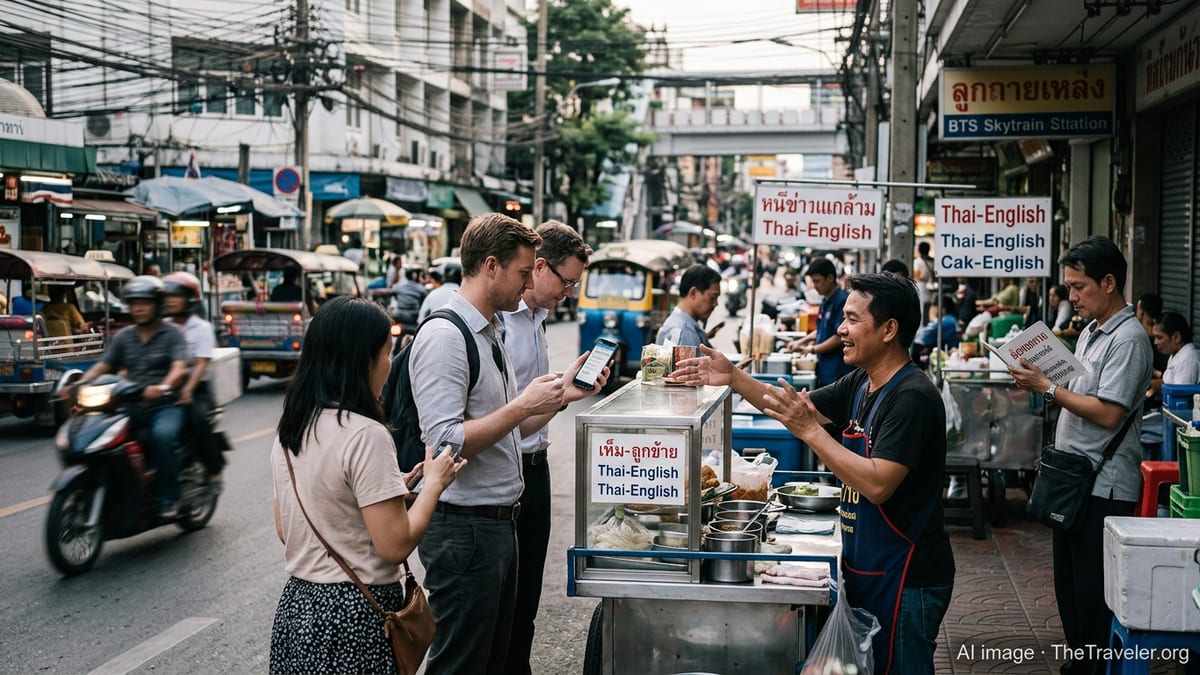
In local markets, small shops, neighborhood clinics, provincial transportation hubs, and traditional service providers, very little English can be expected. Tasks such as arranging home repairs, negotiating detailed renovation work, or explaining medical symptoms to a non-international clinic staff member usually require at least basic Thai phrases, written notes, or assistance from a Thai speaker. While translation apps can bridge simple gaps, they are less reliable for nuanced topics or in stressful situations such as accidents or emergencies.
Foreigners prepared to confine their routines to English-friendly institutions can accomplish much of daily life in Bangkok and some tourist centers using English alone, but at a higher financial cost and with less flexibility. Those who want to interact more broadly with the local economy, including using cost-effective services or small local businesses, will find that English quickly becomes insufficient.
Digital Tools, Translation Aids, and Workarounds
Widespread smartphone adoption and the increasing quality of translation technology have made it more feasible to live in Thailand with limited Thai language knowledge. Real-time translation apps can handle restaurant menus, basic written notices, and simple back-and-forth conversations. Many foreigners rely heavily on these tools when dealing with delivery drivers, tradespeople, or government forms, especially when they are accompanied by visuals such as photos or screenshots.
Some Thai government and large-organization websites now offer partial English interfaces, though the coverage is inconsistent and important details may only exist in Thai. Online banking apps, ride-hailing platforms, and food delivery services often offer English-language menus, which reduces language friction for certain transactions. Nevertheless, any time an issue falls outside standard transaction flows, the user may be pushed into Thai-only call centers or branch offices.
These digital tools reduce the minimum Thai skill required to complete basic tasks, but they do not eliminate the need for language adaptation. Machine translation struggles with informal Thai, technical jargon, or bureaucratic language, and many official documents use complex phrasing. Foreign residents who rely solely on machine translation for critical matters such as contracts, insurance policies, and legal correspondence risk misunderstandings that can carry financial or legal consequences.
In practice, an effective strategy for English-only residents often combines: selective use of English-capable service providers, routine use of translation apps for simple interactions, and recourse to Thai-speaking intermediaries for high-stakes issues. This structure can function reasonably well in major cities but is less robust in provincial areas where English-language service options and third-party support are more limited.
Social Integration, Community, and Long-Term Adaptation
From a social and community perspective, living in Thailand with only English is feasible but significantly narrows integration options. In Bangkok, Pattaya, Phuket, Chiang Mai and similar hubs, there are dense expatriate communities, English-speaking social groups, and international schools that collectively allow foreigners to construct an almost fully English-language social environment. Social media groups, international clubs, and foreign-focused events provide additional English-speaking spaces.
However, limiting life to these environments often results in a parallel existence largely separate from mainstream Thai society. Interactions with neighbors, local authorities, and community events are constrained by language, reducing opportunities for deeper cultural understanding and participation in local networks. In smaller cities and towns, where expatriate populations are thinner and local social life is more tightly knit, the absence of Thai skills can lead to practical isolation outside a narrow circle of bilingual acquaintances.
Even modest Thai language ability, such as the capacity to handle greetings, basic small talk, and common daily-life vocabulary, tends to substantially improve social interactions. Thais often respond positively to foreigners who make the effort to speak some Thai, which can lower barriers in negotiations, conflict resolution, and informal support from neighbors or local businesses. Over multi-year time horizons, the difference between relying exclusively on English and achieving functional Thai is often the difference between transactional coexistence and genuine community integration.
For families relocating with children, language plays an additional role in school selection and parental engagement. While international schools operate primarily in English, interactions with non-academic staff, drivers, and extended family networks of local classmates are frequently in Thai. Parents who speak only English may find it more difficult to engage with the broader school community outside formal channels.
The Takeaway
English can be sufficient to live in Thailand under specific conditions: residence in major urban or tourist centers, use of international or premium services, employment in an English-using organization or fully remote position, and a willingness to rely on translation tools and intermediaries for more complex interactions. Under these circumstances, a foreign resident can function day to day without speaking Thai, though often at higher cost and with reduced flexibility in provider choice.
However, for foreigners seeking broader lifestyle options, residence in smaller cities or rural communities, deeper integration into Thai workplaces, or long-term participation in local society, English alone is unlikely to be adequate. The structural reality of low national English proficiency, combined with Thai-dominant public administration and local commerce, makes at least basic Thai language skills a practical necessity over time.
From a relocation-planning perspective, English-only candidates should explicitly factor language into their choice of location, employer, schooling, and service providers. Those who anticipate a stay of several years or more are strongly advised to view Thai language learning not as an optional cultural extra, but as a core investment in risk reduction, autonomy, and quality of life. English can open the door to living in Thailand, but Thai remains the primary key to operating confidently and independently across the full spectrum of daily and professional life.
FAQ
Q1. Can I live in Bangkok long term using only English?
It is generally possible to live in central Bangkok using only English if you rely on international employers, private hospitals, major banks, and modern retail centers. However, tasks involving local authorities, neighborhood-level services, or complex problem resolution often still require Thai or assistance from a Thai speaker.
Q2. Is English enough to work in Thailand without learning Thai?
English alone may be enough in multinational companies, regional headquarters, or fully remote roles serving overseas markets. In domestically focused businesses or customer-facing positions, lack of Thai usually limits opportunities and advancement, even when formal job descriptions do not list Thai as a requirement.
Q3. How well do service staff in Thailand speak English?
In international hotels, large malls, and major tourist areas, many frontline staff can manage basic English. In local markets, small shops, and provincial services, usable English is far less common, and communication may be restricted to very simple phrases or gestures.
Q4. Are public services and government offices accessible in English?
Some central government agencies and large municipal offices provide limited English support or bilingual forms, but most detailed procedures are conducted in Thai. Foreigners often rely on Thai-speaking colleagues, agents, or partners to navigate registrations, licensing, or dispute resolution.
Q5. Can translation apps replace learning Thai for daily life?
Translation apps are helpful for menus, simple conversations, and basic written notices. They are less reliable for nuanced discussions, technical language, or stressful situations such as medical emergencies or legal issues, where misunderstandings can have serious consequences.
Q6. Is English commonly used in Thai workplaces?
English is regularly used in multinational corporations, export-driven sectors, and some technology and professional services firms. In many purely domestic companies, internal communication is predominantly in Thai, and meetings may switch between Thai and English, limiting full participation by non-Thai speakers.
Q7. Do international schools operate entirely in English?
Instruction in international schools is usually in English, and academic staff are generally fluent. However, interactions with administrative staff, drivers, support staff, and local parent networks may still involve substantial Thai, especially outside formal school channels.
Q8. How much Thai do I need for life outside the main cities?
In provincial towns and rural areas, at least basic conversational Thai is strongly recommended for handling shopping, healthcare, transport, and local administration. Without it, foreigners are likely to depend heavily on intermediaries and face frequent communication barriers.
Q9. Will speaking some Thai significantly change my experience?
Even modest Thai ability typically improves service interactions, reduces misunderstandings, and facilitates friendlier relations with neighbors and local businesses. Over time it enhances autonomy and reduces the need to rely on expat-only networks and premium-priced, English-focused services.
Q10. Is it realistic to plan a multi-year stay in Thailand with no Thai at all?
A multi-year stay relying solely on English is realistic only for those based in major urban hubs who remain within international work and service ecosystems. For most long-term residents, learning at least functional Thai becomes increasingly valuable for managing risks, controlling costs, and integrating into everyday life.