


Lower Manhattan is where New York City began: a compact triangle of centuries-old streets, soaring glass towers, harborside parks and some of the most emotionally powerful sites in the United States. For many travelers, it is their first stop in the city. Others wonder if it is really worth carving out a half or full day from an already packed New York itinerary. The answer usually depends on what you want from your trip, how much time you have and how comfortable you are with crowds and higher prices. This guide walks through what Lower Manhattan offers in 2026, how much it realistically costs, and who will get the most from a visit.
Get the latest updates straight to your inbox!
What Counts as Lower Manhattan, Really?
When New Yorkers talk about Lower Manhattan, they usually mean the tip of the island south of roughly Chambers Street. On a map, it is the tight wedge between the Hudson and East Rivers, ending at the Battery, where the ferries to the Statue of Liberty and Staten Island depart. Within this small area you will find neighborhoods that often blur together: the Financial District around Wall Street, the World Trade Center campus, the historic canyon of Broadway, the narrow lanes of the South Street Seaport and the harbor-facing promenades of Battery Park.
This area is compact enough to walk across in 20 to 30 minutes, but it contains many of New York’s highest-profile sights: the 9/11 Memorial & Museum, the One World Trade Center observatory, the Oculus transit hub and mall, ferries to the Statue of Liberty and Ellis Island, the New York Stock Exchange exterior, and City Hall Park. Because everything is so tightly packed, you can easily combine business history, modern architecture, harbor views and poignant memorials in a single morning.
Lower Manhattan is also one of the best-connected parts of New York for public transportation. The World Trade Center campus and nearby Fulton Center bring together more than a dozen subway lines plus New Jersey’s PATH trains, so most visitors staying in Midtown, Brooklyn or even New Jersey can reach the area on a single train with no transfers. That connectivity makes it simple to drop in for a specific experience, then head back to other parts of the city the same day.
Unlike Midtown, which hums well into the evening, Lower Manhattan still feels shaped by office life. Weekday mornings and late afternoons are busiest, while weekends and evenings are comparatively calmer once commuters go home. That rhythm is helpful to understand when deciding when to visit and what to expect.
Top Reasons Lower Manhattan Is Worth a Stop
For many travelers, Lower Manhattan is worth visiting for the emotional resonance alone. The 9/11 Memorial plaza, with its two reflecting pools set in the footprints of the Twin Towers, is one of the most quietly powerful public spaces in the country. You can visit the outdoor memorial for free and at your own pace, reading the engraved names and watching the waterfalls disappear into the center voids. For a deeper, more intense experience, the 9/11 Museum below ground requires a ticket and at least 90 minutes; most visitors who go describe it as sobering but essential.
Another major draw is the Statue of Liberty and Ellis Island, which technically sit on islands in New York Harbor but are only accessible by ferries that depart from Battery Park in Lower Manhattan. In 2026, adult tickets for the official Statue City Cruises ferry are typically in the mid-20-dollar range for basic access, including round-trip boat transport and entry to both Liberty Island and Ellis Island. Crown or pedestal access costs a bit more and must be reserved well in advance, often several months out in peak seasons. If standing at the base of the statue or climbing inside it is a personal dream, that alone makes a Lower Manhattan morning non-negotiable.
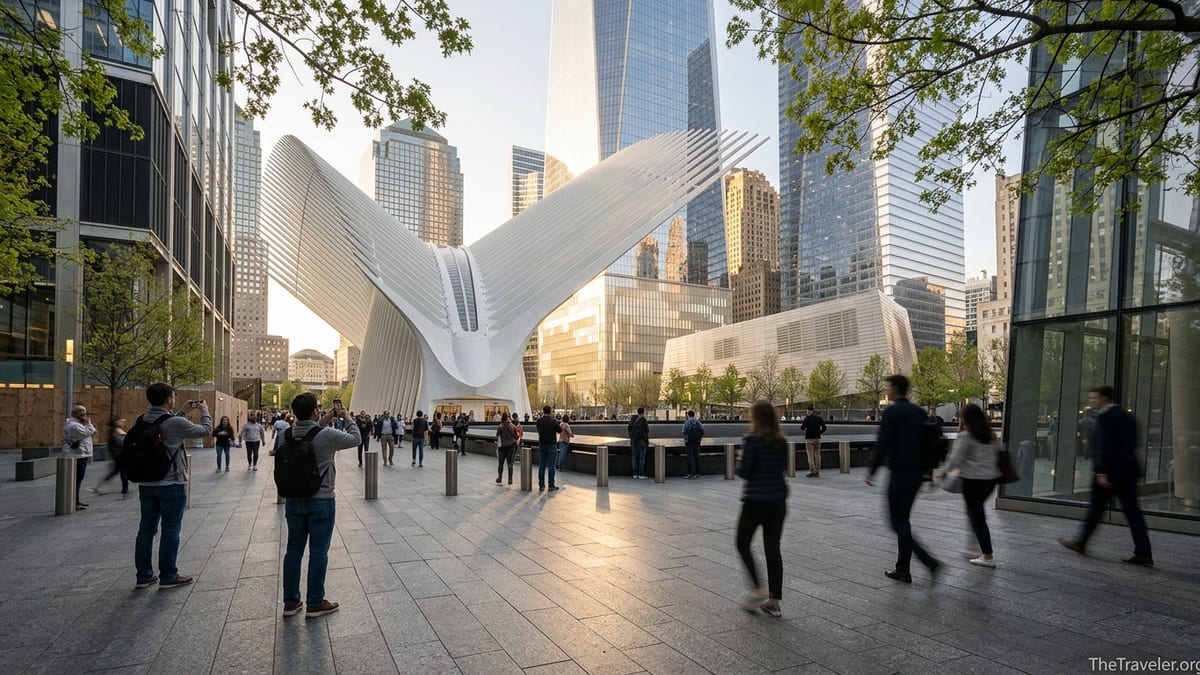
Lower Manhattan also rewards travelers interested in architecture and city photography. One World Trade Center’s glass facades mirror the sky, while older stone towers like 40 Wall Street and the Woolworth Building show off early 20th century ornament. The Oculus transit hub, designed by Santiago Calatrava with its white ribbed “wings,” has quickly become one of the most photographed interiors in New York. Even if you are not riding a train, walking through its bright, vaulted main hall gives a sense of how the city rebuilt after 2001 while adding shopping and transit functions in one place.
Finally, the waterfront itself is a reason to go. At the Battery, you can stroll along paths looking toward the Statue of Liberty and Staten Island, watch local commuters boarding the Staten Island Ferry, and see harbor tour boats coming and going. On warm evenings, this is one of the better spots in Manhattan for sunset over the water without leaving the island.
What It Actually Costs: Tickets, Food and Time
Because so many high-profile sites cluster together, a visit to Lower Manhattan can get expensive if you try to do everything in one day. The good news is that many of the most memorable experiences are either free or low-cost, so with planning you can keep your spending controlled. Walking the 9/11 Memorial plaza, exploring the exterior of Wall Street, admiring the Oculus, and wandering the narrow streets around Stone Street or the Seaport will not cost you anything beyond subway fare.
The major paid attractions tend to be the Statue of Liberty and Ellis Island ferry, the 9/11 Museum, and the One World Observatory. As of 2026, a basic Statue City Cruises ticket for adults hovers around the mid-20-dollar range before tax, with discounts for children and seniors. That single ticket covers the ferry plus access to Liberty and Ellis Island and their museums, which makes it relatively good value if you budget half a day. Crown or pedestal tickets are limited and carry a modest surcharge, so expect to pay a bit more if you want those experiences and to lock them in months in advance, especially in summer.
The 9/11 Museum and One World Observatory both charge separate admission, and together they can easily add up to a significant expense for a family. Many travelers choose one or the other: for instance, spending two hours in the museum and then experiencing skyline views from a different observatory in Midtown another day, or skipping the museum and instead investing in the observatory for its panoramas of the harbor and Brooklyn. If you are visiting with kids who may tire quickly, consider focusing spending on the Statue ferry plus either the museum or the observatory, not all three.
Food in Lower Manhattan ranges from inexpensive grab-and-go to high-end dining, though sit-down restaurants near the World Trade Center and inside Brookfield Place tend to price more in line with downtown office-worker budgets than tourist traps. A casual lunch at a counter-service spot in the Oculus or at the Brookfield Place food hall can be in the low to mid-teens per person for a sandwich, salad or bowl, while a coffee and pastry in a chain café will feel similar to prices in Midtown. If you are watching costs, consider grabbing breakfast before heading down and planning a picnic-style lunch on a bench near the Battery or in a small park like Zuccotti or City Hall Park.
Crowds, Safety and When to Go
Lower Manhattan sees heavy visitor numbers, but congestion is not uniform throughout the day. Morning rush hour on weekdays can feel very crowded around transit nodes like Fulton Center, the Oculus and PATH entrances, with office workers streaming to their desks. If your goal is quiet reflection at the 9/11 Memorial or less hectic photographs of the Oculus interior, aim for mid-morning after 10 a.m., or late afternoon once commuters are already at work. Weekends tend to bring fewer office workers but steady tourist traffic around Battery Park and the World Trade Center campus.
In terms of safety, Lower Manhattan is among the more heavily policed and surveilled parts of New York. City data for 2025 shows traffic deaths in Manhattan trending downward, and visitor-focused areas like the World Trade Center and Battery Park are generally calm, with security staff, police officers and cameras visible. Visitors still need standard big-city awareness: keep phones and wallets secure in crowded subway cars, watch for pickpockets in tight queues for ferries and observatories, and be extra alert crossing busy intersections where drivers and cyclists may be rushing to beat lights.
Weather has a big impact on how enjoyable Lower Manhattan feels. The winds off the harbor can make winter days feel colder than the rest of the city, especially at the Battery and on open ferry decks. In July and August, heat radiating from pavement, combined with minimal shade around some memorial areas, means you will want water, sunscreen and breaks indoors in air-conditioned spaces like the Oculus or Brookfield Place. Shoulder seasons such as late April to early June and late September to October often deliver the most comfortable walking conditions, with clearer air for harbor views.
Time of day matters too. An early morning ferry to the Statue of Liberty can mean shorter lines at security screening and more space on deck for photographs of the skyline. Late afternoon visits to the 9/11 Memorial often feel more contemplative, with softer light and fewer large tour groups. Evening walks around the World Trade Center, with One World Trade Center and the Oculus lit up against the dark sky, are atmospheric even if shops are beginning to close.
How to Get There and Navigate Easily
Reaching Lower Manhattan by public transit is straightforward from most parts of New York City. The World Trade Center and Fulton Street complexes function as two massive transit hubs that feed into each other, linking more than a dozen subway lines. Trains labeled 1, 2, 3, 4, 5, A, C, E, J, Z, R and W all serve stations within a few blocks of the World Trade Center campus, and the PATH system connects New Jersey commuters directly into the Oculus hall. That concentration of lines means that if you are staying anywhere near a major subway in Manhattan or Brooklyn, you can probably get downtown in 20 to 30 minutes without a transfer.
The Oculus, officially the World Trade Center Transportation Hub, is both a station and an indoor thoroughfare. Its main hall connects PATH trains from New Jersey, multiple subway lines, and underground passages to surrounding office towers and shopping centers such as Brookfield Place. For a first-time visitor, the space can be disorienting because signage shares space with retailer branding and there are multiple levels. A practical approach is to follow the clearly marked exits for Church Street, West Street or Fulton Street depending on your next destination, then orient yourself once you are outside.
If you are heading specifically to the Statue of Liberty ferries, you will want to navigate toward the Battery at the southern tip of Manhattan. From the World Trade Center area, you can either walk straight down Greenwich Street for roughly 15 minutes, passing by the 9/11 Memorial and several office towers, or you can ride the 4 or 5 subway one stop to Bowling Green or the R and W to Whitehall Street. Once in Battery Park, you will see signage and security queues for the Statue City Cruises ferries. Plan to arrive at least 30 minutes before your ticketed departure, or longer in peak summer weeks and holiday weekends.
Taxis and rideshares remain an option, but traffic congestion near the Brooklyn-Battery Tunnel entrance, around the FDR Drive ramps and along West Street can be significant during rush hours. For many visitors staying in Midtown or near major subway corridors in Brooklyn and Queens, trains offer a faster and more predictable trip than cars. Those arriving on cruise ships docked in Brooklyn or New Jersey will often find dedicated shuttle buses or can use the subway and PATH combined with short walks to reach Lower Manhattan landmarks.
Who Will Love Lower Manhattan (and Who Might Skip It)
Lower Manhattan is particularly rewarding for travelers who care about American history, architecture, finance, or stories of immigration. If you have ever watched live coverage from Wall Street, read memoirs about Ellis Island arrivals, or followed the rebuilding of the World Trade Center, walking these streets gives those narratives concrete form. Standing at Castle Clinton in Battery Park, for example, you can imagine immigrants first setting foot in New York in the 19th century, then compare that with exhibits at the Ellis Island National Museum of Immigration later that same day.
Families often find that a carefully structured visit works best. A common pattern is to book a morning ferry to the Statue of Liberty, spend an hour or so walking Liberty Island and its museum, continue to Ellis Island for another hour, then return to Battery Park by early afternoon. After a late lunch, some families walk north through the Financial District, stopping briefly at the Charging Bull statue or Stone Street’s cobblestones, then end the day at the 9/11 Memorial plaza for a quieter moment before catching the subway home. This mixes active outdoor time, boat rides and more reflective stops in a way that keeps children engaged.
On the other hand, some travelers are primarily interested in contemporary culture, nightlife and neighborhood “feel” rather than icons or museums. If your ideal New York trip is live music in Brooklyn, cafes in the Village and galleries in Chelsea, you may be satisfied with just a quick pass through Lower Manhattan to see the harbor and memorials without lingering. The area has fewer independent boutiques and casual street-level venues than neighborhoods like the Lower East Side or Williamsburg, since many blocks are dominated by offices and large complexes.
Budget travelers who are comfortable viewing the Statue of Liberty from a distance might decide to save money by skipping the official ferry and instead taking the free Staten Island Ferry from Whitehall Terminal. This local commuter route passes close enough to the statue for decent photos and also delivers sweeping skyline views, though you will not set foot on Liberty or Ellis Island. Pairing that ride with a free walk around the 9/11 Memorial plaza allows you to experience some of Lower Manhattan’s highlights without paying for multiple attraction tickets.
Practical Tips to Make the Most of Your Visit
Advance planning pays off more in Lower Manhattan than in many other parts of New York because security screening and timed entries can eat into a day. For the Statue of Liberty, booking your ferry tickets for an early-morning departure, ideally the first or second sailing, reduces waiting time in lines and helps you avoid the hottest or most crowded midday hours on the islands. If you want crown access, you should expect to book several months ahead, especially for summer and holiday trips.
When visiting the 9/11 Museum, consider your group’s emotional readiness and energy level. Many travelers find the exhibits deeply affecting; scheduling the museum toward the middle or end of the day rather than first thing in the morning allows you to process what you have seen without feeling pressured to immediately jump into something lighthearted. If you are traveling with children, read the museum’s guidance on age-appropriateness in advance and think about whether the memorial plaza alone might be more suitable.
Footwear and packing choices matter more than you might expect. The Financial District’s older streets can be uneven, with cobblestones near the Seaport and Stone Street, while long stretches of the Battery offer limited seating. Comfortable walking shoes, a light layer for breezes on the water, and a small daypack with water and snacks will make it easier to move between sites without constant café stops. Note that for security reasons, large backpacks and certain items may not be allowed in the Statue of Liberty pedestal, crown or the 9/11 Museum, so check current guidelines and pack accordingly.
Finally, stay flexible. Weather or security alerts can occasionally disrupt ferry schedules or temporarily close parts of the World Trade Center campus. Having a backup plan, such as exploring the indoor exhibits at the Seaport Museum, browsing shops in Brookfield Place, or walking across to Tribeca for a café break, helps you adapt without feeling that your day is lost.
FAQ
Q1. Is Lower Manhattan safe for tourists in 2026?
Lower Manhattan is generally considered safe for visitors, with a strong police and security presence around major sites like the World Trade Center and Battery Park. Normal big-city precautions still apply, particularly in crowded subways and ferry queues, but problems are uncommon in the main tourist corridors.
Q2. How much time do I need to see the main sights?
If you want to visit the Statue of Liberty and Ellis Island plus the 9/11 Memorial plaza, plan on a full day. A half day is usually enough for the memorial plaza, a quick walk through the Oculus, a stroll to the Battery and some time exploring the Financial District without entering multiple museums.
Q3. Do I need to book Statue of Liberty tickets in advance?
Yes, advance booking is strongly recommended, especially for summer, weekends and any crown or pedestal access. Basic ferry tickets can sometimes be bought on the day, but popular time slots and crown tickets often sell out weeks or months ahead.
Q4. Is the 9/11 Museum appropriate for children?
The outdoor memorial plaza is generally suitable for all ages, though it is a solemn space. The museum contains intense imagery and personal stories; many families wait until children are older or choose to visit in small groups so that at least one adult can step outside with a child if needed.
Q5. Can I see the Statue of Liberty without paying for a ticket?
You can see the statue from the Manhattan shoreline at Battery Park and more clearly from the free Staten Island Ferry, which passes relatively close. However, to stand on Liberty Island or visit the museum and pedestal or crown, you must purchase a ticket for the official Statue City Cruises ferry.
Q6. Which subway should I take to reach Lower Manhattan?
Several lines serve Lower Manhattan. For the World Trade Center area, the E train terminates at World Trade Center and the A, C, 2, 3, 4, 5, J, Z, R and W trains stop within a short walk at nearby stations like Fulton Street and Cortlandt Street. For Battery Park and ferries, the 4 and 5 to Bowling Green or the R and W to Whitehall Street are convenient.
Q7. Is Lower Manhattan worth it if I only have two days in New York?
For many first-time visitors, yes. Even with a tight schedule, a morning in Lower Manhattan for the Statue of Liberty or 9/11 Memorial plus a harbor walk can provide a strong sense of the city’s history and skyline. If your interests are strictly arts, nightlife and neighborhoods, you might allocate more time to Midtown and Brooklyn instead.
Q8. Are there good food options near the World Trade Center?
Yes. The Oculus and nearby Brookfield Place offer a mix of coffee bars, bakeries, casual counters and sit-down restaurants, suitable for quick lunches or relaxed meals. You will also find smaller spots scattered through the Financial District and along Stone Street, especially on weekdays when office workers are in the area.
Q9. What should I wear for a day in Lower Manhattan?
Comfortable walking shoes are essential. In cooler months, bring a warm layer and wind-resistant jacket for the harbor and ferry decks. In summer, light breathable clothing, sun protection and a hat will help with heat reflected off pavement and limited shade in some open plazas.
Q10. Is Lower Manhattan accessible for travelers with limited mobility?
Many major sites, including the 9/11 Memorial, the World Trade Center transportation hub and official Statue of Liberty ferries, provide ramps, elevators and other accessibility features. Some older streets and cobblestone areas can be challenging, so planning routes around smoother sidewalks and checking current accessibility information for each attraction is advisable.